A photo of old colleagues reuniting has pushed Hyperliquid back into a larger narrative.

In October, Meta's Chief AI Officer and one of the founders of Scale AI, Alexandr Wang, posted a photo with Jeff Yan and Scott Wu, writing: “got the HRT gang back together!”
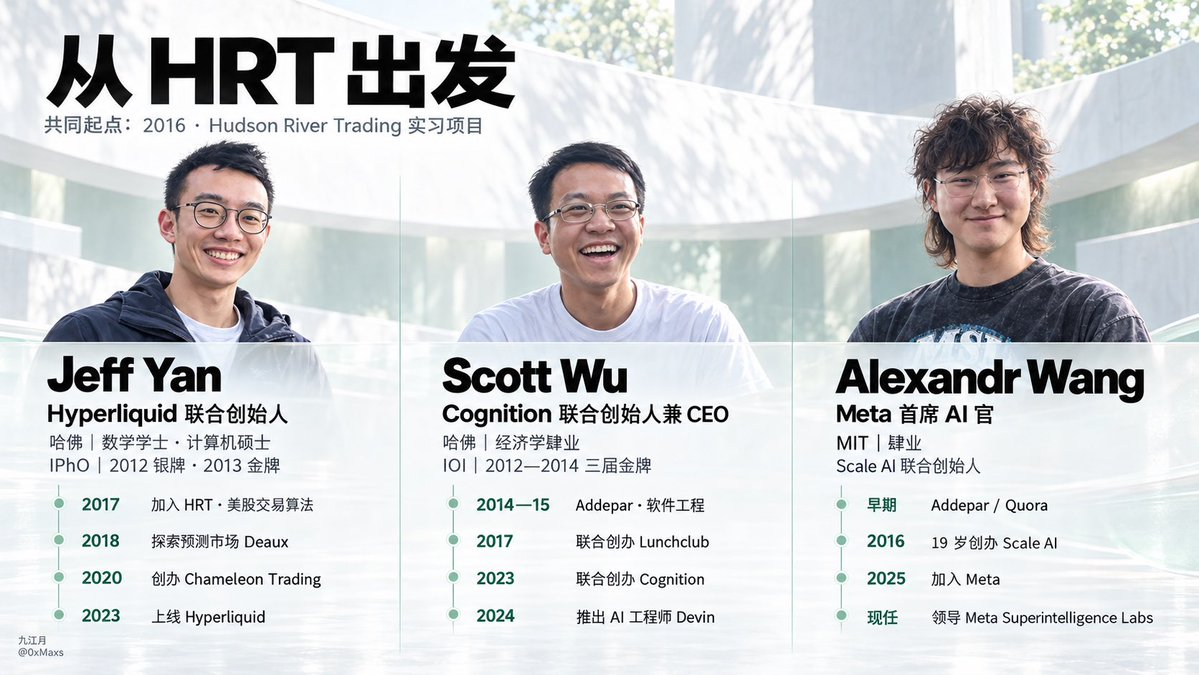
The three have since moved on to Meta AI, Cognition, and Hyperliquid respectively. But the more interesting part is not just their current identities as entrepreneurs, but that they once appeared together in the first intern network of Hudson River Trading (HRT). The first ten interns at HRT included Alexandr Wang, Scott Wu, Jeffrey Yan, and Jesse Zhang.
This photo cannot, of course, prove any investment conclusions, nor can it be deduced that Hyperliquid will surely succeed merely because all three have quantitative or competition backgrounds.
However, it offers an entry point to observe Jeff Yan's product roadmap: Hyperliquid has not only aimed to be a cryptocurrency trading page from the start, but is attempting to expand speed, order books, liquidity, and risk management capabilities into a larger financial infrastructure.
1. What is truly valuable about the "HRT gang" is not their prestigious school resumes
The core training of quantitative trading companies involves more than just knowing how to code or solve math problems.
More importantly, traders are forced to repeatedly confront several practical issues:
- How an order enters the market;
- How liquidity changes over different time periods;
- How price discovery is delayed and affected by inventory and counterparty behavior;
- How risk is calculated and restricted in real-time;
- How trading systems remain stable under high concurrency and extreme market conditions.
This type of experience is not entirely the same as traditional entrepreneurial resumes. It primarily focuses on whether the system can operate, and only then on whether the product story is attractive enough.
Therefore, the value of the HRT experience in understanding Jeff Yan more effectively lies not in "a quantitative background means HYPE is worth buying," but rather in explaining why, when Hyperliquid entered through perpetual contracts, it focused on prioritizing order books, matching, margin, clearing, and on-chain transparency within its product.
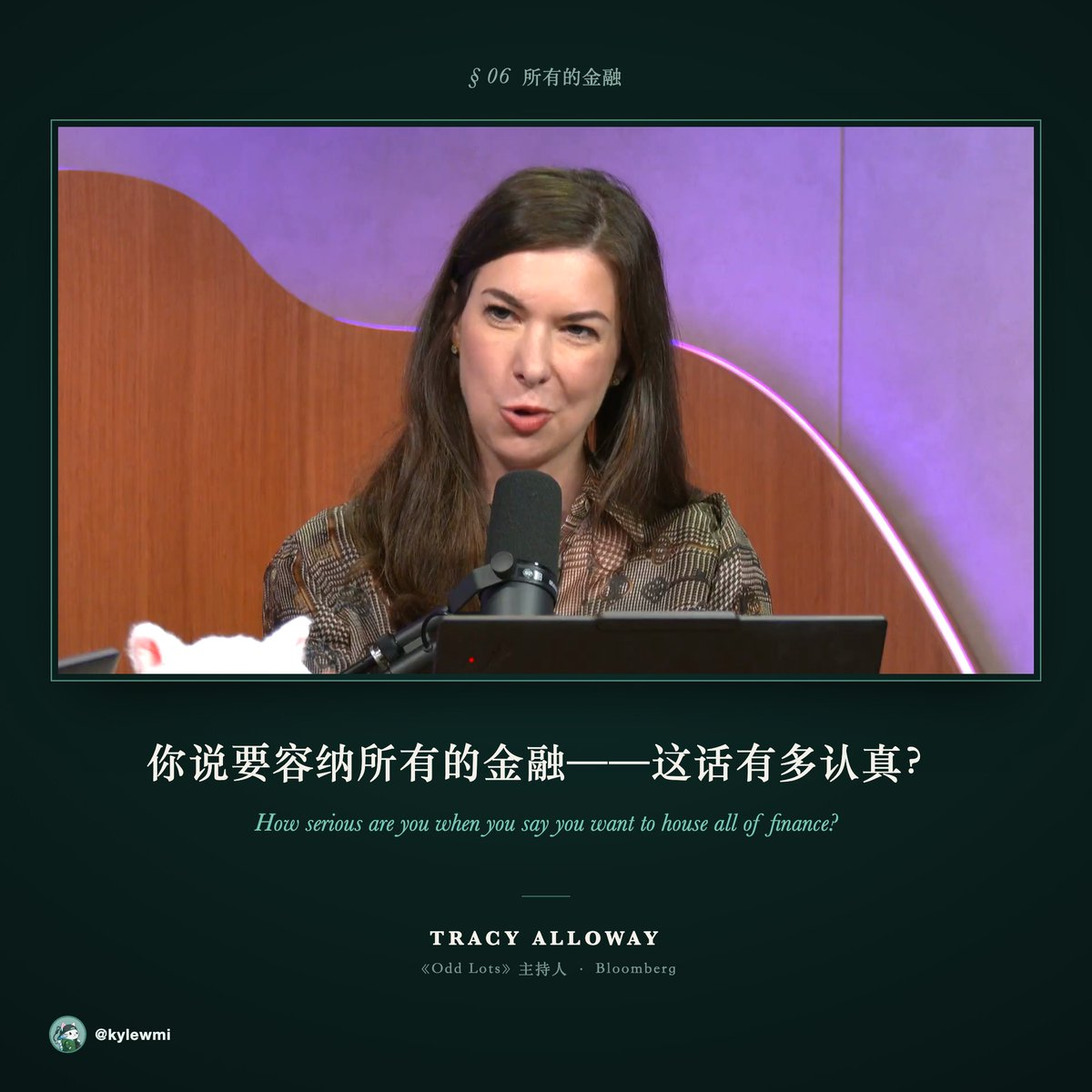
Hyperliquid officially positions itself as an "infrastructure that accommodates all finance," rather than merely a cryptocurrency trading application. Official documentation also clearly describes it as a liquidity infrastructure that developers can use when building financial applications.
The underlying logic of this route is simple: if the underlying market, collateral, and settlement are reliable enough, the front-end and products can be developed by different teams.
2. "The biggest competitor is Nobody," does not imply there is no competition in the market
In two statements during discussions at TOKEN2049, Jeff Yan responded to questions about how big Hyperliquid can be by saying, "Finance as a whole," and when asked about the biggest competitor, he replied, "Nobody."
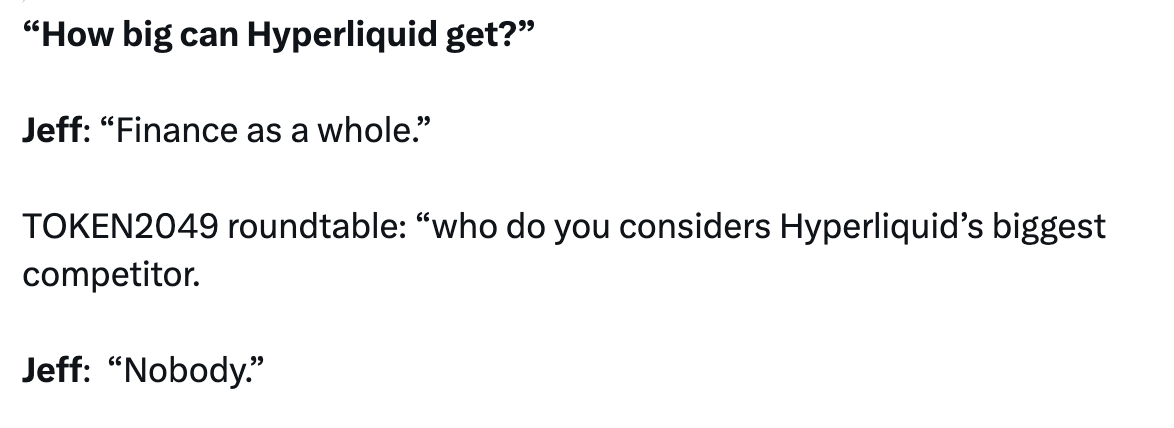
If these two statements are understood as "Hyperliquid has no competitors," it will turn into a marketing slogan.
The reality is that Hyperliquid is certainly facing competition: centralized exchanges, other on-chain trading platforms, professional brokers, traditional futures exchanges, and an increasing number of protocols offering exposure to stocks, commodities, and foreign exchange, all of which may compete for users and liquidity.
Jeff's answer seems more akin to rejecting a too-narrow competitive framework.
If the question is "Which exchange does Hyperliquid need to defeat?" the answer would certainly fall onto a specific platform; however, if the question is "What does Hyperliquid need to redo?" the answer is no longer about a particular trading product or exchange ranking, but rather about the access points, settlement, and liquidity organization methods of the financial market itself.
This is also the true meaning of "Finance as a whole": it does not mean that Hyperliquid can cover all finance tomorrow, but rather that it is unwilling to define its upper limit as "a perpetual cryptocurrency exchange."
3. From perpetual cryptocurrency to oil and indices, what matters is not the increase in product variety
The current product direction showcased on Hyperliquid's official website includes not just BTC and ETH, but also commodities, indices, foreign exchange, and real-world assets. The official page describes this direction as "Trade BTC, S&P500, oil, FX, and more from a single account with markets that never close."
Many platforms can also add trading varieties, so "able to trade oil" does not in itself constitute a decisive advantage.
What is truly important is whether users can observe and adjust positions across markets using the same set of accounts and the same risk management logic.
For example, when macro shocks occur, traders might care simultaneously about:
- Whether BTC is being sold off as a risk asset;
- Whether crude oil is fluctuating rapidly due to geopolitical conflicts;
- Whether the dollar and indices are encountering safe-haven trading;
- Whether gold is absorbing some funds;
- Whether the volatility in different markets is amplified at the same time.
The issue of traditional markets is not merely that "there are no prices." Many times, the problem lies in the fragmentation of trading times, settlement networks, account systems, and capital arrangements across different markets.
The scenario raised by Dmyonhl is that during the closure of traditional markets, Hyperliquid's 24/7 oil market allows traders to continue responding to events. This is better understood as a product scenario rather than as an already independently verified trading volume or price discovery conclusion.
But this scenario indeed illustrates the value of a round-the-clock market: traders do not necessarily migrate actively between different platforms; rather, when a platform is always open, the platform itself becomes the entry point for event response.
4. All-weather does not mean always high liquidity
A cool head must be maintained here.
A market that is open 24/7 does not imply that there is a sufficient depth at any moment; having a trading page does not guarantee that the price is equivalent to traditional spot markets; having perpetual commodities does not mean that users own physical ownership of oil.
Hyperliquid's HIP-3 mechanism allows deployers to create their own perpetual markets. Official documentation shows that deployers are responsible for market definitions, oracles, contract specifications, market operations, leverage limits, and settlement; HIP-3 markets inherit the order book and margin system of HyperCore.
This means that while there is a lot of product innovation space in HIP-3, the market quality cannot merely be judged by its name.
Users need to continue checking:
- What prices are referenced by the oracle;
- How the mark price is updated when traditional markets are closed;
- Whether the perpetual funding rates are abnormal;
- Whether market depth can support large orders;
- Whether deployers have the capability to maintain the market;
- What the rules are for clearing and settlement under extreme market conditions.
Particularly for perpetuals related to commodities, indices, and stocks, they represent price exposure, not the actual spot assets themselves. Hyperliquid's official explanation of perpetual contracts also emphasizes that perpetuals do not have an expiration date, liquidity is concentrated in a single tool, and does not involve physical delivery.
Therefore, Hyperliquid's "all-weather finance" is more accurately stated as: **allowing more financial asset trading exposures to be expressed, hedged, and managed in an all-weather on-chain market.** This is fundamentally different from simply transferring traditional assets onto the chain unchanged.
5. What Hyperliquid truly wants to build is a layer of “market operating system”
When viewed only from the current user interface, Hyperliquid appears as a trading platform.
When examined in terms of its underlying structure, it resembles a layer of a market operating system:
HyperCore: Order books, margins, clearing, and trade execution
HyperEVM: Development of smart contracts and financial applications
HIP-3: Perpetual markets for different assets deployed by developers
Single account: Connects multiple markets and capital management
On-chain state: Enables verifiable orders, transactions, and clearing
The official homepage describes Hyperliquid as an open, transparent, and trustworthy neutral financial system, and emphasizes that orders, cancellations, trades, and clearances all occur on-chain.
The core value of this structure is not to turn all users into programmers but to enable more product teams to build a matching, margin, and settlement system without starting from scratch.
This also explains why Jeff Yan's response about competition seems very “arrogant”: he is not saying that a specific existing platform is unimportant, but rather he is saying that if the underlying infrastructure succeeds, the true competitive targets are no longer just another exchange, but those parts of traditional financial markets that have long been segmented by accounts, time, custody, and settlement.
6. The HRT training background ultimately returns to user-perceived experience
For ordinary users, no matter how legendary the HRT intern network is, it cannot replace the actual judgment of the product.
What really needs to be observed is:
- Whether placing and canceling orders are stable;
- Whether the margins between different markets are understandable;
- Whether funding rates and slippage are within a reasonable range;
- Whether clearing is transparent under extreme market conditions;
- Whether the oracle and liquidity of new markets are reliable;
- Whether trading data is sufficiently public, enabling users to review transactions.
The AiCoin mobile terminal is more suitable for taking on the role of the "observation layer." Users can first observe price changes across different markets such as BTC, crude oil, indices, HYPE, etc., and then combine with OI, funding rates, significant order movements, and clearing data to determine whether the market situation is due to a single asset's volatility or if multiple markets are simultaneously re-pricing.
This is much closer to the trading method that Hyperliquid truly wants to provide: first observe how the market connects, then decide whether to express a viewpoint.
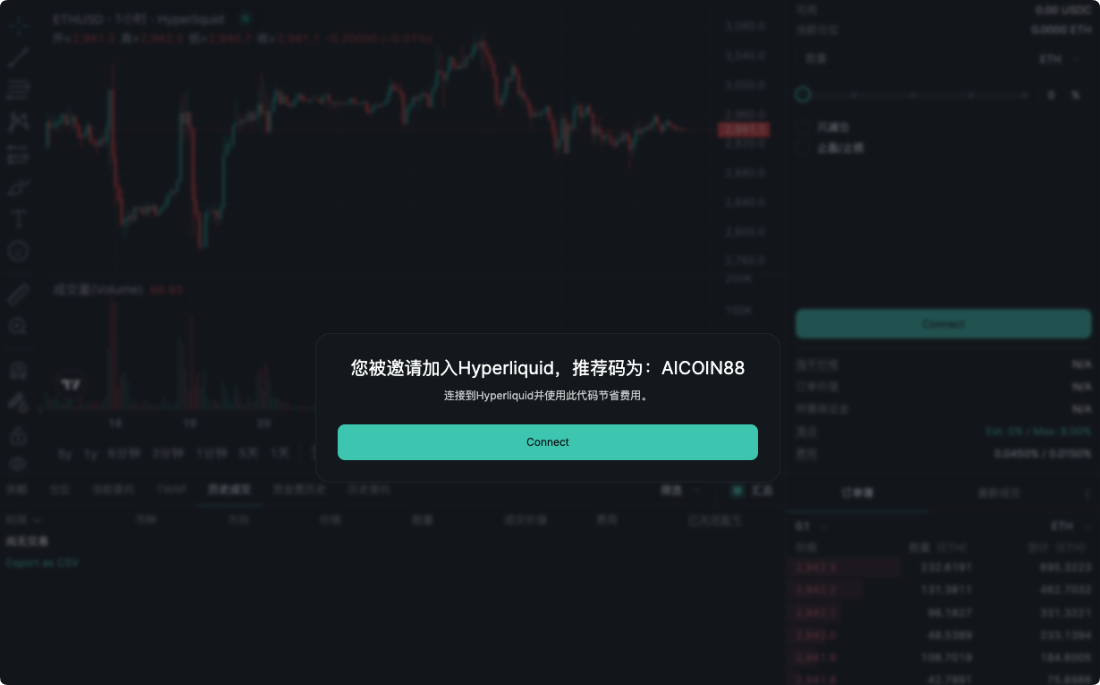
Invitation code: AICOIN88. Transactions meeting the criteria can receive 4% rebate on transaction fees, with specific qualifications, scope, and timeframes subject to activity rules. Rebates are merely an optimization of transaction costs and do not represent profits nor can they offset leverage, slippage, funding rates, and clearing risks.
Conclusion: The next exchange, or the next layer of financial network?
The first HRT interns have since ventured into AI, software engineering, and on-chain finance, certainly marked by a strong fortuitousness of the times.
However, the direction chosen by Jeff Yan is likely not to create a faster cryptocurrency exchange.
What he really wants to validate is whether he can combine high-performance order books, transparent settlement, 24/7 markets, and developer liquidity into a new financial network.
If this goal is merely to expand the volume of perpetual cryptocurrency trading, its upper limit remains as an exchange platform.
If it can continue to accommodate commodities, indices, foreign exchange, real-world assets, and more complex financial applications, then "the biggest competitor is Nobody" will no longer be an exaggerated slogan, but rather a strategic statement:
Hyperliquid does not just want to win a single exchange competition, but rather aims to redefine how users enter the financial market.
Exclusive benefits for AiCoin users
👉 Enter the invitation code AICOIN88 when binding your Hyperliquid account to enjoy a 4% transaction fee rebate
🔗 Exclusive registration link:
https://app.hyperliquid.xyz/join/AICOIN88
📖 Beginner Tutorials:
-《AiCoin PC Hyperliquid Authorized Trading Tutorial》:
https://www.aicoin.com/zh-Hans/article/514197
-《AiCoin Mobile Hyperliquid Authorized Trading Tutorial》:
https://www.aicoin.com/zh-Hans/article/541383
-《Zero-Based Entry! Hyperliquid First Trading Super Detailed Graphic Tutorial》:
https://www.aicoin.com/zh-Hans/article/510225
📖 Community Exchanges:
- Telegram:
https://t.me/AiCoinWhaleData
- Discord:
https://discord.gg/5XSXjXSpz
- AiCoin Group Chat:
https://www.aicoin.com/link/chat?cid=N6OVMor5g
The content of this article represents only the author's personal views and does not represent the position of this platform. The views, conclusions, and suggestions in the article are for investor reference only, and do not constitute any investment advice related to this platform. Investors must bear market risks, regulatory risks, and local legal compliance risks when investing in U.S. stocks (especially foreign exchange controls, offshore investment declaration, etc.).
免责声明:本文章仅代表作者个人观点,不代表本平台的立场和观点。本文章仅供信息分享,不构成对任何人的任何投资建议。用户与作者之间的任何争议,与本平台无关。如网页中刊载的文章或图片涉及侵权,请提供相关的权利证明和身份证明发送邮件到[email protected],本平台相关工作人员将会进行核查。