1. US CPI Exceeds Expectations, Market Reprices Federal Reserve Rate Path
The US inflation data for September puts pressure on the market once again.
The US Consumer Price Index (CPI) in September rose by 3.7% year-on-year, higher than the market expectation of 3.6%; excluding food and energy prices, the core CPI increased by 2.6% year-on-year, also exceeding economists' forecasts.
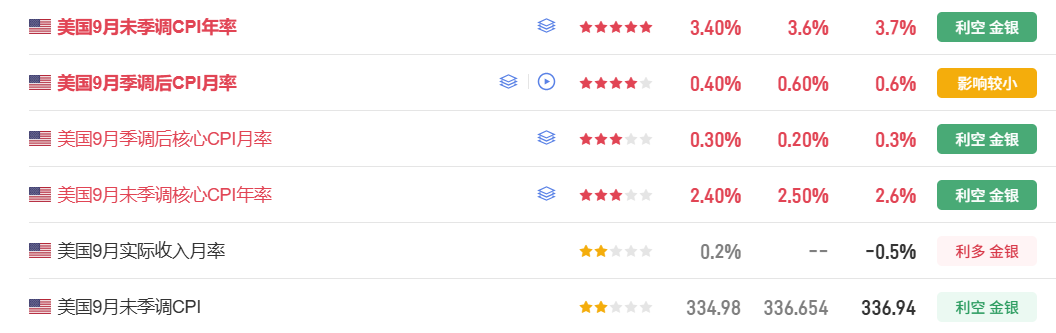
The importance of this data lies not only in the inflation numbers being slightly higher than expected but also in its potential to alter the market's judgment regarding the Federal Reserve's next policy move.
In a scenario of continued inflation decline, the market usually finds it easier to accept the expectation of unchanged interest rates or even further rate cuts. However, if inflation accelerates again, particularly if core prices remain sticky, the Federal Reserve may find it challenging to shift towards easing.
Following the data release, the market quickly adjusted its pricing of the rate path.
According to CME FedWatch data, the market's expectation of the Federal Reserve raising interest rates by 25 basis points on October 28 increased from 22.1% the previous day to 53.7%. Meanwhile, traders believe there is over a 95% probability that the Federal Reserve will raise rates at least once before the end of the year, and the probability of a cumulative increase of 50 basis points before the end of the year rose to 40%, double that of the previous day.
It is important to note that these figures reflect the pricing of the interest rate futures market at that time and do not indicate that the Federal Reserve has already decided to raise rates.
What is truly noteworthy is that the market's originally relatively moderate policy expectations are shifting towards a more cautious, even hawkish direction.
For BTC, this means that the market needs to reassess future financial conditions. If interest rate expectations continue to rise, the cost of funds and the opportunity cost of holding non-yielding assets may also change accordingly.
2. Energy Price Shock is Emerging as a Potential Risk to Core Inflation
Another key aspect of this inflation pressure is that energy costs may no longer just affect gasoline and transportation expenses but further transmit to other goods and services.
The situation in the Middle East has driven up energy prices, potentially enlarging the cost pressures faced by businesses. If businesses cannot absorb these costs themselves, they may pass the pressure onto consumers by raising prices for goods and services.
This is one of the reasons the market is concerned about inflation being unable to decline quickly.
In simple terms, the rise in energy prices represents a first-round shock; if the production, transportation, and operational costs for businesses continue to increase, prices in other sectors may also be affected. Even if energy prices stabilize afterwards, the established cost pressures may not immediately dissipate.
Additionally, some market participants believe that rising diesel prices and changing demand and costs brought about by the AI industry boom may continue to complicate inflation assessments.
However, these remain judgments made by market analysts, and whether they will develop into broader, sustained inflationary pressures still requires validation from subsequent data.
For the Federal Reserve, the most troublesome scenario is that energy shocks drive up overall inflation while core prices for goods and services remain stubbornly high. In this case, even if other parts of the economy start to come under pressure, the Federal Reserve may find it challenging to quickly loosen policy.
📌 If you want to continuously track the impact of BTC, ETH, and macro data on the market, you can follow the public account "Crypto Lao Ding," which explains important market changes and the logic behind them every day.
3. Rising Rate Expectations: How Will the Dollar, US Treasury Yields, and Risk Assets Interact?
When the market re-bets on rate hikes, the impact often does not stop at interest rates themselves, but instead transmits through the dollar, US Treasury yields, and overall financial conditions to other assets.
First, US Treasury yields.
If investors believe the Federal Reserve needs to maintain high rates for a longer period or that another rate hike is possible in the future, the bond market will need to readjust its pricing for future rates. Rising yields may increase financing costs for businesses and consumers, and also change the allocation of funds among different assets.
Second, the dollar.
Under otherwise similar conditions, rising US interest rate expectations may enhance the relative attractiveness of dollar-denominated assets, providing support for the dollar. However, the actual movements of the dollar still depend on interest rate changes in other economies, market risk aversion, and capital flows, and cannot simply be interpreted as rising rate expectations necessarily leading to a stronger dollar.
Finally, BTC and other risk assets.
While Bitcoin has its own supply-demand structure and market cycle, it is also influenced by macro-financial conditions in the context of increasing institutional participation.
If the dollar strengthens and US Treasury yields continue to rise, the market may exhibit more cautious valuations for risk assets, and some funds may reduce their risk exposure. Conversely, if subsequent data alleviates rate hike expectations and financial conditions do not continue to tighten, risk assets may gain breathing space.
However, an important distinction needs to be made: the macro environment affects market pricing and capital preferences, but it cannot determine BTC's short-term price movements on its own.
BTC's inherent spot demand, ETF capital flows, derivatives positions, and market liquidity also significantly affect price performance. Therefore, to assess whether the current rate hike expectations will exert sustained pressure on Bitcoin, it is essential to combine macro variables with internal data from the crypto market.
4. Inflation Exceeds Wage Growth, Consumer Resilience May Also Face Tests
The issue of inflation not only affects the Federal Reserve but also impacts the real purchasing power of ordinary households.
Views from US investment analysts indicate that the overall CPI year-on-year growth has exceeded the annual growth rate of wages for six consecutive months. This means that if price increases continue to outpace wage growth, household purchasing power may be squeezed.
In the short term, consumers may maintain consumption by reducing savings, adjusting spending structures, and other measures, but if living costs continue to rise, consumer resilience may ultimately weaken.
This will present the Federal Reserve with a more complicated policy trade-off: on one hand, it needs to prevent inflation from persistently deviating from the 2% target; on the other hand, it also needs to be mindful of the effects of high rates on economic activity, employment, and consumption.
A few signals are worth noting moving forward.
First, whether the US PPI Producer Price Index can further validate cost pressures on the business side. If production prices continue to rise, inflationary pressures may not yet be over.
Second, how Federal Reserve officials interpret the latest CPI. Although the market's bets on a rate hike in October have clearly increased, policy decisions still depend on subsequent data and officials' judgments, and conclusions cannot be made based solely on one report.
Third, whether US Treasury yields and the dollar can maintain their strength. If rate expectations continue to rise, risk assets may continue to face pressure; however, if subsequent data eases these expectations, the market may also reprice.
Fourth, BTC's own capital flows and price performance. If the macro environment is tight but spot demand remains strong, Bitcoin's reaction may differ from that of traditional risk assets.
📌 If you want to continuously track the impact of BTC, ETH, and macro data on the market, you can follow the public account "Crypto Lao Ding," which explains important market changes and the logic behind them every day.
📌 Mr. X from Web3: What Truly Affects BTC Is Not Just the CPI Number, But How Interest Rate Expectations Change
The US September CPI exceeded expectations, and the most direct impact is that the market is reassessing the Federal Reserve's rate path. The rising probability of an October rate hike, and the doubling of bets on a cumulative rate increase of 50 basis points before the end of the year, reflect that investors' concerns about the persistence of inflation are increasing.
However, this does not mean that the Federal Reserve will necessarily act according to the current market pricing. Whether energy prices continue to transmit to core inflation, whether the PPI can verify business cost pressures, and how Federal Reserve officials weigh inflation against economic growth will all influence the final policy choice.
For BTC, what truly needs to be focused on is the complete transmission chain: changes in inflation affecting interest rate expectations, interest rate expectations affecting US Treasury yields and the dollar, and changes in financial conditions further affecting capital allocation and risk preferences. At the same time, spot demand, ETF capital flows, and derivatives positions will also determine how the crypto market digests macro shocks.
Therefore, rather than simply predicting whether Bitcoin will rise or fall based on one CPI report, it is better to continuously observe whether inflation shows persistence, whether market rate hike expectations further intensify, and whether BTC's own capital demand synchronously weakens. Only by putting these signals together can we more comprehensively understand the impact of macro changes on the crypto market.
—— I am Mr. X from Web3, with 6 years of growth in Web3, focusing on Bitcoin, the crypto market, macroeconomics, and industry trends. If you wish to continuously track the impact of BTC, ETH, HYPE, and macro data on the market, you can follow the public account "Crypto Lao Ding." Understand the trends, insight the logic, and build your own judgments rather than just fixating on price fluctuations.

免责声明:本文章仅代表作者个人观点,不代表本平台的立场和观点。本文章仅供信息分享,不构成对任何人的任何投资建议。用户与作者之间的任何争议,与本平台无关。如网页中刊载的文章或图片涉及侵权,请提供相关的权利证明和身份证明发送邮件到[email protected],本平台相关工作人员将会进行核查。