1. Why is the U.S. CPI release tonight attracting such high attention in the market?
Investors outside the Beijing time zone are also waiting for this important data tonight. The U.S. Bureau of Labor Statistics is expected to release the September Consumer Price Index (CPI) at 20:30 tonight. Market focus is not only on whether inflation has continued to rise, but also on whether there is a divergence between overall inflation and core inflation.
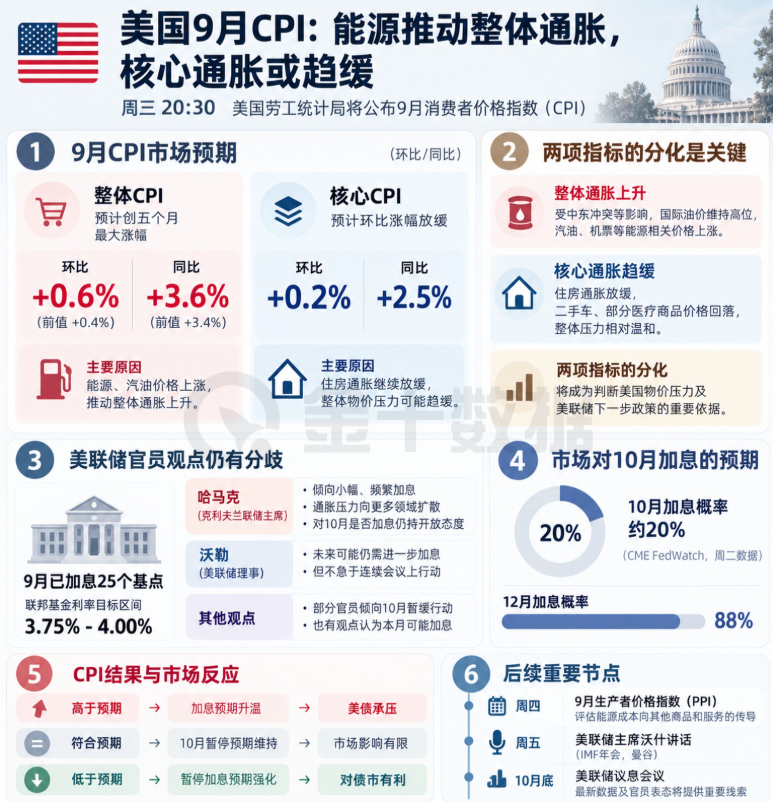
Currently, the market expects that the U.S. September overall CPI will rise by 0.6% month-on-month, higher than August's 0.4%, possibly achieving the largest increase in five months; the year-on-year increase is expected to rise from 3.4% to 3.6%.
Meanwhile, the core CPI, excluding food and energy prices, is expected to rise by 0.2% month-on-month and 2.5% year-on-year. This indicates that overall prices may accelerate due to rising energy costs, but price pressures in other areas may not necessarily expand in tandem.
This is also the most important point of concern in this data: Overall inflation heating up does not necessarily mean that inflation in all areas is deteriorating; but a slowdown in core inflation does not equate to the inflation problem being resolved.
For the market, the key is to determine whether the impact of energy prices is temporary or spreading to more goods and services. If only a few items are driving the overall CPI up, the Federal Reserve may have room to observe; if price increases gradually spread, the pressure for policy tightening may rise again.
2. Why might oil prices become a key driver of inflation rebound?
The current overall CPI is facing upward pressure, a significant reason being energy prices.
Due to the ongoing conflict in the Middle East, international oil prices remain high, and U.S. retail gasoline prices have reached their highest level in four months. Goldman Sachs predicts that energy prices rose about 5% month-on-month in September, and the increase in aviation fuel costs may also drive up ticket prices.
The impact of energy prices on inflation is primarily transmitted through two pathways.
The first is direct impact. Rising gasoline, electricity, and fuel prices directly increase household expenditures and push up the overall CPI.
The second is indirect impact. Energy is not only a good that consumers purchase, but also an essential cost in air transport, logistics, manufacturing, and construction. If energy prices continue to run high, companies may gradually pass the higher costs onto consumers, causing the price pressures originally concentrated in the energy sector to spread to other goods and services.
This is why the market cannot just look at how much oil prices have risen in the short term; it must also pay attention to whether this increase can be sustained, and whether this change further affects core inflation.
However, rising energy prices do not necessarily mean overall inflation must accelerate. If demand weakens in other sectors, rental increases slow, or companies cannot fully pass on costs to consumers, overall and core inflation may still diverge.
For investors, what matters is judging whether this round of energy shock will change the Federal Reserve's judgment on future inflation trends.
📌 If you want to continuously track BTC, ETH, and the impact of macro data on the market, you can follow the public account "Crypto Lao Ding," which daily explains important market changes and the underlying logic.
3. With divergence between overall CPI and core CPI, how should the Federal Reserve choose?
The importance of inflation data ultimately reflects on the Federal Reserve's policy choices.
The Federal Reserve needs to strike a balance between controlling inflation and maintaining stability in the job market. Persistently high inflation above target means that interest rates may need to be kept at elevated levels or even tightened further; however, if demand has already begun to cool, excessive tightening may impose additional pressure on the economy and employment.
Currently, there are still differences among Federal Reserve officials regarding the next policy steps.
Cleveland Federal Reserve President Mester believes that inflation pressures are spreading to more areas of the economy and mentioned that investment demand spurred by artificial intelligence infrastructure construction could push up prices for computers, electronic products, and high-tech components; cost pressures could also spill over into industries such as aviation, electricity, and construction.
Federal Reserve Governor Waller, on the other hand, indicated that further interest rate hikes may still be needed in the future, but policy adjustments can remain flexible and do not necessarily need to take action at two consecutive meetings. Some institutional economists also believe that if core inflation remains moderate, the Federal Reserve may have reason to pause interest rate hikes.
This means that the market is not simply facing a scenario of "high inflation leads to rate hikes, low inflation leads to rate cuts," but needs to assess the source of inflation, its duration, and whether price pressures are expanding.
If the overall CPI is significantly higher than expected and the core CPI isn't cooling, the market may reassess the necessity for the Federal Reserve to tighten policy further.
If the overall CPI rises due to energy prices but the core CPI meets or falls below expectations, the market may perceive that inflation pressures haven't fully spread, allowing the Federal Reserve room to pause action.
Therefore, tonight what is truly worth comparing is not just the difference between the published values and market expectations, but the relationship between overall CPI and core CPI.
4. How does CPI affect the U.S. dollar, U.S. Treasury yields, and BTC?
From a macro transmission mechanism perspective, the impact of CPI on the cryptocurrency market is usually not direct; it first alters market expectations regarding interest rates, then affects the cost of capital and risk appetite.
This logic can be understood as:
CPI data → Federal Reserve interest rate expectations → U.S. Treasury yields and the U.S. dollar → market liquidity and risk appetite → BTC and other crypto assets.
If inflation data exceeds expectations, investors may believe that the Federal Reserve needs to maintain high rates longer or even raise rates further. Once the market raises interest rate expectations, U.S. Treasury yields and the U.S. dollar may gain support, while risk assets may face valuation pressure.
For BTC, a high-rate environment may increase the opportunity cost of holding non-yielding assets and prompt some investors to reduce risk exposure. However, BTC does not always move inversely to the U.S. dollar or U.S. Treasury yields; the actual trend will also be influenced by spot capital flows, ETF fund changes, leverage positions, and market sentiment.
Conversely, if core inflation is lower than expected, market concerns about further tightening may ease, potentially supporting risk assets. But this does not imply that BTC must rise, as the market also needs to confirm whether the data is sufficient to change the future policy path.
Market data also shows that on Tuesday, the market was pricing the probability of a rate hike by the Federal Reserve in October at about 20%, and the probability for December at about 88%. These numbers reflect the market's expectations at the time, not the Federal Reserve's formal decisions; probabilities could also change rapidly after the CPI is released.
For the cryptocurrency market, the most critical misconception to avoid is: seeing inflation rise, immediately concluding that BTC will definitely fall; or seeing core inflation slow, concluding the market has turned bullish. Data is just one variable affecting market judgments, and ultimately, it still depends on how capital reacts.
📌 If you want to continuously track BTC, ETH, and the impact of macro data on the market, you can follow the public account "Crypto Lao Ding," which daily explains important market changes and the underlying logic.
5. Besides tonight's CPI, what else should we look at next?
After the CPI release, the market's attention won't end there.
First, it is essential to observe whether the overall CPI and core CPI meet expectations and which components contributed to the major increases. If energy prices are the main driver, while housing and core goods prices continue to cool, the market may be more inclined to view this inflation uptick as a localized pressure; if core services, goods, and other components strengthen simultaneously, concerns about the persistence of inflation may increase.
Second, the U.S. September Producer Price Index (PPI) to be released on Thursday is also worth attention. The PPI helps observe whether energy and other input costs are being transferred to corporate prices, but it does not directly determine how consumer prices will change in the future.
Next, the subsequent speeches of Federal Reserve officials may also influence market judgments. Even if the CPI meets expectations, if officials continue to emphasize inflation risks, market pricing on interest rates may remain cautious; conversely, if data is mild and policy statements lean towards waiting, concerns about further tightening may ease.
For BTC, it is recommended to focus on three signals:
Whether interest rate expectations change: Whether the market revises future rate hike expectations upwards or downwards.
How the U.S. dollar and U.S. Treasury yields react: Whether post-release trends are sustained rather than just showing temporary fluctuations.
BTC's own capital and price performance: Whether spot buying can follow up, and whether ETF fund flows, trading volume, and leverage positions support a continuation of the trend.
These variables combined provide more reference value than simply judging BTC direction based on a single inflation data point.
📌 Mr. X in Web3: What truly affects BTC is not just the level of CPI, but how interest rate expectations change.
The importance of the U.S. September CPI lies in its potential to influence market judgment on inflation persistence, further changing expectations for the Federal Reserve's next policy steps. The current core contradiction is that energy prices may push overall inflation higher, but core inflation could also slow. If these two signals diverge, the Federal Reserve will need to assess whether the current price pressures are a localized impact or spreading into a broader, more persistent inflation issue.
For the market, inflation exceeding expectations may prompt investors to reassess interest rate risks and affect the valuation of the U.S. dollar, U.S. Treasury yields, and risk assets; if core inflation performs moderately, concerns about further tightening may ease. But in any case, we cannot directly deduce that BTC must rise or fall. The cryptocurrency market still needs to confirm direction through spot capital flow, ETF fund changes, leverage positions, and price reactions.
Therefore, tonight, we should not only focus on a single number for the overall CPI. It is more crucial to monitor whether core inflation cools, whether energy costs continue to transmit, whether there are substantial changes in interest rate expectations, and whether BTC can receive support from the capital side. Macroeconomic data serves as the basis for assessing the market environment, not a directly applicable price prediction formula.
—— I am Mr. X in Web3, with six years of growth in Web3, focusing on Bitcoin, the crypto market, macroeconomics, and industry trends. If you wish to continuously track BTC, ETH, HYPE, and the impact of macro data on the market, you can follow the public account "Crypto Lao Ding." Understand the hotspots, gain insight into the logic, and establish your own judgments, rather than simply focusing on price fluctuations.

免责声明:本文章仅代表作者个人观点,不代表本平台的立场和观点。本文章仅供信息分享,不构成对任何人的任何投资建议。用户与作者之间的任何争议,与本平台无关。如网页中刊载的文章或图片涉及侵权,请提供相关的权利证明和身份证明发送邮件到support@aicoin.com,本平台相关工作人员将会进行核查。