The liquidity incentives on X Layer continue to expand.
OKX wallet benefits: A new round of designated liquidity pool incentives for Boost X Liquidity has started: Users can provide liquidity for designated pools with stocks, precious metals, mainstream coins, and stablecoins through the OKX wallet to share a reward worth 250K USD; the event will end on October 26 at 15:00 (UTC+8).

The event page currently shows that the overall reward framework for X Liquidity is 1,050,000 USDT + USDC, including 200,000 USD for designated asset deposit rewards, 360,000 USD for liquidity provider rewards, and 490,000 USD for PT-USDG deposit rewards.
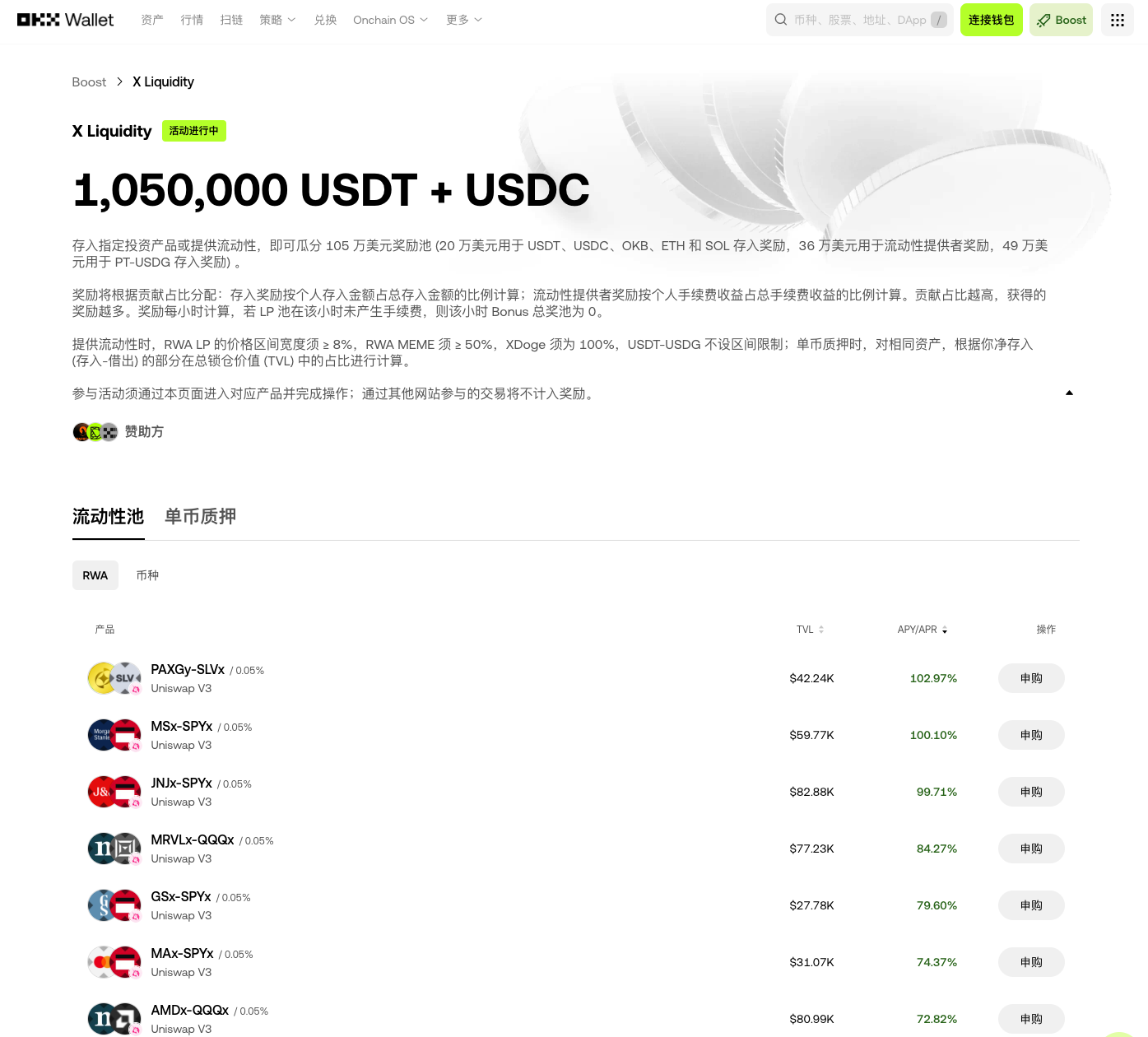
It is important to distinguish: the 250K USD equivalent is the latest dynamic promotion for this round of designated liquidity pool incentives, while 1.05M USDT + USDC is the overall reward framework shown on the event page and cannot be simply added together.
For users, what is truly worth studying is not “how big the reward numbers are,” but: which pools have real trading fees, how much contribution proportion can be earned once personal funds enter, and whether the high APY can cover impermanent loss and price fluctuations.
Why is this round of activity worth paying attention to?
Previously, many on-chain incentives focused on a single token or highly volatile trading pairs, whereas this round covers a wider range of assets:
- xStocks stock-mapped assets;
- PAXGy and other gold-related RWAs;
- Mainstream coins and index assets;
- Stablecoin trading pairs.
This provides different entry points for users with various risk preferences. Users optimistic about US stocks and RWAs can study stock-index or gold-precious metal combinations; users more concerned about trading fees and relatively stable fund management can look at stablecoin pools; users willing to take on higher volatility can further compare mainstream coins and other designated pools.
However, “superior assets” do not guarantee LP profitability. Liquidity providers will still face impermanent loss, price ranges, trading slippage, smart contract, and liquidity risks.
How are activity rewards calculated?
The rules provided on the X Liquidity page are very critical:
Deposit rewards are calculated based on the proportion of an individual’s deposit amount to the total deposit amount; liquidity provider rewards are calculated based on the proportion of an individual's fee earnings to total fee earnings. The higher the contribution proportion, the more rewards can theoretically be obtained.
This means that providing $10,000 in liquidity does not equate to receiving a fixed reward based on $10,000. LP rewards are related to actual fee generation, and fees depend on trading volume, pool fee rates, personal effective liquidity, and price range settings.
The page also shows that rewards are calculated hourly. If a specific LP pool does not generate fees in a given hour, then the total bonus reward for that hour is 0.
Therefore, when users evaluate whether a pool is worth participating in, they should not only look at APY but also observe:
- Whether there has been real trading in the recent past;
- Whether the pool consistently generates fees;
- Whether personal funds are within an effective price range;
- Whether the current TVL is already too high;
- Whether activity rewards primarily rely on short-term subsidies.
High APY is just a result, not the source of income itself. Real trading fees and the sustainability of activity rewards are the more important data.
What pools on the current page are worth noting?
At the time of writing, the activity page displayed several designated pools on X Layer. The following data belongs to a dynamic page snapshot and may change with fund inflow, trading volume, and market price:
- PAXGy–SLVx: TVL approximately $42.24K, page shows APY/APR approximately 102.97%;
- MSx–SPYx: TVL approximately $59.77K, page shows APY/APR approximately 100.10%;
- JNJx–SPYx: TVL approximately $82.88K, page shows APY/APR approximately 99.71%;
- MRVLx–QQQx: TVL approximately $77.23K, page shows APY/APR approximately 84.27%;
- GSx–SPYx: TVL approximately $27.78K, page shows APY/APR approximately 79.60%;
- MAx–SPYx: TVL approximately $31.07K, page shows APY/APR approximately 74.37%;
- AMDx–QQQx: TVL approximately $80.99K, page shows APY/APR approximately 72.82%;
- Vx–SPYx: TVL approximately $31.16K, page shows APY/APR approximately 70.24%;
- ASMLx–QQQx: TVL approximately $95.68K, page shows APY/APR approximately 63.62%;
- INTCx–QQQx: TVL approximately $123.18K, page shows APY/APR approximately 52.51%.
These numbers can help users establish a preliminary observation framework but should not be directly treated as future yield rates. The APY/APR displayed on the page may include activity incentives and will change with TVL, trading fees, and reward distribution.
Three types of pools, what to observe in each?
1. Stock-index pools: Focus on RWA trading demand and price range
Pools like MSx–SPYx, JNJx–SPYx, GSx–SPYx, MAx–SPYx, and Vx–SPYx connect individual stock-mapped assets with SPYx; pools like MRVLx–QQQx, AMDx–QQQx, ASMLx–QQQx, and INTCx–QQQx connect individual stocks with QQQx.
The opportunity in these types of pools lies in the fact that users can combine their understanding of the US stock sector to participate in on-chain trading liquidity between real asset-mapped assets. There exist price differences and trading demands between different stocks and indices, which may generate fees.
However, when stock prices change inconsistently, impermanent loss may also become more significant. For example, if a specific stock rises while the index changes little, the proportion of assets recovered upon LP exit may differ from simply holding the assets.
When choosing these types of pools, it is recommended to observe stock fundamentals, on-chain trading volume, TVL, and price range simultaneously instead of merely selecting the pool with the highest APY on the page.
2. Precious metals RWA pools: Focus on asset correlation and sources of volatility
PAXGy–SLVx involves both gold equity assets and silver-related assets. The page shows its current APY/APR is approximately 102.97%, but this number may be influenced by short-term incentives and pool size.
While there is some market correlation between precious metals, gold and silver are not the same type of asset, and their price driving factors are not completely the same. Gold is influenced by safe-haven demand, interest rates, and central bank demand, while silver is also affected by industrial demand and manufacturing cycles.
Therefore, these types of pools cannot be simply understood as “two precious metals rising together.” Users should also bear the risk of asset price deviation and LP impermanent loss.
3. Stablecoin and mainstream coin pools: Focus on real trading and fund efficiency
Stablecoin pools are generally easier to understand; users can focus on observing trading volume, fees, and depeg risks. Mainstream coin pools may have higher price volatility, but trading demands may also be more active.
The page rules state that USDT–USDG does not set price range limits; this is simpler for users who do not want to manage concentrated liquidity ranges. However, no range limit does not mean no risk; stablecoins may still experience depegging, and pools may face liquidity shortages and smart contract risks.
Price range is key for participating LPs
The activity rules set different price range requirements for different categories of LPs:
- RWA LP: The price range width must be at least 8%;
- RWA Meme: The price range width must be at least 50%;
- XDoge: The price range must be 100%;
- USDT–USDG: No range limit is set.
The characteristic of concentrated liquidity is that funds within the effective price range may have higher capital efficiency, but when the price moves outside this range, funds may no longer continuously generate trading fees.
For beginners, it is essential not to set a very narrow price range just because of a high APY. The narrower the range, the more frequent management is needed; the greater the asset volatility, the more likely it is to move out of range. A wider range may reduce capital efficiency but can decrease the operational and trading costs associated with frequent adjustments.
How to judge if “high APY” is really worth it?
It is recommended to analyze in the following order:
First, look at the composition of APY
Distinguish between fee earnings, activity rewards, and other sources of income. If APY mainly comes from short-term incentives, it may decline rapidly after the activity ends or if participating funds increase.
Next, look at TVL and personal fund ratio
Pools with lower TVL may indicate higher reward density, but they may also represent insufficient trading depth. The larger the personal fund proportion, the more significant the price impact and exit risk need to be emphasized.
Next, look at real fees
Since LP rewards are distributed based on fee contributions, whether the pool has continuous trading is more important than the annualized numbers on the page. If there are no fees in a certain hour, that hour's total bonus reward becomes 0.
Finally, calculate impermanent loss and costs
Analyze the asset price changes, price range, Gas fees, exchange fees, and slippage all together. Activity rewards are only part of the income and cannot independently determine whether to participate.
Correct path to participation
The activity rules require users to enter the corresponding product through the official page and complete operations; transactions participated in through other websites do not count towards rewards.
The suggested participation steps are as follows:
- Open the X Liquidity official activity page;
- Check real-time pools, TVL, APY/APR, and reward rules;
- Confirm that you have chosen the activity-designated product;
- Access the corresponding liquidity product through the page;
- Verify network, trading pairs, rates, and price range;
- Conduct small-scale test deposits, check fees, and exit processes;
- Continuously observe pool trading volume, effective ranges, and reward changes.
Conclusion: 250K is an entry point, but data is the basis for determining participation value
The core information for this round of X Liquidity designated liquidity pool incentives is: Stocks, precious metals, mainstream coins, and stablecoin pools can participate in sharing rewards worth 250K USD, ending on October 26 at 15:00 (UTC+8).
The page overall also displays an activity reward framework of 1.05M USDT + USDC, of which 360K USD corresponds to liquidity provider rewards; LP rewards are calculated based on individual fee earnings proportion and are tracked hourly.
For users, the most important focus should not be blindly chasing APY but finding pools with real trading fees, reasonable personal contribution ratios, and sustainable effective price ranges. Stock RWAs, precious metals, and stablecoins correspond to different sources of risk, and it is crucial to understand the assets and LP mechanisms before participating.
Exclusive benefits for AiCoin users
Use the OKX Web3 wallet, “invest in assets around the world”!
Bind the invitation code 【AICOIN88】 and enjoy a 20% savings on trading costs (Gas optimization and other benefits)!
Download/upgrade the OKX Web3 wallet now to catch the wave:
https://jump.do/xlink?checkProxy=true&proxyId=24
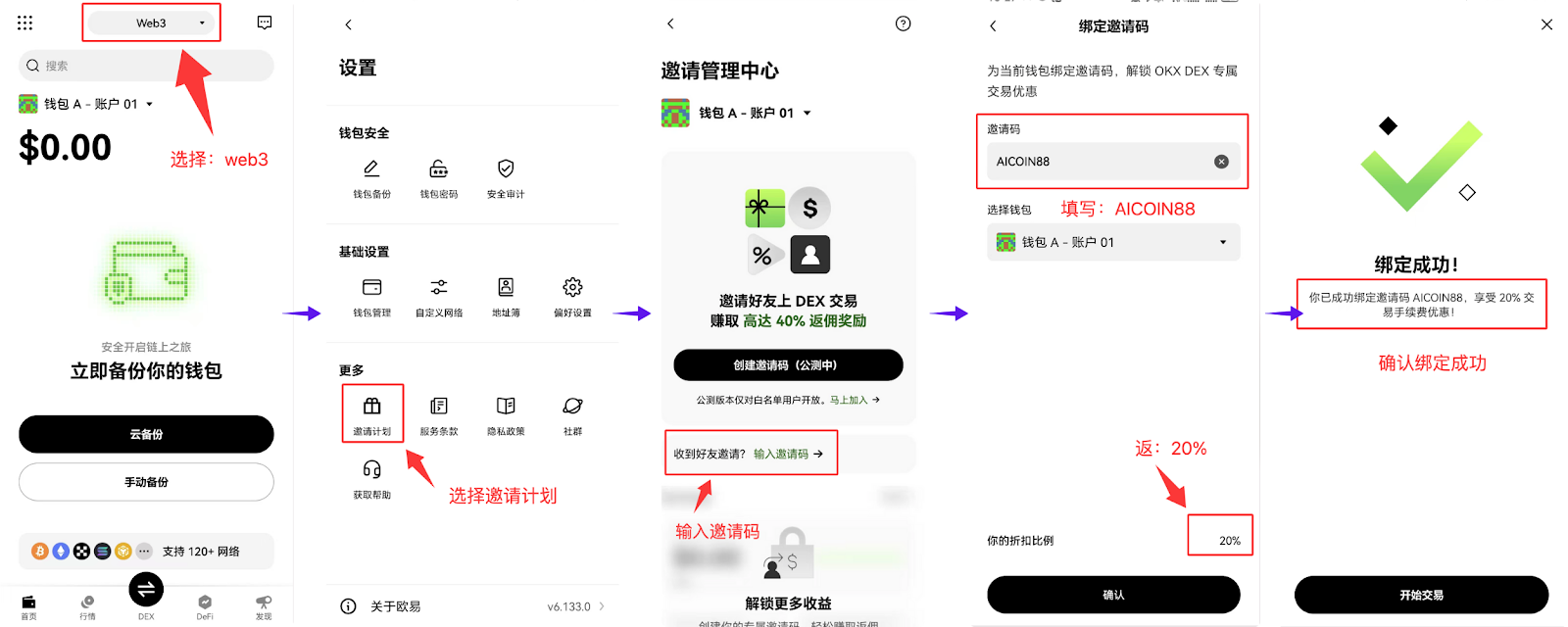
Use the exclusive invitation code 【AICOIN88】 to bind your OKX wallet; the web can also be operated conveniently!
https://web3.okx.com/ul/joindex?ref=AICOIN88
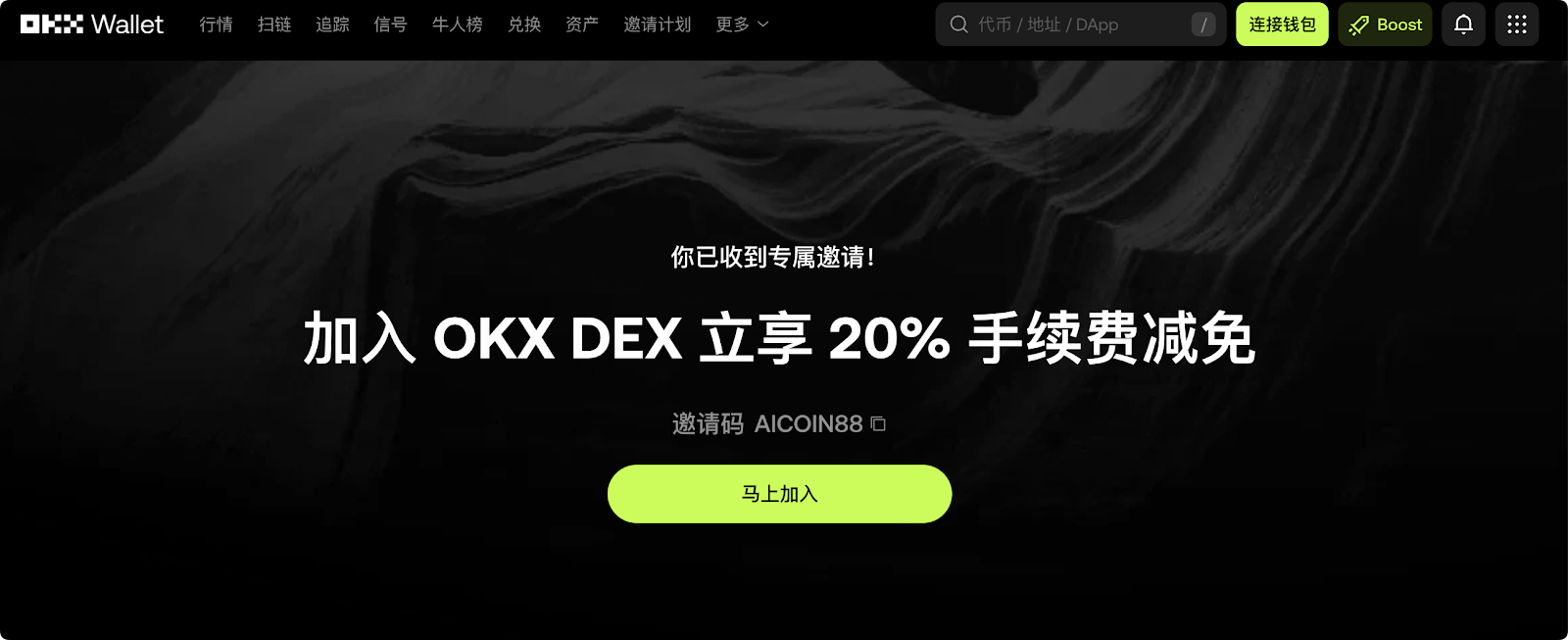
Don't wait, set up the OKX wallet, bind discounts, and reap new wealth!
免责声明:本文章仅代表作者个人观点,不代表本平台的立场和观点。本文章仅供信息分享,不构成对任何人的任何投资建议。用户与作者之间的任何争议,与本平台无关。如网页中刊载的文章或图片涉及侵权,请提供相关的权利证明和身份证明发送邮件到support@aicoin.com,本平台相关工作人员将会进行核查。


