Many people understand exchange competition, and the first reaction is matching speed.
Whoever has lower latency, whose servers are closer, and who can submit an order to the system faster seems to explain everything.
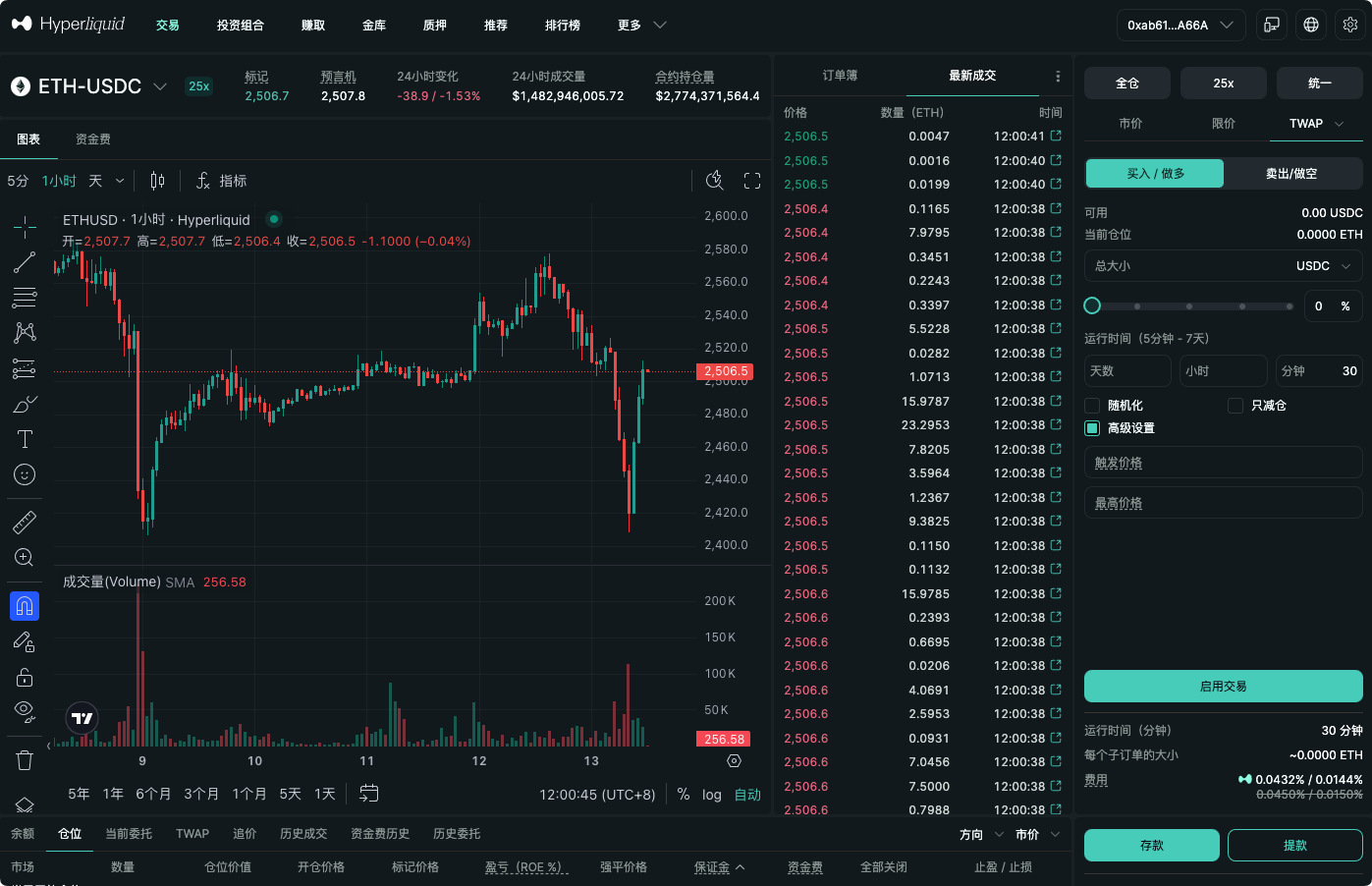
However, when the founder of OKX recently discussed Hyperliquid, he focused not on a simple speed ranking but on a more easily overlooked question: Why are market makers willing to place quotations here?
In the interview, he stated that centralized exchanges usually process orders one by one, while Hyperliquid processes by block and prioritizes order cancellations within the block. This means that market makers have the opportunity to cancel outdated orders first when the market changes rapidly, before other orders continue processing.
The value of this comment lies not in proving that all order books on Hyperliquid are deeper but in pointing out an underlying logic:
Liquidity does not appear out of thin air. Exchanges must first design a set of rules that encourage liquidity providers to stay.
1. What market makers fear most is not volatility, but outdated prices
The job of market makers is not simply "buy low, sell high."
They will place quotations on both the buy and sell sides simultaneously to earn the spread or gain trading flow. However, when the external market suddenly moves, what was originally a reasonable quote may turn into an erroneous price within milliseconds.
For example, if BTC prices in other markets drop rapidly while a buy order in a particular exchange remains at an old price. At this point, the taker will attempt to fill this outdated quote. For market makers, losses may not necessarily come from incorrect directional judgments but could arise from not canceling their quotes quickly enough.
This type of risk is typically referred to as outdated quote risk. It directly affects how much depth market makers are willing to provide, how long they are willing to post quotes, and which low-liquidity assets they will cover.
If on-chain matching rules prioritize cancellations within each block, then the risk structure for market maker quotations differs from traditional one-by-one matching.
This does not mean that market makers can always cancel quotes successfully, nor does it mean that every extreme market condition can avoid losses. But from a mechanical perspective, prioritizing cancellations reduces the pressure on market makers to be exposed to outdated quotes for extended periods.
2. How does the official documentation describe this priority system?
The Hyperliquid official documentation's description of the priority fee mechanism is much more restrained than the "market makers are invincible" rhetoric found on social media.
In supported IOC orders and non-reduce-only ALO orders, orders can use priority grouping. The official documentation clearly states: even with order priority fees, all cancellations still take precedence over all immediately executable orders; afterwards, orders with higher priority fees will receive higher rankings.
This is not the same as saying "all orders are given time priority by market makers."
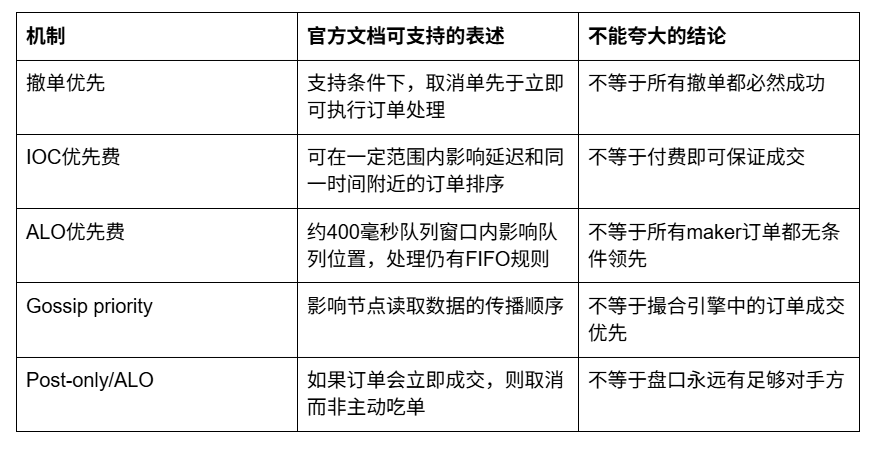
The official API documentation also stipulates that the unfilled portion of an IOC order will be canceled, and ALO orders that will match immediately will also be canceled, while GTC orders will remain on the order book.
Thus, a more accurate way to say it would be: **Hyperliquid has written part of the market makers' responsiveness into the on-chain order processing rules.** This may improve the conditions under which market makers manage their quotes, but the effect still depends on network propagation, order types, priority fees, block states, and actual market volatility.
3. The so-called "better depth" should be broken down into three questions
This design, friendly to market makers, may explain why Hyperliquid's order book depth appears to be superior to that of many centralized exchanges and provides an alternative path for long-tail, low-liquidity assets.
However, this statement cannot be directly translated into "the depth of all markets on Hyperliquid is superior to that of centralized exchanges."
Because trading depth consists of at least three different issues:
First, how many quotes are displayed on the screen.
This is the static order book that users see. It can quickly determine the nominal buy and sell volume near a certain price, but it does not represent that these orders will still exist when the price moves quickly.
Second, how much volume can be filled during real transactions.
Whether the order book can complete a large order at a reasonable slippage is what constitutes executable depth. Static depth may look good, but if actual transactions are subject to price jumps, it still does not equate to high-quality liquidity.
Third, who is still willing to quote during extreme market conditions.
Comparing depth in ordinary market conditions is relatively easy, but what is truly difficult is whether market makers continue to provide bilateral quotes when prices change rapidly, liquidations occur in clusters, or external markets move first.
Therefore, a better approach is to consider it as a mechanical hypothesis: reducing cancellation risk may make market makers more willing to place orders in long-tail markets; this hypothesis needs to be verified with real transaction data, slippage, and extreme market conditions.
4. How being friendly to market makers may help long-tail assets?
Mainstream assets like BTC and ETH have multiple external markets to refer to, and market makers can hedge risks in other markets even if they cancel quotes in one exchange.
Long-tail assets are different. They have lower transaction volumes, larger price swings, and external hedging markets may be incomplete. If market makers are concerned that they cannot cancel orders promptly after placing them, they usually choose one of three strategies: reduce the scale of their orders, widen the bid-ask spread, or simply avoid participating in that market.
All three outcomes make it more difficult for ordinary users to trade.
If matching rules alleviate the concerns of quote providers about outdated orders, market makers may be more willing to cover more assets or provide more quotations under the same risk conditions. For traders, the potential outcome is that long-tail assets do not have to rely entirely on a large centralized exchange to form a tradable market.
Hyperliquid also positions itself as a liquidity infrastructure for developers to build financial applications and emphasizes the transparency of trading records, open access, and on-chain verification.
But "an alternative path" does not mean "risk disappears."
Long-tail assets may still face oracle distortions, price jumps, insufficient liquidation depth, price manipulation, and extreme slippage. Increased willingness to quote among market makers only addresses part of the liquidity supply; the quality of information and risk management regarding the assets themselves still requires traders to assess independently.
5. Ordinary traders should note: prioritizing cancellations can be a good thing, but may also change what you see in the order book
The perspective of market makers is not entirely the same as that of ordinary takers.
For market makers, prioritizing cancellations can reduce the risk of being hit by outdated prices. For ordinary traders, this also means that the orders you see may not be willing to be filled by you when the market changes rapidly.
This is not a moral issue unique to a specific platform, but a fundamental trade-off in liquidity markets:
- Protecting quote providers may increase their willingness to place orders;
- However, if quote providers can cancel orders faster, this may also cause the visible depth in extreme market conditions to vanish more swiftly;
- Static order books may appear thicker, but actual executable depth still needs to be validated through order feedback and slippage.
Therefore, do not only ask "how much volume is there on the order book," but also ask: When I actually buy or sell, how much was executed, what was the average slippage, and were orders partially filled or canceled during volatility?
This is also why, when using trading tools, one should not solely focus on the candlestick charts.
6. The value of AiCoin is transforming "appears to have liquidity" into verifiable data
For ordinary traders, understanding the matching engine does not mean having to run a market-making strategy themselves, but rather knowing what signals to observe.
On the AiCoin mobile app, one can first look at professional candlestick charts and real-time depth, then combine large order movements, open interest, funding rates, and trading changes to assess whether a market trend is driven by genuine support or merely the order book temporarily thickening.
For those monitoring smart money, one can also compare on-chain address activities and changes in the order book. When large players accumulate while market depth increases in sync, versus large players accumulating but the order book continuously retreats, these represent two completely different market states.
Once the trading logic has been confirmed, connect to Hyperliquid through AiCoin to execute trades. By using the referral code AICOIN88, eligible trades can earn a 4% rebate on fees. Detailed activity eligibility, scope, and refund times are subject to the platform rules.
Rebates can only reduce part of the transaction fees, and do not eliminate slippage, funding rates, oracle risks, liquidity, or liquidation risks.
The real moat may be making quote providers willing to stay
What is most worth noting is that it shifts market competition from “who has a larger trading volume” back to “who has a microstructure that better supports liquidity.”
Trading volume is the result; matching rules are one of the conditions.
If market makers can more easily manage quote risks, they may be willing to provide liquidity in more markets; if more long-tail assets receive consistent quotes, Hyperliquid could become more than just a trading entry point, but potentially a foundational on-chain liquidity base that other financial applications can invoke.
However, this logic must be verified by data. The next time you see "better order book depth," consider looking beyond a promotional line to evaluate four indicators: actual transaction slippage, cancellation-to-execution ratio, depth changes under extreme conditions, and whether open interest and liquidations rapidly drain liquidity.
This is more closely aligned with where trading actually happens than judging which platform’s promotional words are louder.
Exclusive benefits for AiCoin users
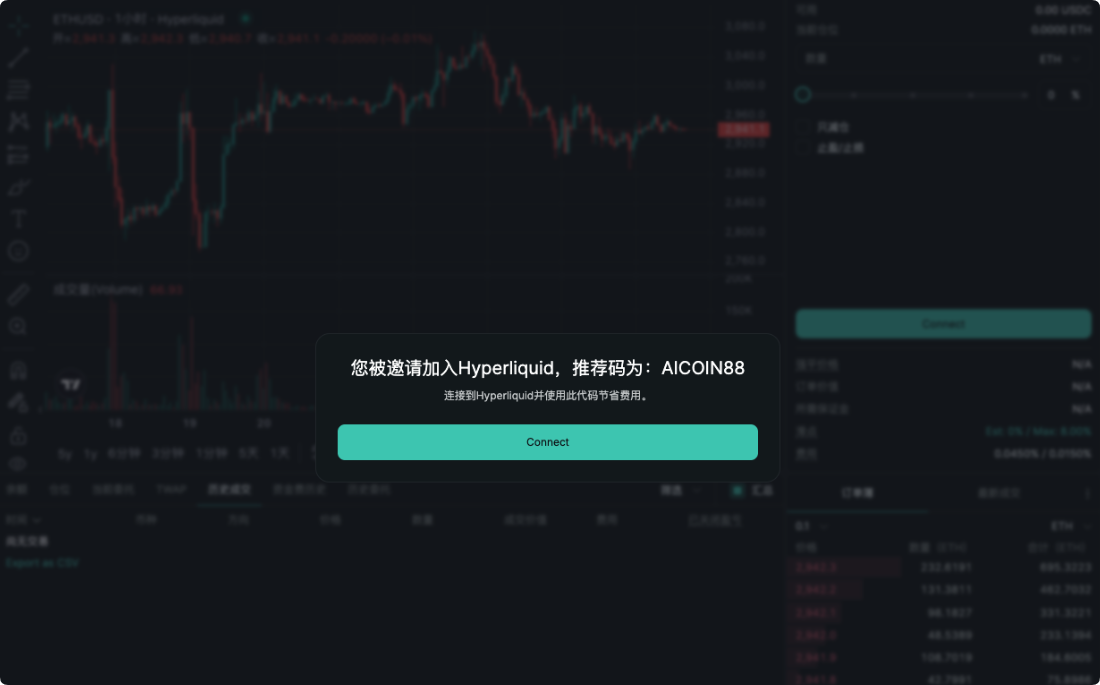
👉 Enter referral code AICOIN88 when binding your Hyperliquid account to enjoy a 4% fee rebate
🔗 Exclusive registration link:
https://app.hyperliquid.xyz/join/AICOIN88
📖 Beginner's Guide:
- "AiCoin PC Hyperliquid Authorized Trading Tutorial":
https://www.aicoin.com/zh-Hans/article/514197
- "AiCoin Mobile Hyperliquid Authorized Trading Tutorial":
https://www.aicoin.com/zh-Hans/article/541383
- "Beginner's Guide! Hyperliquid First Trading Super Detailed Illustrated Tutorial":
https://www.aicoin.com/zh-Hans/article/510225
📖 Community Communication:
- Telegram:
https://t.me/AiCoinWhaleData
- Discord:
https://discord.gg/5XSXjXSpz
- AiCoin-Group Chat:
https://www.aicoin.com/link/chat?cid=N6OVMor5g
The content of this article only represents the author's personal opinion and does not reflect the platform's stance. The viewpoints, conclusions, and suggestions in the article are for investors' reference only and do not constitute any investment advice related to this platform. Investing in U.S. stocks still requires self-assessment of market risks, regulatory risks, and compliance with local laws and regulations (especially foreign exchange controls, overseas investment declarations, etc.).
免责声明:本文章仅代表作者个人观点,不代表本平台的立场和观点。本文章仅供信息分享,不构成对任何人的任何投资建议。用户与作者之间的任何争议,与本平台无关。如网页中刊载的文章或图片涉及侵权,请提供相关的权利证明和身份证明发送邮件到support@aicoin.com,本平台相关工作人员将会进行核查。