1000x leverage, users can receive tokens from losses, and there was a huge nominal transaction volume shortly after launch.
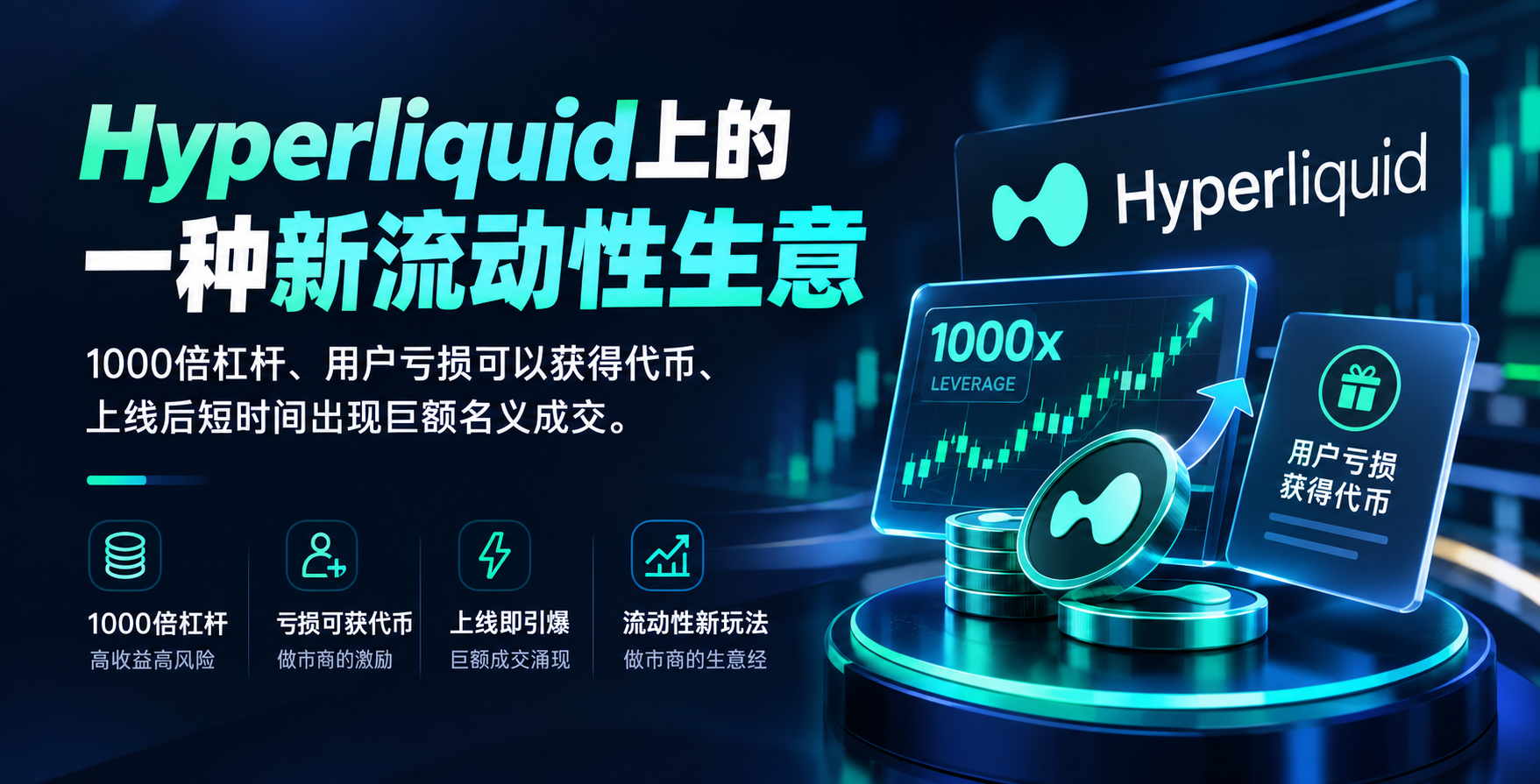
But what is truly worth studying is not the number "1000," but how it compresses the four toughest issues for a trading platform into the same set of smart contracts:
- Where does the liquidity come from without initial market-making funds?
- Can user losses be converted into protocol capital?
- When profit-takers need to cash out, does the protocol really have money?
- Are token rewards creating real income, or are they just compensating for risk-taking?
This is also the most valuable aspect of Papertrade for the Hyperliquid ecosystem: it does not simply add a trading page, but rather experiments with a financial market structure different from the traditional order book on HyperEVM.
1. Papertrade does not move orders onto the chain, but transforms trading into “users against LP”
According to the official Papertrade documentation, it is deployed on HyperEVM, using the bid and ask midpoint of the Hyperliquid order book as an oracle to synthesize perpetual positions like BTC and ETH, but does not open corresponding perpetual hedge positions on Hyperliquid itself.
This leads to several results that differ from traditional perpetuities:
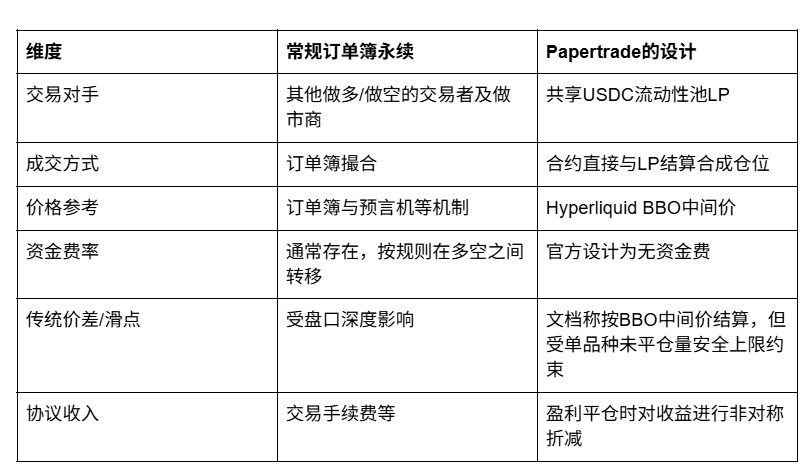
This is not “free trading.” It simply changes the fees from explicit nominal transaction fees to a reduction in the profits realized; at the same time, traders still bear the risks of price oracles, LP solvency, extreme leverage, and contract risks.
In other words, what Papertrade eliminates is not risk, but the form of transaction costs.
2. The most radical innovation: LP starts from zero, but debt does not disappear into thin air
Traditional trading platforms require market makers to deposit funds in advance to handle user profits and losses. Papertrade tries the opposite: Martingaler LPs can start with $0, with all trades directly facing LPs, and users' cumulative losses gradually filling the capital pool.
The logic can be simplified like this:
User loss → LP increases → Subsequent profit-takers gain cash-out ability
User profit → LP decreases → If funds are insufficient, profits enter the queue waiting
The part of this mechanism that marketing language most easily obscures is future cash flow debts.
Assuming the LP currently has only $5 million, but a profit-taker is entitled to $6 million, the protocol can first pay out $5 million; the remaining $1 million enters the FIFO queue, waiting for future other traders to incur losses before repayment.
This corresponds to using potential future trading losses to finance today's profit requests.
It has two completely opposite interpretations:
- Optimistically, this is a liquidity model that does not require traditional market-making capital and can bootstrap with user trading activities;
- Conservatively, this is also a queue model that exposes protocol solvency to trading sequences, user profit and loss distributions, and extreme market conditions.
Therefore, the most important indicators for Papertrade should not be just trading volume, but should also include: LP balances, debts to be repaid, profit closing amounts, queue repayment speed, and the fund distribution between old and new users when LP is insufficient.
Trading volume tells you how many people are betting, but queue data tells you whether the protocol can honor its commitments.
3. PAPER is not a free airdrop, but the tokenization of “loss certificates”
Papertrade's tokenomics is also very unique.
The official documentation states that the initial supply of PAPER is 0, with no pre-mining, team allocation, VC allocation, airdrop, or lock-up; the token is derived from realized user losses. When LP falls below $2 million, for every qualifying $1 loss, a maximum of 100 PAPER can be minted; the higher the LP, the lower the minting rate.
This means that PAPER is not awarded out of thin air for “participation,” but rather transforms an economic fact — that someone has incurred a loss in trading — into a certificate of protocol equity.
The official documentation further explains that staking PAPER can earn USDC yields, which come from 1% of settled trading realized PnL and excess growth allocation beyond the $5 million LP cap.
Design-wise, it forms a closed loop:
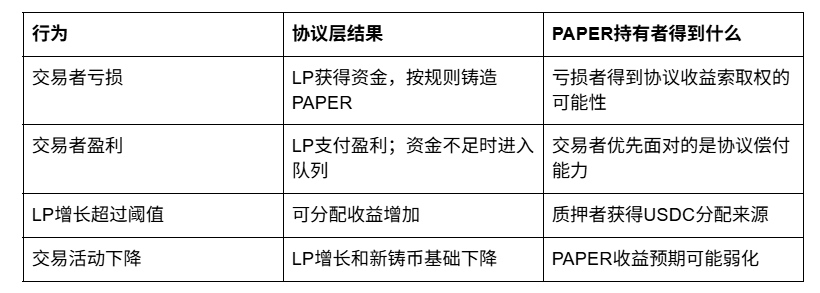
This is different from the common DeFi model of “depositing assets to obtain governance tokens.” The issuance of PAPER relies on real trading losses, but this also creates a clear problem: if traders artificially create losses through pairing long and short positions, low-cost repeated operations, or other strategies, will they mint a large number of tokens with minimal real economic contribution? Bankless has listed PAPER farming and token dilution as risks to monitor.
Thus, when judging the value of PAPER, one must not only look at the issuance amount and staking rate but also at: how much new tokens correspond to new LP capital, how much real protocol income there is, and how much is merely nominal activity generated from internal trading.
4. How should we view the $102 billion in the first hour after launch?
On October 10th, market KOLs discovered data about Papertrade approximately one hour after its launch: the nominal trading volume exceeded $102 billion, with approximately $9.35 billion in open contracts and about $1.2 million in TVL.
These numbers are very viral, but cannot simply be written as “the platform has already deposited $102 billion in funds.”
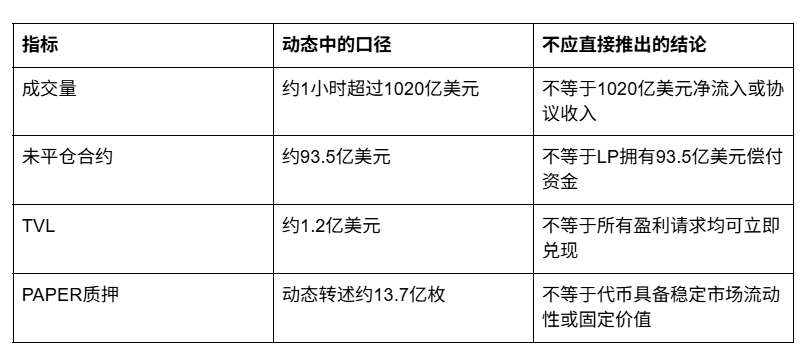
It is especially important to note that 1000x leverage can amplify nominal trading volumes. Bankless points out that under 1000x leverage, about 0.1% adverse price movements can wipe out margin.
Therefore, the larger the trading volume, the less we can judge success solely based on volume. For a protocol like Papertrade, at least four lines need to be observed synchronously:
- Nominal trading volume: how active are user trades;
- LP balance: how much usable capital the protocol has;
- Outstanding queue: whether profit needs to wait;
- PAPER issuance and staking: whether token incentives bring sustainable cash flow.
This is the meaning of on-chain data: not just looking for one hot number, but breaking down the hot number into a group of mutually-restrained balance sheet variables.
5. Why is this important for Hyperliquid?
The value of Papertrade does not lie in whether it will inevitably become the largest trading platform, but in how it demonstrates a way to expand the Hyperliquid ecosystem.
Hyperliquid is not just a front end for users to trade BTC and HYPE. HyperEVM allows developers to combine trading, collateral, token incentives, and profit distribution into new financial applications; HyperCore provides high-performance trading states and price infrastructure.
Papertrade uses Hyperliquid’s BBO midpoint as a price reference, connecting external traders' market information to a completely different settlement model. This is somewhat like expanding the Hyperliquid order book from “one trading venue” to “a market state that other financial products can read.”
This path also differs in significance from HIP-3: HIP-3 involves third parties deploying independent perpetual markets, with deployers responsible for market definitions, oracles, and operations; Papertrade constructs synthetic trading and bootstrapped LP in the form of smart contracts on HyperEVM.
One extends the tradable assets, while the other redesigns profit and loss settlements after trading.
If such experiments continue to increase, Hyperliquid’s competitive barrier will not solely stem from the trading volume of a particular day, but from:
an increasing number of different financial products willing to incorporate Hyperliquid’s price, liquidity, or settlement capabilities as their underlying components.
Of course, more applications calling the underlying also means that risks are amplified in more places. Oracle errors, chain congestion, contract bugs, or single price source manipulation can transmit from one application to a group of user assets.
6. What ordinary users really need to learn is not 1000x, but data structures
Products like Papertrade can easily lead one to fall into two extremes: either attracted by high leverage and massive trading volumes, or simply categorizing it as a casino and stopping analysis.
A more valuable approach is to observe how it transforms trading behavior into protocol data:
- Are users opening positions, or closing rapidly in succession?
- When trading volumes increase, is the LP thickening or thinning?
- Is the increase in open interest accompanied by an increase in debts to be repaid?
- Do PAPER staking yields come from real LP growth, or mainly rely on losses from new trades?
- Are profit-takers able to smoothly obtain USDC, rather than just receiving a queue ticket?
On the AiCoin mobile app, one can first observe the market using professional candlesticks, open interest, funding rates, and large order movements, and then combine on-chain smart money and project data to assess the quality of trading activities. For new products in the Hyperliquid ecosystem, the focus should not just be on “whether positions can be opened,” but on first examining price sources, LP structure, payment orders, and revenue sources.
Conclusion: Real innovation means writing risk into the balance sheet
The most noteworthy aspect of Papertrade is not whether it can turn 1000x leverage into a long-term product, nor whether the trading volume in the first hour can continue to set records.
What is truly noteworthy is how it lays bare several issues that were previously hidden behind the exchange’s background directly onto the chain: where does liquidity come from, who bears counterparty risk, how profits are cashed out, why tokens are issued, and who ultimately creates the revenue.
This is a high-risk experiment, but it is also an experiment with higher information transparency.
For Hyperliquid, Papertrade shows that HyperEVM is beginning to bear not only “more applications,” but also different financial market mechanisms. For users, the most important thing is not to chase the most extreme leverage, but to learn to look beyond volume: to examine LP, to observe the queue, to understand real cash flows, and to scrutinize the economic activities behind token issuance.
AiCoin user exclusive benefits
👉 Enter the invitation code AICOIN88 when binding your Hyperliquid account to enjoy a 4% commission rebate
🔗 Exclusive registration link:
https://app.hyperliquid.xyz/join/AICOIN88
📖 Beginner tutorial:
“AiCoin PC-side Hyperliquid authorization trading tutorial”:
https://www.aicoin.com/zh-Hans/article/514197
“AiCoin mobile-side Hyperliquid authorization trading tutorial”:
https://www.aicoin.com/zh-Hans/article/541383
“Zero-based introduction! Hyperliquid First Trade Ultra Detailed Illustrated Tutorial”:
https://www.aicoin.com/zh-Hans/article/510225
📖 Community communication:
Telegram:
Discord:
AiCoin-Group Chat:
https://www.aicoin.com/link/chat?cid=N6OVMor5g
The content of this article only represents the author's personal opinion and does not represent the position of this platform. The opinions, conclusions, and suggestions in the text are for investors' reference only and do not constitute any investment advice related to this platform. Investing in U.S. stocks still involves market risks, regulatory risks, and local legal compliance risks (especially foreign exchange controls, overseas investment declarations, etc.).
免责声明:本文章仅代表作者个人观点,不代表本平台的立场和观点。本文章仅供信息分享,不构成对任何人的任何投资建议。用户与作者之间的任何争议,与本平台无关。如网页中刊载的文章或图片涉及侵权,请提供相关的权利证明和身份证明发送邮件到support@aicoin.com,本平台相关工作人员将会进行核查。