The CoinW Research Institute
Key Points
Hyperliquid has established a scale advantage in on-chain perpetual contracts. As of now, Hyperliquid's total open contracts across all platforms amount to approximately $13.5 billion, with the HIP-3 market accounting for about $3.5 billion. According to data from DefiLlama, the protocol fees in the past 30 days are approximately $64.78 million, and the protocol revenue is about $48.81 million, supported by trading activity and verifiable revenue.
The value capture of HYPE is built upon the protocol revenue and the net buying mechanism of the assistance fund. Public disclosures show that the assistance fund has accumulated and isolated more than 46 million HYPE. The mid-term funding dynamics for HYPE depend on the balance between protocol revenue, actual net purchases by the assistance fund, net inflows from staking, and the new market supply available for sale.
HIP-3 and HIP-4 have expanded Hyperliquid's market creation capabilities. Currently, among the $3.5 billion in open contracts for HIP-3, Trade.xyz represents approximately 99.10%. The selected result-oriented contracts of HIP-4 have already launched trading on the mainnet, while the permissionless standard deployment is still in the testing phase. The market boundaries continue to expand, with the concentration of the development team, the quality of oracles, and compliance pathways becoming the core variables in the next stage. HyperCore and HyperEVM together form the dual execution environment of Hyperliquid L1. HyperCore is responsible for order books, matching, margins, and settlements, while HyperEVM handles smart contracts and third-party applications. The two share HyperBFT consensus where CoreWriter acts as the write interface connecting the two execution environments, enabling smart contracts on HyperEVM to submit operation instructions such as orders, asset transfers, and staking to HyperCore for validation and execution.
The HyperEVM application layer has formed core sectors such as liquid staking, lending, cross-chain assets, stablecoins, and spot trading. As of now, DefiLlama data indicates that the DeFi TVL for Hyperliquid L1 is approximately $1.597 billion. The growth of the application layer shows characteristics of parallel trading concentration and capital division. Trade.xyz is mainly responsible for the trading volume of HIP-3, Kinetiq provides HYPE liquid staking, and HyperLend and Felix meet lending and stablecoin demand. Each sector has formed a clear division of labor, although there is still significant room for improvement in cross-protocol combinatorial capacity.
In 2026, U.S. regulation of on-chain derivatives progressed from policy discussions to product approvals and rule-making stages. On May 29, the CFTC approved an U.S.-registered exchange to launch Bitcoin perpetual futures. On August 19, U.S. President Trump publicly mentioned Hyperliquid at the White House, stating that CFTC Chairman Michael Selig is researching how to allow its entry into the U.S. market in a legal and compliant manner. Meanwhile, Hyperliquid is participating in regulatory discussions for stock and commodity perpetual contracts through the Washington Policy Center. The changes in the U.S. regulatory environment create new possibilities for Hyperliquid to attract institutional funds and compliant users, but its market access in the U.S. still depends on operating licenses, legal definitions of products, and related compliance requirements.
Four core indicators worth tracking in the future include the total locked value and capital retention of HyperEVM, HIP-3 transaction volume and Trade.xyz market concentration, HIP-4 third-party deployment and actual transaction activity, as well as the dynamic balance of HYPE token unlocks and net inflows to the application layer. These indicators will collectively reflect whether Hyperliquid can form a sustainably growing application ecosystem beyond its current perpetual contract business and convert trading volume and liquidity advantages into more stable protocol revenue and token value capture capabilities.
Hyperliquid is forming an on-chain financial ecosystem centered around HyperCore as the trading and liquidity hub and HyperEVM responsible for financial application expansion, creating differentiated competition with general public chains like Ethereum. Its advantages include a mature order book, liquidation system, and protocol revenue mechanisms, but the concentration of the HIP-3 market, oracle risks, new HYPE supply, and competition from compliant exchanges within the U.S. remain major constraints. This report believes that the valuation logic of HYPE is extending from that of general DeFi protocol tokens to an on-chain financial infrastructure with continuous transaction income; whether it can achieve a higher valuation in the future depends on independent revenue growth at the application layer, continuous access of institutional funds, and the actual establishment of compliant business in the U.S.
Table of Contents
1. Constructing the Liquidity Foundation of HyperEVM
1.1 Hyperliquid has already become the absolute leader in on-chain perpetual contracts
1.2 The funding flywheel of HYPE tokens has been validated by the market
2. HyperEVM and HyperCore form dual execution environments on the same L1
2.1 Two execution environments on one chain
2.2 HyperCore: The core engine of the Hyperliquid system
2.3 HyperEVM: The application expansion layer of the Hyperliquid system
3. Market openness and application division of labor shape the HyperEVM application layer
3.1 HIP-3: Giving the issuance rights of perpetual contracts to third-party development teams
3.2 HIP-4: Integrating event contracts into a unified margin account
3.3 The application layer forms a division of labor system for trading and fund management
4. What will define HyperEVM next
4.1 Possible new protocol directions
4.2 Existing major categories that still haven't produced leading projects
4.3 Core differentiation of the HyperEVM application layer
5. The boundaries of uncertainty for HyperEVM are risk and regulation
5.1 Risk dimensions
5.2 Regulatory dimensions
6. The next indicators worth tracking
6.1 Growth curve of the total locked value in HyperEVM
6.2 Cumulative trades and open contracts for HIP-3
6.3 Timeline for advancing HIP-4 on the mainnet
6.4 Monthly unlock of HYPE and net inflow to the application layer
7. The position and next steps for HyperEVM
7.1 Main conclusions
7.2 Several independent judgments
7.3 Future directional outlook
References
1. Constructing the Liquidity Foundation of HyperEVM
Hyperliquid simultaneously undertakes the functions of an underlying public chain and a core trading venue. HyperEVM runs on the same L1, providing a smart contract environment for third-party developers. HyperCore provides user, asset, order book, and settlement capabilities, while HyperEVM further combines these into lending, stablecoins, staking, yield, and asset management products. To understand the application value of HyperEVM, it is necessary to first grasp the trading scale of Hyperliquid and the value capture mechanism of HYPE.
1.1 Hyperliquid has already become the absolute leader in on-chain perpetual contracts
In the past twelve months, the overall landscape of the on-chain perpetual contract market has undergone a complete redistribution. As of now, Hyperliquid's nominal trading volume for perpetual contracts over the last 30 days is approximately $184.9 billion, with total open contracts across all platforms amounting to about $13.5 billion. The platform continues to maintain a scale advantage in the on-chain perpetual contract market, with HIP-3's contribution to open contracts and turnover further increasing. Growth sources have expanded from crypto-native contracts to stock indices, commodities, and other traditional assets.
In analyzing Hyperliquid's current position, the main focus is not on market share itself but on the cost structure behind its growth. Since the genesis airdrop completion in November 2024, Hyperliquid has not relied on trading subsidies, token mining, or token incentives to drive user and trading volume expansion. Its market share growth has primarily been driven by native order book performance, matching speed, variety of contracts, and continuous investment in the tooling ecosystem. Such organic growth without subsidies is relatively rare in the history of crypto derivatives, indicating that Hyperliquid's market share is not a result of short-term subsidies but rather of real product depth built up over time.
From a competitor perspective, this report believes that the real competitive pressure Hyperliquid currently faces does not come from on-chain peer protocols. The most immediate competitors at this stage are centralized exchanges, from which Hyperliquid is continuously capturing market share in derivatives trading. In the medium to long term, once U.S.-based compliant exchanges are permitted to launch perpetual contracts, systemic competition for Hyperliquid will be more significant.
1.2 The funding flywheel of HYPE tokens has been validated by the market
The reason HYPE tokens have been repeatedly discussed in the past six months lies in the feedback loop among protocol revenue, token buybacks, market capitalization performance, and the protocol's attractiveness, which has been validated by monetary value. The core mechanism driving the cycle is Hyperliquid's assistance fund. 97% of the protocol fees are injected into the assistance fund, which then buys back HYPE daily in the secondary market using USDC. Currently, the assistance fund has repurchased over 43.13 million HYPE, with a corresponding cost basis of approximately $1.04 billion, annualized buyback volume equivalent to around 7% of HYPE's circulating market cap.
The underlying drive for this flywheel comes from real protocol revenue; as of now, DefiLlama data indicates that Hyperliquid's protocol fees in the last 30 days are approximately $64.78 million, with protocol revenue around $48.81 million, primarily coming from perpetual contract trading.
Why the valuation methodology for HYPE should use price-to-earnings ratio
This report believes that the valuation anchor for HYPE should shift from the commonly used "FDV and TVL ratio" in the crypto circle to a price-to-earnings ratio method closer to that of publicly listed companies, as the assistance fund mechanism essentially puts HYPE in the form of "quasi-earning equity."
The value capture of typical DeFi protocol tokens relies on governance rights, protocol fee sharing, or functionality permissions based on token holdings, which often cannot present stable and auditable cash flows; hence, the valuation anchor usually could only rely on simple ratios of FDV to TVL. HYPE is different in that the assistance fund consistently converts 97% of protocol fees into secondary market buys for HYPE. This behavior closely resembles the mechanism in traditional finance where publicly listed companies buy back shares with post-tax profits, making it traceable, verifiable, predictable, and directly linked to the protocol's operational status. Based on this mechanism, HYPE's valuation can be assessed using the protocol's annualized revenue divided by circulating market cap as a quasi-price-to-earnings indicator.
Using a simple annualized estimate of the past 30 days' protocol revenue, Hyperliquid's annualized protocol income is about $586 million. If we calculate HYPE's circulating market cap at about $18.3 billion, it corresponds to a price-to-earnings ratio of approximately 31 times. The value in this metric is that it allows for a comparable framework between HYPE and assets with trading income, such as electronic brokers and derivatives trading platforms.
2. HyperEVM and HyperCore form dual execution environments on the same L1
2.1 Two execution environments on one chain
Hyperliquid is an L1 optimized for on-chain finance. State execution is divided into two parts: HyperCore and HyperEVM. HyperCore handles spot and perpetual order books, matching, margins, and settlements, while HyperEVM runs general EVM smart contracts. Both share HyperBFT consensus and validation nodes, with transaction and application states progressing in the same order along the same chain.
Hyperliquid can be understood as a complete on-chain financial system. HyperCore is similar to the trading and clearing department, responsible for handling orders, margins, settlements, and emphasizing throughput, determinism, and low latency. HyperEVM resembles the product and application department, where developers can deploy lending, stablecoins, yield, asset management, and trading tools. The two environments share a security system while retaining their respective execution responsibilities. HyperCore provides standardized trading primitives, and HyperEVM offers flexible contract combinatorial capabilities. Development teams can leverage HyperCore's market state and asset system to design products, thereby reducing the costs of duplicating order books and clearing systems. Users can manage spot, perpetual contracts, and application-layer assets within a unified account system.
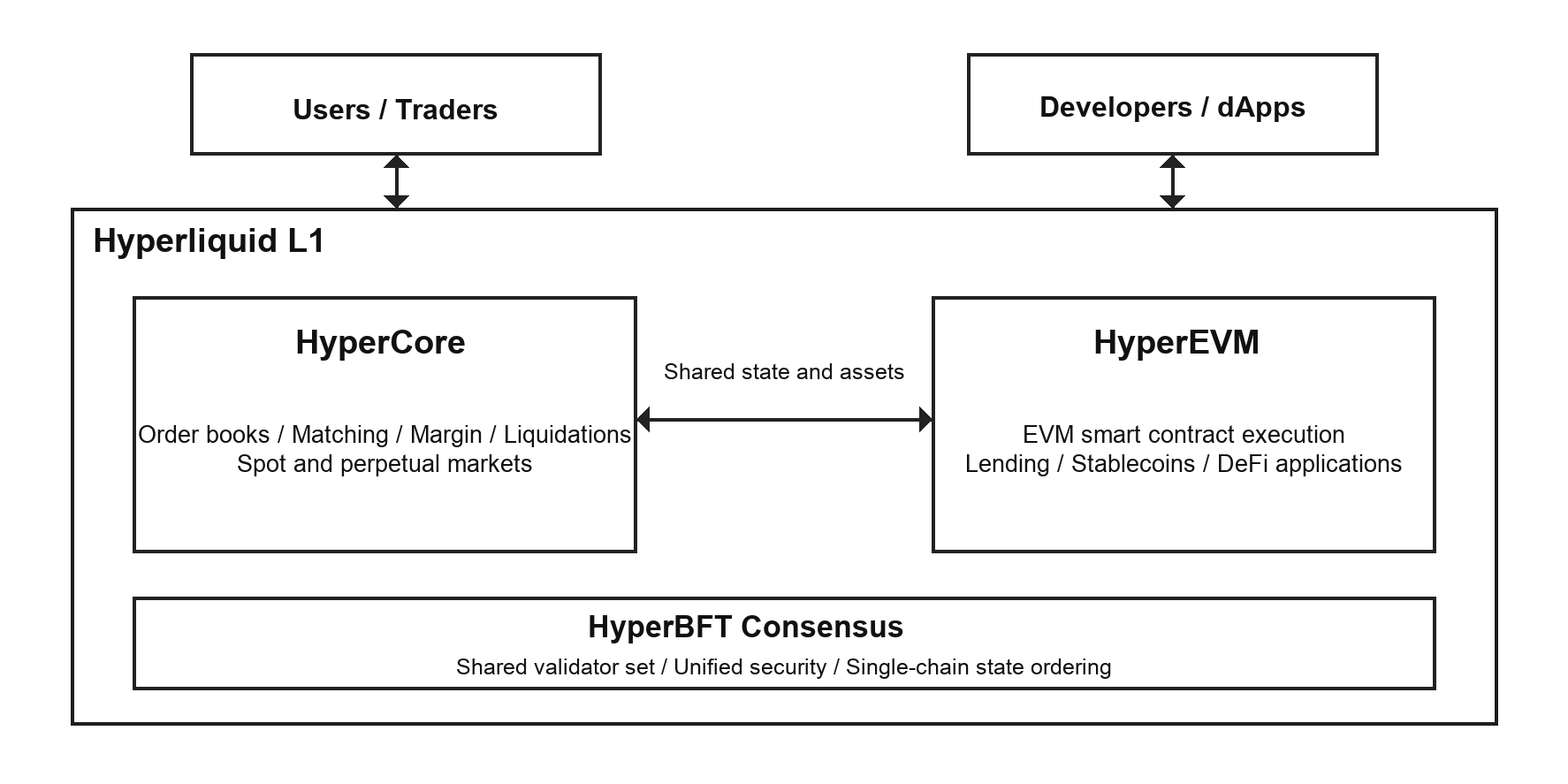
Source: The CoinW Research Institute, Hyperliquid Official Technical Documentation
2.2 HyperCore: The Core Engine of the Hyperliquid System
Imagine Hyperliquid as a fully operational financial institution with two components. The first component is called HyperCore, fulfilling all core functions of a traditional securities exchange, such as order book matching, margin calculations, clearing, and settlement. Its characteristics are speed, specialization, and extreme sensitivity to latency, but the types of functions are predetermined, and external teams cannot add new product types within it. The second part is the HyperEVM application layer, which serves as an open application programming interface allowing any third-party developer to deploy smart contracts and assemble their financial products. Its characteristics are flexibility, openness, and high combinability, but it does not have a ready-made matching system.
HyperCore and the HyperEVM application layer are not in a hierarchical relationship, but rather represent two parallel working spaces within the same institution. They operate under the same consensus protocol, with blocks advancing in the same order and maintained by the same group of validation nodes. HyperCore handles the order book and matching, while HyperEVM processes the execution of smart contracts; they are independent of each other but functionally interdependent.
HyperCore's "Read-Write Dual Channel," Key for Application Layer Accessing Core Engine
In July 2025, Hyperliquid activated a critical upgrade at the protocol level, transitioning the connection between HyperEVM and HyperCore from read-only to a read-write dual channel. Before this upgrade, application contracts on HyperEVM could read the order book status, prices, and margins of HyperCore but could not proactively initiate any transaction instructions, making the application layer akin to a bystander able to see but not operate the core trading engine.
After the upgrade, application contracts on HyperEVM could directly issue transaction actions to HyperCore for the first time, autonomously completing opening positions, hedging, transfers, and rebalancing all within the same blockchain transaction. From the perspective of application layer product morphology, this represents a fundamental release of capability, enabling complex financial combinations that previously relied on centralized front-ends or third-party agents to be fully realized on-chain from this moment onward.
Understanding HyperEVM application layer projects requires recognizing HyperCore's position. Each protocol on HyperEVM that possesses true business capacity, whether it is Felix's collateralized stablecoin or Kinetiq's liquid staking certificates, directly or indirectly relies on the liquidity and matching capabilities provided by HyperCore. This is the fundamental difference between HyperEVM and other public chains like Ethereum and Solana. On other public chains, application layer protocols must build their own matching systems; on HyperEVM, this layer is already provided by Hyperliquid's subject, enabling application layer protocols to focus engineering efforts on the product itself.
2.3 HyperEVM: The Application Expansion Layer of the Hyperliquid System
If HyperCore is the trading and clearing department of this on-chain financial institution, HyperEVM is more like its open product department. HyperCore is responsible for the most core, standardized, and low-latency trading actions, including order book matching, margin calculations, clearing, and settlements; HyperEVM is responsible for carrying third-party developers' smart contracts, allowing applications such as lending, stablecoins, liquid staking, yield vaults, asset management, and trading tools to run on the same L1. HyperEVM is not an independent new chain, nor is it a layer-2 network deployed outside Hyperliquid; rather, it is the second execution environment within Hyperliquid L1, sharing HyperBFT consensus security with HyperCore.
The distinction of HyperEVM from typical EVM chains is that it does not rebuild a set of on-chain financial infrastructure from scratch. Applications on generic EVM public chains, when wanting to implement perpetual contracts, order books, clearing systems, or margin systems, often have to construct matching logic, oracles, liquidation bots, and liquidity networks themselves. The unique aspect of HyperEVM is that HyperCore already provides high-performance order books, spot and perpetual contract markets, a margin system, and clearing capabilities on the same chain, thereby saving application layer protocols from having to redundantly build this layer and enabling them to design new financial products around existing trading infrastructure.
The Programmable Combinatorial Layer of HyperEVM, The Entry Point for Application Protocols Accessing Core Trading Capabilities
On HyperEVM, developers can deploy smart contracts using familiar EVM tools like Solidity while accessing key states of HyperCore through pre-compilation, such as prices, balances, positions, margin information, vault states, and staking states. This means that application protocols do not need to fully rely on external oracles or off-chain synchronization to utilize HyperCore's trading and account states within contract logic. For lending, stablecoins, structured vaults, and trading tools, this is crucial, as these products' risk control logic needs timely awareness of user collateral, position risks, and market price changes.
Following the July 2025 upgrade, the connection between HyperEVM and HyperCore further expanded from read access to action initiation capability. The CoreWriter system contract enables HyperEVM smart contracts to send specific operations to HyperCore, including order placement, asset transfers, vault operations, and staking-related actions. However, it is important to note that CoreWriter is not analogous to synchronous calls in ordinary smart contracts. After invoking CoreWriter, the actions are encoded and submitted to HyperCore, which further validates and processes them according to its rules; some orders and vault transfer actions may intentionally be delayed to prevent HyperEVM contracts from gaining an unfair low-latency advantage. Therefore, the writing capabilities of HyperEVM are better suited for asset management, automated strategies, structured products, and risk-control tools rather than allowing application contracts to bypass HyperCore and become high-frequency trading channels. This determines HyperEVM's positioning; it is not a substitute for HyperCore but an application expansion layer of HyperCore. HyperCore is responsible for ensuring that the trading system itself is fast enough, deep enough, and stable enough; HyperEVM is responsible for enabling external teams to develop more complex financial products based on this trading system.
Thus, the core significance of HyperEVM lies in its transformation of Hyperliquid from a single perpetual contract trading platform to an L1 capable of hosting a complete financial application ecosystem. HyperCore provides underlying trading and clearing capabilities, while HyperEVM offers application innovation and asset combination capabilities. Together, they enable Hyperliquid's growth to no longer solely depend on perpetual contract trading volume but also on new applications formed around trading, collateralization, yield, risk management, and asset issuance. The subsequent discussion of stablecoins, lending, liquid staking, structured vaults, and HIP-3-related tools fundamentally builds upon this dual execution environment.
3. Market Openness and Application Division of Labor Together Shape the HyperEVM Application Layer
HIP-3 went live on the mainnet in October 2025, allowing third-party development teams to deploy perpetual contract markets. HIP-4 entered the mainnet in May 2026, further introducing fully collateralized result-oriented contracts. These two upgrades expanded the market scope that HyperCore can accommodate and brought new trading, collateralization, and risk management scenarios to the HyperEVM application layer.
3.1 HIP-3: Giving The Issuance Rights of Perpetual Contracts To Third-party Development Teams
HIP-3 was officially launched on the Hyperliquid mainnet on October 13, 2025. In subsequent discussions, this report uses "third-party development teams" uniformly to refer to entities deploying HIP-3 markets.
Protocol Mechanism
In order to deploy their perpetual contract markets, third-party development teams must first stake 500,000 HYPE as an entry collateral. This amount serves as collateral for subsequent operational activities, and any actions violating protocol rules may trigger penalties or confiscation of part or all of the stake. Each development team has auction-free quotas for their first three contract markets, and beginning from the fourth market, they must participate in a Dutch auction held every 31 hours. Development teams have complete parameter control over their contract markets, including oracle selection, margin assets, funding rates, and liquidation parameters.
In terms of fee distribution, the fees paid by traders in the HIP-3 market are double that of the perpetual contract market operated by validators, with the development teams sharing 50%. From the protocol side, the revenue derived from a HIP-3 trade is consistent with that of the validator market; the development teams gain from the additional half that users pay.
Measured Data
As of now, the total open contracts in HIP-3 are approximately $3.5 billion, having accumulated nearly 11.4 times growth over the last three months. In terms of transaction volume share, HIP-3 accounts for over 35% of the total transactions in Hyperliquid, rising from a feature initially seen as an experimental upgrade to become the third growth curve of the Hyperliquid system.
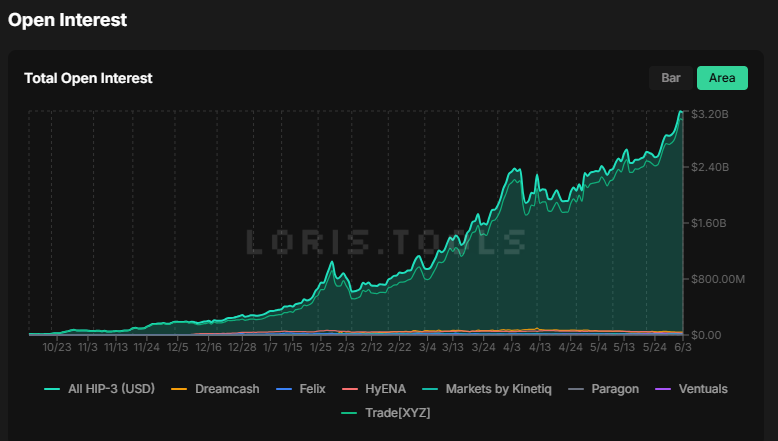
Source: : Loris.tools HIP-3 Dashboard
The market share structure within the HIP-3 ecosystem is highly concentrated, an unavoidable fact when evaluating this sector. The following illustration presents the share of open contracts held by various development teams. Trade.xyz alone accounts for 96.6% of the total open contracts in HIP-3, with the remaining 3.4% being shared by other development teams. This high concentration not only proves a real match between HIP-3's product form and market demand but also indicates that the health of the entire HIP-3 sector is almost entirely tied to the stability of a single development team.
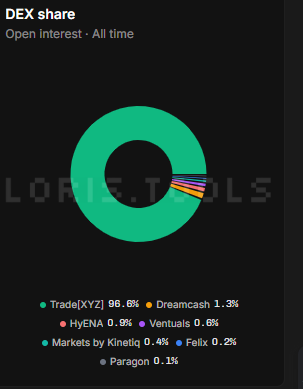
Source: : Loris.tools HIP-3 Dashboard
3.2 HIP-4: Integrating Event Contracts Into A Unified Margin Account
HIP-4 officially activated on the mainnet on May 2, 2026, representing a protocol upgrade for Hyperliquid in the direction of event contracts. HIP-4 is a type of fully collateralized on-chain tool that settles between 0 and 1 based on results, integrating the core carrying capabilities of on-chain prediction markets into Hyperliquid's unified margin accounts.
Three Key Design Choices of Mechanism
The event contract settlements of HIP-4 are determined by the oracles selected by the development team, with three key designs defining its differentiated capabilities at the protocol level. First, zero opening transaction fees, directly targeting the core revenue model of Polymarket and Kalshi. Second, sharing the same margin account with perpetual contracts and spot trades allows event contract positions to automatically hedge with long and short positions. Third, the registration threshold for development teams is set at a stake of 1 million HYPE, doubling the entry threshold of HIP-3, reflecting the higher abuse risk of event contracts due to reliance on oracles, with any confiscated stakes being directly burned.
Core Differences With Polymarket and Kalshi
After its launch, Hyperliquid captured visible event contract market share from Polymarket, especially in high-frequency contracts related to sports betting and macro events, which typically involve larger transaction amounts. This report believes that the true differentiation capability of HIP-4 does not stem from the zero opening fees, which Polymarket could match in the short term, but from the cross-product hedging capability brought by the unified margin accounts.
Polymarket and Kalshi have separate account systems for professional prediction market protocols, isolating prediction market accounts from perpetual contract and spot accounts. Users wishing to execute combined operations between the two must charge and manage collateral separately. In Hyperliquid, a hedge fund can hold both "long target policy events" and "short corresponding industry indices," offsetting their collaterals against each other. This capability for product combination is difficult for other platforms to replicate in the short term. HIP-4 does not so much seek to provide another prediction market, but rather integrates event contracts into a risk tool that can be managed alongside traditional derivatives.
Ecological Positioning and Short-term Limitations
Regarding the position of HIP-4 in the ecosystem, it should be viewed alongside the other two main revenue streams of Hyperliquid. Currently, over 90% of Hyperliquid's protocol revenue comes from perpetual contract fees, exceeding $60 million per month; HIP-4's event contracts have naturally smaller transaction volumes supported by fully-collateralized requirements (i.e., users must deposit funds equal to their maximum potential losses without using leverage). Additionally, the "holding periods" for event contracts are generally measured in days or weeks, while perpetual contracts turn over in minutes or hours. These two points determine that HIP-4 will not become a major income engine for Hyperliquid in the short term, with its monthly protocol revenue contribution expected to remain below single digits.
Nonetheless, this does not diminish the strategic significance of HIP-4; this report views HIP-4 as a critical piece for ecological completeness—HIP-3 opened up issuance for perpetual contracts, while HIP-4 opened up issuance for event contracts. Future proposals may further address options and structured products.
3.3 The Application Layer Forms A Division of Labor System For Trading and Fund Management
As of now, over 175 protocols have launched on HyperEVM, with the total lockup amount exceeding $1.8 billion. However, when selecting projects based on business scale, income generation capacity, product differentiation, and ecological influence, the core projects truly capable of supporting application layer narratives remain relatively concentrated. A few leading protocols account for over 90% of asset deposits and trading volume in the application layer. This chapter highlights the following projects as key analysis targets based on business scale and product representation: Trade.xyz, Felix Protocol, HyperLend, Kinetiq, and PURR.
3.3.1 Trade.xyz: The Traditional Asset Trading Entrance of HIP-3
Business Overview
Trade.xyz is the first team to complete market development team registration and launch contract markets on the mainnet following the HIP-3 protocol upgrade, going live concurrently with the HIP-3 mainnet in October 2025. Regarding product rhythm, Trade.xyz launched in high synchronization with the opening of Hyperliquid's HIP-3 mainnet, deploying in October 2025, distributing in November, and launching over 50 targets in December, with plans for the first quarter of 2026 to achieve simultaneous rollout across tokenized stocks, commodities, and foreign exchange, and to introduce synthetic composite products encompassing stock indices and U.S. bonds in the second quarter.
Product Matrix
The product matrix of Trade.xyz currently divides into three main lines and one composite product line. The first main line is tokenized stock perpetual contracts, covering major tech stocks such as Tesla, Apple, NVIDIA, Amazon, Meta, Google, Microsoft, as well as synthetic index contracts like S&P 500 and NASDAQ 100, all adopting a 24-hour uninterrupted trading model. The second main line is commodity perpetual contracts, covering major targets such as WTI crude oil, Brent crude oil, gold, silver, copper, natural gas, coffee, and corn. The third main line is foreign exchange perpetual contracts, covering major currency pairs like Euro, Pound, Yen, and Swiss Franc.
In terms of product expansion, Trade.xyz currently acts more like a HIP-3 market development team continuously stocking assets for perpetual contracts of real-world assets rather than a platform that has already launched structured composite products. In addition to single stocks, commodities, and foreign exchange contracts, its product lines have now expanded to encompass indices, ETFs, pre-IPO assets, and AI/computation-themed markets. Currently, Trade.xyz has expanded from early stocks and commodity perpetual contracts to a comprehensive HIP-3 trading entrance for real-world assets covering stocks, indices/ETFs, commodities, foreign exchange, pre-IPO, and AI-themed assets.
Token Situation
Trade.xyz has yet to issue a native token, and the team has not publicly disclosed a specific timeline for token issuance. Considering its position within the HIP-3 system, any future token issuance by Trade.xyz could become one of the most significant token issuance events in the HyperEVM application layer.
Data and Revenue
As of now, Trade.xyz still occupies a substantial majority of the trading and open contracts across the entire HIP-3 network. Loris Tools data indicates that Trade.xyz has a nominal trading volume of approximately $83.13 billion in perpetual contracts over the last 30 days, with nominal open contracts amounting to about $3.43 billion, covering 103 listed markets, with approximately 103,900 independent traders and around 33.435 million transactions. During the same period, the overall HIP-3 network had a total trading volume of approximately $84.04 billion and nominal open contracts of about $3.45 billion, which translates to Trade.xyz accounting for approximately 98.9% of the total HIP-3 network trading volume in the past 30 days.
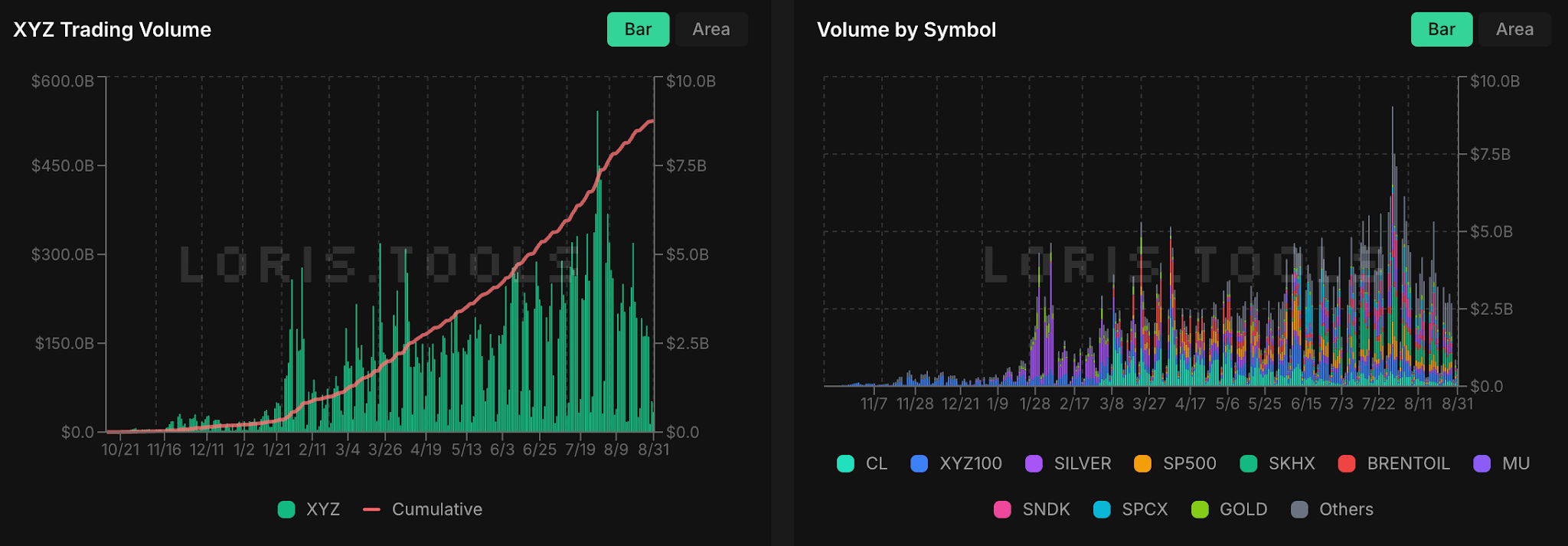
Source: :https://loris.tools/hip3/xyz
In terms of contract structure, the largest volume is no longer solely the former major commodities, but is now jointly driven by AI/Compute, indices, pre-IPO assets, commodities, and stocks. Loris Tools shows that the leading markets by trading volume over the past 30 days consist primarily of real-world assets or related thematic contracts; currently, the most financed targets within the HIP-3 framework have shifted from commodities to tokenized stocks, further evolving into a dominant mix of AI/Compute, indices, and commodities.
In terms of revenue structure, the revenue for Trade.xyz is still primarily dictated by the fee distribution prescribed by the HIP-3 protocol layer, where the fees for non-validator operated perpetual contracts are double the standard rate, resulting in a 50/50 revenue split between Trade.xyz and Hyperliquid. Currently, Trade.xyz remains in Growth Mode, with fees significantly reduced to incentivize market adoption. DeFiLlama data shows that the recent fees for TradeXYZ are approximately $8.44 million, with protocol revenue amounting to about $2.95 million, annualized fees of approximately $68.89 million, and annualized protocol income around $27.17 million.
Current Situation
Trade.xyz’s advantages in the HIP-3 system manifest in three levels. First, the liquidity flywheel driven by scale advantages: larger open contracts attract more market makers, and deeper market making further attracts traders. Loris Tools data shows that Trade.xyz has approximately $83.13 billion in transaction volume over the last 30 days, covering 103 listed markets, with around 103,900 independent traders and about $3.43 billion in open contracts, indicating that a remarkable trading and liquidity concentration has formed within HIP-3. Second, the cost dilution from oracles and data sources: real-world asset contracts necessitate continual access to external price data, and the costs of procuring, verifying, and risk-controlling data for single targets can be spread across greater transaction volumes. Third, the speed of product integration and market selection ability: Trade.xyz has expanded from early stocks, commodities, and foreign exchange into indices, pre-IPO assets, and AI/computing thematic markets, enabling it to adapt quickly to changes in market hotspots. These changes indicate its market is transitioning from being utilized solely by crypto-native traders to extending broader institutional trading infrastructures.
Risks and Hidden Dangers
Trade.xyz faces risks primarily from three levels.
The first is single-point concentration risk. Currently, Trade.xyz still bears a significant share of total transactions and open contracts in the HIP-3 network, meaning the overall health of HIP-3 is tightly bound to the stability of a single development team. Any error at the team, technical, or market parameter levels could amplify into systemic fluctuations within the entire HIP-3 sector. As more HIP-3 development teams enter, Trade.xyz maintains liquidity advantages in the short term, but will face competition from alternative targets, fee competition, and market maker distribution in the long term.
The second is oracle and external market data risks. The assets on Trade.xyz, such as stocks, indices, commodities, and foreign exchange, derive their price benchmarks from traditional financial markets or third-party data sources. This risk is no longer just a theoretical assumption; Galaxy Research reported that on July 28, 2026, an anomalous but genuine low-priced transaction occurred in the pre-market of SK Hynix on South Korea's NextTrade platform, which was transmitted to TradeXYZ-related markets and triggered around $60 million in leveraged long positions to be liquidated, with TradeXYZ subsequently compensating related liquidation losses. This incident underlines that the risks of real-world asset perpetual contracts do not only stem from on-chain systems but also from traditional market pre-market liquidity, price fluctuations, data source selections, and marking price mechanisms.
The third is the uncertainty in regulatory classification. Although tokenized stocks, pre-IPO assets, and synthetic index perpetual contracts are traded in the form of perpetual contracts, the underlying reference assets involve stocks, ETFs, indices, and valuations of unlisted companies, which may still touch on securities regulation, derivatives regulation, and cross-border market entry requirements. Discussions on U.S. regulation have shifted from principle-based expressions to concrete phases of product classification, disclosures, market supervision, and access pathways. The Hyperliquid Policy Center has begun communication with the SEC regarding on-chain perpetual contract issues, and the White House and CFTC have also started discussions on Hyperliquid's U.S. compliance access pathway. Policy signals are shifting towards rule building; if regulators ultimately categorize some stocks, pre-IPO, or index-related contracts as unregistered securities derivatives, Trade.xyz may face upscaling pressures, access restrictions, adjustments in trading parameters, or migration to stricter compliance frameworks.
Future Directions
Based on the public pacing, it appears that Trade.xyz may pursue three directions moving forward.
The first is to further expand real-world asset targets that suit 24/7 perpetual contract trading. Early markets focused predominantly on stocks, commodities, and foreign exchanges, but the latest data shows that AI/Compute, indices, pre-IPO assets, and commodities are collectively forming Trade.xyz’s core trading routes. Meanwhile, crude oil, silver, Brent crude, and NASDAQ 100 proxy contracts have remained among the highest traded since the beginning of the year. This indicates that Trade.xyz's subsequent expansion focus may center not just on increasing the volume of traditional asset offerings, but rather on continuously stocking targets with event catalysts, significant price fluctuations, and traditional trading time constraints.
The second is to support the oracle, risk control, and compliance frameworks. The SK Hynix incident has demonstrated that the core difficulty in real-world asset perpetual contracts is not simply transitioning the prices of stocks or commodities onto the chain, but rather how to manage pre-market and post-market trading, atypical transactions, periods of low liquidity, price fluctuations and stopping trends, as well as inconsistencies in cross-market data. Should Trade.xyz look to continue expanding stock, pre-IPO, and index-related products, improvements must be made in aspects like price redundancy, abnormal price filtering, risk control parameters, circuit breaker mechanisms, and clearing protections. Moreover, regulatory sensitivities of tokenized stocks and pre-IPO related products are greater than those for commodities and foreign exchanges, requiring Trade.xyz to proactively allow for adjustment space regarding access for users from different regions, product classification, and compliance disclosures.
3.3.2 Felix Protocol: Collateralized Stablecoin and On-chain U.S. Stock Composite Platform
Business Overview
Felix Protocol is one of the larger collateralized stablecoin and comprehensive DeFi protocols on HyperEVM. It adopts a collateral debt position similar to Liquity V2, allowing users to collateralize HYPE, cross-chain bridged BTC, ETH, and liquid staking certificates to mint a stablecoin pegged to the U.S. dollar, feUSD. In 2026, Felix expanded its product line by introducing on-chain U.S. stocks through cooperation with Ondo Finance, transitioning from a single collateral debt protocol into a trifecta of lending, real assets, and perpetual contract integration.
Product Matrix
Felix's product matrix is divided into four layers; the first layer consists of collateral debt positions, where users deposit HYPE, PURR, and cross-chain bridged BTC and ETH, opening positions to mint feUSD based on collateral ratios. The feUSD faces multiple deep liquidity pools on HyperEVM, with main trading pairs focused on USDC, USDT, and HYPE. The second layer offers floating-rate lending pools with independent isolated pools for long-tail assets. The third layer features the on-chain U.S. stock segment, providing 250+ tokenized U.S. stock trading interfaces through cooperation with Ondo Global Markets (where Ondo holds the underlying stocks) to users, with a maximum transactional scale reaching $1 million and net execution costs below 10 basis points. The fourth layer connects with HyperCore, allowing feUSD holders to open perpetual contract positions directly within the protocol to hedge exposure to their collateral assets.
Token Situation
Currently, the issued token by Felix is the stablecoin feUSD minted via the collateral debt mechanism, essentially serving as a dollar-pegged debt certificate rather than a governance token. The governance token for Felix's protocol has not been issued yet; the team has mentioned in public planning that they might issue a protocol token in the future, structurally tying it to feUSD's stability mechanism and governance processes.
Data and Revenue
As of now, DeFiLlama suggests that Felix's total lockup amount is about $116 million, marking a roughly 15.1% increase over the past 30 days. During the same period, Hyperliquid L1's total DeFi lockup stands at approximately $1.482 billion, indicating that Felix's share in Hyperliquid L1's DeFi TVL is around 7.8%. As for feUSD, CoinGecko data shows that its current circulation is approximately 75 million, with a market cap about $74.84 million. In terms of on-chain U.S. stock segments, Felix officially disclosed that its current real-time U.S. stock trading volume has surpassed $50 million, with the number of tradable assets expanding to over 440.
In terms of revenue, Felix's cash flow primarily arises from collateral debt borrowing rates, lending pool spreads, asset yield, and various trading-related fees. DeFiLlama currently lists Felix as a meta protocol that encompasses products like Felix Vaults, Felix CDP, Felix USDhl, and Felix Perps; based on that scope, their recent fees are approximately $388,100, with protocol income around $32,800, and annualized fees estimated at about $9.54 million, with annual protocol income reaching about $948,000. Under this accounting approach, Felix's revenue markedly falls below projected monthly income figures based on anticipated growth in U.S. stock trading and lending, thus necessitating attention to three key indicators moving forward: the speed of recommencement of feUSD expansion, whether the cumulative volume for on-chain U.S. stocks can continue to amplify, and if including stocks and ETFs within collateral can stimulate demand for loans and push up protocol revenue.
Current Status and Potential Issues
Felix’s product integration stands out within the HyperEVM application layer, as it is one of the few protocols to have integrated collateral debt, real assets, and perpetual contracts into a single margin account. This level of integration itself serves as a differentiator compared to traditional protocols on Ethereum. However, there are three layers of potential issues to be mindful of. First, as the stablecoin minted from collateral debts, feUSD may be classified into a new regulatory category following the official implementation of U.S. stablecoin legislation, as its issuance structure doesn’t comply with the "1:1 cash or U.S. Treasury reserve" requirement. Second, compliance risks on the on-chain U.S. stocks segment are analogous to those faced by Trade.xyz. Third, the next stage of protocol growth will rely more deeply on the connection with HyperCore, and the depth of integration between Felix and HyperCore will determine its capacity to maintain a leading position in the structured product sector.
3.3.3 HyperLend: The Core Lending Protocol on HyperEVM
Business Overview
HyperLend is one of the core lending protocols on HyperEVM, with a codebase derived from Aave V3, and was recognized as an Aave friendly fork through the Aave governance process in February 2025. Under relevant governance terms, HyperLend must share 10% of the income generated from the portion of the Aave codebase with Aave DAO and allocate 3.5% of HPL tokens to Aave DAO during TGE, along with giving out 1% of HPL tokens to staked AAVE holders. In terms of authorization conditions, HyperLend has to return 10% of protocol income to Aave DAO, and allocate 3.5% of future token issuance to the Aave treasury; the signal of this authorization itself stands as a recognition of HyperEVM’s long-term value.
Product Matrix
HyperLend's product forms mainly align with the Aave V3 lending market and further extend to modules like Core Pools, Isolated Pools, P2P Loans, and Flash Loans. Core Pools employ Aave V3.0.2 codebase supporting multiple assets being deposited and borrowed; Isolated Pools are based on the Fraxlend V3 architecture, which only includes one collateral asset and one lending asset per market, isolating the risks of long-tail or highly volatile assets; P2P Loans cater to customized lending demands, allowing users to set collateral assets, borrowing assets, term, repayment amounts, and liquidation conditions; Flash Loans serve advanced scenarios such as arbitrage, liquidation, and collateral switching.
Compared to general lending protocols on the Ethereum mainnet, HyperLend's differentiation primarily stems from the native asset framework of HyperEVM. On one hand, it incorporates liquid staking certificates like kHYPE into the lending market, enhancing the capital turnover efficiency of staked HYPE assets, but it should not be simply stated as viable as collateral in all scenarios; on the other hand, it provides liquidity for lending and isolated pools centered around stablecoins such as feUSD, aiding stablecoin assets in forming secondary lending markets. Overall, HyperLend's core value is not to replicate Aave but to embed an Aave-style lending framework within Hyperliquid’s native assets, stablecoins, and yield certificate system.
Token Situation
HyperLend has issued the native token HPL, with a circulating market cap of about $2 million and a circulating supply of roughly 160 million tokens, with a max supply of 1 billion tokens. According to previously disclosed token economic models, HPL total supply allocations include 30.14% for ecological growth and incentives, 25% for Genesis Distribution, 22.5% for core contributors, 17.36% for strategic investors, and 5% for liquidity. Furthermore, HyperLend is bound to Aave friendly fork terms, allocating 3.5% of HPL tokens to Aave DAO during TGE and 1% to staked AAVE holders.
Data and Revenue
As of now, DeFiLlama data shows that HyperLend's total locked amount is about $542 million, a roughly 30.2% increase over the past 30 days; active loans are approximately $292 million, making it one of the largest lending protocols on HyperEVM. In terms of revenue, HyperLend income primarily derives from protocol shares of loan interest with flash loan fees and liquidation fees serving as additional supplements. DeFiLlama data indicates that HyperLend’s fees over the recent 30 days are approximately $886,300, with protocol income around $108,600; based on current metrics, annualized fees are about $10.03 million, with annualized protocol income of approximately $1.54 million. Compared to TVL scale, protocol revenue is still in its early stage of release, with key variables dependent on whether asset utilization rates can be improved, whether lending rates can be maintained, and whether HPL incentives can stimulate real borrowing demand.
Current Situation and Potential Issues
As a permissioned protocol officially authorized by Aave on HyperEVM, HyperLend has a first-mover advantage in safety, risk parameters, and external trust. It directly leverages the liquidation mechanisms and risk models iterated over years by the Aave team. However, while the Aave template reduces developmental risks, it also constrains product differentiation space: HyperLend's differentiation from other HyperEVM lending protocols mainly arises from the scope of collateral assets and isolated pool designs rather than from its foundational lending mechanisms. Should a natively designed perpetual contract collateralized lending protocol based on the HyperCore writing channel emerge in the future, HyperLend’s moat may face challenges.
The current critical observation should not solely focus on HyperLend's ability to absorb more TVL, but rather on whether borrowing demand can keep pace with the expanding asset supply. The current protocol TVL exceeds $500 million, but the reported income for the last 30 days is around $108,600, indicating that its commercialization efficiency still depends on core asset utilization rates, the effectiveness of HPL incentives, and the capability of isolated pool risk management. Should borrowing demand fail to sustainably increase in the future, HyperLend might face the dilemma of leading asset scales with insufficient protocol income elasticity.
3.3.4 Kinetiq: The Leading Liquid Staking Protocol
Business Overview
Kinetiq is the first liquid staking certificate protocol on HyperEVM, launched on the mainnet in July 2025. The core idea of liquid staking certificates is simple: users deposit HYPE entrusted to Kinetiq, which allocates these HYPE to Hyperliquid's validation nodes to participate in consensus and earn staking yields; simultaneously, users receive an on-chain certificate called kHYPE, which they can sell in the secondary market at any time without waiting for unstaking time windows. kHYPE automatically accumulates staking yields while also serving as collateral assets in protocols like Felix and HyperLend, enabling users to earn staking interest and continue circulation within DeFi.
The product form of Kinetiq aligns with Ethereum’s Lido, also being a liquid staking certificate protocol while occupying the largest share of the staking sector in its respective public blockchain. The difference lies in that Hyperliquid's validation node pool is much smaller than Ethereum's, and Kinetiq has implemented more refined designs in node selection and rotation mechanisms, embedding loss-sharing rules within the protocol layer to address node punishment incidents.
Product Matrix
Kinetiq's product matrix revolves around kHYPE along with three supporting products. kHYPE is a liquid staking certificate automatically granted to users upon depositing HYPE, with a basic annualized yield of approximately 2.37%. Above kHYPE, Kinetiq operates an Earn vault, further deploying kHYPE into DeFi yield strategies, yielding a combined annualized return of approximately 5.37%. Additionally, Kinetiq issues two related tokens, iHYPE and KNTQ; iHYPE offers opposite exposure to HYPE's price trend (purchasing iHYPE essentially means shorting HYPE), while KNTQ is Kinetiq’s governance token launched on November 27, 2025.
In early 2026, Kinetiq further launched Markets.xyz, a product from its HIP-3 development team focused on native crypto derivatives, representing a move towards a multi-product platform.
Token Situation
Kinetiq is one of the earlier projects to have completed token issuance within the HyperEVM application layer. KNTQ underwent its TGE on November 27, 2025. However, the unlocking cycle for insiders is relatively long, and the initial circulating volume is limited, theoretically providing token holders with a relatively secure early window.
Data and Revenue
As of now, DeFiLlama data shows that Kinetiq’s total locked amount is about $1.232 billion, a 48.4% increase over the past 30 days. Of this, Kinetiq's kHYPE contributes approximately $1.122 billion, marking a 48.1% rise over the same period, still being the core asset of the protocol; Kinetiq Earn currently has about $57.48 million locked, up 53.5%; Kinetiq Markets recorded $309 million in transactions in the past 30 days, with open contracts about $523 million. Overall, Kinetiq's scale focus remains on kHYPE liquid staking, while its revenue sources have expanded from solely staking yields to Earn vault and Markets trading operations.
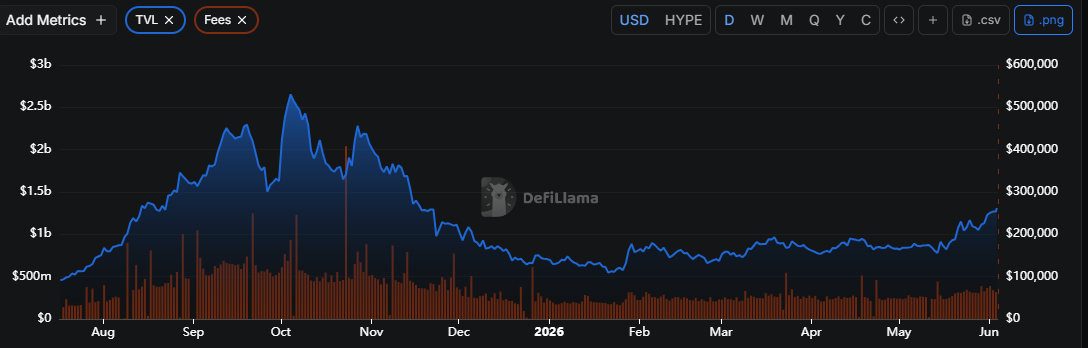
Source: https://defillama.com/protocol/kinetiq
In terms of revenue, DeFiLlama data indicates that Kinetiq's fees for the last 30 days are approximately $1.83 million, with protocol income around $230,900; based on current figures, annualized fees are roughly $31.99 million, with annualized protocol income near $4.76 million, and over the last 30 days, holders earned approximately $114,500. Split by product, kHYPE had fees of around $1.63 million, with protocol income about $163,100; Earn had fees around $100,700, with a protocol income of about $20,100; Markets contributed fees close to $93,900 and protocol income around $47,200. Thus, Kinetiq's revenue structure has shifted from staking yield share + Earn performance to include kHYPE staking yield share + Earn treasury performance + Markets trading-related fees, although its revenue scale still falls below leading lending and stablecoin protocols, its cash flow sources are more diversified.
Current Status and Potential Issues
Kinetiq's dominant position on HyperEVM is directly constrained by two factors. First is the scale of Hyperliquid's validation node pool, which is smaller compared to Ethereum's thousands of validation nodes; the penalty mechanism (i.e., penalties imposed on nodes that err) and adjustments in node commissions could directly affect kHYPE’s asset net value. Second is competitive threats; Hyperbeat's launch of beHYPE (a liquid staking certificate in collaboration with Ether.fi) has begun to siphon Kinetiq's market share, posing a long-term challenge to Kinetiq's dominant position in the liquidity staking sector.
3.3.5 PURR: The First HIP-1 Native Token on Hyperliquid L1
Business Overview
PURR is the first HIP-1 native spot token launched on Hyperliquid L1 in April 2024. HIP-1 is the protocol standard for issuing native tokens on Hyperliquid, while HIP-2 is designed to provide permanent on-chain liquidity for new tokens. The issuance of PURR simultaneously validated the underlying mechanisms for HIP-1 native token issuance and HIP-2 liquidity deployment, serving as a genesis sample of Hyperliquid's spot asset issuance system. PURR is positioned as a non-sales, non-functional preset cat-themed token, though its issuance timing, distribution method, and protocol experimental properties define its identity.
Role in the Ecosystem
PURR has three real roles within the HyperEVM ecosystem. One is the live validation of protocol mechanisms; subsequent projects issuing native tokens on Hyperliquid will build on the issuance and liquidity mechanisms validated by HIP-1 and HIP-2, making PURR's stable operation an early proof of this mechanism's viability. Second is the sentiment and beta asset within the ecosystem; historically, PURR holders have received airdrops of other Hyperliquid spot ecosystem tokens, thus the market views it as an indirect target for participating in the growth of Hyperliquid's spot and meme ecosystems. Third is that PURR serves as a pilot asset for the assistance fund mechanism, with Hyperliquid previously announcing that PURR was included in the Assistance Fund as a pilot asset, initially holding 3 million PURR, about 0.5% of the total supply at the time. This indicates PURR has progressed from a simple genesis meme asset into the observational realm of Hyperliquid's ecological capital mechanisms.
Token Mechanism and Data
PURR has a maximum supply of 1 billion tokens, with 500 million distributed via airdrop according to early Hyperliquid reward holders' ratios; another 400 million were initially designated for HIP-2’s permanent liquidity deployment and later burned. PURR is a deflationary asset; all transaction fees paid with PURR will be burned. As of now, CoinGecko shows that PURR has a market cap of approximately $70.46 million, but trading volume is still primarily concentrated in Hyperliquid's PURR/USDC spot market.
Current Status and Potential Problems
PURR's core value still stems from three components: its status as a HIP-1 genesis sample, its Beta attributes within the Hyperliquid ecosystem, and the deflationary mechanism driven by trading fee burns. Future assessments of PURR's value should focus on three indicators: one, the number of Hyperliquid spot assets issued and the activity level of the meme ecosystem; two, the trading volume of PURR and the ongoing scale of burns driven by transaction fees; three, whether the Assistance Fund or subsequent governance mechanisms continue to expand support for PURR and other ecological assets.
3.3.6 Other Noteworthy Projects
Aside from the aforementioned core projects, several smaller-scale but representative projects exist on HyperEVM, which will be briefly presented in this section.
Hyperbeat: An Integrated Financial Entry Built Around Hyperliquid
Hyperbeat is a yield and integrated financial entry built around Hyperliquid. The team completed a $5.2 million seed round of financing in August 2025, co-led by ether.fi Ventures and Electric Capital, with participation from Coinbase Ventures and Chapter One, among others. Its product offerings have expanded from an initial yield treasury and lending module to encompass Liquid Banking functionalities, covering yield, staking, lending, payments, trading, and asset management. DeFiLlama currently classifies Hyperbeat as a meta protocol, which includes modules like Hyperbeat Earn, Hyperbeat LST, Hyperbeat USD, etc. As of now, Hyperbeat's total locked amount is about $42.73 million, with fees over the past 30 days approximately $148,200 and protocol income reaching around $36,700, while the trading volume of perpetual contracts in the last 30 days is about $50.35 million. Hyperbeat is better suited to be positioned as a complete product line, although its scale still requires further validation.
Project X: One of the Fastest Growing Spot DEXs on HyperEVM
Project X is one of the faster-growing spot DEXs on HyperEVM, positioned as a low-friction token exchange and liquidity provision platform. DeFiLlama data shows that as of now, Project X has a total locked amount of about $45.56 million, with trading volume over the past 30 days at approximately $2.498 billion, grasping fees of about $2.08 million and protocol income near $297,000. Its long-term value hinges on two factors: the ability to continuously attract trading flow from long-tail assets after their issuance, and whether liquidity can persist within the protocol post the termination of rewards and incentives.
HyperSwap: The Early Mainstream AMM DEX on HyperEVM
HyperSwap is among the earlier launched automated market maker DEXs on HyperEVM, responsible for long-tail token spot trading and liquidity management. DeFiLlama data illustrates that as of now, HyperSwap has a total locked amount of roughly $19.41 million, with about $253 million in trading volume over the past 30 days, and fees amounting to approximately $678,800, with protocol income around $75,400; the current price of SWAP is about $0.036, with a circulating market cap around $2.54 million and FDV at about $3.37 million. HyperSwap has issued a governance token SWAP, intending to utilize part of protocol income for repurchases and burns, with 75% of protocol income for the V3 pool allocated for repurchasing and burning SWAP. Its long-term value still depends on the quantity of long-tail token issuance, spot trading activity, and whether it can maintain its liquidity share amidst competition from new DEXs like Project X.
Theo Network: Institutional-grade RWA and Strategy Vault Platform
Theo Network was founded by quantitative traders with backgrounds from Optiver and IMC Trading, completing a $20 million funding round in April 2025, co-led by Hack VC and Anthos Capital, with support from Manifold Trading and Mirana Ventures, as well as personal angel investors from traditional trading institutions like Citadel, Jane Street, HRT, Optiver, IMC, 5 Rings, and JPMorgan. From a product perspective, Theo is not merely a basis arbitrage vault; it is more accurately defined as a full-stack RWA and trading infrastructure that bridges on-chain capital with global financial markets. As per current DeFiLlama statistics, its total locked amount is around $27.52 million, though the relevant scale remains relatively small with approximately 95.9% of it related to Solana.
alt.fun: Token Issuance Experiment Driven by Perpetual Contract Prices
alt.fun is a relatively experimental token issuance project on HyperEVM, its core mechanism is not an ordinary bonding curve issuance, but rather combines new token issuances with Hyperliquid perpetual contracts and BounceTech's leverage token mechanism. When creating tokens, users can choose the underlying assets, direction of long or short, and leverage levels of 2x, 3x, or 5x; when buying tokens, USDC will be converted to the corresponding leveraged position in Hyperliquid perpetual contracts, then encapsulated into an ERC-20 token form for users' wallets. It’s worth adding that Pump.fun has supported trading of HyperEVM tokens since August 2026, allowing users to trade HyperEVM assets via USDC, indicating that competition for meme and long-tail token trading entries for HyperEVM is intensifying, and whether alt.fun can retain users depends on the ongoing market acceptance of its token mechanisms wrapping leveraged exposures.
4. What Will Define HyperEVM Next
4.1 Possible New Protocol Directions
This section discusses two possible new protocol directions in order of likelihood, explaining each in a manner that ordinary investors can understand what it is, why it was previously unfeasible, and why it might succeed now.
First Type: Unified Fund Management Protocol Across Protocols
Currently, a typical pain point for users on HyperEVM is the fragmentation among protocols. A typical cycle looks something like this: collateralizing HYPE on Felix to borrow feUSD (Operation One), staking through Kinetiq to obtain kHYPE (Operation Two), opening perpetual contracts for hedging on HyperCore (Operation Three). Each step requires separate signing, separate fee payments, and separate liquidation risks. A type of cross-protocol fund management protocol could leverage HyperCore's writing channel to compress those three actions into a single blockchain transaction, automatically completing collateralizing, staking, and hedging from the user’s wallet while uniformly calculating margins at the protocol layer.
In the traditional financial framework, similar services are provided by comprehensive financial institutions. Clients open accounts with a broker, where the broker manages their cash, securities, margins, and hedging positions collectively while offering unified reports and risk exposures across products. HyperEVM currently lacks such an on-chain manifestation.
Second Type: On-chain Native Bulk Trading Tools
HyperCore's current matching system is a continuous order book, excelling at high-frequency small trades. However, for larger transactions, such as an institutional investor buying tens of millions of dollars worth of contract positions in one shot, the order book gets impacted, leading to noticeable slippage. In traditional finance, products carved out for such scenarios follow the inquiry trading model. Market makers quote a price for a large order, completing transactions outside the order book. HyperEVM could realize this form by taking the liquidity depth from HyperCore's order book as a pricing reference but facilitating actual asset delivery outside the order book. This preserves the authenticity of the pricing while avoiding large orders impacting the order book. Such protocols represent critical infrastructure for large-scale institutional funds entering HyperEVM.
4.2 Existing Major Categories That Haven’t Yet Yielded Leading Projects
Section 4.1 discusses new protocol forms, while this section dives into already existing major categories in DeFi that haven’t yet produced leading protocols, with distinctions in product types and opportunities.
Decentralized Oracles
The development teams for HIP-3 and HIP-4 currently heavily rely on centralized data sources (e.g., Polygon.io, Twelve Data, etc.). As the scale of contracts for HIP-3 and HIP-4 expands and regulatory transparency on oracles increases, a decentralized oracle network built natively for derivative markets on HyperEVM will become a necessity. Possible representative projects in this direction could be versions of RedStone or Chainlink adapted for HyperEVM or could be new protocols native to HyperEVM.
Integrated Service Protocols for Institutional Clients
Ripple Prime has already integrated with Hyperliquid in February 2026, yet a complete, integrated on-chain service protocol encompassing multi-account management, risk control, reporting, and reconciliation is still lacking. Institutional investors entering Hyperliquid require access platforms covering full-service trading, cross-product collateral management, unified reporting for compliance, and reconciling. Should a protocol be created on HyperEVM to fully implement these services on-chain, it would become key foundational infrastructure for substantial institutional fund entry.
4.3 Core Differentiation of the HyperEVM Application Layer
After describing the potential directions for the HyperEVM application layer, a more fundamental question needs to be addressed: What is the essential difference between HyperEVM and other smart contract public chains like Ethereum and Solana? The answer lies in the following two layers:
The first layer is the difference in product depth. Ethereum and Solana are general public chains; their design goals are to support any type of applications—games, social, art, finance, privacy services, etc.—can run on them. This generality comes at the cost of not providing dedicated infrastructure for financial applications, which are acutely sensitive to performance and liquidity. Any protocol aiming to conduct derivative trading has to build matching systems, margin management, and clearing engines from scratch—these engineering barriers have consumed hundreds of millions in capital on Ethereum, yet it has not yielded a truly competitive on-chain derivatives protocol against centralized exchanges. HyperEVM is a financial-specific public chain; the core trading engine, HyperCore, has already set up order books, matching, margins, and clearances, allowing application protocols on HyperEVM to directly utilize HyperCore's capabilities, focusing their engineering energy on the product’s differentiation.
The second layer is the difference in ecological form. Ethereum's ecological form is an open ecosystem where applications can freely combine and compete without any application having a special status on the main net. HyperEVM's ecological form resembles a hub structure centered around the core trading engine for liquidity, with all application layer protocols revolving around HyperCore. Although they are diverse, their bargaining power in Hyperliquid is evidently lower than that of applications on Ethereum against its main net. Protocols on HyperEVM are more like functional module tokens within the Hyperliquid system rather than truly independent protocol tokens.
Combining these two layers of difference allows us to perceive HyperEVM not merely as another Ethereum-compatible public chain but as a specialized on-chain trading platform tailored for financial scenarios. In the areas of perpetual contracts, real assets, and event contracts—all of which are highly sensitive to order book depth—the convergent structure of HyperEVM offers structural advantages. In contrast, for long-tail tokens, purely on-chain native assets, and privacy applications—where order book depth is not as critical—Ethereum and Solana will maintain their positions, with the relationship between HyperEVM and other public chains being more differentiated rather than substitutive.
This judgment carries significance for investors: when evaluating projects within the HyperEVM application layer, the correct framing should not focus on the innovations made within the EVM but rather on how these protocols can leverage HyperCore's liquidity to create products that are unattainable on other public chains. Projects providing compelling answers to this question will hold long-term value within the HyperEVM application layer.
5. The Boundaries of Uncertainty for HyperEVM Are Risk and Regulation
This chapter discusses both risk and regulatory dimensions separately, as the triggering mechanisms and resolution paths for each differ entirely. Risks stem from structural characteristics within the ecosystem requiring protocol or market behavior to resolve, while regulatory aspects stem from external policy environments necessitating compliance and legal frameworks to respond.
5.1 Risk Dimensions
Single-Point Concentration Risk: The True "Gray Rhino" of the HyperEVM Application Layer
This report believes that the current most real endogenous risk present in the HyperEVM application layer is the concentration we see on Trade.xyz within the HIP-3 framework. Trade.xyz alone bears the majority of open contracts, meaning the overall health of HIP-3 is almost entirely bound to the stability of a single development team. Should any issues arise, their impact would propagate across the entire HIP-3 sector within hours, potentially affecting HYPE token prices due to adjustments in Hyperliquid's protocol income. The root of the concentration risk lies in the encouragement of large-scale operations within the HIP-3 protocol layer, but the market layer lacks any checks and balances; there are no protocols or market mechanisms capable of preventing a single development team's market share from exceeding a critical threshold. The resolution path does not lie within the protocol layer but rather in the market layer; whether it is possible to see a second pivotal development team emerge in the commodities or foreign exchange sub-sectors will be crucial.
Oracle Manipulation Risk: The Fragility of Low Liquidity Assets
Development teams for HIP-3 and HIP-4 have the flexibility to select oracles, which introduces manipulation risks associated with oracles. The risk originates from two dimensions. First, the manipulation costs for small-cap real assets (like valuations of certain pre-listed companies, emerging market currency contracts
免责声明:本文章仅代表作者个人观点,不代表本平台的立场和观点。本文章仅供信息分享,不构成对任何人的任何投资建议。用户与作者之间的任何争议,与本平台无关。如网页中刊载的文章或图片涉及侵权,请提供相关的权利证明和身份证明发送邮件到support@aicoin.com,本平台相关工作人员将会进行核查。