There is a kind of regret in the market that is more painful than getting the direction wrong.
You understood a company, a technology, or an ongoing industry change very early, yet did not participate at the entry point. By the time it is finally publicly listed, and you can buy in, the price has already incorporated several rounds of financing, growth expectations, and early investors' returns.
Of course, not all listed companies have completed their growth curve, and not all early investments make money. But this does not prevent us from asking a question: If two people are equally optimistic about an asset, why can some participate in its growth while others can only trade the outcome after the growth is fully priced in?

Jeff Yan, co-founder of Hyperliquid, recently discussed this issue.
According to Token2049 news, Jeff believes that certain assets are only open to a select few during periods of significant growth; by the time the public can participate, the early value growth has already been captured by those with access advantages. He views this wealth creation model as unsustainable.
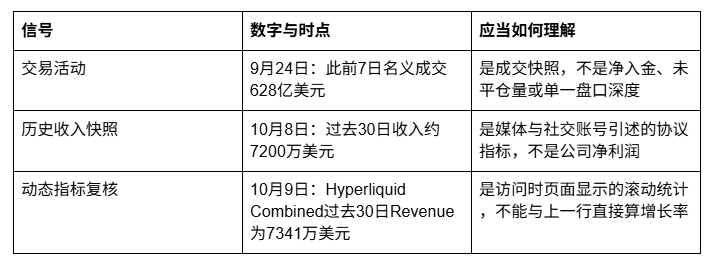
Put this together with another piece of trading data, and Hyperliquid's positioning becomes clearer:
What it aims to solve is not just making trading faster, but allowing more people to enter a market where there are real quotes and someone is willing to take on risk when needed.
The first half is vision; the second half is the test.
1. What retail investors often lack is not research capability but participation eligibility
When discussing trading fairness, people usually think of information disparity, speed difference, and capital volume disparity.
But before these gaps, there is an even earlier barrier: Can you participate?
Assets at the private placement stage, account conditions for cross-border trading, and trading hours in different markets can keep a judgment at "I see the potential," but unable to turn it into "I can express this judgment."
Hyperliquid chooses to tackle this barrier from the angle of trading tools and infrastructure. Through HIP-3, eligible third parties can deploy perpetual markets, defining underlying assets, oracles, and leverage parameters, using HyperCore's order book and margin system, without having to rebuild the entire trading infrastructure from scratch.
For traders, this means: around the deployed assets that meet local access requirements, there can be more channels to express long and short positions, adjust exposures, and manage risks.
However, a clear boundary must be established here.
Being able to trade a company's price exposure does not equate to obtaining early equity in that company; perpetual stocks also do not grant holders the dividend rights or voting rights of original shares simply because they have the company code in the name.
Hyperliquid opens a part of the risk trading entry; it does not flatten all private equity, all securities accounts in all regions, and all compliance requirements at once.
Getting involved in pricing earlier and enjoying early shareholder rights are two different things.
2. Why are perpetual contracts suited to be this entry point?
Not because more leverage is better but because it reduces some unnecessary trading choices.
Traditional futures have different expiration months, and options have various strike prices and time frames. A judgment in the same direction could be scattered across many contracts. Traders not only need to judge the price rise or fall but also decide on the time frame, manage rollovers, and find the contract with real liquidity.
Hyperliquid's official documentation summarizes the advantages of perpetual contracts: There is no fixed expiration date, no need to rollover positions, thus reducing liquidity fragmentation caused by different expirations and strike prices.
This makes it easier to match "I want to express a direction" with a continuously trading market.
However, no expiration date does not equal no position cost and does not mean liquidity will never fragment.
Perpetual contracts still have funding rates. Hyperliquid's funding fees are settled hourly, exchanged between long and short sides, not revenue collected by the platform from this payment. Different deployed markets under HIP-3 also have their own order books and margin arrangements; using the same underlying infrastructure does not automatically merge into an infinitely deep market.
Thus, the simplicity reduced is a part of the product usage complexity, not the risks of trading itself.
3. $62.8 billion in transaction volume: An open entry must have users willing to use it
Market access carries a second layer of meaning: being able to enter doesn't guarantee smooth transactions.
Even if an asset is open for trading, if the bid-ask spread is large, orders of any significant size result in severe slippage, or if one finds no counterparty when wanting to exit, then "everyone can participate" remains just a slogan.
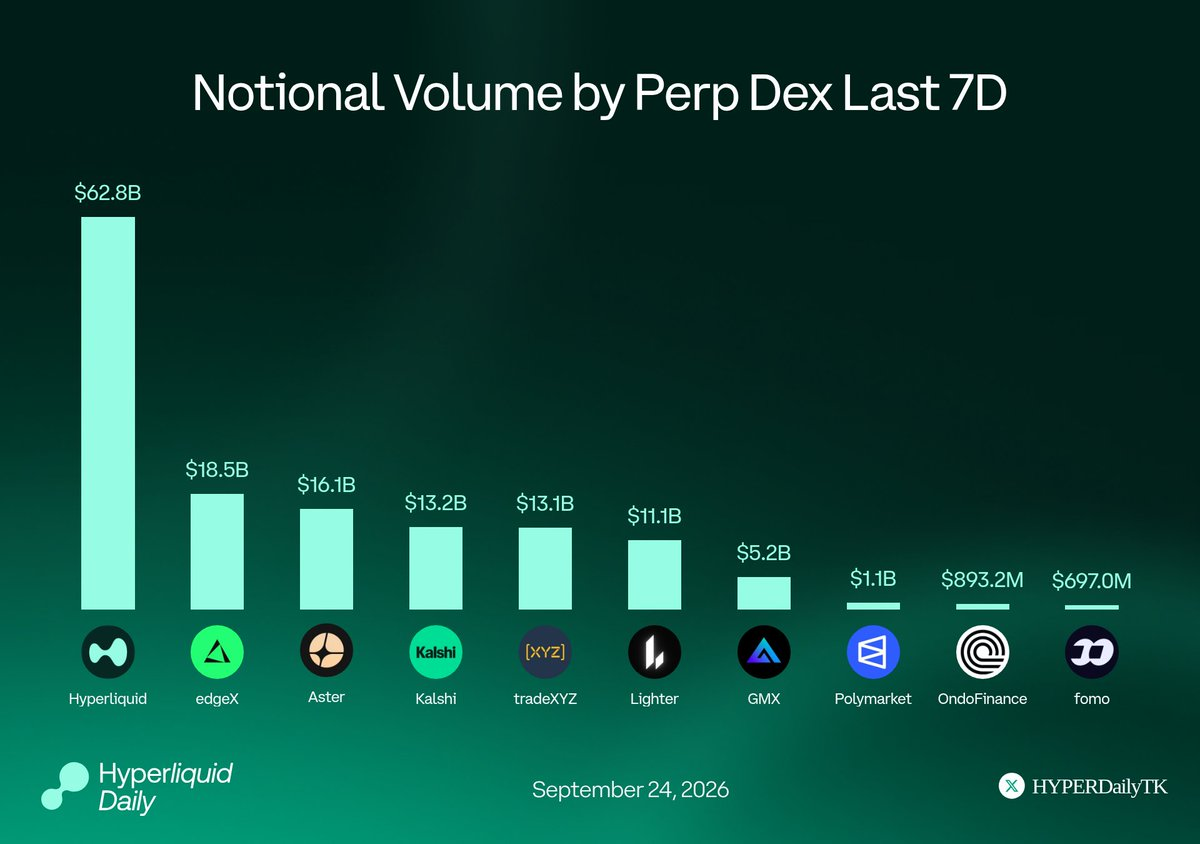
According to market news, in the snapshot released on September 24, Hyperliquid reported a nominal transaction volume of $62.8 billion over the past seven days. This number is worth noting but should not be directly equated with today's real-time transactions nor with $62.8 billion in new capital inflow.
The original images from September 24 mixed perpetual platforms, predictive markets, and other products, while separately listing HIP-3 deployers trade.xyz; this article does not calculate the pure perpetual DEX market share based on these and does not simply add these numbers together.
These figures do not prove that ordinary users find it easier to make money, but at least they shift the discussion from "finance should be more open" to "how are users using this market."
Transaction records provide clues to activity, and fee records provide clues for commercial use. As for why users choose this platform, whether specific markets have sufficient depth, and whether orders can be completed at reasonable costs, we still need to look at the order book, fee rates, active accounts, and performance under extreme market conditions.
True valuable openness does not just allow you to place an order but also give your judgments a chance to receive executable quotes.
4. Just because the exchange makes money doesn't mean retail investors do
This is a layer that is easily overlooked when interpreting two pieces of news.
Jeff Yan emphasizes that Hyperliquid does not prioritize revenue optimization; revenue is a byproduct of providing value to users.
This is his product philosophy, not proof that "users will necessarily benefit."
Increased platform revenue may accompany more effective trades, but it can also accompany more frequent speculation and more leverage turnover. Simply relying on revenue numbers cannot determine how much participants earn, nor can it determine whether retail investors share in growth opportunities that were previously blocked.
Hyperliquid's official fee rules also allocate fees to HLP, the Assistance Fund, and deployers, instead of equating revenue statistics on the platform to the net profits of the R&D team.
Therefore, more explanatory than "how much was made in a month" are several other matters: Whether users can complete trades with smaller spreads, whether position costs are bearable, whether price sources are reliable, and whether they can exit orderly in adverse market conditions.
These questions are harder to answer than ranking but are closer to what Jeff Yan refers to as "creating value for users."
5. After access becomes more open, information also needs to become usable
Even if retail investors and professional traders gain the same trading access, they do not automatically possess the same judgment ability.
On-chain transparency holds value as trade records can be publicly viewed and verified. It provides us the chance to get insights from capital behavior rather than just hear how others explain their positions.
However, seeing an address does not equate to understanding the complete strategy. A large short position might indicate bearish sentiment, or it might be hedging another spot or risk exposure. Following an on-chain order does not necessarily mean following the true net direction of that account.
This is precisely where information and data tools should play a role: Transforming "a certain market can be traded" into "I know what I am trading, why I am trading, and what costs I am taking on."
For instance, after a piece of news about a tech stock appears, rather than first asking how much leverage can be applied, it is better to check whether price changes accompany transaction volume and open interest changes, whether funding rates are crowded, and whether smart money addresses are continuously increasing positions or withdrawing as prices rise.
On the AiCoin mobile app, users can place news, professional candlestick charts, and capital behavior in the same observational process: first observing how information affects the market, and then combining with open interest, funding rates, and significant order movements to check position structure, using smart money tracking to seek further validation, rather than treating the win rate of a certain address as a reason for their own trade.
After forming a judgment, users can then link with Hyperliquid through AiCoin to execute and manage their positions. Staying at the observation stage without a sufficiently clear judgment is completely reasonable.
It is not about promising profits for everyone but reducing "you are not qualified to participate"
Integrating both pieces of news, what truly deserves discussion about Hyperliquid is not "retail investors can finally profit alongside institutions."
Rather, it is a more restrained, yet more important change: Can the market offer participation opportunities that are less dependent on identity, channels, and trading hours, allowing research and judgment to have more possibilities to turn into trading actions?
$62.8 billion in historical weekly transaction volume and rolling protocol revenues in the tens of millions of dollars indicate that this infrastructure already has observable usage traces; they cannot prove that market fairness has been achieved and cannot prove that entering earlier guarantees greater profits.
But at least, we no longer only argue about whose vision is more appealing; instead, we can use data to ask: What has this market opened up, who is using it, what are the trading costs, and who bears the risks?
Hyperliquid opens up trading entry, but traders must still be accountable for their own judgments. The value of AiCoin lies in providing an additional layer of information verification between entry and action.
Exclusive Benefits for AiCoin Users
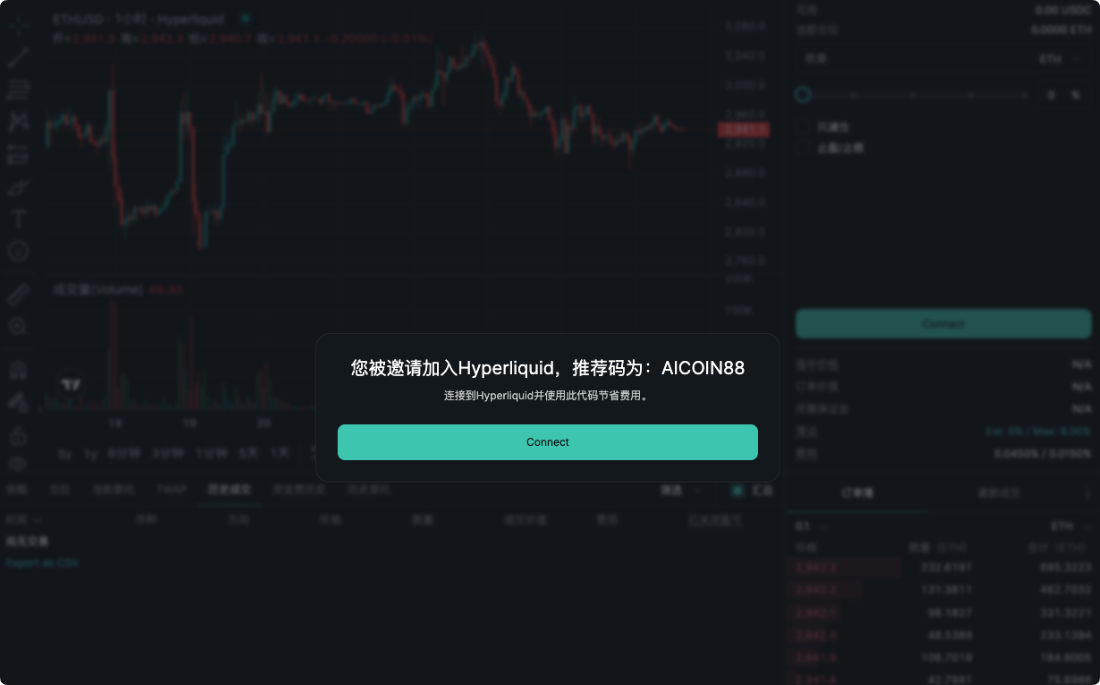
👉 Enter invitation code AICOIN88 when binding your Hyperliquid account for a 4% fee rebate.
🔗 Exclusive registration link:
https://app.hyperliquid.xyz/join/AICOIN88
📖 Beginner's tutorials:
- "AiCoin PC Hyperliquid Authorization Trading Tutorial":
https://www.aicoin.com/zh-Hans/article/514197
- "AiCoin Mobile Hyperliquid Authorization Trading Tutorial":
https://www.aicoin.com/zh-Hans/article/541383
- "Zero Basic! Hyperliquid First Trading Super Detailed Illustrated Tutorial":
https://www.aicoin.com/zh-Hans/article/510225
📖 Community Communication:
- Telegram:
https://t.me/AiCoinWhaleData
- Discord:
https://discord.gg/D7UjAcFrah
- AiCoin Group Chat:
https://www.aicoin.com/link/chat?cid=N6OVMor5g
The content of this article only represents the author's personal views and does not represent the platform's stance. The views, conclusions, and suggestions in the text are for investors' reference only and do not constitute any investment advice related to the platform. Investing in U.S. stocks still requires self-bearing the market risk, regulatory risks, and compliance risks with local legal regulations (especially foreign exchange controls, foreign investment declarations, etc.).
免责声明:本文章仅代表作者个人观点,不代表本平台的立场和观点。本文章仅供信息分享,不构成对任何人的任何投资建议。用户与作者之间的任何争议,与本平台无关。如网页中刊载的文章或图片涉及侵权,请提供相关的权利证明和身份证明发送邮件到support@aicoin.com,本平台相关工作人员将会进行核查。