🚨 Trump Makes 517 Transactions in August! NVIDIA, Microsoft, AMD All Featured, Disclosure on Award Day Sparks Controversy Over Conflict of Interest
Trump's latest investment disclosure once again brings the White House, Wall Street, and tech giants into the same spotlight.
Latest documents submitted by U.S. President Donald Trump show he made 517 securities transactions in August 2026, involving well-known companies such as NVIDIA, Microsoft, AMD, Meta, Netflix, and SpaceX.
What's more notable is that this disclosure was made public on October 8, the same day Trump attended an awards ceremony in Washington, where he presented national science and technology medals to several leaders in the tech industry, including NVIDIA CEO Jensen Huang, AMD CEO Lisa Su, and Microsoft CEO Satya Nadella.
On one hand, there are stock transactions involving tech giants, and on the other, government public commendations of executives from related companies, combined with ongoing U.S. government discussions about export policies that could affect the chip industry; this timing has quickly raised concerns about conflicts of interest, investment transparency, and government ethics norms. (Reuters)
It is essential to emphasize that the existing disclosure does not prove that Trump personally directed the related transactions, nor does it imply that insider trading or illegal activities occurred. However, when a president's investment portfolio intersects with companies affected by government policies, the public naturally becomes more concerned about the transparency involved.
NVIDIA, Microsoft, AMD on the Trading List, Meta's Single Transaction Amount Astonishing
According to the disclosure documents, Trump's transactions in August involved several tech industry giants, and the direction of transactions varied among different companies.
NVIDIA is one of the most prominent companies in this regard.
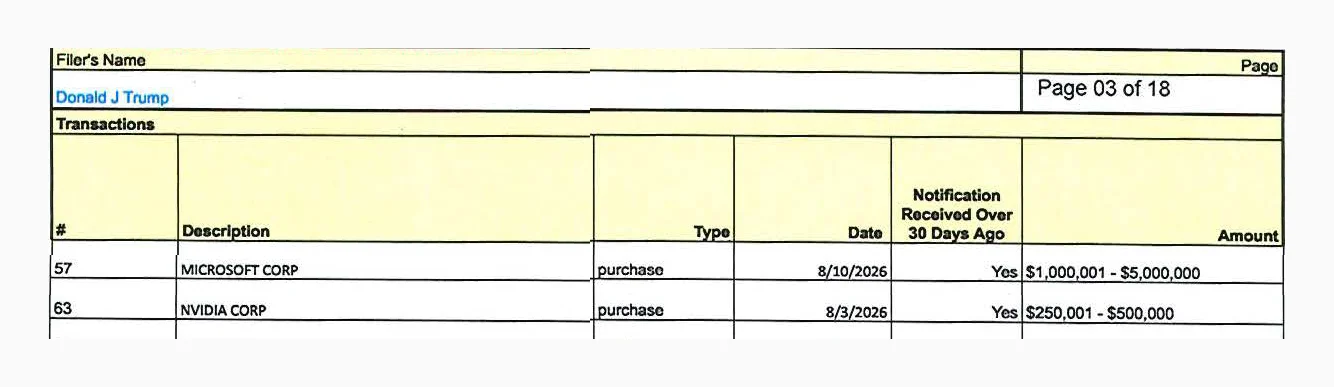
The documents show that Trump's related investment accounts bought NVIDIA stock valued between $250,000 and $500,000 on August 3, and then another purchase of NVIDIA stock valued between $500,000 and $1 million on August 17. At the same time, the accounts also conducted sell transactions of NVIDIA stock with disclosed amounts reaching up to $1 million.
Based on the disclosed trading ranges, the total amount of NVIDIA stock purchased in August was approximately $1.5 million, while some media summarized it as being around $1.6 million. Because the disclosure uses ranges, these figures are not precise transaction amounts.
Regarding Microsoft, a purchase transaction on August 10 amounts to between $1 million and $5 million.
AMD showed different directional operations. The disclosure documents indicate that on August 21, accounts sold AMD stock worth between $1 million and $5 million.
However, the most striking single transaction is not with NVIDIA or Microsoft, but with Meta.
On August 21, Trump's related accounts purchased Meta stock valued between $5 million and $25 million, making it one of the highest single transactions in the August disclosure documents. Meanwhile, Netflix also made a purchase transaction valued between $1 million and $5 million. (Cryptopolitan)
This list also includes Tesla, Alphabet, Dell, and other large companies.
In other words, this is not a concentrated bet solely focused on AI chip stocks, but rather a broad securities trading activity covering technology, communication, consumption, and other industries.
More Sensitive Matters: Government Policies May Directly Affect These Companies
Why has this disclosure attracted so much attention?
The key is not only what Trump bought but also the potential intersection between the president's policy power and the commercial interests of the related companies.
For example, with NVIDIA.
NVIDIA is one of the core companies in the global AI computing power industry, and the sales scope of its advanced chips, export licenses, and access to overseas markets may all be influenced by U.S. government policy.
Restrictions by the U.S. government on advanced semiconductor exports not only relate to NVIDIA's potential revenue but also affect global investments in AI infrastructure, data center construction, and the competitive landscape of related tech companies.
Therefore, when Trump's investment disclosures show that related accounts hold or trade NVIDIA stock, the market naturally questions: Could future government chip policies affect the value of these assets?
This does not mean that the relevant policies will certainly favor NVIDIA, nor does it imply that Trump participated in specific stock trading.
The real issue is whether the public can clearly determine if there is sufficient institutional separation between government decisions and the president's personal assets.
Similar questions also apply to Microsoft, AMD, and other large enterprises with business ties to the U.S. government.
For the market, the policy itself is already crucial; and when policymakers' investment portfolios also involve relevant companies, transparency becomes an additional focal point.
White House Response: Investments Managed by Independent Managers
In response to public concerns, White House spokesperson Davis Engel stated that investment decisions in Trump's portfolio are made by independent third-party managers, and the related accounts track recognized market indices, including the Schwab 1000 Index.
The Trump Organization also indicated that trades are chosen by third-party agencies, and Trump and his family did not participate in specific investment decisions.
The core of this explanation is that stock trades in the accounts do not equal the president personally deciding to buy or sell a company's stock.
However, the controversy has not completely disappeared as a result.
This is because independent management is not the same as a blind trust.
Independent management means that a third party is responsible for investment operations; blind trusts are generally aimed at further restricting the asset owner's awareness of specific investment holdings and trading to reduce potential conflicts between personal interests and public duties.
Related reports indicate that Trump did not place his investment portfolio completely under a traditional blind trust arrangement as some previous presidents have done.
This allows the discussion around investment transparency to continue.
However, based on public documents alone, one cannot directly infer whether Trump has knowledge of each specific transaction, nor can one claim he violated the law.
517 Transactions Disclosed in August, Totaling Over 9,200 for the Year
From the number of transactions, the 517 securities transactions in August are just part of Trump’s investment activities this year.
As of this disclosure, there have been over 9,200 related transactions disclosed from January to August 2026.
Previous quarterly filings have also shown a large number of securities transactions, involving Microsoft, Meta, NVIDIA, Oracle, and other large companies.
It is important to note that the number of securities transactions does not equate to the actual scale of the investment portfolio, nor can it be simply understood that Trump is actively betting on 9,200 independent investment opportunities.
The disclosed records may include purchases, sales, and other trading activities of different securities, and the same company may appear multiple times on different dates.
Additionally, government ethics disclosures typically present transactions in ranges rather than revealing the precise transaction prices and complete changes in holdings.
Therefore, for investors analyzing this type of data, it is necessary to distinguish between three concepts: number of transactions, disclosed amount ranges, and the actual net exposure of the investment portfolio.
These three cannot be equated directly.
Meta and SpaceX Transactions Are Also Worth Attention
In addition to AI chip companies, Meta and SpaceX are also significant highlights in this disclosure.
For Meta, the stock purchase amount on August 21 reached $5 million to $25 million, ranking as the largest amount range in the document.
For SpaceX, Trump's related accounts on August 18 purchased senior unsecured bonds worth between $1 million and $5 million that mature in 2031.
Unlike ordinary stocks, bond investments involve the issuer’s repayment ability, interest rate changes, and credit risks. The occurrence of SpaceX bonds also means this disclosure is not solely a record of large tech stock transactions.
However, one cannot directly infer that because an investment occurred before a specific policy announcement, the investor had prior knowledge of policy information.
To determine whether improper behavior exists, more evidence regarding transaction decision-making, information acquisition, account management, and relevant legal requirements is needed.
The proximity in time is worth noting but cannot replace factual investigation.
What Impact on U.S. Stocks and Crypto Markets?
From a direct impact perspective, this disclosure will not automatically change the fundamentals of NVIDIA, Microsoft, or AMD, nor is there evidence to suggest it will immediately alter the price trends of Bitcoin or other crypto assets.
However, from a broader market logic perspective, there are still three directions worth observing.
The first is AI industry policy.
NVIDIA, AMD, and Microsoft are all in crucial positions in the AI industry chain. U.S. government policies regarding advanced chip exports, AI infrastructure, and tech competition may affect future revenue expectations and valuations of these companies.
The second is market focus on government transparency.
If the related transactions further provoke congressional investigations, regulatory discussions, or institutional reforms, the market may reassess the relationship between the government and large businesses. However, these are potential developments and cannot be viewed as results that have already occurred.
Finally, there's the policy sensitivity of risk assets.
Although there is not a complete synchronization between the crypto market and tech stocks, both may be influenced by U.S. dollar liquidity, interest rate expectations, and risk appetite in the AI industry. If there's a significant change in U.S. tech policy, valuations of relevant companies and overall market sentiment may be affected, which in turn could indirectly influence crypto assets.
Thus, for investors in the crypto space, this matter is better viewed as a window to observe the relationship between U.S. policy environments and tech capital, rather than a direct trading signal to judge rises or falls in BTC.
Conclusion: The Real Focus Is Not What Was Bought, but Whether the Public Can See the Decision Boundaries Clearly
The 517 transactions disclosed by Trump in August involve well-known companies such as NVIDIA, Microsoft, AMD, Meta, and SpaceX.
Moreover, on the same day that the related disclosures were made public, he presented national medals to several leaders in the tech industry, quickly making this document a market focal point.
Currently, the White House's explanation is that the investments are managed by independent managers and that Trump and his family did not participate in specific trading decisions. Existing information also does not suffice to prove that illegal trading exists.
However, this discussion reveals a deeper issue:
When a government leader's assets involve companies that may be affected by government policies, is merely disclosing transactions enough? Can independent management fully eliminate potential concerns about conflicts of interest?
This issue not only pertains to Trump personally but also relates to how the public assesses the fairness of government decisions, the transparency of financial markets, and the boundary between political power and capital.
For investors, what truly needs to be focused on is not blindly following the buy or sell actions disclosed but whether new policy changes, regulatory reviews, or institutional reforms emerge thereafter.
Because in the financial market, transaction records can tell us what happened, but they may not explain all the reasons behind the trades individually.
Daily sharing of real-time trading strategies, providing free position diagnostics, unblocking ideas, and market practical insights, scan to follow the official account《Bright Star Planet》,Join the community for strategies!

免责声明:本文章仅代表作者个人观点,不代表本平台的立场和观点。本文章仅供信息分享,不构成对任何人的任何投资建议。用户与作者之间的任何争议,与本平台无关。如网页中刊载的文章或图片涉及侵权,请提供相关的权利证明和身份证明发送邮件到support@aicoin.com,本平台相关工作人员将会进行核查。