Data verification: September 29, 2026. The range of products, interest rates, and fees may be adjusted, and the actual applicable rules in the account shall prevail.

If you have some stablecoins that you don't need to use for now, and you don't want to chase prices every day but also feel it's a shame to just hold them—OKX stablecoin interest product is definitely worth understanding. However, when you dive in, you'll find that USDG, RLUSD, and OKUSD are listed together, with similar names, but the ways to participate are not entirely the same.
To understand this product, you can start with three questions: why does the money generate rewards, how much can you actually receive, and what costs will be incurred when exiting? The answers are more helpful for you to determine whether it's suitable for your idle funds than the annual percentage rate indicated on the homepage.
1. The same entry point, three choices
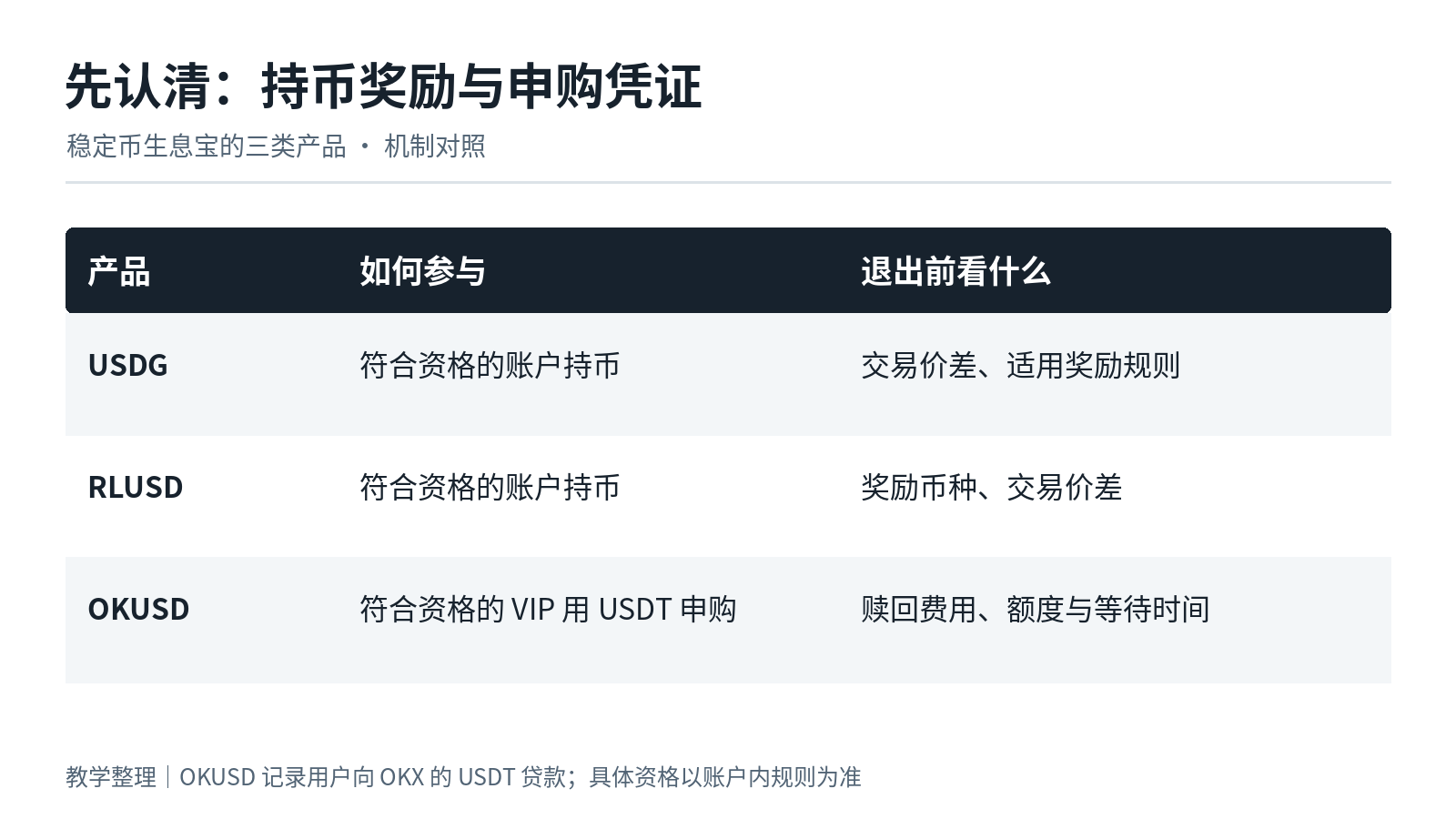
USDG and RLUSD can be initially understood as two different issuance systems of dollar stablecoins. USDG belongs to the Paxos system, while RLUSD belongs to the Ripple system; holding them in a qualifying OKX account enables participation after meeting reward conditions, without the need for separate locking like in fixed-term products. Rewards are provided by the platform and do not imply that transferring the coins to any wallet will continue to yield the same profits automatically.
OKUSD needs to be looked at separately: currently available to qualifying VIP users, purchased with USDT, and rewards are distributed in USDT. Its protocol defines OKUSD as a digital certificate that records the user's lending of USDT to OKX, not a regular stablecoin that can be freely transferred to a chain wallet. For newcomers, distinguishing this difference is more valuable than simply focusing on a slightly higher annual percentage rate.
The official overview lists the sources of income for USDG and RLUSD as U.S. Treasury bonds and cash reserves; OKUSD involves platform strategy returns. They are not three different names with completely identical risks acting as "piggy banks."
2. A user experience similar to demand deposits does not equal bank deposits
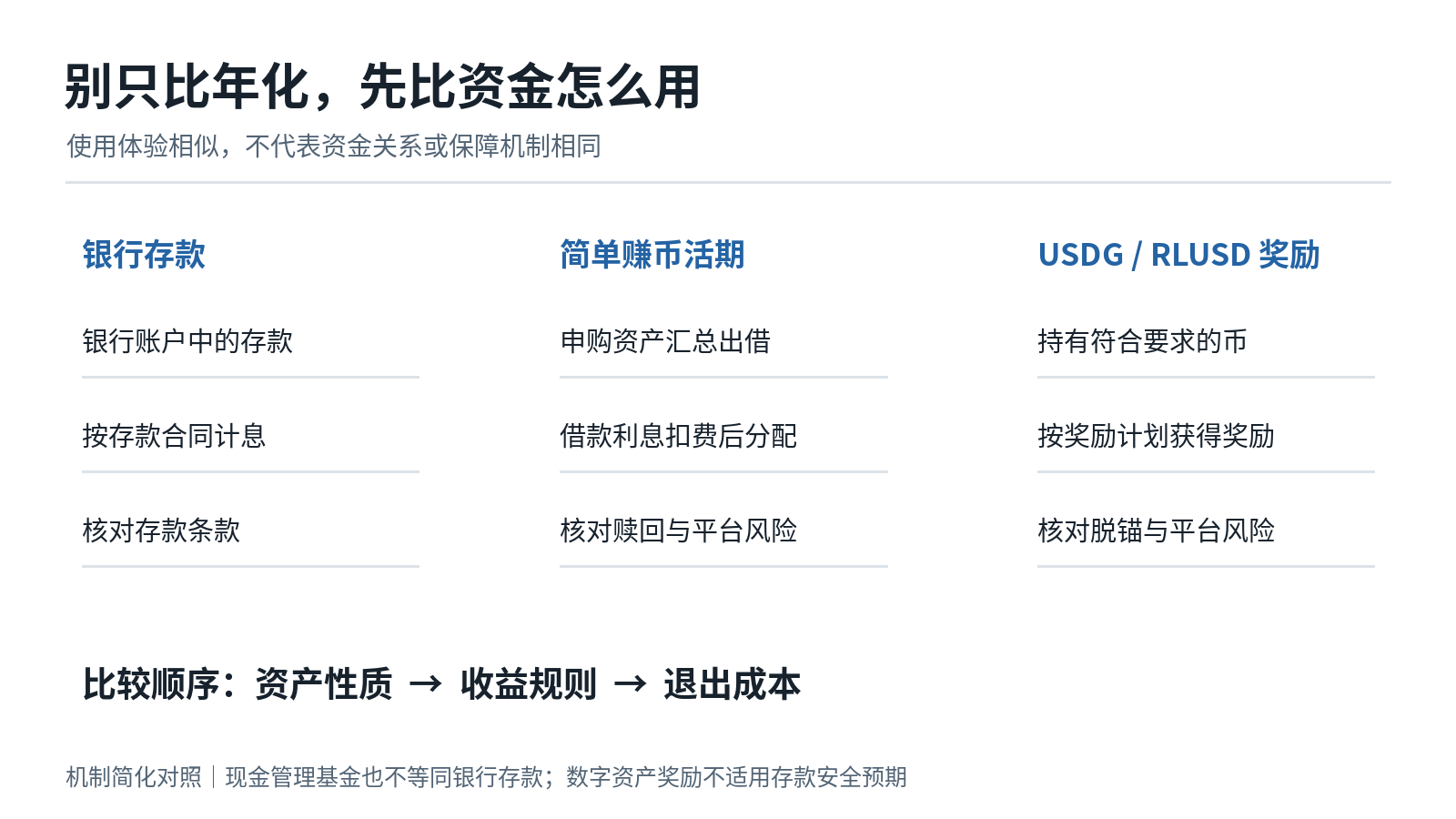
If we compare with traditional financial management, the rewards for USDG and RLUSD are more akin to the experience of "staying compliant with the required assets in your account and earning yields based on the rules." The convenience is that you don't need to frequently purchase and redeem, nor do you need to research on-chain contracts; the burden of operation is relatively small for those who already hold digital assets.
But this analogy should stop here. Bank deposits, cash management funds, and platform token rewards differ in legal relationships, underlying assets, and security mechanisms; one cannot directly transfer the safety expectations from deposits. Even if the coin price fluctuates around the U.S. dollar, converting it back to RMB or local currency will also be affected by the exchange rate, influencing the final purchasing power.
This is different from the simple coin-earning products we introduced earlier: simple earning products use the purchased assets collectively for lending, and after deducting borrowing interest and fees, distribute the rest to users; here, USDG and RLUSD refer to the rewards for eligible token holding. When comparing, you should consider both the yields and whether to swap coins, how funds are used, and the costs of exiting; it's not just about comparing the big numbers on the homepage.
3. Rules just updated: Daily distribution, not end of month balance check
According to the latest announcement, USDG and RLUSD rewards will change to daily distribution starting September 21, 2026, with new interest calculation rules implemented from September 22, 2026. Therefore, the "weekly arrival" mentioned in previous articles now needs updating.
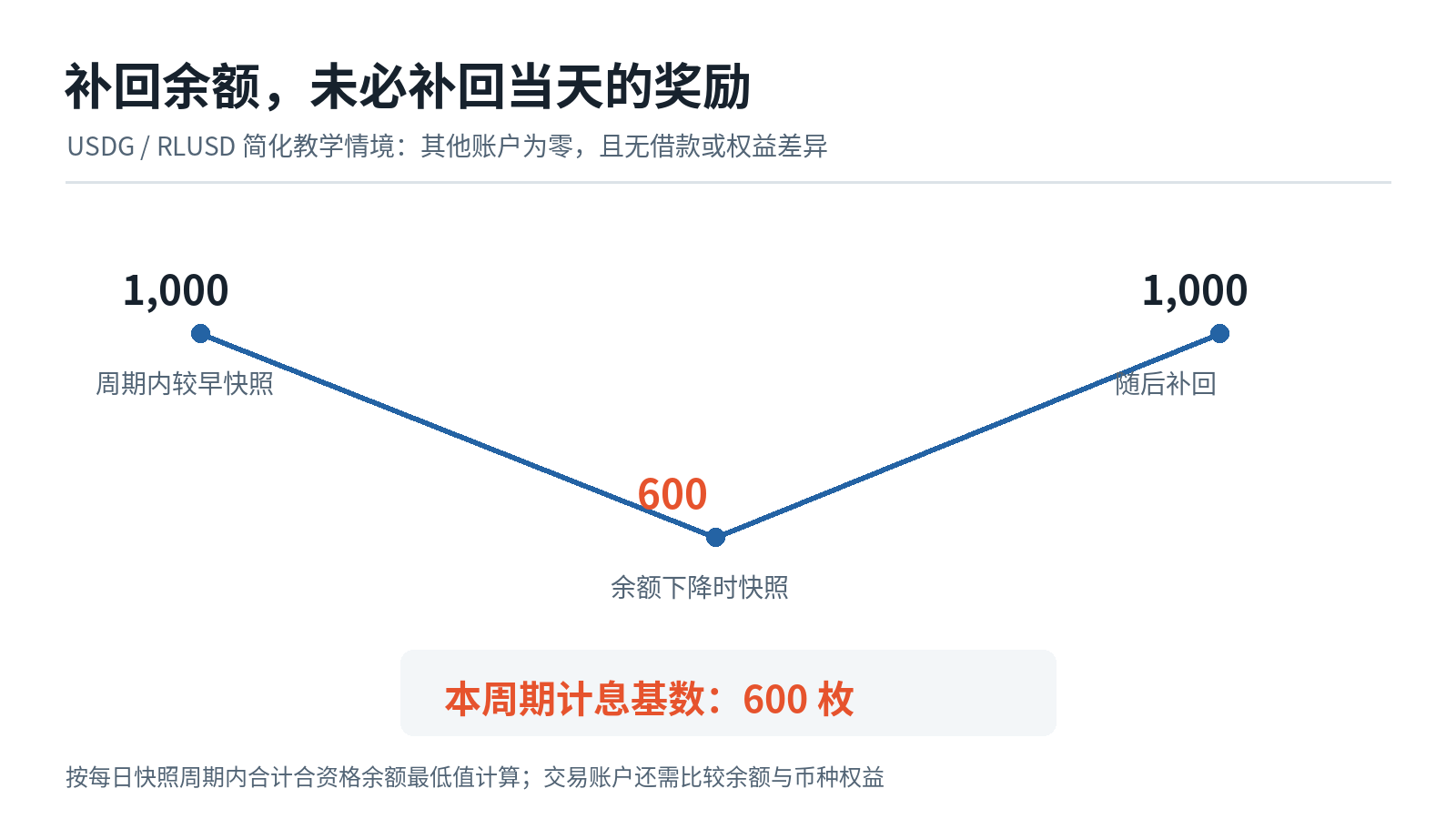
The key lies in the "interest calculation amount": the platform takes the minimum qualifying balance of related accounts during the daily snapshot period. For the trading account section, it must also take the lesser of the coin balance and the coin rights. Ordinary holders only need to remember one point: the balance seen at the end of the day does not necessarily equal the balance that earns rewards that day.
For example, assume that there are initially 1,000 qualifying amounts on a certain day, and during one snapshot, the amount drops to 600, and later it returns to 1,000. In this simplified scenario, the interest for the period is calculated based on 600, not 1,000. Swapping, transferring, or trading can alter the basis for interest calculation. The first thing to do after participation should be to verify the reward records.
4. How much can 1,000 coins yield in a month?
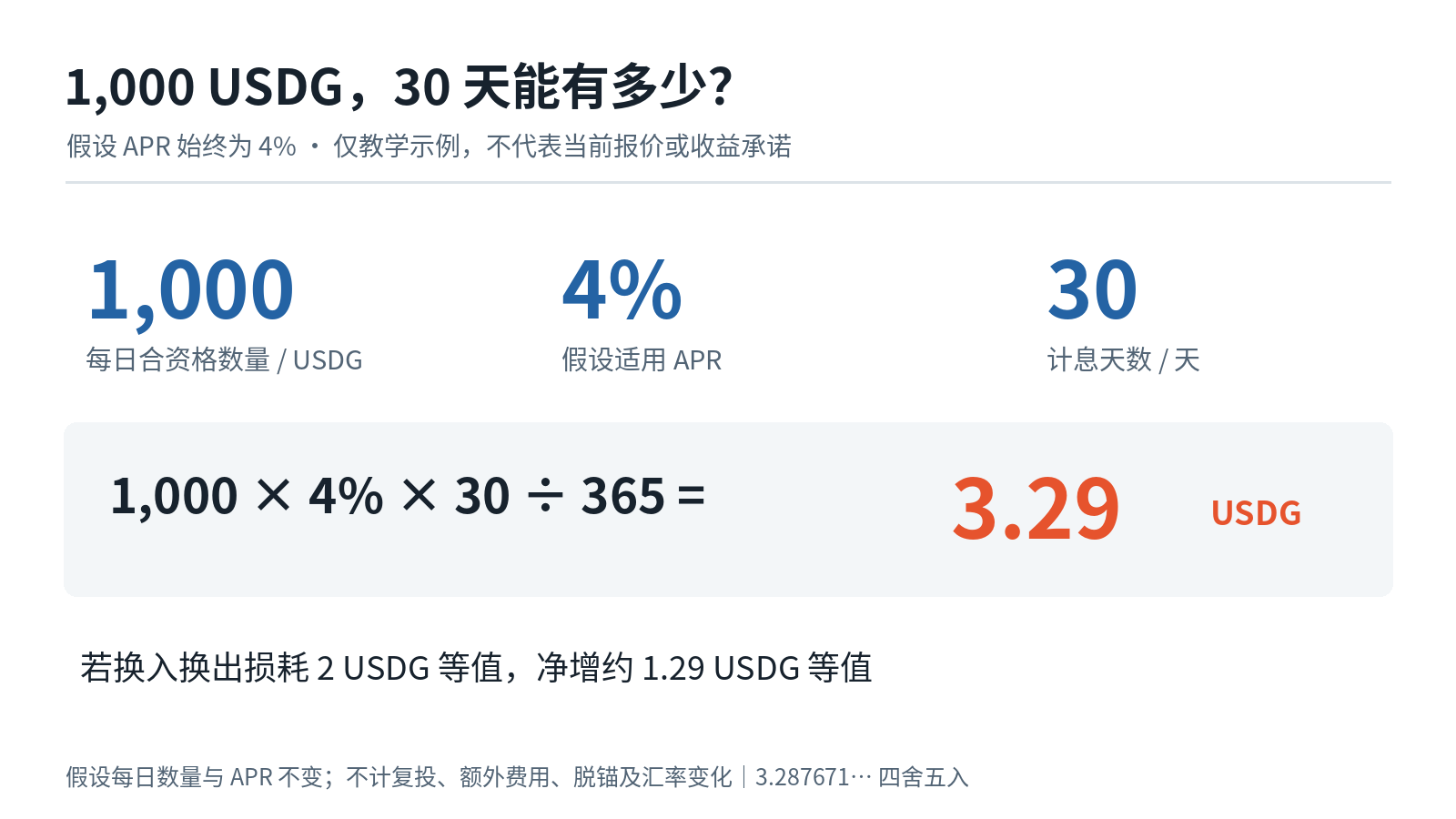
Let's use a purely educational example for calculations: suppose you continuously have 1,000 USDG that qualifies for interest for 30 consecutive days, with a consistently applicable APR of 4%, not counting compounded interest and related fees. Note that 4% is a hypothesis, not the current rate promised in this article.
Expected reward = 1,000 × 4% × 30 ÷ 365 ≈ 3.29 USDG.
This is the level of "annualized" figures: 4% expresses the return on a yearly scale, not 4% earned in one month, and certainly not implying that seeing "7-day annualized" means you can earn that percentage in seven days. APR usually excludes compounding, while APY reflects the compounding rate, and they should not be directly mixed; the official latest interest calculation formula uses the applicable APR.
Think a step further: assume that swapping in and out incurs a loss equivalent to 2 USDG, then the above 3.29 will be reduced to about 1.29. If the coin price further deviates from its peg, the final result may also change. The returns on idle funds are often small, while fees are real deductions, which is why it's not advisable to frequently move money just for temporarily high annualized rates.
5. How to find the entry point? Check in this order
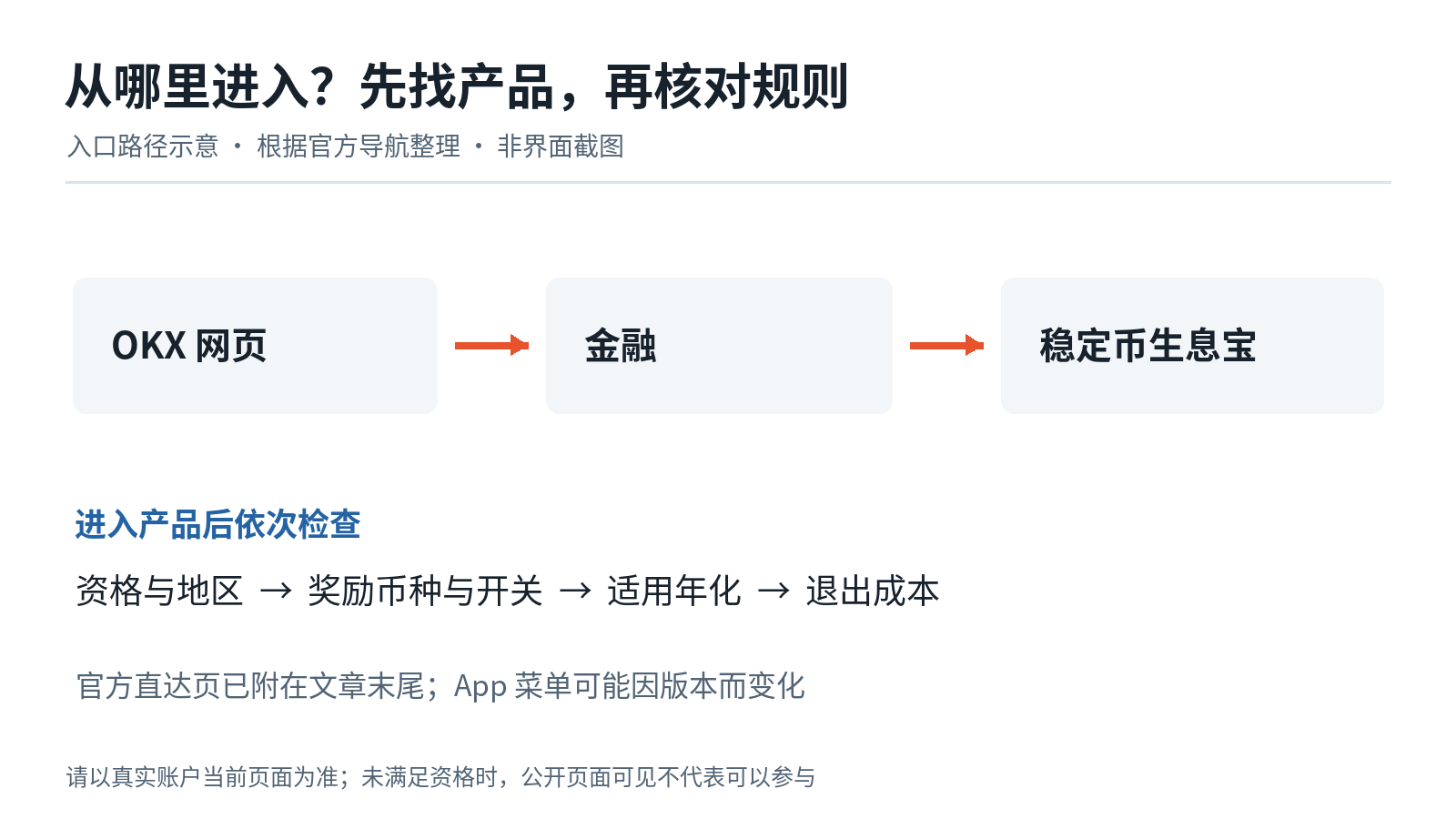
You can find "stablecoin interest product" from the "Finance" section at the top of the OKX website, or you can open the official direct access page at the end of the article. The app menu may vary with version and region, but you can look for the corresponding name under "earn coins"; if it doesn't appear in your account, first verify the region, identity verification, and product eligibility, and do not assume that all users can participate.
Once you enter, first distinguish whether you are choosing USDG or RLUSD token rewards, or OKUSD purchases; then check applicable annualized rates, minimum amounts, reward switches, reward currencies, and exit rules. The official page currently lists a requirement to hold at least 1 coin of RLUSD, and the reward can choose RLUSD or XRP; choosing XRP means accepting the price volatility of the rewards themselves.
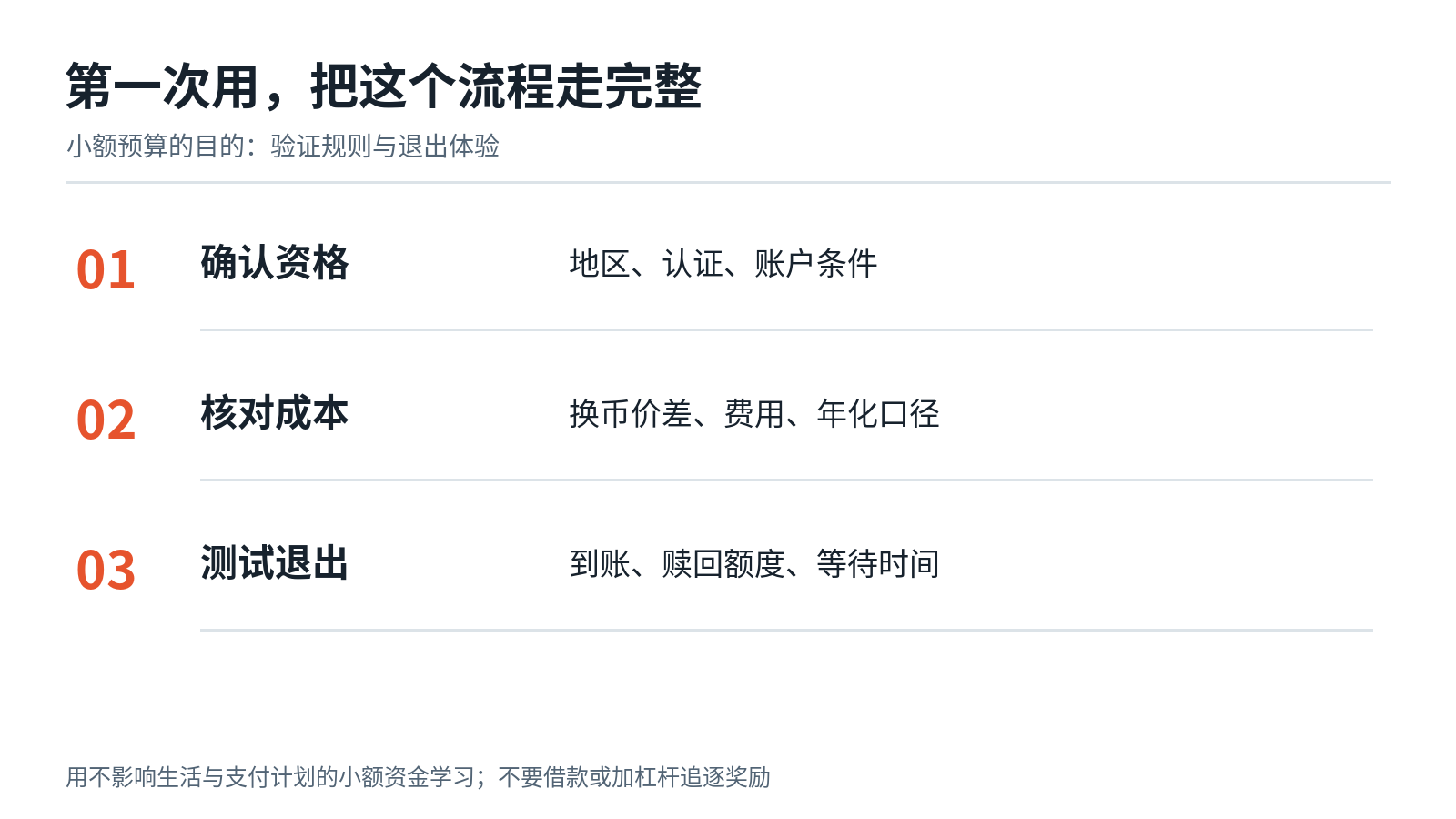
After confirming eligibility, acquire the corresponding assets through the channels supported by your account. For first-time use, consider starting with a small budget that you can temporarily leave without affecting your daily life, check the incoming rewards, and then test the exit. The purpose of this process is to confirm that you understand the rules rather than hastily moving all balances in.
6. Three easily overlooked pitfalls that affect the actual experience
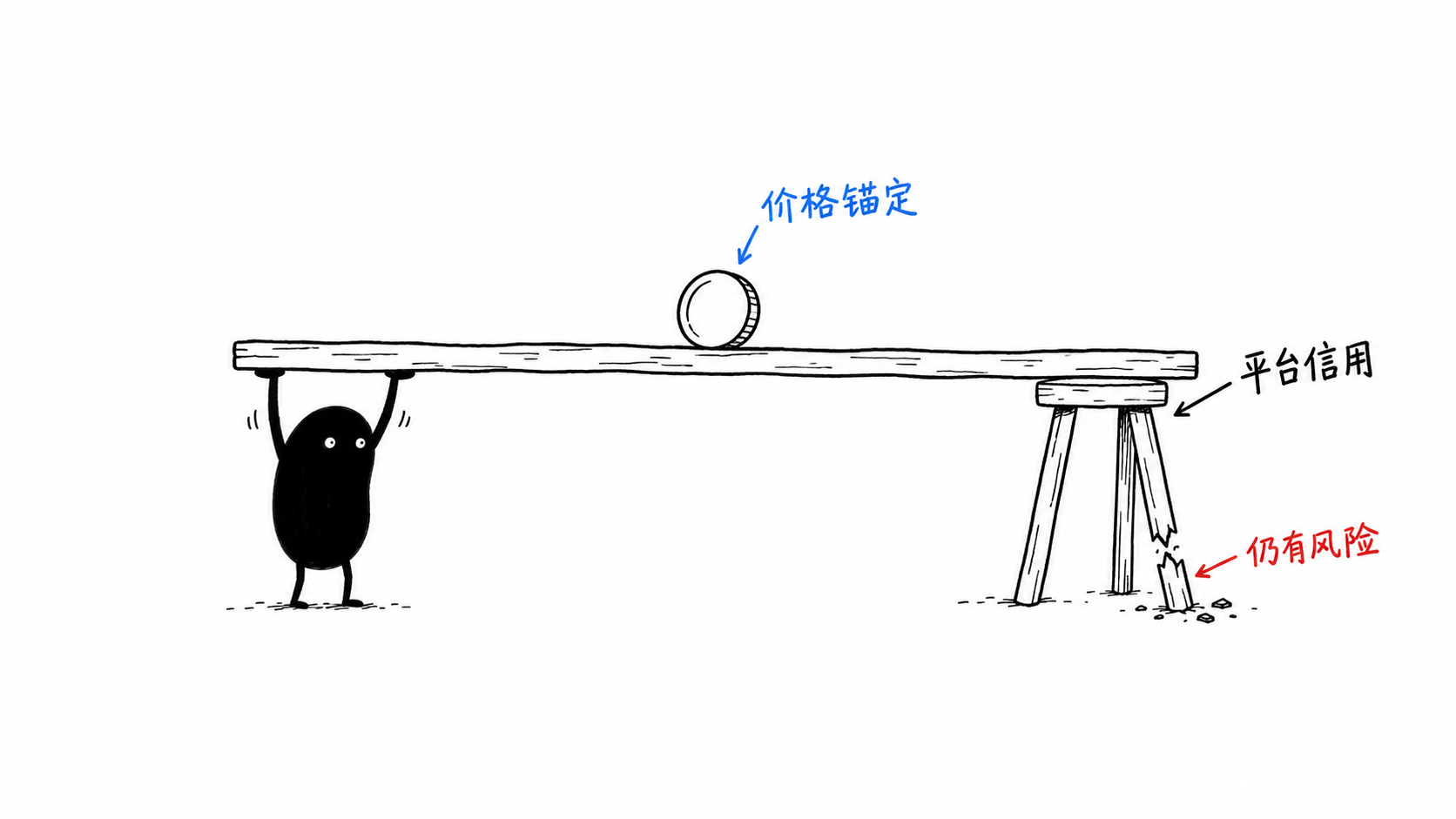
First, stablecoins can also de-peg. Reserve arrangements do not guarantee that they can always be liquidated without loss at any moment, and platform accounts also carry systemic, custodial, and access risks. Living expenses, emergency funds, and pre-determined payments are not suitable to move in simply because of the two words "stable."
Second, zero purchase fee does not equal zero exit cost. The OKUSD protocol lists a 0.1% redemption fee, while the onboarding description states 0.1% for quick redemption and 0.025% for standard redemption. The statements on different official pages may not be entirely consistent; you cannot interpret the overview's "zero fees" as being free for the entire process. Verify the current confirmation page, applicable protocol, and limits before operating; if there are still contradictions, ask customer service before participating.
Third, platform promises do not equal deposit protection. The 1:1 redemption promise for OKUSD relies on OKX's continuous solvency and operational capability; fees may also cause the net redemption amount to be lower than the original purchase amount. "Principal protection" should not be interpreted to mean you will never lose money under any circumstances.
As for "you can earn rewards while using it as collateral," newcomers should be informed. The use of collateral will add borrowing costs, liquidation risks, and trading risks; do not turn a simple token holding plan into a leveraged trade just to earn a few rewards.
7. Is it suitable for you? Finally answer three questions
Does just holding USDT automatically qualify you? That is not how it works. The current overview presents rewards for USDG, RLUSD, and OKUSD, which require compliance with the rules related to your selected asset and account.
Do ordinary users really need to upgrade to VIP? Don’t jump to this conclusion. The overview comparison of USDG and RLUSD lists the differences between ordinary users and VIP tiers; OKUSD currently has VIP thresholds. It isn’t necessary to increase trading volume or add unnecessary positions for just a little extra reward.
Who do I prefer to recommend it to? Those who already understand stablecoins, have idle digital assets, and are willing to verify the rules can consider adding it to their comparison list. If this is your first encounter with crypto assets, or if you require funds that can be accessed risk-free at any time, first learn about the nature of the assets and the exit process.
A truly useful financial tool should help you understand why you hold it. If you want to learn more, you can first open the official page to verify the product; once you ensure compliance with local regulations and decide to use OKX, complete the registration and necessary verifications through the access link below. Understand first, then test with a small amount; if the yield records and exit experience meet your expectations, you have a reason to continue using it.
Access link: AiCoin exclusive link permanently returns 20%:
https://jump.do/zh-Hans/xlink?checkProxy=true&proxyId=2
This article is a general product introduction and educational example and does not constitute personalized investment advice. Digital assets are not bank deposits and may incur principal losses.
免责声明:本文章仅代表作者个人观点,不代表本平台的立场和观点。本文章仅供信息分享,不构成对任何人的任何投资建议。用户与作者之间的任何争议,与本平台无关。如网页中刊载的文章或图片涉及侵权,请提供相关的权利证明和身份证明发送邮件到[email protected],本平台相关工作人员将会进行核查。