Author: AiPlot Research Institute
Focus: RWA / Digital Assets / In-depth Analysis of Financial Infrastructure
1. Investment Conclusion: The Next Batch of Users in Crypto May Not Be Humans, But Machines
BlackRock released "The Machine-Native Economy: How digital assets connect intelligence, commerce, and compute" in September 2026, discussing the growing connection between AI and the digital asset economy.
The market interpretation of this report captures a key shift: when AI Agents are able to complete tasks independently, they not only need to generate text and call models, but they will also continuously purchase data, call APIs, rent GPUs, subscribe to software, and conduct a large number of small transactions at high frequency, operating around the clock.
This means that the potential user structure of digital assets may change:
Crypto no longer only serves human investors and traders, but may also serve machines that continuously engage in procurement, payments, settlement, and asset allocation.
From an industrial chain perspective, the machine economy requires at least five layers of infrastructure:
- Intelligent Layer: LLM, AI Agents, MCP, and A2A enable machines to understand tasks, access tools, and collaborate in execution;
- Payment Layer: Stablecoins, x402, MPP, ACP, AP2, etc., provide callable payment methods for machines;
- Settlement Layer: Blockchains, public chains, or dedicated payment networks provide settlement for high-frequency, low-value, and verifiable transactions;
- Asset Layer: Tokenized RWA, stablecoins, on-chain collateral, and future computing power certificates allow machines to hold and call assets;
- Resource Layer: GPUs, CPUs, data centers, electricity, and network bandwidth form the actual production materials required for the AI economy to operate.
The reality is that linking AI narratives, machine-native economies, financializing computing power, and on-chain infrastructure is not about finding an "AI token," but rather observing whether the value transmission between these five layers forms a true closed loop.
2. First Layer Insight from BlackRock's Report: AI and Blockchain Share a "Tokenization" Language
1. Tokens in LLM and Tokens in Blockchain Are Not the Same Thing
BlackRock summarizes the intersection of AI and digital assets with an insightful analogy:
- LLM segments human language into tokens and encodes language into digital representations that machines can process;
- Blockchain represents economic value, ownership, and rights as tokens, allowing them to be verified, transferred, and settled by machines.
Functionally, the two are certainly different. LLM tokens are units of information processing by models, while blockchain tokens are carriers of economic rights or value transfers. However, they share an underlying structure: transforming complex real-world objects into standardized representations that machines can read and process.
This is crucial for the Agent economy. An Agent capable of executing tasks autonomously needs to understand:
- What the natural language task is;
- Where callable tools are;
- How data and APIs are priced;
- What proof is needed for payments;
- What assets can be used as collateral or payment;
- How to verify and record completion of transactions.
If language, tools, payments, and assets can all be represented in a machine-readable standard, Agents can move from "answering questions" to "completing economic activities."
2. The Real Value of Tokenization Is Reducing Interface Costs
Tokenization is not just about putting an asset on-chain. Its more important role is to transform assets that originally required manual, customized interfaces and complex reconciliations into standard objects that can be called by programs.
For AI Agents, this means they can:
- Query asset prices;
- Check ownership and collateral status;
- Initiate payments or transfers;
- Trigger contracts;
- Obtain services or resources;
- Automatically settle based on outcomes.
If each type of data, API, GPU rental contract, and financial asset has different accounts, logins, credit checks, and settlement processes, the machine economy will face significant frictions. The long-term value of tokenization lies in making these decentralized economic objects into orchestratable, machine-native assets.
3. Second Layer Insight: Stablecoins May Become Cash for Machines
1. Why Traditional Payment Systems Are Not Fully Suitable for Agents
Credit cards and ACH can support automated payments. In fact, many businesses have already achieved programmatic payments through APIs, account authorizations, and automatic deductions. However, they are still designed around "human or business accounts," which creates friction in the following scenarios:
- Agents need to operate autonomously 24/7;
- Each payment amount may be only a few cents or even lower;
- Transaction frequency may far exceed that of human business activities;
- The counterparty may be an unknown API or other Agents;
- Service delivery needs to occur immediately after payment confirmation;
- Both parties may not want to rely on complex account opening, credit, and reconciliation processes.
BlackRock points out that traditional payment systems involve account setups, identity verification, authorization, merchant rates, settlement cycles, and dispute resolution, which may become uneconomical in high-frequency, low-value machine transactions.
Thus, what Agents need is not simply "connecting credit cards to robots," but a financial system that can natively handle machine identities, permissions, budgets, payments, service delivery, and auditing.
2. Why Stablecoins Are in a Prime Candidate Position
Stablecoins have three characteristics that suit machine transactions:
- Stable Valuation: Priced against reference currencies like the USD, suitable for API, data, and computing pricing;
- Programmable Transfer: Can be initiated by wallets, contracts, or Agents according to rules;
- On-Chain Verifiability: Payment status, amounts, and settlement records can be automatically checked by service providers.
Data quoted in the BlackRock report indicate that by 2025, filtered stablecoin transaction volume could reach approximately $11.2 trillion, with a compound annual growth rate of about 80% from 2020 to 2025, compared to a growth rate of around 8.5% for ACH transactions during the same period. The report also states that by September 2026, the circulating market value of stablecoins will exceed $300 billion.
This data should not be simply equated with consumer payment scale, as stablecoin transaction volume includes trading, DeFi, lending, minting and redeeming, and other on-chain activities, and does not completely align with the statistical scope of Visa, Mastercard, and ACH. However, it indicates that stablecoins are no longer just settlement tools within crypto exchanges but are forming a layer of a global programmable dollar network.
3. The Value Capture of Stablecoins Is Not Just About the Token Itself
With the adoption of stablecoins, beneficiaries may include:
- Stablecoin issuers and their reserve management systems;
- Public blockchains and payment-specific chains;
- Wallets, custodians, compliance, and identity service providers;
- API, data, software, and computing service providers;
- Trading platforms, clearing institutions, and cross-border payment networks.
Therefore, it should not be assumed that "increased stablecoin usage will necessarily favor a public chain token." If the transactions occur in a permissionless network that pays gas in ETH, it may increase the demand for ETH's block space, validators, and settlement. If transactions take place in a dedicated network using USDC as the native gas asset, the value transmission path may be more reflected in the settlement utility of USDC and the income from network services.
Ultimately, value capture depends on:
- What asset pays for gas;
- Whether the network allows other chains to compete for settlement;
- How fees are distributed;
- Whether validators and stakers earn income;
- Whether there is gas sponsorship or application payment;
- How economic value is allocated among stablecoin issuers, chains, and applications.
4. Third Layer Insight: x402 Integrates "Payment" into Internet Requests
1. From Manual Account Opening to Request-Payment
x402 uses the HTTP 402 Payment Required status code to have the server return a payment request when the customer has not completed payment, and the client or Agent can complete the stablecoin payment before re-requesting the service.
This mechanism is suitable for the following scenarios:
- Agents purchasing data on a per-use basis;
- Software calling external APIs;
- Models paying based on tokens or inference quantities;
- Agents renting GPU or storage resources;
- An Agent calling the service of another Agent.
The key change is that payment is no longer an independent account management process but part of the service request. Service providers can deliver data or computational results immediately after confirming the on-chain payment, reducing credit and reconciliation risks.
2. x402 and Traditional Payment Protocols Are Not Mutually Exclusive
BlackRock also introduces several Agent payment protocols:
- x402: For HTTP resources and machine-to-machine payments, suitable for on-chain stablecoin settlement;
- MPP: Machine Payments Protocol launched by Stripe and Tempo, supporting stablecoins and traditional payment methods;
- ACP: Agentic Commerce Protocol launched by Stripe and OpenAI, allowing Agents to programmatically check out with merchants while retaining the merchant's existing payment infrastructure;
- AP2: Agent Payments Protocol by Google, proving user authorization through encrypted authorization and audit trails;
- TAP: Trusted Agent Protocol by Visa, helping merchants identify trustworthy Agents and securely receive payment credentials.
This suggests that the future may not be dominated by a single protocol for Agent payments. A more likely structure is:
- On-chain protocols responsible for high-frequency, low-value, and immediate settlement between machines;
- Traditional payment protocols responsible for payments between Agents and human merchants, banks, and consumers;
- Authorization and identity protocols responsible for proving that Agents are authorized to spend on behalf of users;
- Merchant protocols responsible for integrating Agents into existing commercial systems.
3. The Key of Agent Payments Is Not Automation, But Control
Allowing machines to spend automatically brings new risks. A usable Agent payment system must manage:
- Single transaction and daily budgets;
- Whitelist of payment recipients;
- Quality of service and delivery verification;
- Refunds, disputes, and fraud handling;
- Security of private keys and wallets;
- User authorization scopes;
- Identity and reputation between Agents.
Thus, machine-native financial infrastructure requires not only low-cost settlement but also "verifiable authorization." If Agents can automatically consume without clear budgets and permissions, the greater the payment efficiency, the faster the risks can spread.
5. Fourth Layer Insight: Computing Power May Become the Next On-Chain Commodity
1. Computing Power Is Shifting from Cost Item to Economic Resource
Training and inference of AI models require GPUs, CPUs, data centers, electricity, networks, and cooling. In the past, computing power has been viewed more as cloud service costs or enterprise IT expenses; as the scale of AI use expands, computing power is becoming a scarce economic resource that requires capital financing, price discovery, and risk management.
Market estimates quoted by BlackRock indicate that cumulative capital expenditures in AI infrastructure may exceed $5 trillion from 2025 to 2030; total revenue from AWS, Microsoft Intelligent Cloud, and Google Cloud may reach approximately $1.1 trillion by 2030, reflecting a compound growth rate of about 29% compared to 2025.
This set of forecasts represents the potential market size and capital investment and does not equate to realized revenue or cash flow that can be directly used for valuation. What they truly indicate is that AI computational resources may form a sufficiently large market, making the procurement, financing, leasing, hedging, and assetization of computing power economically necessary.
2. What Computing Power Certificates Can Be
Future financial products related to computing power may not be a general "GPU Token," but rather standardized rights to specific resources, such as:
- The right to use a certain model of GPU in a specific region for GPU-hours;
- The inference capacity of a specific data center during a defined time period;
- Computing services under a combination of specific chip, memory, bandwidth, and latency conditions;
- Contracts for computing power linked to the actual number of model tokens, inference tasks, or training cycles;
- Debt, income rights, or collateral financing certificates for future computing power revenue.
BlackRock mentions that standardized computing power contracts may possess transferability, pledging, collateral, and programmatic settlement capabilities in the future, and could develop into spot, contract-for-difference, futures, and other risk management tools.
3. Why Financializing Computing Power Is More Complex than "GPU on Chain"
Computing power is not as easily stored as gold or oil. Unused GPU-hours today cannot typically be saved for sale tomorrow. Computing resources have the following characteristics:
- Significant generational differences in chips;
- Different electricity, networking, and cooling costs across regions;
- Performance differences for the same model of GPU across different clusters;
- Different temporal distribution of training and inference demand;
- Risks of downtime, latency, queuing, and delivery quality exist;
- The value of computing power depends on the software stack, model compatibility, and data location.
Thus, the computing power financial market must address standardization issues: how much deliverable computing power is represented by contracts, how performance is measured, how delivery failures are compensated, how cash settlement and physical delivery are arranged, and how inter-regional price differences are reflected.
The electricity market is a worthy reference precedent: it similarly has features like non-storability, real-time supply-demand balancing, and regional price differences, and therefore typically requires a combination of spot, forward, futures, and contract-for-difference to manage risks. The computing power market may develop along similar lines in the future, but its product standards may be even more complex.
6. AI Inference Will Change the Structure of Computing Power Demand
1. Shifting from Centralized Training to Distributed Inference
The training market is usually dominated by a few large model companies and cloud vendors; the inference market, however, addresses a broader array of enterprises, developers, and consumers. As AI Agents continuously operate within customer service, finance, search, software, robotics, and enterprise workflows, inference tasks may become a more frequent and more decentralized source of computing power demand.
Market forecasts cited by BlackRock show that by 2030, AI inference may become the largest AI workload and account for an increasing proportion of data center electricity demand; scenarios depicted in report charts forecast that AI inference will account for about 43% of data center electricity demand by 2030.
This has two implications for computing power financialization:
First, computing power procurement will shift from one-time construction to continuous, flexible, and on-demand purchasing. Enterprises may not need to own GPUs but could rent the most suitable computing resources in real-time based on Agent tasks.
Second, the value of computing power certificates will become increasingly dependent on time, latency, and reliability. For an Agent that requires real-time responses, a cheaper but high-latency GPU may be less desirable than more expensive, closer resources.
2. How Agents Automatically Purchase Computing Power
BlackRock outlines a possible workflow: a user asks an Agent to perform a complex analysis, the Agent continuously estimates computing needs, queries real-time prices, available capacity, reliability, regions, chip models, and latency from different suppliers, then selects the optimal resource and pays on demand via protocols like x402, returning results after computation.
This process requires cooperation across multiple protocols:
- MCP allows Agents to access computing power markets, price, and status data;
- A2A enables the main Agent to collaborate with a dedicated computing power procurement Agent;
- x402 or other payment protocols finalize settlement on a per-use, task, or consumption basis;
- On-chain certificates record purchasing, pledging, delivery, and settlement status;
- Oracles or service proof mechanisms verify that computing resources have been actually delivered.
In this case, the role of the blockchain is not simply to "store a GPU token," but to become the settlement, ownership, and verifiable execution layer within resource markets.
7. Tokenized RWA Allows Machines to Hold and Call Real Assets
1. The Meaning of RWA for Human Investors Differs from Its Meaning for Agents
For human investors, Tokenized RWA primarily offers advantages such as fragmentation, tradability, combinability, and longer trading times. For AI Agents, the value of RWA is further reflected in being "callable":
- Agents can hold stablecoins as operational funds;
- Use tokenized treasury bonds or money market funds as collateral;
- Automatically allocate assets based on risk and liquidity needs;
- Obtain credit limits through smart contracts;
- Pay for data, computing power, and software using on-chain assets;
- Automatically split and settle accounts after workflow completion.
Thus, the endgame for RWA is not simply "moving Wall Street assets onto the chain" but enabling assets to have machine-readable, machine-verifiable, and machine-callable interfaces.
2. What Assets Can Machines Call
Tokenized RWA suitable for the Agent economy may include:
- Stablecoins and tokenized cash;
- Short-term treasury bonds, money market funds, and highly liquid collateral;
- Supply chain receivables and trade financing;
- Data center and GPU equipment financing certificates;
- Rights to use computing power and long-term cloud computing revenues;
- Rights to use energy, bandwidth, storage, and network services.
However, asset tokenization must retain clear legal rights. Just because a machine can read a token does not mean it automatically owns the underlying asset, redemption rights, or bankruptcy recourse. The custody, corporate actions, valuation, redemption, and regulatory identities of RWA remain foundational for the entire system.
3. Differences between Machine-Native RWA and Traditional RWA
Traditional RWA primarily serves human investors, with product designs typically emphasizing yield, liquidity, and compliant distribution; machine-native RWA emphasizes:
- API accessibility;
- Programmable transfer and collateral;
- Low-value, low-latency settlements;
- Permissions and budget control;
- Automatic valuation and risk triggers;
- Machine verifiability of asset status.
In the future, an Agent may not need to "understand the complete sales material for a fund," but it must be able to read standardized asset metadata: price, duration, liquidity, collateral ratio, redemption period, risk level, and calling permissions.
8. Value Transmission: From Agent Transactions to Public Chain Tokens, Intermediate Links Cannot Be Skipped
The market suggests a potential transmission path: Agents use x402 to purchase APIs and pay in stablecoins; if transactions settle on a public chain, the increase in machine transactions will bring more block space, verification, and settlement needs, which may ultimately reverberate back to public chain native assets like ETH.
This logic has a directional aspect but should not be oversimplified to "the more Agents there are, the more ETH will inevitably rise." At least seven variables are involved:
- Whether Agents use a blockchain rather than traditional API accounts and payment methods;
- Which chain is being used;
- Whether the transactions genuinely produce on-chain settlements instead of being processed by centralized providers in bulk;
- Whether the transaction amounts match gas costs;
- Whether the chain reduces transaction costs through aggregations, Rollups, or payment channels;
- Whether gas is paid with native tokens, stablecoins, or application payments;
- How network fees, staking returns, and MEV return to holders of native assets.
Therefore, studying the value capture of AI × Crypto should establish the following bridges:
Agent economic activity → API/compute/data payment → on-chain transactions and settlements → block space demand → network fees and verification services → economic rights of native tokens.
If any one of these links is absorbed by centralized service providers, paid for by stablecoins, or offset by gas sponsorship, value transmission may remain with infrastructure companies and stablecoin issuers rather than necessarily returning to public chain tokens.
9. The Industry Benefit Hierarchy from BlackRock's Perspective
First Layer: Machine Payment and Settlement Infrastructure
Includes stablecoins, wallets, custody, payment protocols, identity, and authorization systems. This layer is closest to real commercial processes, with key metrics being payment volumes, active Agents, merchant integrations, and service fee income.
Second Layer: Asset Issuance and Tokenized RWA
Includes tokenized cash, treasury bonds, funds, receivables, data center financing, and computing power certificates. Key metrics are asset scale, redemption capability, secondary liquidity, collateral utilization, and legal rights.
Third Layer: Computing Power Market and Resource Financialization
Includes GPU cloud, model routing, computing power markets, long-term financing, futures, and contracts-for-difference. Key metrics are deliverable capacity, utilization rate, price differentials, default rates, contract standardization, and financing costs.
Fourth Layer: Public Chains and Settlement Networks
Includes Ethereum, dedicated stablecoin networks, Layer 2, and other payment chains. Key metrics are the share of machine transactions, block space demand, network fees, validator income, stablecoin balances, and gas asset designs.
Fifth Layer: High-Volatility AI Narrative Assets
Includes AI Agent tokens, computing power tokens, and related infrastructure tokens. They may have high price elasticity but must demonstrate real users, actual revenues, token usage demand, and value recapture mechanisms.
10. Risks: There Is a Time Gap Between Grand Narratives and Real-World Infrastructure
1. The Agent Economy Remains Early Stage
BlackRock explicitly points out that Agentic Payment activities are still in their infancy, with limited liquidity and standardization in the computing power market.
Currently, many AI Agents remain at the prototype, assisted tool, or semi-automated workflow stage. They may be pre-set by humans for payment accounts, calling permissions, and consumption limits, and have not yet formed large-scale autonomous transactions by machines. Therefore, market predictions for 2025-2030 should not directly translate to today's on-chain revenues.
2. Stablecoin Transaction Volume and Machine Payment Volume Should Not Be Confused
The adjusted stablecoin transaction volume of $11.2 trillion reflects the overall activity of the stablecoin network, but does not equate to transactions where AI Agents procure data, GPUs, and APIs. It requires separate tracking of:
- The number of payments initiated by Agents;
- The proportion of machine-to-machine transactions;
- Individual payment amounts;
- The actual settlement volume of protocols like x402, MPP, etc.;
- The number of paid API and computing power service providers;
- The retention rate of automatic payments after user authorization.
3. Computing Power Is Not a Homogeneous Commodity
If different GPUs, regions, networks, and software environments cannot form unified standards, so-called computing power tokens may only serve as prepayment certificates for a specific provider rather than widely liquid commodities. They also need to resolve issues related to delivery, failure, performance, alternatives, and defaults.
4. Security Risks of Agent Payments
Automated payments by machines may encounter prompt injections, malicious APIs, fake services, private key leakage, budget overruns, and identity theft. A scalable Agent financial system must simultaneously possess:
- Encrypted authorizations and revocable permissions;
- Transaction limits and risk scoring;
- Verification of service results;
- Dispute resolution and refund mechanisms;
- Agent identity and reputation records;
- Transactions that are auditable without overly exposing privacy.
5. Risks in Token Value Capture
Even if the AI Agent economy grows, it does not mean that all related tokens will benefit. One should observe:
- Whether protocols charge real fees;
- Whether the fees are generated by Agents rather than speculative trading;
- Which assets cover gas and payments;
- Whether the network possesses pricing power;
- Whether token holders receive buybacks, burns, staking, or usage rights;
- Whether new issuances and unlockings offset actual revenue growth.
11. Research Framework: How to Use AiPlot to Track Real Progress in AI × Crypto
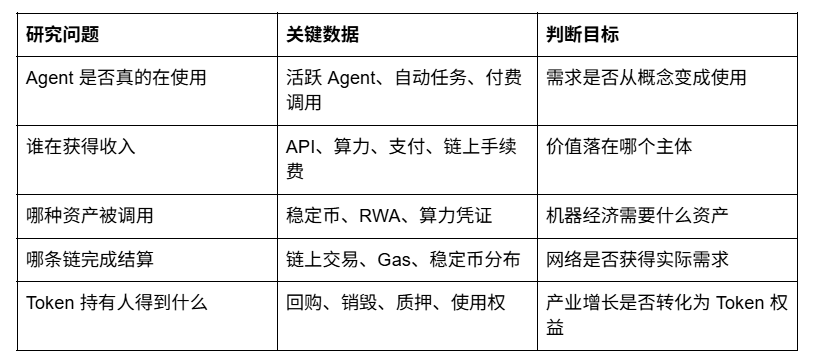
AiPlot's value in this topic lies not just in showcasing the price of a specific AI token, but in helping researchers establish a complete observational chain from technological usage to asset value.
1. Agent Adoption Layer
Track the number of Agent products, active users, automatic task completion rates, callable tools, and real payment behaviors to assess whether AI is transitioning from demo to production environment.
2. Payment Protocol Layer
Track transaction volumes, settlement amounts, merchant numbers, stablecoin proportions, and cross-chain distributions for x402, MPP, ACP, AP2, and other Agent payment protocols.
3. Asset Layer
Track the supply of stablecoins, size of tokenized RWA assets, collateral usage, computing power financing certificates, redemption volumes, and secondary market depth.
4. Computing Resource Layer
Track GPU rental prices, utilization rates, chip generations, regional electricity costs, cloud vendor revenues, model routing, and computing power supply-demand differentials.
5. Network Value Capture Layer
Track block space demand, proportion of machine transactions, network fee income, validator yields, gas assets, staking ratios, protocol buybacks, and token unlocks.
6. Events and Policy Layer
Track collaborations, acquisitions, licenses, product launches, and rule changes among cloud vendors, payment companies, stablecoin issuers, trading platforms, and regulatory agencies.
Ultimately, each project can be placed into a unified judgment model:
12. Conclusion: True AI × Crypto Is Not "AI Tokens," But the Financial Operating System of the Machine Economy
BlackRock's report provides a more explanatory framework than "AI + Crypto":
- AI is machine-native intelligence;
- Digital assets are machine-native currency and asset representations;
- Stablecoins are cash that machines can use;
- Blockchains are programmable settlement layers for machine transactions;
- Tokenized RWA are real assets that machines can recognize, call, and pledge;
- Computing power may become new commodities that can be standardized, financed, traded, and hedged;
- Agents are one of the most important new economic participants of the future.
The significance of this industrial pathway lies in connecting AI and Crypto into an economic cycle rather than two parallel narratives: AI Agents create transaction demands, stablecoins complete payments, blockchains provide settlements, RWA offers assets, computing power provides production resources, and protocols and networks attempt to capture revenues from the machine economy.
However, this cycle has not yet fully formed. What needs to be avoided most urgently is translating grand long-term predictions directly into short-term token valuations. The three questions worth tracking are:
- Are machines really beginning to autonomously pay, rather than having humans use wallets on their behalf?
- Is computing power genuinely forming standardized contracts and a financeable market, rather than simple GPU rentals?
- Are the revenues generated by the Agent economy truly returning to stablecoins, RWA, settlement networks, and related token holders?
If these three questions gradually receive affirmative answers, the user base of Crypto will expand from humans to a massive number of machines operating around the clock, and digital assets will evolve from investment and trading tools into financial interfaces of the machine economy.
The endgame of AI is not just to make machines smarter; the long-term opportunity for Crypto is not just to enable humans to trade more conveniently. The real intersection worth关注 is the moment when machines start to possess budgets, assets, and payment capabilities, and can autonomously complete economic activities on-chain.
免责声明:本文章仅代表作者个人观点,不代表本平台的立场和观点。本文章仅供信息分享,不构成对任何人的任何投资建议。用户与作者之间的任何争议,与本平台无关。如网页中刊载的文章或图片涉及侵权,请提供相关的权利证明和身份证明发送邮件到[email protected],本平台相关工作人员将会进行核查。