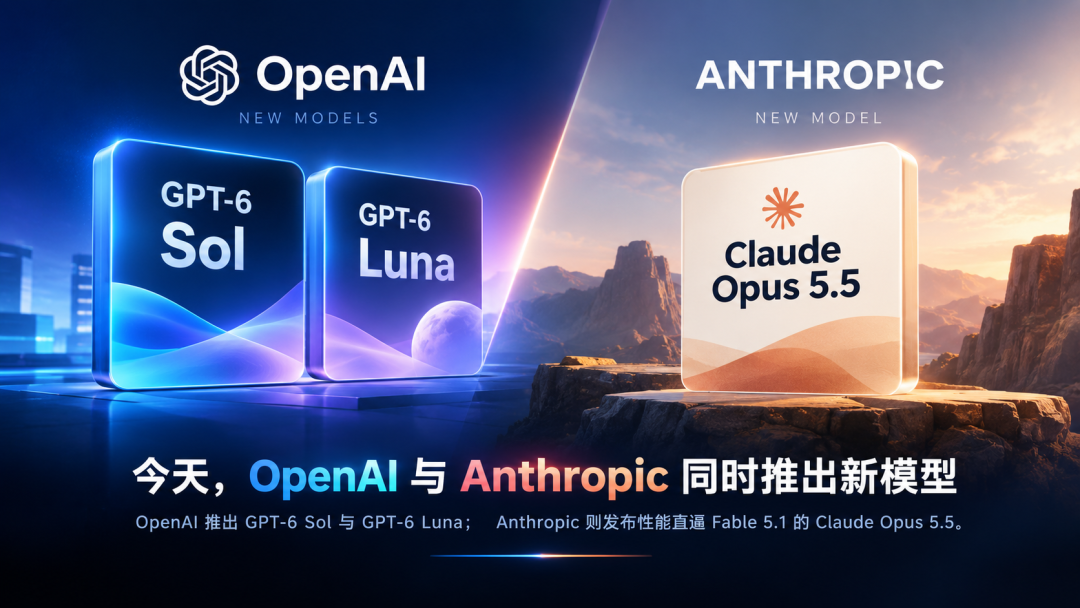
Anthropic and OpenAI released their new models, one after the other, within about an hour and a half of each other.
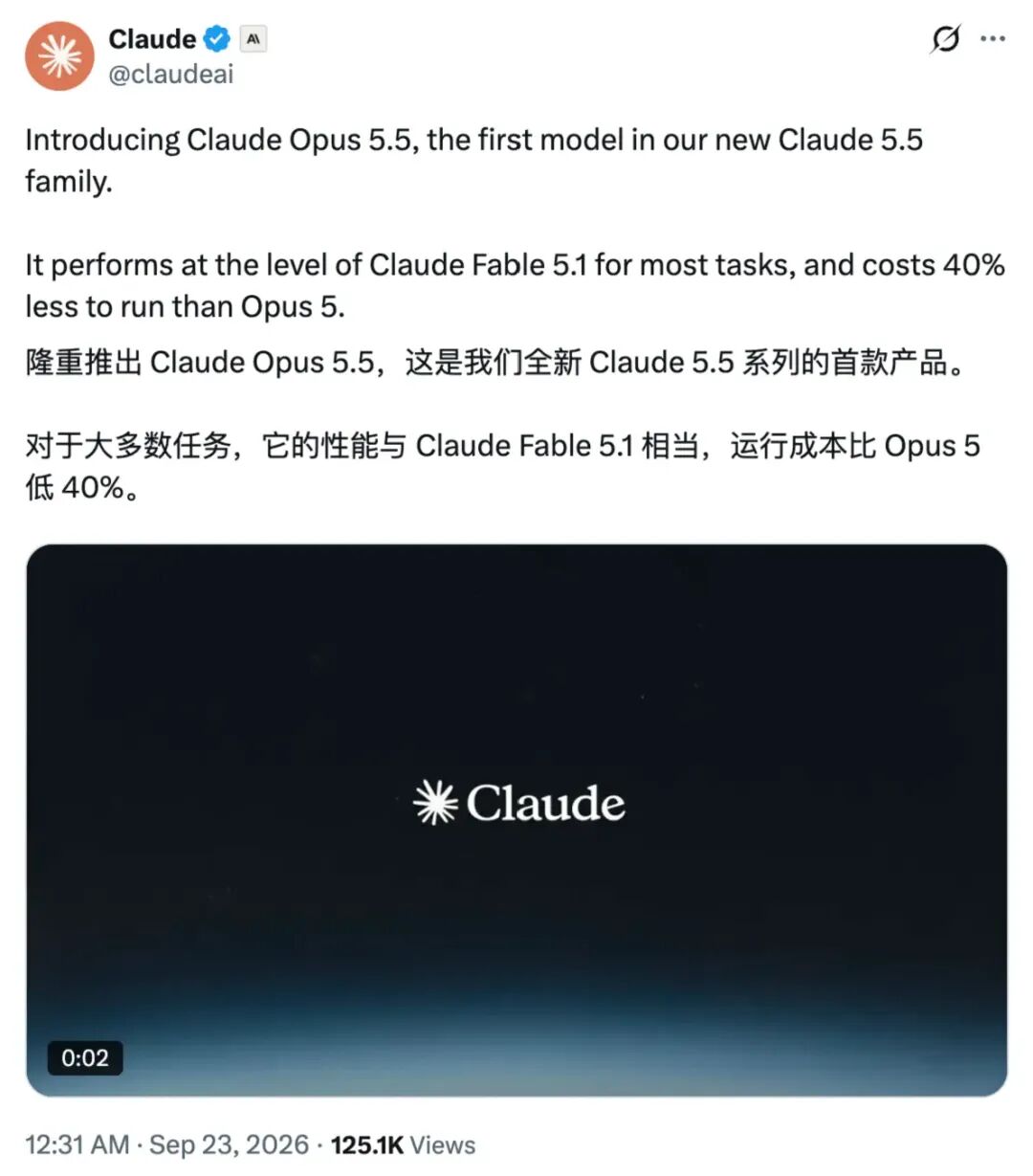
Anthropic made the first move: Claude Opus 5.5, the first model in the Claude 5.5 series, whose performance matches the flagship Fable 5.1, with costs reduced by 40%.
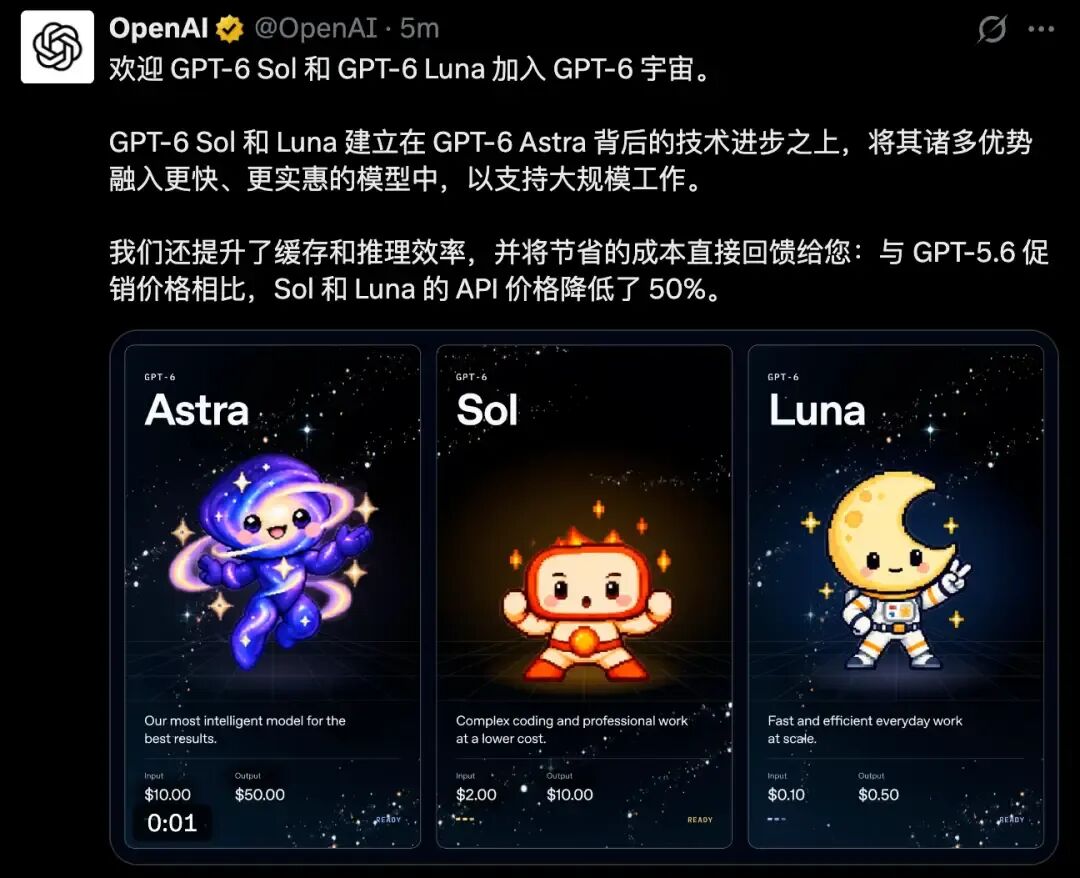
OpenAI quickly followed: GPT-6 Sol and GPT-6 Luna, two models with API prices directly slashed by 50%.
This is not a coincidence. It is a showdown between two opponents forced to the same table, revealing their hands on the same night.
The cards do not read "who is stronger," but rather "who is cheaper."
Three Cards, Three Strategies
GPT-6 Sol—OpenAI's "super brain." It is aimed at complex coding and Agent workflows, inheriting some capabilities from Astra, specialized in tackling hard problems. One million tokens cost $2 to input and $10 to output. In the DeepSWE code test, it scored 68.8%, just 1.1 percentage points away from Fable 5.1's 69.9%, but the single-task cost was reduced by about 80%.
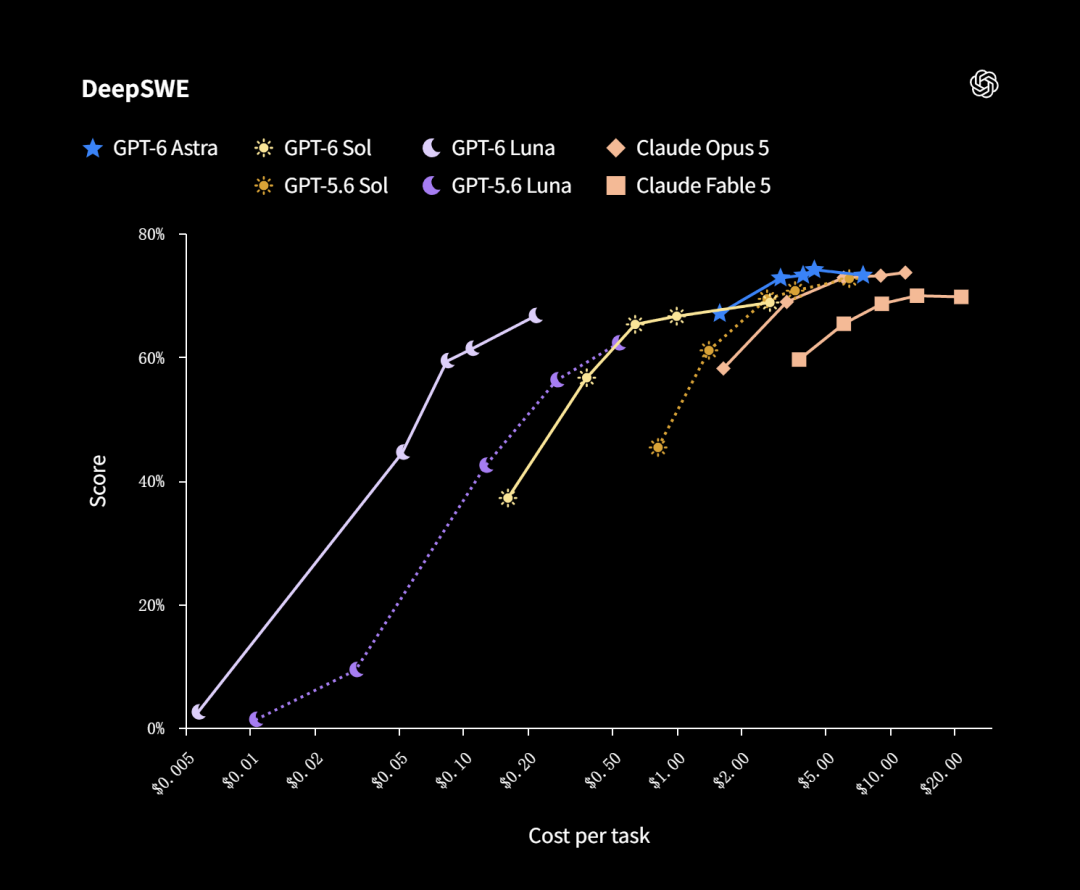
GPT-6 Luna—OpenAI's "efficiency monster." It is focused on high-frequency lightweight tasks, fast and costing so little that it is almost negligible. One million tokens cost $0.1 to input and $0.5 to output. A model costing $0.1 per million tokens achieved a coding test score of 66.6%, close to the mid-tier levels of Opus 5 and Fable 5, but costs were reduced by 93% and 96%, respectively.
Claude Opus 5.5—Anthropic's "flagship alternative." Its performance reaches the level of Fable 5.1, but costs are down by 40%. One million tokens cost $4 to input and $20 to output. It scored 66.4% on Terminal-Bench 4.0, surpassing Astra's 57.9%. In less than a day, it completed the migration of 680,000 lines of code and audited and fixed 200,000 lines of code in less than 3 hours.
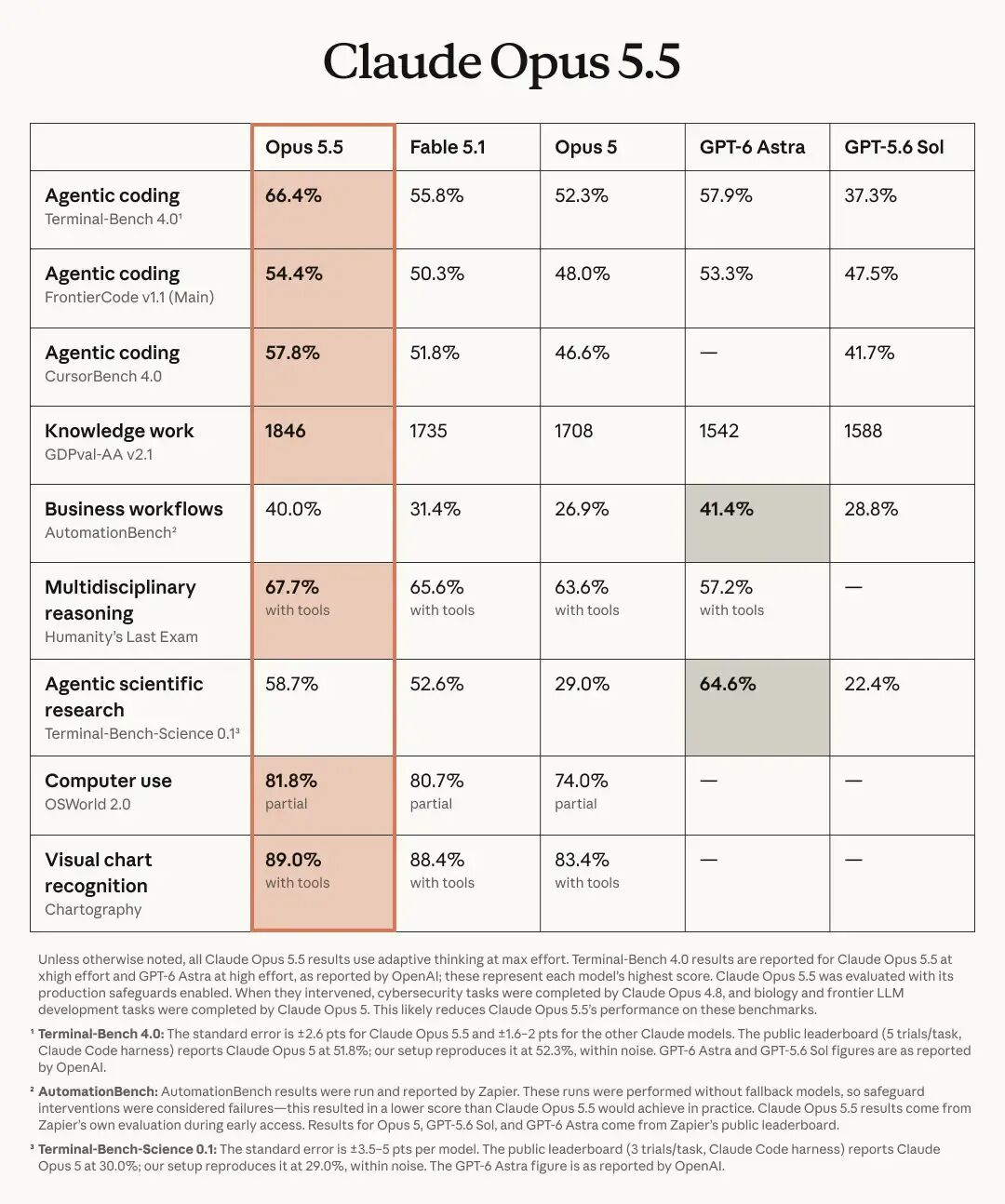
Three cards, three positions. OpenAI uses two models to sandwich Anthropic, which confronts head-on with one model.
The Price War Has Already Hit the Floor
Looking at the pricing of the three models together:
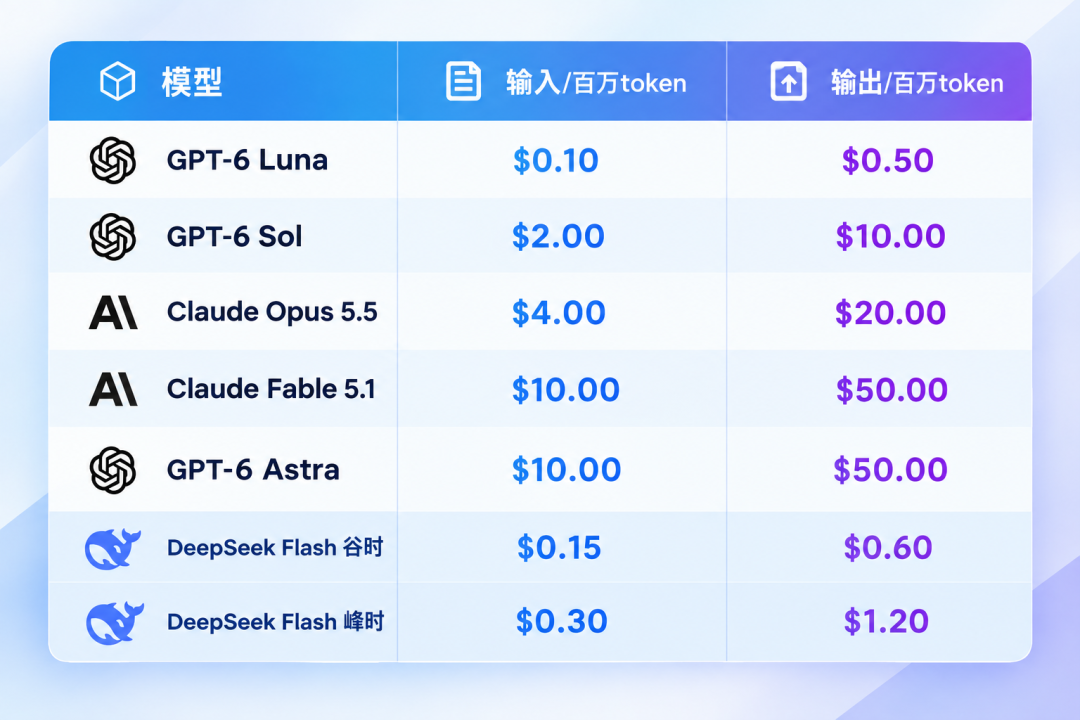
Luna's $0.1 per million tokens is a significant concept. The input price for DeepSeek V4.1 Flash's idle cache misses is 1 Chinese Yuan (about $0.14), with output costing 4 Yuan (about $0.56). Luna is already cheaper than DeepSeek in ordinary request scenarios, without the cost fluctuations that peak and valley pricing brings.
Chinese open-source models have driven prices to the floor. Now OpenAI and Anthropic themselves have further dug downwards.
The Performance Gap is Narrowing, the Cost Gap is Widening
One of the most noteworthy signs this time is that the focus of both companies' releases is no longer "our model is the strongest," but rather "how much cheaper our model is with comparable capabilities."
OpenAI says: Sol has squeezed into the frontier Agent ranking at under 30% of the price. Luna, at $0.1, achieved coding levels close to mid-tier flagship models.
Anthropic states: Opus 5.5 offers Fable-level capability at 40% of the price, thereby placing Opus solidly within the highest capability range of Astra and Fable.
Both are telling the same story with the same logic: the capability is already sufficient; now the competition is about who can lower costs more.
This is not a natural result of technological advancement; it is a result of market competition.
According to data from cloud application company Vercel, Chinese open-weight models are capturing market share from American labs. When your competitor offers 80% of the capability for a tenth of the price, you have no right to continue selling at full price.
Fable 5.1, the Most Awkward One
The most awkward release this time may not be OpenAI or Anthropic, but rather Anthropic's own Fable 5.1.
Released only on September 1, it has only occupied the highest tier for three weeks. Then Opus 5.5 quickly caught up—its performance is comparable or even superior, but costs only a quarter of its price.
The tier design for Fable was initially: Sonnet for daily use, Opus for complex tasks, Fable to push the upper limits of capability, and Mythos as the cutting edge of restricted openness.
But now Opus 5.5 is closing in from below, with Mythos pressing from above, leaving Fable 5.1 sandwiched in the middle, increasingly resembling a "buffer zone."
Media commentary has been blunt: "Fable increasingly looks like it is getting pressure from both sides."
Conclusion
The "showdown" on the night of September 22 marks the shift of AI model competition from an "arms race of capability" to a "cost-cutting" phase.
OpenAI's approach is "layered delegation"—using Astra as a flagship benchmark, with Sol and Luna bringing capabilities down to cheaper tiers, ensuring there is a product for every budget range.
Anthropic's approach is "flagship alternative"—pushing Fable-level capabilities to more users at a lower price with Opus 5.5.
Two routes, same goal: to make the price of one million tokens no longer a psychological barrier for enterprise customers in decision-making.
Axios's analysis hits the nail on the head: as model prices drop, usage will clearly rise, potentially supporting trillions of dollars in AI investments.
As the unit price of one million tokens drops across the board, AI services are shedding their luxury branding.
The next question is no longer "whose model is stronger," but rather "who can help enterprise users spend less money to accomplish more."
This is no longer a technological competition. This is a war on costs.
免责声明:本文章仅代表作者个人观点,不代表本平台的立场和观点。本文章仅供信息分享,不构成对任何人的任何投资建议。用户与作者之间的任何争议,与本平台无关。如网页中刊载的文章或图片涉及侵权,请提供相关的权利证明和身份证明发送邮件到support@aicoin.com,本平台相关工作人员将会进行核查。