Author: AiPlot Research Institute
Focus: RWA / Digital Assets / In-depth Analysis of Financial Infrastructure
1. Investment Conclusion: Regulation is Not a Switch, But a Combination of Permissions
If the “Clear Act” is ultimately not passed, will the U.S. crypto industry stagnate as a result?
A more accurate answer is not “yes” or “no,” but rather to break down the crypto market into different businesses and check one by one whether regulatory agencies already have the corresponding permissions.
The businesses that U.S. regulatory agencies can currently promote, and those that must wait for Congressional authorization, do not exist on the same level:
- Token Attributes and Partial Financing Arrangements: The SEC has established a clearer analytical path through the interpretation of March 2026 and the Regulation Crypto Assets proposed in August;
- Staking and Partial Securities-type RWA: Can continue to be refined within the existing securities law and product regulatory framework;
- Tokenized Stocks and Securities Trading: Securities originally fall under the SEC’s legal scope, the key is to integrate on-chain registration, custody, and trading into the existing system;
- Crypto Derivatives and Some Leveraged Trading: The CFTC can explore new products using its commodity derivatives and designated contract market (DCM) powers;
- Complete Unleveraged Digital Goods Spot Regulation: Involves unified platform registration, client asset segregation, listing review, capital requirements, and ongoing supervision, which remains the core gap the “Clear Act” seeks to address.
Therefore, the industry may face a state of “layered implementation” in the future: some businesses operate under administrative pathways first, while others continue to wait for legislation. This will create real business opportunities but also require companies to manage regulatory uncertainty, state-level regulation, cross-departmental authority, and policy continuity risks simultaneously.
2. What is “Administrative Market Structure”
1. It is Not a Substitute Law
The so-called “administrative market structure” does not mean that the SEC or CFTC can create a complete new law through administrative documents, but refers to the gradual reduction of uncertainty by the two agencies within their existing authorizations, through the following methods:
- Issuing interpretations to clarify when certain types of Tokens or transactions fall under the scope of securities law or commodity law;
- Providing registration exemptions or conditional safe harbors;
- Adjusting applicable rules for trading venues, custodians, and market makers;
- Approval of specific products, exchanges, or derivatives listing plans;
- Allowing market testing through no-action letters, staff statements, and regulatory pilots;
- Establishing more coordinated asset classification and jurisdictional boundaries between the SEC and CFTC.
The advantage of this path is faster speed, the ability to pilot specific businesses, and it does not require waiting for Congress to create a comprehensive statute. The downside is that its legal efficacy and stability are not as strong as Congressional legislation, and its scope is limited by the agency’s original authority.
2. Why It Still Holds Practical Significance
For a crypto enterprise, “rules are not completely certain” and “there is no compliance pathway at all” are two different situations.
If a company knows what exemptions are available for a certain type of financing, what information it needs to disclose, which transactions must be conducted through registered venues, and how client assets are to be safeguarded, then it can estimate compliance costs, design product structures, and decide whether to operate in the U.S. Even if the final regulations might still change, a clear application pathway is more suited for capital deployment than relying entirely on enforcement risk.
This highlights the economic value of the administrative pathway: it may not solve all legal issues at once, but it can potentially transform “unpredictable enforcement risks” into “assessable licensing, disclosure, and operational costs.”
3. One of the SEC Paths: First Distinguish Between the Token Itself and the Initial Investment Contract
1. Core Changes in the March 2026 Interpretation
On March 17, 2026, the SEC issued an interpretation regarding the application of federal securities laws to crypto assets, with the CFTC participating to provide guidance consistent with the Commodity Exchange Act.
The official announcement stated that the interpretation established classifications for Tokens such as digital goods, digital collectibles, digital instruments, stablecoins, and digital securities, explaining when a crypto asset that is not itself a security may be subject to investment contract obligations, and when that relationship may potentially end. The interpretation also discussed issues related to airdrops, protocol mining, protocol staking, and non-security crypto asset packaging.
This approach addresses a long-standing controversy: The attributes of Tokens as assets and the financing commitments made by the project party during the initial sale of Tokens are not necessarily the same thing.
If the project party promises investors ongoing management efforts, network building, or revenue expectations through financing arrangements, then the initial sale may involve an investment contract; however, whether each subsequent transaction automatically inherits the initial financing relationship once the network is running and tokens enter the secondary market cannot be simply generalized.
2. Why This is Important for Project Parties
In the absence of a clear analytical framework, project parties often face two extremes: either treat Tokens as a potential securities risk indefinitely, or evade the U.S. market through complex offshore structures. The former raises operational and financing costs, while the latter undermines the U.S. capital market and innovation activities.
If regulators allow project parties to analyze the following factors separately, the financing design will become more precise:
- Initial sales targets and sale methods;
- Project party’s commitment to future management efforts;
- Whether Tokens have network usage functions;
- Whether the network is already operational;
- Whether secondary market transactions depend on the issuer’s ongoing efforts;
- Whether relevant transactions still constitute investment contract arrangements.
This does not mean project parties can automatically evade securities laws by changing contract names, nor does it imply that Token prices or investment returns are recognized by regulators. It merely provides a more detailed legal analytical framework.
4. One of the SEC Paths: Regulation Crypto Assets Provides an Experimental Avenue for U.S. Financing
1. Specific Content of the Proposal
The SEC proposed Regulation Crypto Assets on August 18, 2026, aimed at establishing a customized securities issuance system for specific investment contracts involving crypto assets.
The proposal includes two main registration exemptions:
- One-time Early Financing Exemption: Allows cumulative issuance of no more than $5 million over four years;
- Larger Scale Financing Exemption: Allows issuance of no more than $75 million every 12 months.
Both exemptions require issuers to provide principled, narrative disclosures. Issuers using the second larger scale exemption also need to provide financial statements and undertake continuous reporting obligations.
The proposal also includes a conditional safe harbor: If the issuer completes or permanently ceases the necessary management efforts promised or indicated in the investment contract, the relevant crypto assets may no longer be subject to the definition of “investment contract” if conditions are met.
As of the date of this report, the rule remains a proposal, and the SEC’s rule page indicates that public comment is due by October 20, 2026, and it has not yet taken effect.
2. What $75 Million Means
For early crypto projects, $75 million is no longer a symbolic amount. A project that needs funding to complete core products, infrastructure, and market expansion may obtain sufficient scale of domestic financing through this system.
Its potential impacts include three points:
First, projects can assess the costs and disclosure obligations of U.S. financing earlier, rather than designing complex offshore issuance structures from the outset.
Second, compliant financing may gradually evolve from “special transactions only feasible for large institutions” to a standard capital market pathway for mature crypto projects.
Third, competition among future crypto projects may occur not only at the level of products and communities but also in terms of disclosure quality, financing transparency, U.S. market access, and subsequent Token trading arrangements.
3. Registration Exemption Does Not Equal Exemption from Liability
The significance of Regulation Crypto Assets should not be overstated. It does not allow project parties to issue Tokens freely, nor does it endorse Token prices, business models, or future revenues.
Even if an issuance obtains a registration exemption, project parties may still need to bear:
- Disclosure responsibilities;
- Anti-fraud and anti-manipulation responsibilities;
- Financial statement and continuous reporting obligations;
- Real explanations about the use of financing and management commitments;
- Appropriate investor protections and sales restrictions;
- Compliance arrangements for subsequent secondary transactions and Token distribution.
Therefore, the real change in the proposal is that the financing system is better suited for crypto projects, rather than crypto projects breaking away from securities regulation.
5. Staking and Securities-type RWA: Why They Don’t Have to Wait Entirely for Congress
1. Staking Business Structures Need Layering
Native protocol staking, staking services provided by trading platforms, and traditional financial products like ETFs involving staking involve different legal and economic structures.
Native staking may be closer to network verification and blockchain services; platform-based staking involves client assets, service fees, risk assumptions, and revenue distribution; while ETFs incorporating staking also involve fund assets, custody, valuation, and investor disclosure.
Thus, even if regulatory interpretations provide clearer boundaries for certain native staking activities, it cannot automatically derive that all staking products receive the same treatment. Regulatory agencies still need to determine whether securities, custody, investment company, or broker-dealer obligations arise based on product structures.
2. Legal Entry for Securities-type RWA Already Exists
Stocks, bonds, and fund shares already fall under the securities law system. Putting ownership records, transaction instructions, or settlement vouchers on the blockchain does not automatically change their legal attributes.
The SEC's 2026 statement on tokenized securities points out that tokenized securities are securities represented in the form of crypto assets, and ownership records are fully or partially maintained on a crypto network. The tokenized form itself does not alter the applicability of securities law.
This creates a clear distinction between securities-type RWA and the digital goods spot market: securities-type RWA already possess a relatively clear legal identity, while the current main issue is how to integrate on-chain registration, custody, trading, clearing, and corporate actions into the existing securities market; in contrast, the digital goods spot market must answer who holds ongoing regulatory authority, how platforms should register, and how client assets can be unified in protection.
3. Looking at Tokenized Stocks for Regulatory Implementation
The SEC issued the Innovation Exemption on September 17, 2026, allowing qualified Tokenized Securities Venues to trade tokenized NMS stocks through licensed AMM liquidity pools under temporary, conditional exemptions.
Conditions include: tokenized stocks must provide the same rights and privileges as their traditional counterparts; trading varieties and volumes are limited; third-party tokenization must notify the underlying issuer and provide an opportunity for objections; smart contracts must be auditable, public, and deployed on a public permissionless ledger; when trading of the underlying stock stops, tokenized stocks must also cease trading concurrently.
This case illustrates that the administrative pathway fits best when accessing assets that already have a defined legal identity. Regulatory agencies do not need to redefine what a stock is; they only need to establish operational boundaries for on-chain records, trading, and custody.
6. CFTC Path: Derivatives and Leveraged Trading are Easier to Advance than Ordinary Spot
1. CFTC Does Not Have to Only Wait for Congress
The CFTC lacks comprehensive regulatory authority over all unleveraged digital goods spot platforms, but that does not mean it cannot promote any crypto business.
Commodity derivatives are already within the CFTC’s regulatory scope. As long as new products comply with legal structures like derivatives, futures, or swaps, the CFTC can advance product innovation through existing rules, listing approvals, and trading venue regulation.
This is also why crypto derivatives often gain institutional pathways earlier than ordinary spot markets: they do not need to create a new set of market regulatory authority from scratch; instead, they fit within the existing commodity derivatives framework.
2. “Crypto Asset Markets” and DCM Pathways
CFTC Chairman Michael S. Selig stated in a speech on August 20, 2026, that the CFTC is exploring using its existing authority to establish a designated contract market (DCM) category for existing registered entities and unregistered crypto exchanges, referred to as the “Crypto Asset Market,” and to offer leveraged or margin crypto asset trading under adapted rules.
This is an exploratory direction and not a new system that has already taken effect. However, its policy implication is very clear: the regulatory agency wishes to start from the leveraged, margin, and derivatives business where it has clear authority and incorporate part of the crypto trading into the federal regulatory framework.
For trading platforms, this may bring new product pathways:
- Existing registered entities can apply for trading arrangements that adapt to crypto assets;
- Some unregistered crypto platforms may search for ways to enter the DCM system;
- Leveraged and margin products may shift from gray markets to licensed markets under federal regulation;
- Client assets, clearing, margin, and risk management rules may receive clearer adaptations.
3. Differences Between Leveraged and Ordinary Spot
The reason “leveraged spot” may serve as an entry point for the administrative pathway is that financing, margin, and leveraged structures inherently trigger clearer commodity trading and derivatives regulatory requirements. Regulatory agencies can design products around trading venues, clearing, margin, and client protection.
However, this does not mean that the CFTC has obtained comprehensive regulatory authority over all ordinary spot markets. Unleveraged digital goods spot trading involves a separate set of issues:
- Whether all platforms must register uniformly;
- Who is responsible for client asset segregation;
- Which Tokens can be listed;
- How platforms handle conflicts of interest and market manipulation;
- How exchanges, brokers, custodians, and clearing houses share responsibilities;
- How regulators continuously check whether platforms comply with capital and operational requirements.
These are issues at the legislative level regarding market structure and cannot be completely solved by individual product approvals.
7. Three Types of Issues That Cannot Be Avoided in the “Clear Act”
1. Complete Digital Goods Spot Regulatory Authority
Regulatory agencies can investigate fraud and manipulation, but the authority to enforce against fraud is not equivalent to complete daily market regulatory authority.
Complete spot regulation also requires establishing unified rules for platform registration, client assets, capital requirements, listing standards, market monitoring, conflicts of interest, clearing, and auditing. These rules require explicit statutory authorization; otherwise, administrative agencies cannot create a new jurisdiction that covers the entire market solely based on interpretive documents.
2. Consistency Across Agencies and States
Even with coordination between the SEC and CFTC, platforms may still face state-level money transmission licensing, New York BitLicense, state securities registrations, and other financial business licensing requirements.
The Regulation Crypto Assets proposal indeed plans to exclude certain state securities registration and qualification requirements for qualified issuances and certain secondary transactions, but this does not represent a single federal license that covers all businesses, states, and platforms.
DeFi developers face the same restrictions: while the SEC's analysis of a certain type of Token under securities law is clearer, it does not mean that the Treasury Department, FinCEN, CFTC, state regulatory agencies, or consumer protection laws' requirements automatically disappear.
3. Long-term Policy Stability
The levels of effectiveness of regulatory interpretations, staff statements, formal rules, and Congressional laws vary.
Staff statements may provide important guidance to the market, but do not necessarily possess the legal stability of formal rules; formal rules need to go through consultation and administrative procedures, and may be modified or challenged; Congressional legislation provides higher level certainty for jurisdiction, market structure, and long-term regulatory principles.
Enterprises making short-term pilots and investing years of resources to build trading platforms require different certainties. The administrative pathway is sufficient to help companies start testing products, but significant capital investment must still account for risks related to rules being challenged, policy changes, and future Congressional legislation.
8. Impacts on RWA, Stablecoins, and Trading Platforms
1. RWA: Administrative Pathways May be Implemented Before Comprehensive Legislation
The development of securities-type RWA does not need to fully await the “Clear Act,” as stocks, bonds, and fund shares already have a legal identity. Regulatory focus will be on issuance, custody, on-chain registration, trading, redemption, and investor rights.
This explains why tokenized stocks, government bonds, and money market funds may gain institutional adoption faster than ordinary digital goods spot. They are not first debating “who regulates this asset,” but rather addressing “how traditional assets use blockchain.”
2. Stablecoins: Payment and Settlement Still Require Clear Layering
Stablecoins may be used for payments, cross-border settlements, trading margins, and purchasing RWAs. However, stablecoin issuance, reserves, custody, redemption, and payment purposes involve different regulatory departments and cannot conclude that all stablecoin businesses are resolved simply because there is a pathway for securities-type RWA.
In actual products, it is necessary to distinguish:
- Whether the stablecoin itself is classified as a payment tool;
- Who holds the reserve assets of the stablecoin;
- Whether users have direct rights to the reserve assets;
- Who is responsible for suitability and anti-money laundering when stablecoins are used to purchase securities;
- Whether trading platforms simultaneously undertake payment, brokerage, custody, and clearing functions.
3. Trading Platforms: Compliance Pathways May Become a Competitive Advantage
If some platforms can take the lead in entering clear DCM, TSV, or other regulatory frameworks, they may gain higher trust from traditional financial institutions and more stable liquidity sources.
However, a compliant identity also means higher costs: capital requirements, client asset segregation, market monitoring, auditing, reporting, and technical security all require ongoing investment. Future competition among trading platforms will not only revolve around trading volume but also involve competition for regulatory licenses, custody quality, and system reliability.
9. Investment Research Framework: Don't Just Ask "Will the Bill Pass?" Ask Who Can Turn Space into Revenue
1. Four-level Assessment of Regulatory Events
In the face of new regulatory news, it can be categorized into four levels:
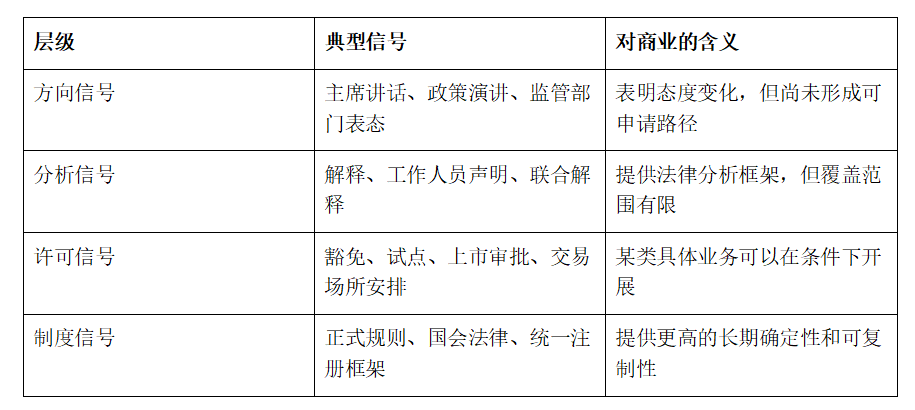
Treating the chairman’s speech directly as an already established system, or considering proposals as effective rules, will overestimate policy certainty.
2. Which Assets May Benefit
If the administrative path continues to advance, potential beneficiaries may not only be public chain tokens but also:
- Token issuance and RWA platforms;
- Custodians, compliance, identity, and on-chain auditing service providers;
- Oracles, cross-chain and settlement infrastructures;
- Regulated trading venues and clearing houses;
- Fintech companies capable of providing stablecoin payments, securities trading, and client asset protection;
- Protocols that can funnel revenues back to Token holders through buyback, destruction, or staking mechanisms.
However, the gap between “industry benefiting” and “Token price rising” still exists. Investment research needs to continue tracking asset scale, trading volume, transaction fees, margins, sources of buybacks, Token unlocks, and holder rights.
10. Risks and Catalysts
Main Risks
Risk of Proposal Not Being Established. Regulation Crypto Assets is still in the proposal stage and may be amended, delayed, or not passed after public consultation.
Risk of Boundary of Authority. The SEC or CFTC’s administrative pathway cannot exceed the existing authorizations of the agencies; companies may gain clear treatment on one regulatory issue but encounter new requirements on payments, custody, state licensing, or consumer protection.
Policy Reversal Risk. The stability of administrative interpretations and staff statements is lower than that of Congressional laws, and changes in future government and regulatory leadership may alter policy directions.
Compliance Cost Risk. Entering a formal regulatory framework may bring higher costs for capital, auditing, client asset segregation, technical security, and ongoing reporting, which small projects may not be able to bear.
Asset Rights Risk. Whether RWA Tokens represent underlying securities, custody rights, or synthetic exposures needs to be confirmed item by item. Tokenization does not automatically confer dividends, voting rights, or rights to bankruptcy recovery.
Market Competition Risk. Once rules become clearer, traditional brokers, banks, exchanges, and cloud providers may enter quickly, and early crypto projects may not be able to retain all profits.
Main Catalysts
- Whether Regulation Crypto Assets advances towards formal rules after the deadline for public comments on October 20;
- Whether the SEC continues to approve more Tokenized Securities Venues or expands the application of the Innovation Exemption;
- Whether the CFTC publishes formal rules or pilot pathways for the “Crypto Asset Market” DCM;
- Whether more staking, tokenized stocks, government bonds, and money market products gain clear regulatory treatment;
- Whether trading platforms can launch compliant leveraged or margin products under the federal regulatory framework;
- Whether large financial institutions will convert the administrative pathways into real RWA, custody, clearing, and settlement businesses;
- Whether protocol revenues can return to Token holders through transparent buybacks, destruction, and staking mechanisms.
11. The Research Value of AiPlot: Transforming Regulatory News into Asset Conduction Maps
Regulatory news itself is not an investment conclusion; what truly matters is how regulatory changes translate into specific businesses and assets.
AiPlot can establish a four-tier tracking framework around this theme:
- Policy Layer: Tracking rules, interpretations, exemptions, and enforcement from the SEC, CFTC, Congress, and state regulators;
- Business Layer: Tracking which issuers, exchanges, custodians, and platforms obtain product or operational licenses;
- Asset Layer: Observing issuance, holders, liquidity, and redemption of Tokenized Stocks, government bonds, funds, and stablecoins;
- Value Layer: Analyzing transaction fees, protocol income, buybacks, destruction, staking, unlocks, and Token holder rights.
For RWA and crypto regulatory studies, the most valuable insight is not to see “a certain chairperson supports crypto,” but to be able to answer: Which regulatory action has fallen onto which product, which types of platforms have gained operational space, and which Tokens can obtain real value returns.
12. Conclusion: Without the Clear Act, the Industry Can Still Progress, but Will Do So in a More Fragmented Way
The blockage of the “Clear Act” does not mean that the U.S. crypto industry will stop developing for the next two years. The SEC has already progressed in areas such as token attributes, investment contract relationships, financing exemptions, and safe harbors; securities-type RWA can continue to develop under existing securities law identities; the CFTC can explore new market structures in derivatives, leverage, and margin businesses; and tokenized stocks have already appeared in temporary, conditional on-chain trading experiments.
However, the administrative path cannot fully replace Congressional legislation. It cannot solve in one stroke the federal regulatory authority over unleveraged digital goods spot markets, unified platform registration, client asset protection, state consistency, and long-term institutional stability.
Therefore, the future U.S. crypto market may present a “semi-institutionalized” state:
- The financing market has clearer exemptions, but requires disclosure and continuous reporting;
- Securities-type RWA have on-chain registration and trading experiments, but must retain traditional securities rights;
- Derivatives and leveraged trading have regulatory pathways but are subject to commodity market authority limitations;
- The ordinary spot market still lacks a complete, unified, and long-term stable federal framework;
- Companies can begin building, but must account for policy changes and boundary of authority in investment returns.
Ultimately, what matters most is not whether the “Clear Act” becomes the sole switch for the industry, but which companies can truly lead in the space opened by administrative pathways: who can obtain regulatory qualifications, who can attract institutional funds, who can turn RWAs and stablecoins into real products, and who can transform trading and service revenues into verifiable rights for Token holders.
Without the “Clear Act,” the U.S. crypto market can still advance; but it is more likely to move along a road stitched together by interpretations, exemptions, pilots, and product approvals. For investors, the opportunities on this road lie in specific businesses, and the risks are equally present in those specific businesses.
For more data and analysis, please follow Aiplot:
📖 Community Communication:
Telegram:
https://t.me/+IIYMcJigBAo4Mjg1
The content of this article represents the author's personal opinion and does not reflect the position of this platform. The views, conclusions, and recommendations in the text are for investor reference only and do not constitute any investment advice related to this platform. The market holds risks; investors must exercise caution.
免责声明:本文章仅代表作者个人观点,不代表本平台的立场和观点。本文章仅供信息分享,不构成对任何人的任何投资建议。用户与作者之间的任何争议,与本平台无关。如网页中刊载的文章或图片涉及侵权,请提供相关的权利证明和身份证明发送邮件到support@aicoin.com,本平台相关工作人员将会进行核查。