Google Cloud enters Puffer UniFi as a Gateway, raising a question that must be answered for the 2026 Rollup roadmap.
Written by: Farmer Frank
The entry of a major Web2 corporation has pushed the new concept of "Gateway," which previously existed more in technical contexts, into the public eye.
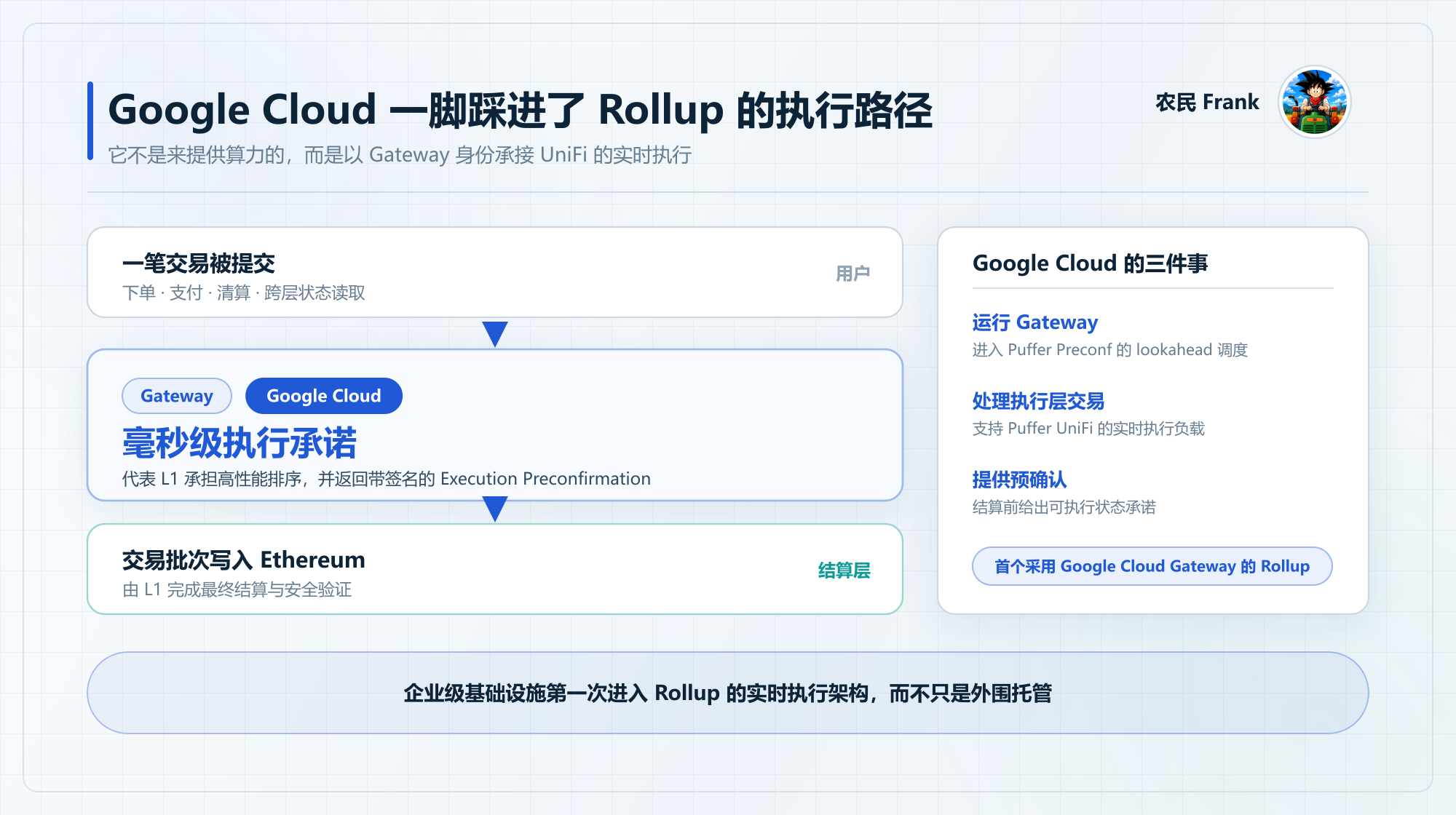
On September 22, Puffer announced a collaboration with Google Cloud, which will serve as a key infrastructure partner, operating Gateway through Puffer Preconf to support the execution layer of Puffer UniFi, aiding in transaction processing and providing Execution Preconfirmation before transactions are finally settled on Ethereum.
More importantly, Puffer UniFi will become the first Rollup to utilize Google Cloud Gateway.
However, if this partnership is merely interpreted as "another Web2 giant entering Web3," one may miss the more significant discussion behind this collaboration.
Because Google Cloud is not taking on a peripheral role in the traditional sense of providing computing power, node hosting, or cloud services for blockchain projects. On the contrary, it is directly entering the real-time execution architecture of Puffer UniFi, becoming one of the layers connecting transaction processing, Preconfirmation, and final Ethereum settlement.
This also raises a larger question: What exactly is Puffer UniFi building? Why does it need a Gateway? And why does Google Cloud choose to engage with Ethereum from this relatively foundational position?
The answer may start from the new phase that Ethereum L2 is entering.
1. Puffer UniFi: An Answer for the Second Half of Rollup
As we move into 2026, Ethereum's Rollup strategy is clearly at a delicate moment.
Since Vitalik Buterin began reflecting on the path of L2, the phased historical mission of L2 as a scaling tool for Ethereum has been announced as complete in both the market and public opinion.
A question has become increasingly sharp: when L2 is no longer just a scaling tool to relieve congestion pressure on L1, how should it define its own existence? How should it redefine its relationship with L1 regarding security, ordering, liquidity, and composability?
Puffer UniFi is attempting to provide one answer to this question.
Puffer UniFi has chosen not to continue operating a relatively independent centralized ordering system but to move towards a Based Rollup: allowing the ordering authority of Rollup to be more directly anchored to Ethereum L1, participating in ordering through the Ethereum validator system, and ultimately inheriting Ethereum's security and neutrality.
This does not mean that L2 has lost its significance.
More accurately, as the phase of purely scaling begins to conclude, Rollup needs to redefine its value positioning: should it continue to exist as a generalized execution layer, or should it become an application infrastructure that better collaborates with Ethereum based on clearer applications, scenarios, and user experiences?
After all, for Ethereum five years ago, L2 scaling was indeed a very realistic and successful route. However, today, five years later, assets and liquidity are scattered across dozens of independent islands, and Rollup must reposition itself, such as the application chain orientation that Vitalik advocates, with clear application scenarios and business boundaries.
The significance of Based Rollup lies in attempting to readjust this relationship.
Its core idea is not complex: since Rollup ultimately still relies on Ethereum for settlement and security verification, the ordering authority can be more directly returned to Ethereum L1, with the Ethereum validator system responsible for Rollup ordering, which theoretically not only eliminates Rollup's dependency on a single sequencer, but also truly achieves synchronous composability between L1 and L2.
In other words, Based Rollup does not propose "to create a faster L2," but rather offers an answer closer to Ethereum's native path—making scaling no longer synonymous with fragmentation, allowing the growth of L2 to reinvest in the security and value of L1.
This is a theoretically impeccable direction, but the problem lies in that the theoretical optimal solution does not automatically equal an operational system in reality:
The first real constraint is speed. Ethereum L1 has a block time of about 12 seconds; if Rollup ordering completely follows L1's pace, each transaction must wait for at least one L1 block to gain relatively reliable confirmation. Ordinary transfers may tolerate this, but for instant payments, order books, perpetual contracts, or high-frequency DeFi applications, this is clearly not comparable to the sub-second feedback provided by centralized sequencers;
The second constraint is the execution burden. As is well known, Ethereum has long insisted on lowering the verification threshold to allow more ordinary hardware and personal nodes to participate in network consensus. However, Based Rollup requires L1 validators to take on roles such as high-frequency ordering and low-latency execution, which inevitably raises the hardware, network, and operational thresholds for validators, potentially creating new centralization pressures at the execution layer;
The third constraint comes from the incentive structure. For many L2 teams, if moving to a Based architecture means increased technical complexity without corresponding benefits, continuing to maintain their own centralized sequencer remains a more rational choice;
Thus, the question around Based Rollup is never about misdirection, but rather that it lacks a layer of practical infrastructure to become genuinely usable—so long as the system is entirely locked to L1's 12-second rhythm, it struggles to balance speed; and if it seeks to retain the neutrality of the mainnet while achieving interaction experiences close to those of centralized sequencers without re-centralizing, it must introduce new role divisions at the execution layer.
This is also the core contradiction that Puffer UniFi must resolve.
Puffer Preconf is introduced into Puffer UniFi's core technology stack in this context—as a set of pre-confirmation services built on EigenCloud (formerly EigenLayer), the ordering authority remains anchored in Ethereum L1, but high-performance ordering, low-latency feedback, and execution pre-confirmation do not need to be fully handled by L1 validators themselves.
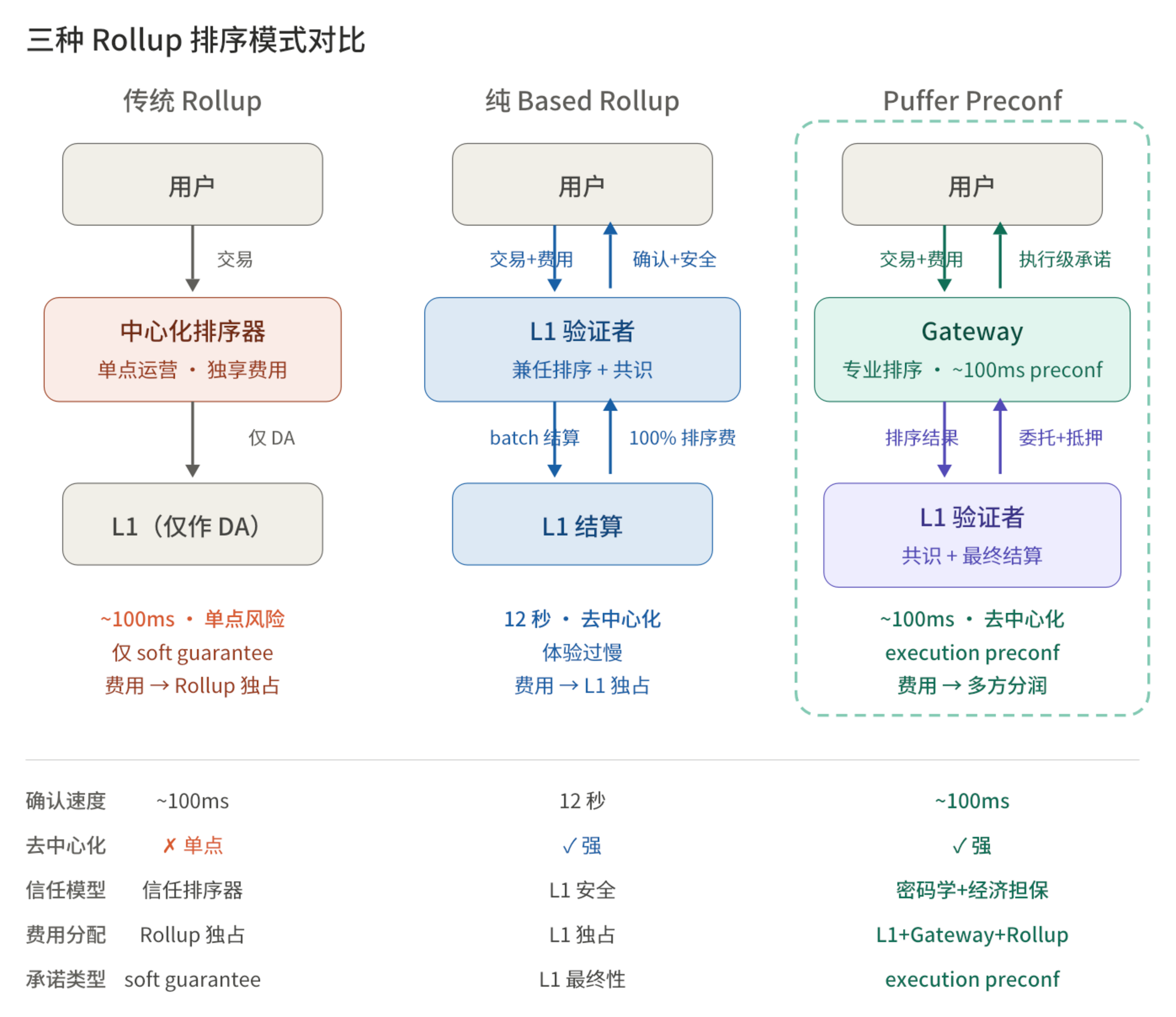
In other words, if Based Rollup answers the question of "who ultimately orders and settles for Puffer UniFi," then Puffer Preconf addresses the question of "how users can receive real-time and reliable execution experiences before final settlement."
And this is precisely the starting point for understanding Gateway.
2. Real-time Execution: Why Does Puffer UniFi Need Preconf?
Before understanding Gateway, we must first understand what Preconfirmation commits to.
In fact, in mainstream L2, the reason users can quickly see transaction feedback is often due to centralized sequencers providing a form of soft guarantee, informing users that their transactions have entered the queue, and the frontend quickly displaying execution results, giving users the experience of "already confirmed."
But strictly speaking, this rapid feedback is largely based on trust in a single sequencer.
Once the sequencer fails, experiences delays, acts maliciously, or encounters censorship, this promise often lacks sufficiently strong economic constraints and verifiable responsibility mechanisms. In other words, the "speed" of traditional Rollups largely derives from the credibility of the sequencer itself.
For Puffer UniFi, this is clearly insufficient, and Puffer Preconf is designed to address this issue.
It attempts to elevate "rapid confirmation" from a trust in a single operator to an execution commitment supported by economic guarantees, signature commitments, and responsibility mechanisms—this not only makes Puffer UniFi faster but also ensures that this "speed" is credible.
To understand this architecture, one must see its role divisions clearly.
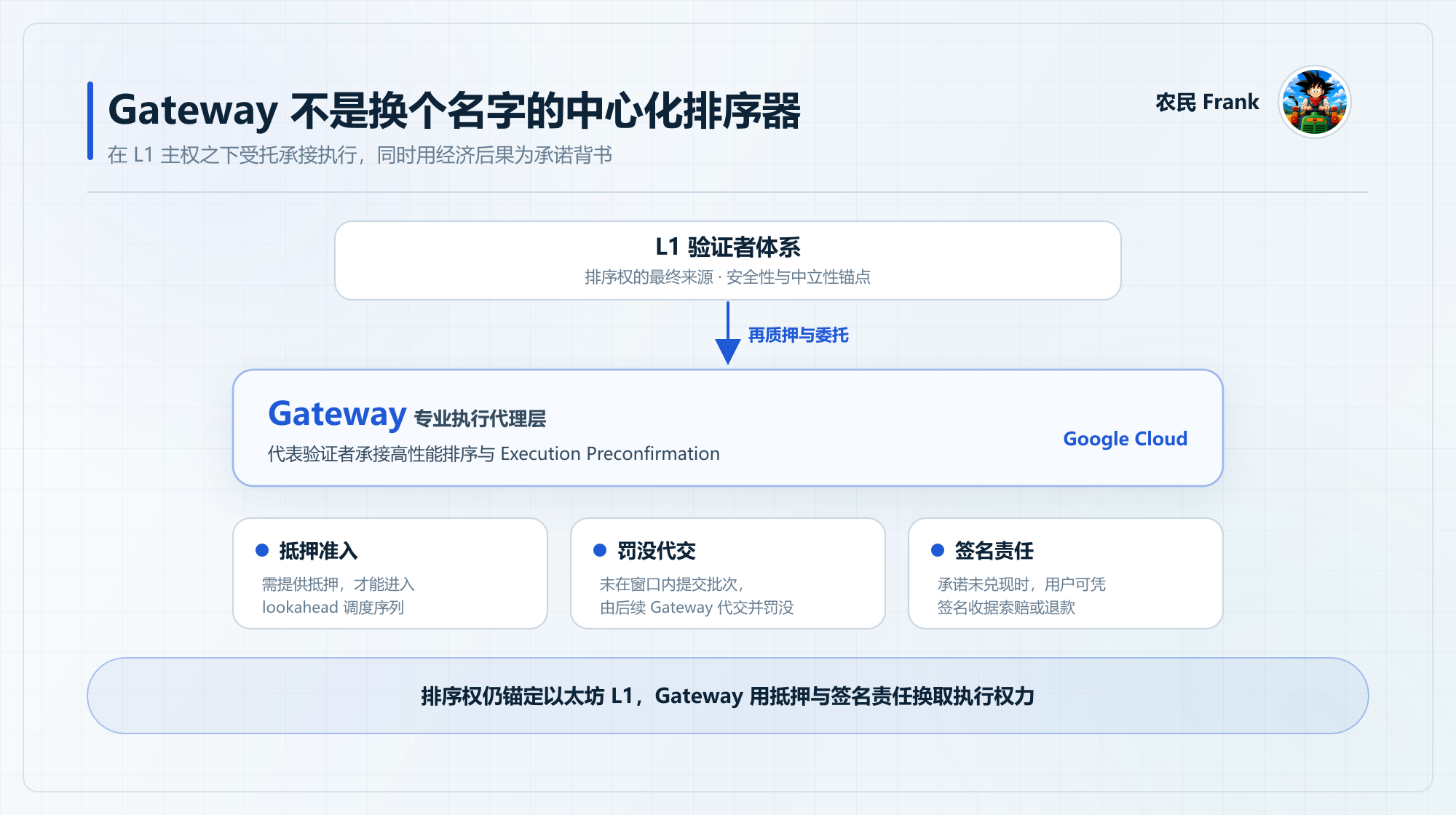
In the design of Puffer Preconf, L1 validators remain the final source of the ordering authority and serve as the anchor for Ethereum's security and neutrality, but they do not need to personally operate a high-performance ordering system or directly bear all low-latency execution work. Instead, through re-staking and delegation mechanisms, validators can delegate this complex work to a more specialized Gateway, which takes on Sequencing and Execution Pre-Confirmation on their behalf.
In other words, the responsibilities of ordering and pre-confirmation are fundamentally borne by the new role of Gateway.
It is not merely a rebranding of traditional centralized Sequencers, nor is it some additional "accelerator plugin" attached to Rollups. It is more akin to a specialized execution agency under the sovereignty of L1, entrusted with carrying out ordering and pre-confirmation duties:
On one hand, it helps L1 Proposers provide higher-performance ordering and pre-confirmation services;
On the other hand, it avoids becoming a new unbounded centralized node through mechanisms such as staking, signature commitments, penalties, and revenue distribution;
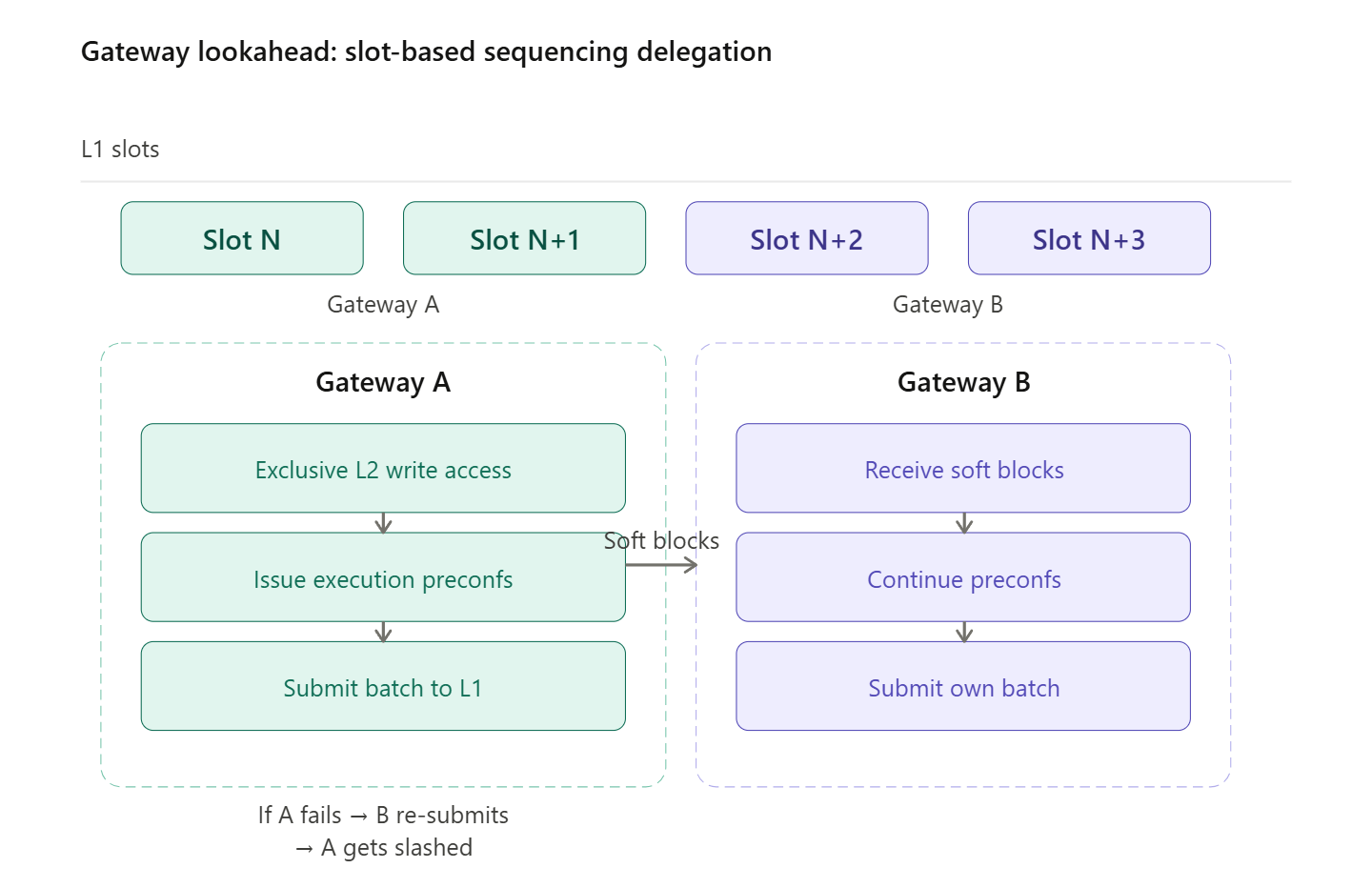
Gateway allows validators to operate a high-performance ordering system without direct operation, but the ultimate ownership of ordering authority remains anchored in Ethereum L1.
This also explains why Puffer emphasizes Execution Pre-Confirmation, rather than just Inclusion Promise: Inclusion promise merely commits that the transaction will be included in a block, whereas Execution Preconfirmation further addresses the question of "whether this transaction will be executed as per the previously committed state."
This distinction is extremely important for applications on high-value chains.
Take perpetual contract DEX as an example. For such scenarios, users are most concerned not about whether their orders have been included in a block, but whether, although they have been packed, the final transaction price, order execution sequence, or liquidation state has deviated. In this context, Execution Preconf can assure users that their transactions will be executed with the state they see when placing their orders, rather than subjecting them to additional slippage or unforeseen execution results.
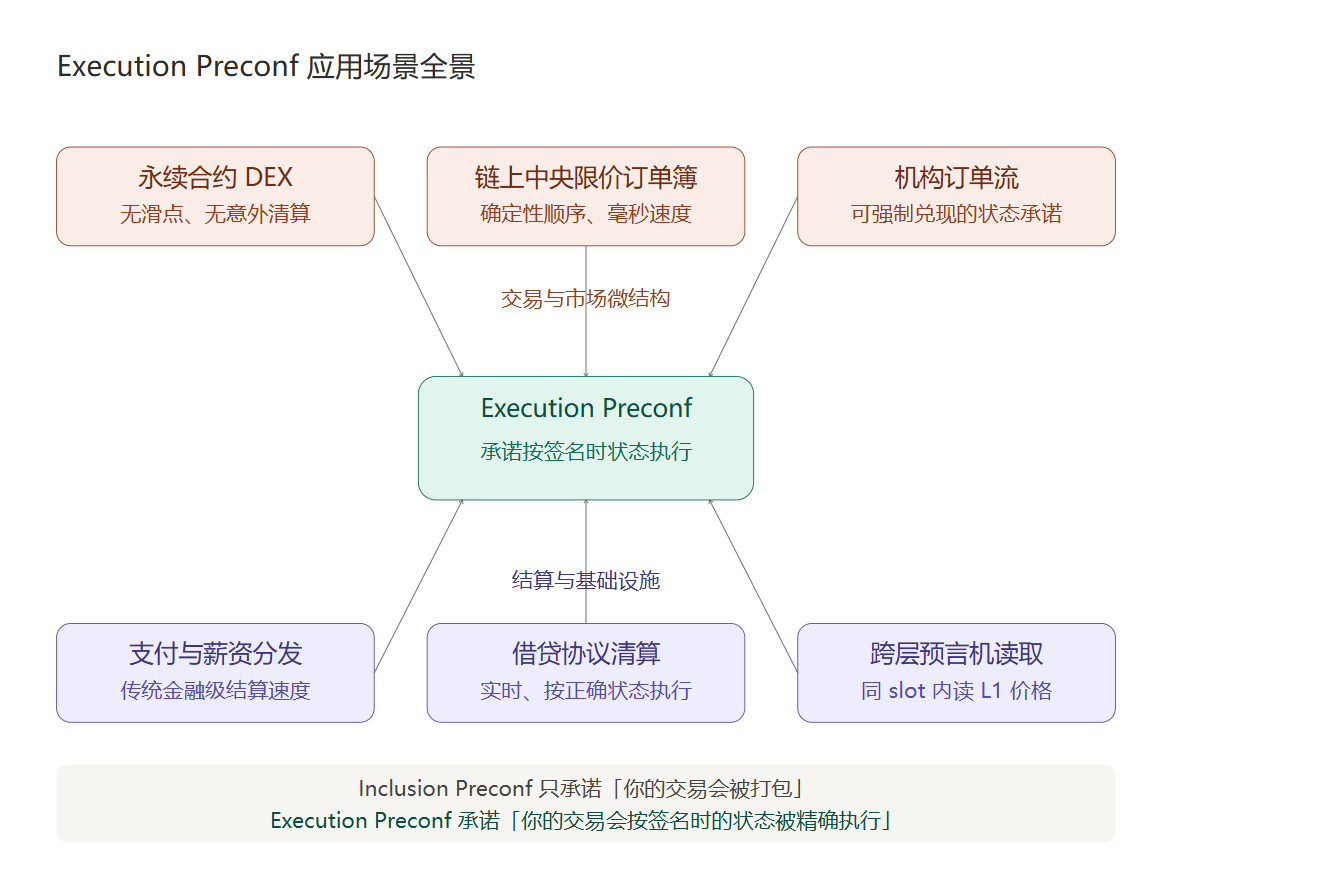
The same logic applies to on-chain central limit order books, institutional order flows, payment settlements, loan liquidations, and cross-layer real-time state reads. CLOB needs deterministic execution order and low-latency feedback; institutional trading requires accountable state commitments; payments and salary distributions need predictable settlement experiences; and liquidation systems need to minimize state drift under volatile conditions.
Of course, any strong commitment must be accompanied by strong constraints. In architectures like Puffer Preconf, the credibility of Gateway does not stem from its self-proclamation of trustworthiness, but from its obligation to bear economic consequences for its actions. There are at least two layers of constraints:
Gateway must provide collateral to enter the lookahead scheduling; if a Gateway fails to submit a batch to L1 in a timely manner within its responsible window, a subsequent Gateway can submit it on its behalf and trigger penalties on the former;
From the user's perspective, if a transaction with pre-confirmation commitments ultimately fails to be fulfilled, users can utilize the signed commitment receipt to claim compensation or request a refund;
It should be noted that the specific penalty mechanisms will evolve with network phases and implementation versions. Therefore, a more accurate statement is not that "Gateway has been slashed in all scenarios," but rather that the design direction of Puffer Preconf aims to substitute traditional centralized sequencers' lack of binding soft commitments with collateral, rewards, penalties, and signature accountability.
In addition to the technical architecture, another unavoidable issue is incentives.
After all, under the traditional Rollup model, most of the sequencing revenue accrues to the Rollup operators; under a purely Based architecture, this revenue flows more naturally towards L1 validators, creating imbalance on both sides.
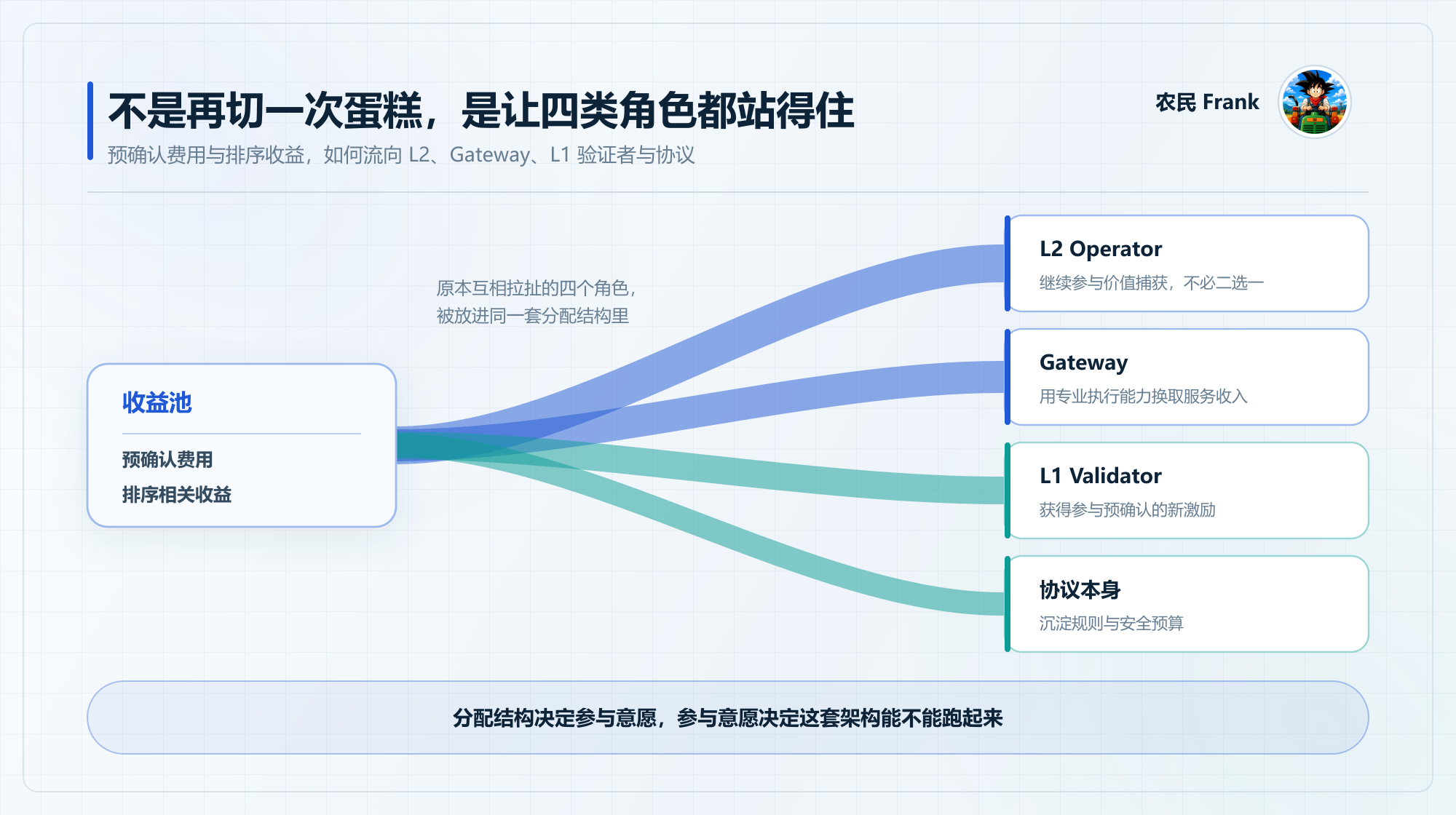
The idea behind Puffer Preconf is to split pre-confirmation fees and sequencing-related revenues among L2 Operators, Gateways, L1 Validators, and the protocol itself. This way, L2 teams do not have to choose between "maintaining experience" and "returning to Ethereum," as L1 validators have the motivation to participate in higher-performance pre-confirmation services, and Gateways become new economic roles that undertake specialized execution capabilities.
The key here is not to "slice the cake again," but rather to pull the previously existing conflicting roles into a single cooperative economic model, allowing L2 to continue to receive profit sharing, L1 Validators to gain new participation incentives, and Gateways to exchange specialized capabilities for service income, while bearing responsibility through collateral, signature commitments, and potential penal mechanisms.At this point, we can better understand the significance of Puffer Preconf for Puffer UniFi.
The real question then becomes: who will run Gateway?
The involvement of Google Cloud is precisely answering this question.
3. From Architecture to Reality: Google Cloud Completes the Gateway Puzzle for Puffer UniFi
Having grasped the previous technical relationships, looking back at the cooperation between Google Cloud and Puffer becomes clearer.
Google Cloud's entry is not into an isolated Preconf network; it is entering the real-time execution architecture of Puffer UniFi directly as Gateway.
According to the partnership announced by both parties, Google Cloud will serve as the key infrastructure partner, operating Gateway through Puffer Preconf to support the transaction processing of Puffer UniFi's execution layer, providing Execution Preconfirmation before transactions are finally settled on Ethereum.
This is why this collaboration cannot simply be understood as a Web2 giant "endorsing Puffer Preconf." For Puffer, the more significant meaning lies in the fact that enterprise-grade infrastructure is genuinely entering the execution architecture of Puffer UniFi.
After all, if Puffer UniFi aims to serve the next generation of DeFi, institutional trading, and even AI Agents, then real-time execution will face real transaction loads, infrastructure stability, network performance, and continuous operational capabilities.
Protocols can define rules, but ultimately, someone needs to run these rules stably. The entry of Google Cloud as Gateway precisely fills this gap.
Looking further out, the significance of Puffer UniFi is not just becoming a new Based Rollup; it is more like Puffer first productizing the entire architectural framework.
Additionally, if Puffer UniFi can prove that Based Sequencing, Preconfirmation, and Ethereum Settlement can simultaneously exist in a real production environment, then it will validate not just a Based Rollup, but a new Ethereum-native Rollup architecture.
For Puffer UniFi, Puffer Preconf is a key module for achieving real-time execution; from a longer-term infrastructure perspective, this Preconfirmation capability could further serve more Rollups.
For existing Rollups, its appeal primarily manifests in two points.
First, it allows Rollup teams to no longer bear the operational pressures of sequencers alone, making Sequencing work jointly shouldered by Gateways and the L1 validator system, while Rollup teams can continue to participate in value capture through revenue sharing mechanisms instead of simply losing all sequencing income.
In other words, it does not require Rollups to completely hand over the cake but rather to redefine the profit-sharing methods among Rollup owners, Gateways, L1 validators, and the protocol.
Second, it can provide stronger state consistency guarantees. For ordinary users, a few cents or dollars in transaction slippage may not be noticeable, but for institutional orders, on-chain order books, derivative trading, and large liquidations, whether the price seen during signing matches the final transaction state directly determines whether the system can accommodate higher-value transaction flows.
Thus, from the overall architecture of Puffer UniFi, Puffer Preconf primarily plays the role of a real-time execution infrastructure: it helps Based Rollups address the issues of low latency and credible execution commitments while introducing specialized trading processing capabilities through Gateway.
However, what Puffer UniFi seeks to validate is not just Preconfirmation itself but whether Based Sequencing, real-time execution, synchronous composability, and Ethereum Settlement can genuinely combine into a usable high-performance Rollup architecture.
In this sense, Puffer UniFi is not a "testing ground" for Puffer Preconf but rather the first time that Puffer's overall judgment about the next phase of Rollup is truly turned into a product.
Preconf is the real-time execution module, Gateway is the professional infrastructure carrying this capability, and Google Cloud's involvement makes Puffer UniFi's architecture one step closer to a real production environment.
In Conclusion
The era of Rollups will not come to an end.
Rather, L2 has completed the first phase of its historical mission to "help Ethereum scale," and needs new paths like Based Rollup to provide answers closer to Ethereum's long-term roadmap.
This is the most accurate way to understand Puffer UniFi and Preconf.
As external infrastructure participants like Google Cloud join as Gateways, Puffer UniFi bears the genuine demands for Rollup execution, Puffer Preconf provides pre-confirmation and economic security frameworks, and Gateway brings specialized trading processing and low-latency execution into the network, with final states still reverting to Ethereum for settlement.
If Puffer UniFi can prove that a Rollup can simultaneously have millisecond-level execution experiences, Ethereum-native Settlement, synchronous composability, and a more open Gateway network, then what it validates is not just a new Based Rollup, but a new possibility:
Applications can have their high-performance execution environments without having to leave Ethereum.
The real-time execution capabilities offered by Puffer Preconf also have the opportunity for validation with this architecture, further serving more Rollups, DeFi, institutional applications, and even AI Agents.
After all, Make Ethereum Whole has never been just a catchy slogan.
Let us wait and see.
免责声明:本文章仅代表作者个人观点,不代表本平台的立场和观点。本文章仅供信息分享,不构成对任何人的任何投资建议。用户与作者之间的任何争议,与本平台无关。如网页中刊载的文章或图片涉及侵权,请提供相关的权利证明和身份证明发送邮件到support@aicoin.com,本平台相关工作人员将会进行核查。