After the SEC opened experimental channels for tokenized US stocks, it was not only the RWA issuance platforms that saw immediate market gains.
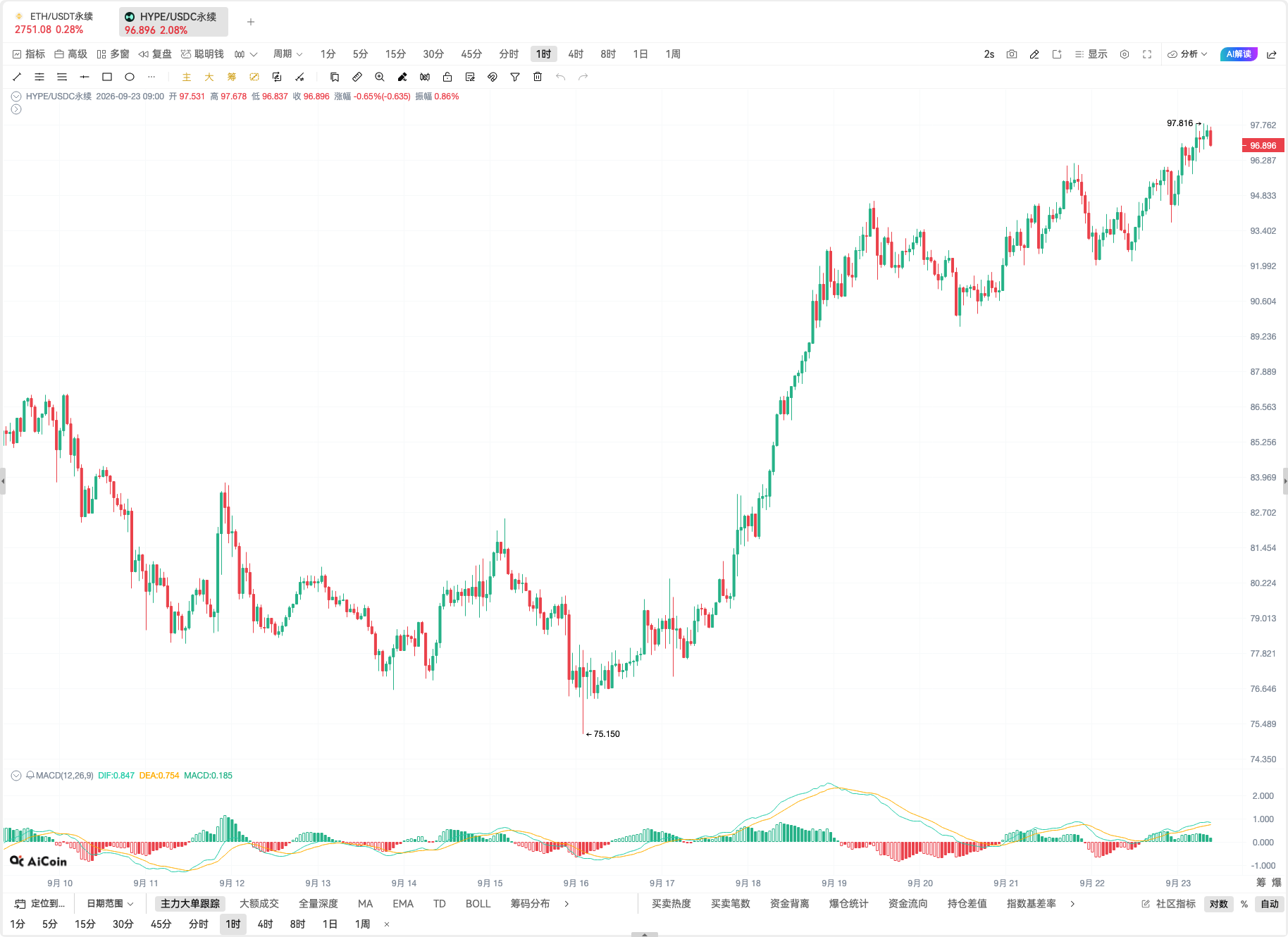
HYPE rose 9.2% in 24 hours, with a cumulative increase of about 10% over two days. In its observations, HYPE is not a direct beneficiary of this policy but has become a "derivative sentiment amplifier" as spot trading spreads to leveraged trades.
This judgment deserves further breakdown.
The SEC's exemption deals with how real stock rights are traded on-chain; Hyperliquid specializes in how markets express direction, manage risks, and use leverage around these assets.
The two are not on the same regulatory path yet may be part of the same funding chain.
Tokenized stocks are responsible for moving assets on-chain, while Hyperliquid focuses on transforming the volatility, hedging, and trading demand around these assets into a market.
This may be the real reason HYPE has been repriced by funds in this wave of the market.
First, let's clarify the policy: the SEC did not allow all platforms to freely issue US stock tokens
On September 17, the SEC issued the "Innovation Exemption," providing conditional, temporary exemptions for specific Tokenized Securities Venues, abbreviated as TSV, for five years.
The core of the exemption allows qualified TSVs to trade tokenized NMS stocks on a public, permissionless blockchain through AMM and liquidity pools that are only open to approved participants. Qualified TSVs can temporarily avoid being recognized as a "exchange" under the Securities Exchange Act, and specific liquidity providers can gain limited exemptions defined as dealers.
But this is not a "license-free operation certificate."
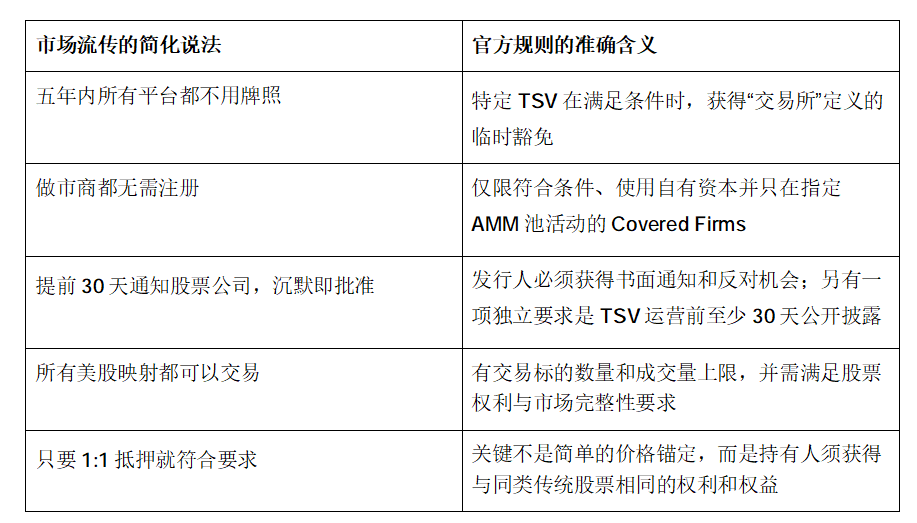
SEC Chairman Paul Atkins emphasized that the tokenized stocks meeting the exemption conditions should not just be exposure to synthetic prices; they should also include corresponding rights such as dividends and voting rights; issuers also have the right to oppose third-party tokenization without their participation.
The SEC's fact sheet further clarifies that this exemption does not cover third-party issued tokenized linked securities or tokenized security-based swaps that provide only synthetic exposure.
In other words, the SEC has released a restricted, licensed, investor-rights-preserving on-chain spot experimental field, rather than giving a blanket green light to all "US stocks on-chain" products.
This boundary is especially important for understanding Hyperliquid.
HIP-3 perpetual stocks are not tokenized stocks under the SEC's current exemptions
Trading stocks perpetually in Hyperliquid's HIP-3 market does not equate to holding a real stock token.
Tokenized NMS stocks represent stock rights; perpetual contracts represent derivative positions established around reference prices. The former focuses on ownership, custody, dividends, and voting rights, while the latter focuses on margin, oracles, leverage, funding rates, and liquidation.
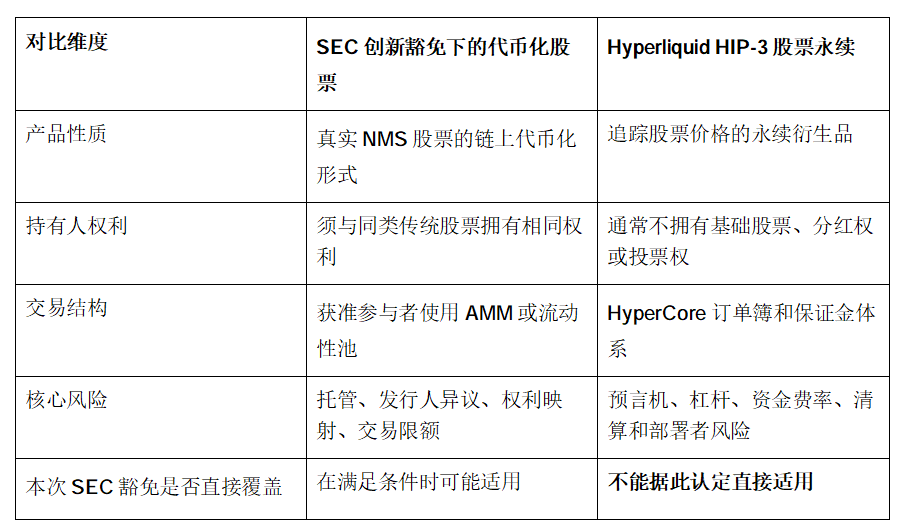
HIP-3 allows Builders to deploy perpetual markets independently and define contracts, oracles, leverage limits, and settlement rules; the market inherits HyperCore’s high-performance order book and margin infrastructure.
This system can accommodate trading demands for stocks, indices, commodities, etc., but does not automatically acquire US derivatives compliance due to the SEC’s approval of tokenized spot experiments.
Therefore, directly stating "Hyperliquid US stock perpetuals have been approved" in reference to the SEC's innovation exemption is incorrect.
However, to think that this policy has nothing to do with Hyperliquid also underestimates the structural changes in the market.
Once the spot is on-chain, it is often the derivative demand that expands first
Financial markets rarely stand still at "buy and hold."
Once an asset gains longer trading hours, broader participation, and increased liquidity, traders naturally will generate new demands:
- Those looking to amplify directional exposure need leverage;
- Those holding spot need to hedge against downside risks;
- Market makers need to manage inventory and cross-market price differences;
- Institutions need to adjust beta without frequently moving the underlying assets;
- Event traders need to quickly express their views during earnings reports, policies, and breaking news.
Tokenized stocks solve the problem of "how assets are held and circulated on-chain," while perpetual contracts solve the problem of "how to trade risks efficiently around assets."
This is the indirect benefit logic of HYPE:
Tokenized stocks expand the on-chain spot market
→ Generate more price discovery and inventory
→ Increase hedging, arbitrage, and leverage demands
→ HIP-3 stocks and indices obtain more trading scenarios
→ Transactions, open interest, and fees may grow
It is important to note that the arrows represent a pathway for which data verification is required, not an automatic income formula post-policy release.
New tokenized spots must first be adopted by operators, issuers, market makers, and users; HIP-3 must also provide reliable oracles, sufficient depth, and competitive fees to truly capture the spillover demand.
Why does HYPE resemble a "volatility toll station" instead of a US stock token issuer?
The US stock tokenization industrial chain is long: issuance, custody, reserve proof, cross-chain, oracles, spot matching, brokerage entry, and derivatives trading may all participate.
However, the importance of the industrial chain does not mean the token necessarily has equal value capture.
HYPE is a "derivatives sentiment amplifier." It captures the valuation method that distinguishes HYPE from other concept tokens: the market is not just betting on Hyperliquid's participation in stock tokenization, but is betting that as more assets go on-chain, trading risks themselves will become a bigger business.
Hyperliquid does not need to be responsible for issuing every stock token, nor does it need to be the custodian of all spot assets. It only needs to make traders willing to express long or short positions, execute arbitrage, or manage risks when prices change at HIP-3.
From this perspective, Hyperliquid is more like a "volatility toll station":
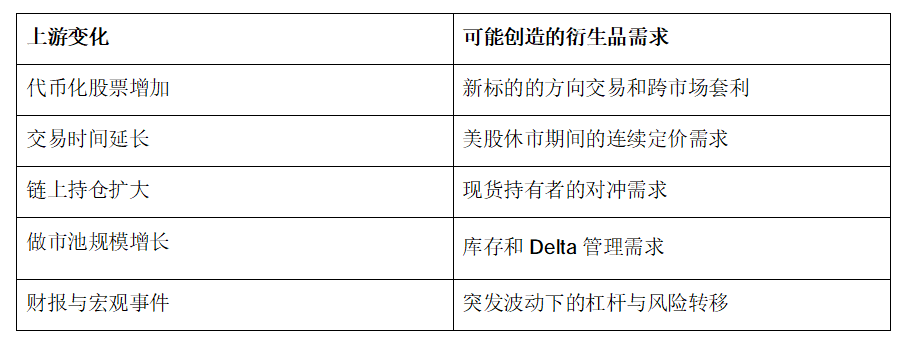
For Hyperliquid, what matters is not how much HYPE rose on the day the policy emerged, but whether the trading volume, open interest, and active accounts of perpetual stocks can sustain long-term increases.
From sentiment amplifier to income amplifier, three steps remain
The rise of HYPE on September 18 only indicates that funds have chosen it as one of the representative tokens for RWA derivatives trading; it cannot prove that income has risen concurrently.
To turn the market narrative into the fundamentals of the protocol, at least three conversions need to be completed.
Step 1: Policy heat transforms into real assets
TSVs need to comply with conditions such as US entity status, sanctions compliance, permitted access, public disclosure, synchronized trading pauses, and limits on the number and volume of underlying assets.
Issuers can also oppose third parties tokenizing their stocks. The policy provides a channel but does not automatically generate on-chain liquidity for stocks like Apple, Nvidia, or S&P components.
Step 2: Spot liquidity transforms into HIP-3 transactions
Having tokenized stocks does not guarantee that users will choose Hyperliquid for hedging.
The HIP-3 market still needs to compete with other exchanges, options, traditional futures, and OTC tools. The ability to provide lower slippage, more reliable price sources, higher capital efficiency, and compliance with regulatory requirements in the user's location will determine where trading demand finally flows.
Step 3: HIP-3 transactions transform into HYPE value recirculation
Hyperliquid's official fee rules show that HIP-3 deployers can set additional fee-sharing; part of non-crypto markets can also enable Growth Mode, reducing overall fees by at least 90%. Protocol fees will flow to HLP, Assistance Fund, and deployers, while parts received by the Assistance Fund will automatically convert to HYPE and permanently withdraw from circulation and total supply.
Thus, it cannot simply use "stock perpetual transaction volume × base fee rate" to estimate HYPE recirculation.
The actual value capture depends on:
Transaction volume × Actual fee rate × Protocol retention × Assistance Fund allocation
Only when this chain continues to grow can HYPE upgrade from the sentiment Beta in the policy market to real income Beta.
In trading this main line, don't just look at whether HYPE has risen
The most common mistake in event-driven markets is to see a concept rise and treat all tokens in the supply chain as the same type of asset.
A more effective observation method is to divide the market into three layers:
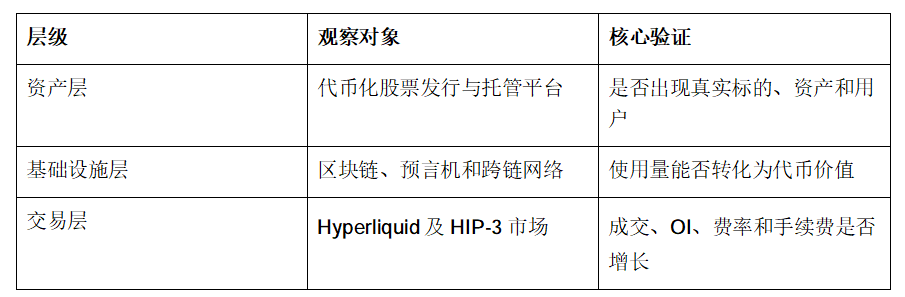
HYPE is closer to the third layer.
Its advantage is its proximity to real trading behavior, allowing market sentiment to quickly reflect in transactions and positions; its risk lies here too - if funding rates become overheated, OI only increases without decreasing, or smart money starts to cash out, the sentiment amplifier will also amplify the downturn.
Therefore, it is necessary not to automatically chase any HYPE rise due to long-term favorable policies from the SEC for on-chain securities. Long-term industrial directions and short-term positions must be judged separately.
Using AiCoin to observe: Is HYPE accommodating demand, or just accommodating sentiment?
When HYPE is seen as a sentiment thermometer for RWA derivatives, the trading focus shifts from just price to the quality of positions behind the price.
Through the AiCoin mobile terminal, you can synchronously observe the relative strength of HYPE against US stock tokenized-related assets, combined with open interest and funding rates to judge whether the rise is driven by spot demand, leveraged chasing, or short covering. If HIP-3 stock market transactions continue to expand and smart money accounts begin to establish cross-market hedging positions, it indicates that policy heat is transforming into real trading demand; if only the HYPE price rises rapidly while the activity in HIP-3 improves, it is closer to sentiment trading.
After making a judgment, you can directly connect with Hyperliquid through AiCoin to execute trades and continue managing positions across different markets on the mobile terminal. This way, users are not led by a "policy benefit leaderboard," but instead seek validation between assets, funds, and trading behaviors.
Access Hyperliquid through the exclusive AiCoin portal and use the invitation code AICOIN88 to receive a 4% fee rebate according to the activity rules:
Exclusive link:
https://app.hyperliquid.xyz/join/AICOIN88
The rebate can reduce the actual trading costs incurred but cannot offset risks from incorrect leverage direction, accumulated funding rates, or liquidity risk in the HIP-3 market.
Conclusion: Stock tokenization is just the first step, and risks will also go on-chain
The significance of the SEC's innovation exemption does not lie in allowing all US stocks to immediately become freely tradable tokens but in providing, for the first time, a temporary, testable framework for trading real stock rights on a public blockchain.
This framework targets tokenized spots and does not directly approve Hyperliquid's stock perpetuals.
However, as real stocks gradually gain on-chain liquidity, traders will not be content just holding. They will also need leverage, hedges, arbitrage, and continuous pricing, and these demands happen to be the parts that Hyperliquid and HIP-3 excel at accommodating.
Stock tokenization expands the on-chain asset pool; Hyperliquid is competing for all trading risks generated around that asset pool.
Therefore, HYPE becoming a "derivatives sentiment amplifier" is not without logic. What needs to be truly verified is whether it can further become a transaction amplifier and a fee amplifier.
In the future, to gauge this main line, look less at daily gains and more at three sets of data: HIP-3 stock market transaction volume, open interest, and actual fee flow.
The policy is responsible for opening the asset entry, while traders ultimately decide where the liquidity stops.
Exclusive benefits for AiCoin users
👉 When binding a Hyperliquid account, enter the invitation code AICOIN88 to enjoy a 4% fee rebate
🔗 Exclusive registration link:
https://app.hyperliquid.xyz/join/AICOIN88
📖 Beginner's Tutorial:
"AiCoin PC Hyperliquid Authorized Trading Tutorial":
https://www.aicoin.com/zh-Hans/article/514197
"AiCoin Mobile Hyperliquid Authorized Trading Tutorial":
https://www.aicoin.com/zh-Hans/article/541383
"Zero Basics Entry! Hyperliquid First Trade Ultra-Detailed Illustrated Tutorial":
https://www.aicoin.com/zh-Hans/article/510225
📖 Community Communication:
Telegram:
Discord:
AiCoin-Group Chat:
https://www.aicoin.com/link/chat?cid=N6OVMor5g
The content of this article only represents the author's personal views and does not represent the position of this platform. The views, conclusions, and suggestions in the text are for investor reference only and do not constitute any investment advice related to this platform. Investing in US stocks still requires self-assessment of market risk, regulatory risk, and compliance risk with local laws and regulations (especially foreign exchange controls, offshore investment declarations, etc.).
免责声明:本文章仅代表作者个人观点,不代表本平台的立场和观点。本文章仅供信息分享,不构成对任何人的任何投资建议。用户与作者之间的任何争议,与本平台无关。如网页中刊载的文章或图片涉及侵权,请提供相关的权利证明和身份证明发送邮件到support@aicoin.com,本平台相关工作人员将会进行核查。