Investment Logic
Atlas Energy Solutions (AESI) primarily provides proppant sand to the Permian Basin and offers supporting logistics services to transport this fracturing sand to well sites. The company has faced a challenging operating environment over the past 18 months as overall oilfield activity in the U.S. has gradually slowed down. With demand falling below existing capacity, the profit margins of the fracturing sand business have also been significantly pressured.
During the peak oilfield activity in the U.S. in 2022, proppant sand prices exceeded $40 per ton. Currently, this price is about $18 per ton. This means that with an increase in U.S. drilling and completion activities following the closure of the Strait of Hormuz, there is a significant opportunity for profit margin expansion in the company's fracturing sand business.
The company believes that the current proppant sand market is tight enough to support future price increases. As producers begin to formulate their production plans for 2027, I expect AESI's fracturing sand sales and corresponding profit margins to improve.
While this is clearly an investment tied to the oilfield activity cycle, the company's modular power business also enjoys additional tailwinds. Currently, AESI has ordered 2GW of Caterpillar engines, meaning the company's growth prospects do not solely rely on cyclical proppant demand.
Based on the combination of these two factors, I continue to rate the company as “Strong Buy.”
Reviewing History to Understand the Fracturing Sand Cycle
AESI only went public in 2023. Therefore, we cannot directly compare the company's stock performance at the beginning of the Russia-Ukraine war with the current situation. However, the company's financial data from that time can still be found through SEC filings.
As shown below, U.S. oilfield activity significantly increased in 2022 and 2023, driving a sharp rise in the price of fracturing sand used in completion activities. As industry activity gradually cooled down, fracturing sand prices fell due to declining demand and excess mining capacity.
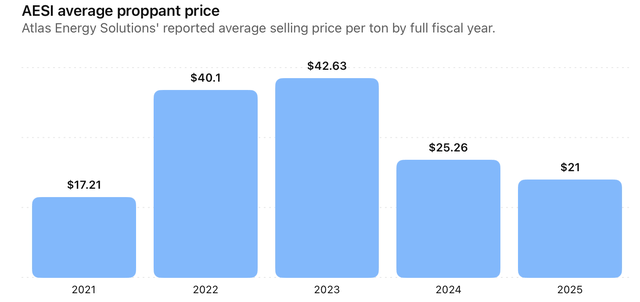
[Original Image Position: Annual Average Proppant Prices (Atlas Energy Solutions / AESI 10-K filings)]
This downtrend persisted until the first two quarters of 2026, during which the actual fracturing sand sales price reported by the company was approximately $18 per ton. However, the closure of the Strait of Hormuz has structurally changed the supply-demand balance for crude oil. A previously oversupplied market has now transformed into one with severe shortages.
Drilling activity has started to accelerate to seize the higher-margin market environment, with the total number of rigs in the U.S. having increased by 10% year-to-date. Typically, completion activities lag behind drilling activities by several months. Therefore, this will further lead to increased proppant demand.
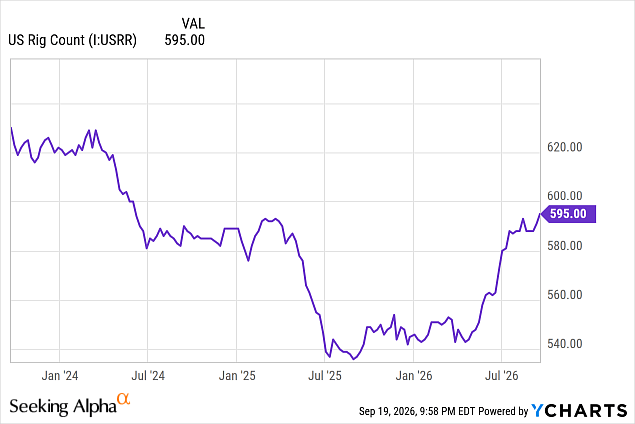
[Original Image Position: Changes in U.S. Rig Count (YCharts)]
This increase in proppant demand could directly become a strong driving force for the company. AESI's management believes that the actual tightness of the current market is significantly higher than perceived by producers. Therefore, the company is adjusting its business strategy in hopes of achieving higher profit margins from product sales.
CFO Blake McCarthy explained in several ways how the company leverages low-cost advantages provided by Dune Express, autonomous trucks, and high-efficiency dredging mines to pressure competitors. During this process, AESI believes that while there may still be apparent excess nominal capacity in the market, these mines have not received sufficient maintenance in the past, making it difficult to quickly restart production.
The company has successfully weathered the low-margin phase and has remained profitable during this period, allowing AESI to shift to an offensive position and actively pursue higher profit margins.
Blake McCarthy—Atlas Energy Solutions CFO:
Over the past six quarters, Atlas has further solidified its relationships with core customers by leveraging its position as a low-cost proppant producer. We are able to provide service levels and execution reliability that other vendors in the market cannot replicate. Therefore, we have begun to implement stricter pricing discipline on the quantity we sell and the customers we choose to serve. We believe this is an important next step for Atlas to achieve maximum success in 2027.
This raises the intriguing possibility that AESI's profit margins may see significant expansion. Many proppant service operators, such as ProFrac (ACDC) and Liberty Energy (LBRT), have reported that completion plans for 2026 are tightening. However, all three companies anticipate that the lag effect between drilling and completion rates will truly manifest in 2027.
To simulate AESI's earnings sensitivity to improvements in proppant demand, I constructed several different price scenarios. I selected $25 per ton as a reference for the average price over the past five years while using $27.50 per ton and $30 per ton as more optimistic upside scenarios.
Proppant Price | New Profit from Existing Sales | New Profit from Incremental Sales | Total New Profit |
|---|---|---|---|
$25/ton | $158M | $62M | $220M |
$27.50/ton | $215M | $74M | $289M |
$30.00/ton | $271M | $87M | $358M |
These numbers indicate that AESI has a very strong profit elasticity in response to improvements in proppant prices. For reference, if we annualize the performance from the first half of 2026, the company's current full-year EBITDA is approximately only $200 million. Therefore, even if proppant prices merely revert to the average level of the past five years, the company's EBITDA could potentially double.
Why AESI is a Superior Proppant Supplier
The statements from management above actually suggest that AESI has been steadily gaining market share during the industry's downturn. The reason the company has been able to do this is due to its significant cost advantages compared to its peers. This advantage stems from both technology and differentiated mining layouts.
In terms of technology, the company reduces transportation costs for the industry through the Dune Express delivery system and autonomous trucks. Both of these factors can reduce actual transportation mileage, as the company can avoid using public roads and optimize the transport distance between mines and well sites.
To further expand this advantage, AESI plans to continue growing its fleet of autonomous trucks. This not only gives AESI the opportunity to become the “Amazon” of proppant transportation but also helps the company mitigate against rising truck driver wages. As oilfield activities increase, there will be a need for significant truck capacity to meet the demands of new drilling and completion teams in the region, and these labor costs are expected to rise accordingly.
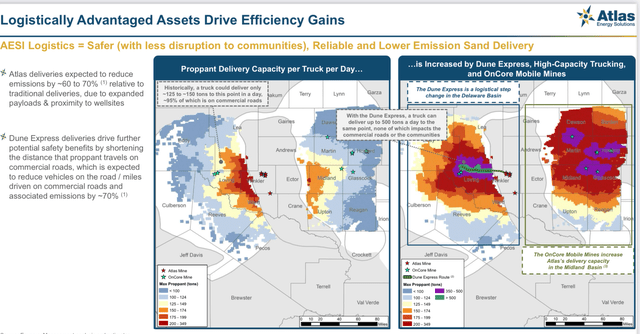
[Original Image Position: Dune Express and Proppant Transport Capacity (AESI Investor Presentation)]
In addition to technology, AESI also has a differentiated mining layout. The company’s operating cost is only about $13 per ton, significantly lower than its competitors.
For comparison, ProFrac, according to current capacity utilization rates, reports operating costs of over $20 per ton. The much smaller competitor Smart Sand (SND) has a more competitive cost structure, approximately $14-15 per ton. However, SND's mines are mainly located around the Great Lakes, so transporting proppant sand to the Permian Basin incurs additional rail transport costs.
From this data, it is clear to see the advantages AESI possesses. Its mines have economic advantages in themselves, and combined with transport capacity, the company can also compete at lower prices in the second stage while protecting its profit margins.
Valuation Forecast
If we assess AESI's valuation based on today's performance, the company appears quite expensive, currently trading at about 25 times EBITDA. However, this situation is not uncommon for cyclical companies. At the bottom of the cycle, valuation multiples often look very high; conversely, at market peaks, valuations can seem very cheap.
However, using forward-looking valuations can provide a more reasonable valuation metric, as this method attempts to incorporate the impact of improvements in the proppant sand market ahead of time. To simulate potential valuation changes, I again used three scenarios: $25, $27.50, and $30 per ton.
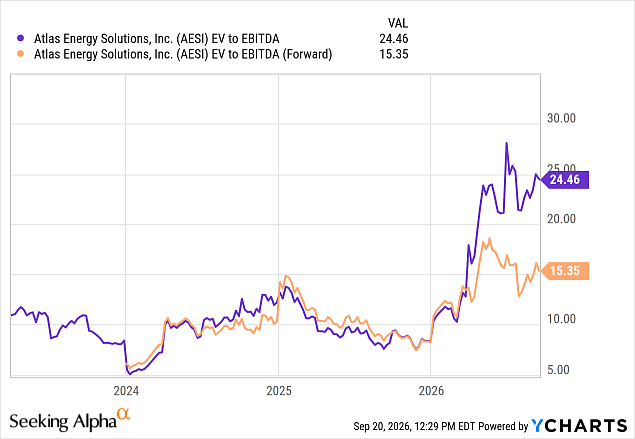
[Original Image Position: AESI Valuation Trends (YCharts)]
In the scenario where the market returns to average price levels, considering the current contributions from logistics and power businesses, AESI’s valuation is about 7.5 times. If proppant prices further recover to $30 per ton, the corresponding forward valuation is about 5 times, which starts to look quite attractive.
I believe these estimates are, in fact, quite conservative, as the model does not account for the cost efficiency improvements that come with increased mining capacity utilization. In reality, profit margins are likely to rise from two directions simultaneously: costs decreasing while selling prices improve.
Furthermore, these forecasts do not take into account the potential improvements in the logistics business that may occur with increased transportation activities. As demand for truck transport rises, given that autonomous trucks have high fixed costs and low incremental costs, this business segment’s profit margins are likely to expand further.
As a final source of value that is still undervalued by the market, I must mention the company's growing power business again. This has also been a key topic in my previous articles about the company.
In this business, the company expects to deploy 180-200MW of on-site power capacity by the end of the year to support drilling and completion activities. Additionally, the company has already ordered 2GW of Caterpillar (CAT) engines to electrify AI data centers. This is clearly a growth strategy that also helps the company’s profit structure gradually break free from reliance on highly cyclical commodity businesses.
In summary, I believe that as completion activities begin to increase over the coming quarters, AESI will derive significant value from improving demand. With sales growth, logistics revenue should also rise in tandem. Furthermore, the growth of the power business provides undeveloped value that can extend up to 2030.
I believe the latter will also help the company achieve higher valuation multiples. As the company’s profits gradually shift toward long-term power contracts while reducing reliance on cyclical profits, this valuation increase is justified. The total value that AESI has not yet been fully priced in by the market leads me to continue to rate the company as “Strong Buy.”
Risks
One of the main risks facing the expansion of proppant prices is the substantial excess capacity still present in the market. The competitors discussed in this article currently have an overall mining capacity utilization of only about 50%. In contrast, AESI's current capacity utilization has reached 75%.
As there is still a significant amount of what is known as “nominal capacity” in the market, the industry will have the opportunity to validate whether the “zombie capacity” described by AESI's management truly exists. Management has strongly emphasized that while this capacity still exists on paper, other mine owners have not performed sufficient maintenance in the past, making it impossible for these mines to restart production quickly.
If management's judgment is correct, then competitors' responsiveness to new proppant demand will be limited. However, if this judgment is exaggerated, competitors can continue to suppress industry profit margins in two ways.
First, more proppant sand re-entering the market will delay the time it takes for the market to truly reach a supply-demand imbalance state, thereby limiting prices from experiencing exponential increases. Second, as producer activity rebounds, AESI's current cost advantages may also diminish. After volumes increase, these three peers should all benefit from economies of scale. However, compared to AESI, ACDC and SND have a significantly greater potential to expand their production volumes, which could result in a more pronounced decrease in their costs per ton.
Investor Key Conclusions
AESI has significant positive profit elasticity in response to rising proppant prices.
The company's current advantageous position allows management to adopt more aggressive pricing strategies in the short term and in 2027.
In the proppant upcycle, the company's proppant business has substantial room for value enhancement. At the same time, with the increase in transport volume, the logistics business should also see growth and realize margin expansion through autonomous truck capabilities.
Additionally, the company expects to deploy nearly 200MW of power capacity by the end of this year and plans to expand this scale to over 2GW by 2030, thereby adding a more stable asset to the company.
As the power business continues to grow, I expect the company to receive higher valuation multiples.
In summary, these factors give AESI both cyclical proppant recovery opportunities and AI power demand-driven long-term growth attributes. Therefore, I rate the company as “Strong Buy.”
免责声明:本文章仅代表作者个人观点,不代表本平台的立场和观点。本文章仅供信息分享,不构成对任何人的任何投资建议。用户与作者之间的任何争议,与本平台无关。如网页中刊载的文章或图片涉及侵权,请提供相关的权利证明和身份证明发送邮件到support@aicoin.com,本平台相关工作人员将会进行核查。


