CoinW Research Institute
1.CATE Explodes, Has the Solana Cat-themed Memecoin Returned?
On July 26, a cat-themed Memecoin called CATE was launched on Solana through Pump.fun. Its initial popularity stemmed from a story involving a little cat related to the Dogecoin (DOGE) community. On that day, Atsuko Sato, the owner of Kabosu, the Shiba Inu that is the face of DOGE, posted a video of a rescued kitten, and the community quickly associated this cat with the concept of a "cat version of DOGE," leading to CATE being launched in the market shortly thereafter. It is important to note that this cat is actually named Momo by Sato, and the CATE Memecoin was not issued or endorsed by Sato herself.
What truly propelled CATE into the spotlight was the familiar "attention - trading volume - price" cycle in the Memecoin market. After its launch, the token quickly spread across social media, soaring over 230 times in a single day and briefly surpassing a market capitalization of 9.5 million USD. Subsequently, CATE experienced significant volatility, but its popularity did not completely fade. By mid-September, project data indicated its market cap had reached around 100 million USD, with a 24-hour trading volume exceeding 20 million USD. The rise of CATE essentially represents a merging of the classic animal Memecoin culture with Solana's high-frequency issuance and trading environment. However, whether this is merely a short-term rotation or signifies that the dormant Solana cat-themed Memecoins are regaining market attention requires examining CATE within the context of the entire Solana Memecoin ecosystem.
2.Has the Cat-themed Memecoin Returned, or Is CATE the Only Project Gaining Strength?
The term "cat" is not a new theme on Solana. During the previous Memecoin cycle, POPCAT and MEW (Cat in a Dogs World) already demonstrated that cat-themed IP can attract market attention. Among them, MEW is particularly noted as one of the representative projects of the "Cat Season" in 2024, distinguishing itself with the simple narrative of "cats entering the dog world," setting it apart from the established dog-themed IPs like DOGE and WIF. By 2026, new projects like CATE and ZCAT continued to emerge, but based on the current market structure, it's still difficult to assert that "cat season" has fully returned. Traditional cat-themed Memecoins like POPCAT and MEW maintain some trading activity, and while new projects can quickly gain market attention, the performance among cat-themed projects remains relatively dispersed, with no clear signs of the entire sector strengthening synchronously.
This reflects not just that "cats are popular again," but rather the continuous rotation of IP within the Memecoin market. Dogs, cats, frogs, and various internet personalities and social hot spots can serve as carriers of short-term attention. Especially with platforms like Pump.fun pushing low-threshold issuance, new tokens can quickly complete issuance, trading, and dissemination, with the speed of market hot spot switching increasing. CATE just happened to align with this mechanism. The classic animal Memecoin culture and the related stories from the DOGE community, combined with Solana's high-frequency trading environment, make it easy for it to gather attention in a short time. However, rather than discussing "whether cat season has arrived," it is more noteworthy to observe whether the entire Solana Memecoin market behind CATE is warming up in tandem.
3.The Trenches Have Indeed Heated Up, but Liquidity Remains Highly Concentrated
Sector Trading Activity Clearly Increased
To determine whether CATE's rise represents an isolated event, we must first examine the temperature of the entire Solana Memecoin market. As of September 21, data from CoinGecko showed that the total market capitalization of the Solana Memecoin sector was approximately 3.7 billion USD, with a 24-hour trading volume of about 710 million USD. In late August, this sector's weekly spot trading volume once reached approximately 5.2 billion USD, setting a new high since 2026 and the highest level since November 2025. However, the capital is not evenly distributed, with TRUMP, PENGU, BONK, WIF, and FARTCOIN still occupying a significant portion of the market cap and trading volume. Although the overall trading activity of Solana Memecoin has rebounded, liquidity still notably concentrates on leading projects, making it difficult for new Memecoins to continuously attract capital. It is also necessary to differentiate between "market cap increase" and "liquidity improvement." For Memecoins, market cap is essentially a result calculated based on the latest price and circulation, and does not imply that there is an equivalent scale of capital within the market. A Memecoin can quickly reach market values of tens of millions or even over a billion USD, but if the liquidity of the main trading pools does not grow in tandem, large buy and sell orders may still encounter significant slippage. Therefore, when judging the popularity of new Memecoins like CATE, in addition to price and market cap, attention must also be paid to the depth of trading pools, actual trading volumes, and turnover rate.
Many New Coins, but Only a Few Truly Survive
If we further look at the supply and lifecycle of new coins, another aspect of the market becomes clearer. Platforms like Pump.fun have significantly lowered the barriers to creating Memecoins, allowing a large number of new tokens to enter the market in a very short time, but very few can maintain continuous trading. An analysis by CoinGecko covering over 18.67 million Pump.fun tokens from January 2024 to June 2026 shows that approximately 68.7% of the tokens had their last trade on the day of issuance, with only 4.55% of the tokens having trading records longer than 90 days. It is important to note that this statistic does not fully track the trading of tokens after graduation on external DEXs like Raydium, Meteora, PumpSwap, and therefore cannot be directly interpreted as the final "survival rate" of projects. However, it still indicates that, amid such a vast supply of new coins, projects that can retain trading attention for the long term remain very limited.
Moreover, the proportion of new coins entering deeper liquidity markets will also change with market conditions and platform mechanisms. In July 2026, the graduation rate of Pump.fun tokens surged to about 6.7%, up from an average of about 4.7% over the previous four days, and around 2.5% the week before. During the same period, Pump.fun introduced new post-graduation liquidity incentive mechanisms like BOOST. Since BOOST primarily takes effect after a token has undergone bonding, it does not mechanically increase the graduation rate, but the auto-buy and token burning mechanisms after graduation may enhance market incentives for tokens that have completed bonding. Thus, the current characteristics of Solana Memecoins are not simply that "more new coins are appearing," but rather an exceedingly ample issuance supply, in conjunction with increasingly intense competition for attention and liquidity among projects. For a new Memecoin, issuance is just the starting point; its ability to continuously attract community attention, trading volume, and liquidity ultimately determines whether it can survive among a multitude of new coins.
Memecoins Have Become an Important Component of Solana's Trading Activity
This competition is supported by a set of mature trading infrastructure. Platforms like Raydium, Jupiter, Pump.fun, and PumpSwap fulfill different roles in new coin issuance, liquidity provision, and trading aggregation. During the week ending August 26, Solana Memecoins had a spot trading volume of approximately 5.2 billion USD; meanwhile, the total spot trading volume for Solana DEXs was about 42.4 billion USD, with PumpSwap accounting for approximately 29.5 billion USD and Jupiter aggregate trading around 5.3 billion USD. It should be noted that the 5.2 billion USD figure specifically counts the spot trading volume of certain Memecoin assets, while the other figures come from a broader DEX statistical scope and cannot be directly added or corresponded one-to-one. They are more suitable for illustrating that Memecoins have now become a significant part of trading activity on the Solana chain. Therefore, CATE faces more than just other cat coins. It enters a Memecoin market characterized by abundant new coin supply, concentrated head liquidity, and rapid hot spot rotation. The Solana Memecoin trenches have indeed heated up again, but "a rebound in trading activity" and "all Memecoins reviving" are still two different matters.
4.New Changes in 2026: Platforms Begin Competing for Liquidity Entry
If the Solana Memecoin boom of 2024 was mainly driven by low-threshold token issuance, then a more apparent change in 2026 is that competition is shifting from "who can issue more Memecoins" to "who can provide new trading methods and liquidity entry." The typical model of 2024 was relatively straightforward. Users mainly traded using SOL, issued new Memecoins through platforms like Pump.fun, entered DEXs like Raydium for deeper liquidity, and subsequently expanded popularity through community dissemination and capital rotation. Consequently, Pump.fun and Raydium became critical infrastructure in the Memecoin ecosystem at the time. By 2026, there was a noticeable increase in combinations of Memecoins with other narratives. In addition to traditional animal IPs and social hot spots, the market began to see new plays like Memecoin + AI, Memecoin + Launchpad, and Memecoin + Tokenized Stocks. Notably, the quoted assets for Memecoins began to expand from SOL to various other on-chain assets.
StonkFun is a representative case of this change. In early September, after integrating with Raydium LaunchLab, its platform token STONK surged over 250% within 24 hours, reaching a market cap of about 14 million USD, with a 24-hour trading volume of approximately 135 million USD. StonkFun's feature is that it allows newly issued tokens to use a richer array of on-chain assets as quoted assets, no longer limited to traditional trading pairs like SOL. This includes traditional assets like tokenized stocks, ETFs, and commodities, as well as popular crypto-native assets like ZEC. This mode effectively links Memecoin issuance with different market narratives like RWA and popular crypto assets, diversifying the trading targets and sources of liquidity for memes. On September 9, Pump.fun launched Custom Pairs, further extending the selectable quoted assets for new tokens from traditional assets like SOL to tokenized stocks, mainstream crypto assets, and metals. This has led to a new form of competition in the market. Platforms are no longer just vying for "where to issue the next hot Memecoin," but also for what assets users use to trade Memecoins and where liquidity ultimately settles.
Source: CoinW Research Institute
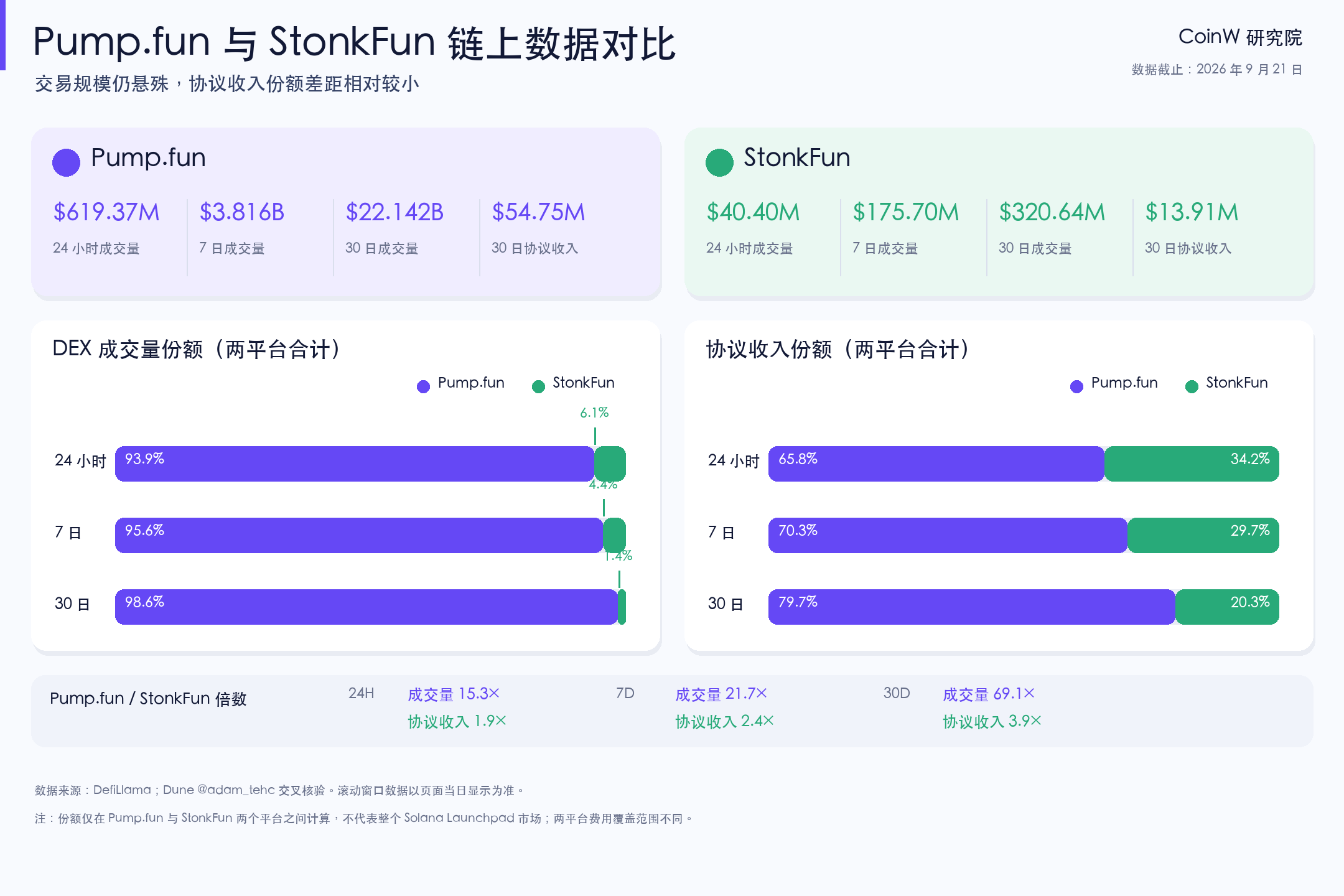
According to rolling window data from September 21, Pump.fun still holds a dominant position in trading scale, but the volume gap between the two platforms is far greater than the revenue gap. In the past 30 days, Pump.fun generated approximately 22.14 billion USD in DEX trading volume, while StonkFun generated around 321 million USD, a difference of about 69 times; the respective protocol revenues over the same period were approximately 54.75 million USD and 13.91 million USD, differing by about 3.9 times. A similar phenomenon is observed in the past 24 hours, with volume differing by about 15.3 times, whereas protocol revenue was only around 1.9 times different. This contrast mainly stems from the differing fee structures. According to DefiLlama, StonkFun charges about a 1% platform fee from Raydium LaunchLab issuance curve trades, and also benefits from creator fees and some transaction fees once tokens enter Raydium's liquidity pools. Pump.fun, on the other hand, leans toward "large scale, low withdrawal," with a significant number of trades occurring on PumpSwap, where the protocol retains approximately 0.05% from each trade, directing the rest more towards liquidity providers and token creators. This difference reflects the two distinct platform models. Pump.fun expands market coverage through larger trading volumes and lower fees, while StonkFun extends its revenue cycle through issuance curves, post-graduation liquidity pools, and other segments. As a result, StonkFun can achieve relatively considerable protocol revenue even with a smaller trading scale. However, because the revenue and trading volume statistics do not entirely align for both, this data is more suited for observing differences in fee and revenue structures rather than directly comparing profitability efficiency.
Nevertheless, a higher fee capture ratio does not imply that StonkFun has established a more stable business model, and "supporting more quoted assets" does not equate to these trading pairs having formed stable liquidity. Custom Pairs more demonstrate that the infrastructure has begun to support new trading combinations, but whether these models can attract users and capital for the long term still requires subsequent data validation. Observations from Arca on the recent market also indicate that there has been a notable competition in products and traffic between StonkFun and Pump.fun, but it is still too early to determine which model can consistently maintain an advantage. Compared to 2024, what is more worth noting in this round of Solana Memecoins is that the competition between platforms is extending from the quantity of coin issuance to quoted assets, trading methods, and liquidity entry. Consequently, Solana Memecoins are evolving from a mere "coin issuance game" to encompass on-chain traffic and trading infrastructure. However, this is an ongoing structural change and cannot be directly equated to signify the completion of an "upgrade" in the Memecoin ecosystem.
5.Have the Memecoin Trenches Really Returned, or Is This Just a Short-Term Rotation?
From CATE to STONK, and with platforms like Pump.fun and StonkFun constantly introducing new issuance and trading mechanisms, the trading activity of Solana Memecoins has indeed seen a notable rebound. However, whether this signifies a "return of the trenches" or a short-term rotation driven by a few hot spots still requires more time to validate. First, can the trading volume sustain itself? A single Memecoin explosion can easily create short-term spikes, but what truly matters is whether the entire sector can maintain trading activity for several weeks, rather than quickly receding after the hype passes. Second, can the capital continue to expand? If liquidity remains concentrated in a few leading Memecoins and current hot tokens, that is closer to a localized market; whereas if more small and mid-cap Memecoins can maintain trading volume and trading depth, it indicates that market enthusiasm is spreading across the entire ecosystem. Finally, has the lifecycle of Memecoins improved? Low-threshold issuance allows for a vast number of new coins to emerge on Solana daily, but "being able to issue" does not equate to "being able to survive." If the number of new coins continues to grow, while the vast majority of projects quickly lose trading and liquidity, then the prosperity is merely at the issuance level, not in the assets themselves.
Thus, while the explosion of CATE is not sufficient to prove that "cat season" has fully returned, it indeed occurs at a stage when Solana Memecoin trading activity is recovering. Rather than seeking the next hundredfold Memecoin, it is more worthwhile to observe whether trading volume can sustain itself, whether liquidity can spread from the head, and whether new Memecoins can genuinely survive longer. The Solana Memecoin trenches are warming up, but there is currently no evidence of a complete revival of cat-themed Memecoins. More clear changes are occurring at the infrastructure level. Competition among platforms is extending from "who can issue more Memecoins" to quoted assets, trading methods, and liquidity entry.
This article is for market research and information analysis only and does not constitute any investment or trading advice.
References
1.CATE token: https://solscan.io/token/Ai66LHZG9MCzg1WKdawwqduVAXpNDUuV8M3uyq5ppump
2.CATE official website: https://catearmy.com/stats/
3.StonkFun dune data: https://dune.com/adam_tehc/stonkfun
4.Pump.Fun dune data: https://dune.com/adam_tehc/pumpfun
免责声明:本文章仅代表作者个人观点,不代表本平台的立场和观点。本文章仅供信息分享,不构成对任何人的任何投资建议。用户与作者之间的任何争议,与本平台无关。如网页中刊载的文章或图片涉及侵权,请提供相关的权利证明和身份证明发送邮件到support@aicoin.com,本平台相关工作人员将会进行核查。