HASHGLOBAL INSIGHT
History tells us that the real question is never whether technology will happen, but how the new system will ultimately be established.

Jessica Feng
Hash Global Research Analyst
Crypto Researcher, Writer and Perpetual Over-thinker.
What does the emergence of new technology actually bring?
"Contemptible. Outrageous. Disgusting. Detestable. Inexcusable. Vile."
It is hard to imagine such merciless words coming from the public statement of a publicly traded company's CEO, but this is exactly how AMC CEO Adam Aron accused Robinhood. Faced with Robinhood's launch of AMC Tokenized Stock, Aron used some of the strongest language available to openly express his anger.
What makes the situation even more dramatic is that Meme Stock was originally AMC's "path of arrival." During the sensational short squeeze battle on Wall Street in 2021, AMC was one of the core stocks being speculated on. The enthusiasm of retail investors transformed a nearly bankrupt cinema company into a cultural symbol in the capital market. Now, a similar market narrative has returned to AMC, yet AMC has flipped the table—
Perhaps because this time it is no longer just a market speculation. A new technological approach is packaging stocks in a "strange" form and presenting them to investors—yet none of this is determined by the issuing company.
Moreover, from the outcome, the market is beginning to accept this new product.
When new possibilities emerge, the old system often first feels not the opportunity, but the loss of control.
This scene has historical precedent. To understand AMC's unease, one can rewind twenty years to when streaming began changing the entertainment industry; the traditional media industry experienced similar shocks.
Just as internet technology fundamentally rewrote the distribution of content, today, blockchain is raising similar questions in the financial market.
Highlights of this article
01
Rewriting the rules of the game: The financial market's "Netflix Moment"
02
What is AMC truly worried about?
03
Resist development or take control of the future?
01
MARKET ACCESS
Rewriting the rules of the game: The financial market's "Netflix Moment"
The story starts with what Robinhood has done.
Robinhood does not simply "move stocks onto the blockchain." The Stock Tokens issued by Robinhood are essentially just derivative assets that are 1:1 backed by underlying stocks, but do not carry corresponding shareholder rights. This is also why Robinhood's CEO believes AMC's concerns are invalid. According to Robinhood, what they are issuing is an "independent financial instrument" that does not change shareholder rights or the issuer's equity structure but merely brings economic exposure onto the blockchain.
It is not "stocks on the blockchain," and this is more significant. Because it means,Robinhood has created a path to access this asset without changing the asset itself or going through the issuer. And AMC was not invited to this whole affair.
If this description is too abstract, one can look back twenty years to the media industry. YouTube, Netflix, and Spotify are akin to today's Robinhood; streaming platforms did not change the movies, music, or videos themselves, but they completely disrupted the way users access content. The internet broke temporal and geographical boundaries, allowing users to access content anytime and anywhere; today’s blockchain and tokenized assets are doing the same in financial markets—allowing investors to access global assets more conveniently and with lower barriers.
The content and assets themselves have not changed; what has changed is the way connections are established between assets and investors.
This is what Robinhood is truly doing.
02
CONTROL & POWER
"What’s the concern": What is AMC truly worried about?
Looking at AMC's reaction from this perspective makes it easier to understand.
What open finance brings is not just trading freedom; tokenization—even offers a possibility to reorganize the capital market. In the past, a company issued stocks, and the relationship between the company, the stock, and the investors was relatively clear. But after the emergence of Stock Tokens, third-party platforms can also design new products and establish new trading markets around a company's stock. So what AMC sees is a market closely related to them, forming outside of AMC's corporate system. This market trades AMC's assets, yet AMC cannot control the rules, entry points, or user relationships of this market.
Here, AMC has become a passive underlying asset provider.
Today, this shadow market is still very small, but its emergence points to a possibility: in the future, will investors still need to go through issuers and the traditional securities system to participate in a company's capital market? And if the entry point changes hands, can companies still truly control their financing lifeblood?
This is precisely Adam Aron's response on X to Robinhood CEO Vlad Tenev with "what's the concern":
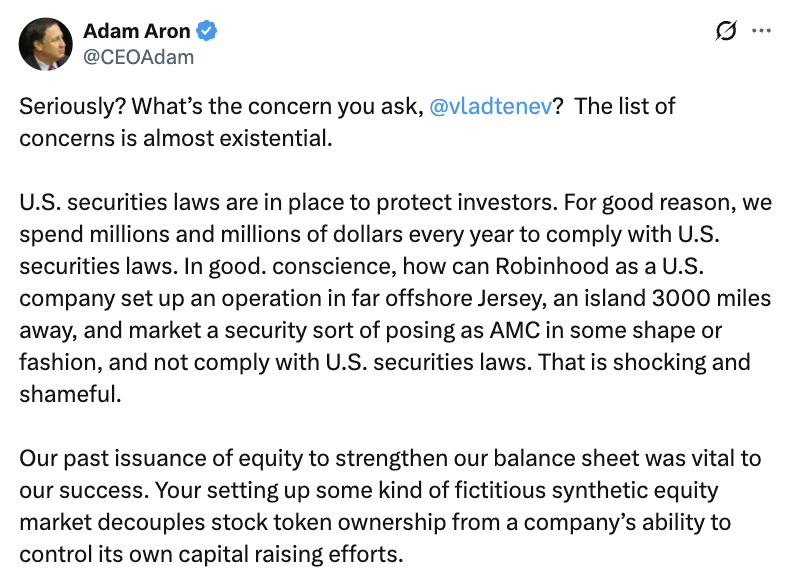
"In the past, we strengthened the balance sheet by issuing stocks, which is crucial for AMC's survival and development. Yet you establish this so-called synthetic stock market, which disconnects the holding of stock tokens from the company's control over its financing behavior."
— AMC CEO Adam Aron
This plot should be familiar to Hollywood. Before resisting Netflix, Hollywood and Netflix actually had a honeymoon period; the new channels and audiences brought by streaming platforms provided Hollywood with considerable licensing revenue. It wasn't until many years later that Hollywood suddenly realized that while movies gained more exposure, they lost their audiences—who all became Netflix users. But it was too late; Netflix had already become the new entry point for users. When platforms control the subscription relationship, knowing when and what the audience likes to watch, producers gradually lost their voice.
Similarly, tokenization brings global access to the issuers' stocks, but on the other hand, the entry points and value capture methods in the capital market may also be getting redistributed.
The democratization driven by blockchain is pushing more than just the opening of trading methods; it is also a reshuffling of the power structure within the industry chain.
03
THE NEXT CHAPTER
The next chapter: Resist development or take control of the future?
Just as Hollywood and the entire film industry once resisted Netflix, the development of technology will not stop because of this. In the end, streaming still changed the way the content industry operates.
Of course, the process of transitioning between new and old systems is fraught with chaos. When digital content first emerged, the industry also fought fiercely over copyright and distribution issues, and traditional industries were worried that new technologies would destroy existing business models, but these disputes did not return the industry to the DVD era. History tells us that the real issue is never whether technology will happen, but how the new system will ultimately be established.
The SEC has begun to establish rules for this system. If we refer to the tokenization classification framework proposed by the SEC in January of this year, the current market solutions can generally be divided into two categories: Issuer-Sponsored and Third-Party-Sponsored, which are two models driven by the stock issuer itself and initiated by a third party, respectively. Among these, the modes initiated by a third party can be further divided into Synthetic and Custodial, with the former primarily providing economic exposure, while the latter also reflects investors' indirect rights to the underlying securities.
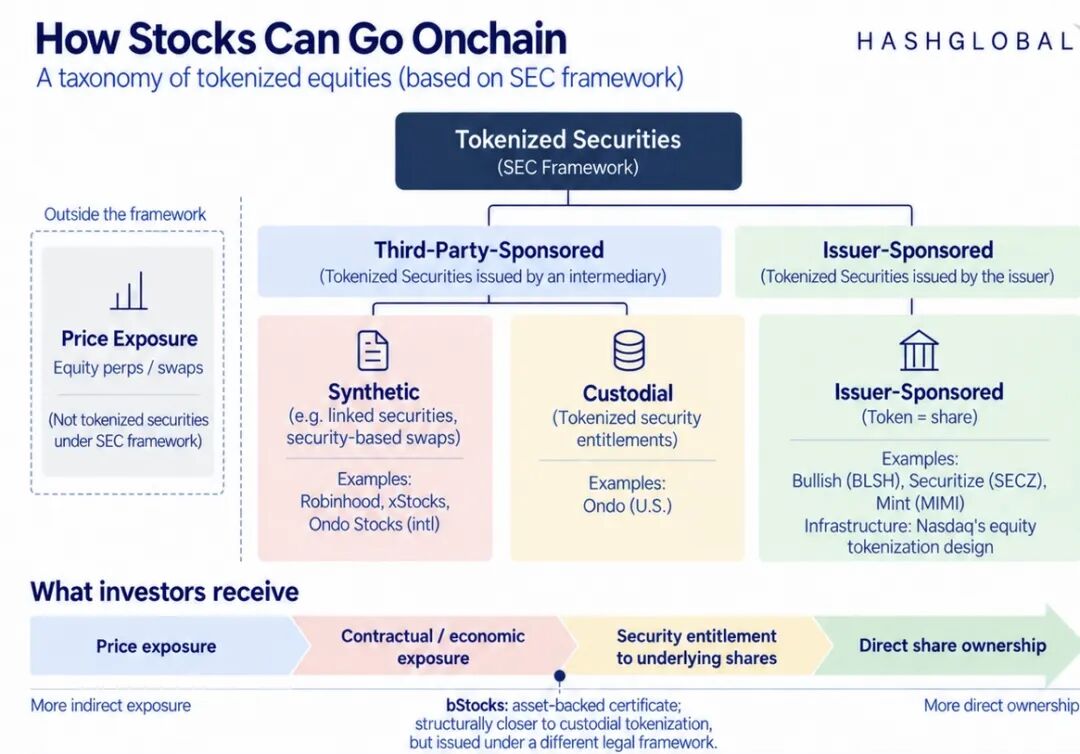
Note: This figure is based on the classification framework published by the SEC in January 2026 in the "Statement on Tokenized Securities." In September, the SEC further released the Innovation Exemption, clearly requiring that tokenized U.S. stocks traded on tokenized securities venues retain the same rights as traditional stocks, such as dividends and voting, while excluding Synthetic Tokens; at the same time, the issuer has the right to oppose their stocks entering related blockchain trading venues. Overall, the latest regulatory direction is further strengthening the actual securities rights and the position of issuers in tokenization.
Robinhood adopts the standard Third-Party-Sponsored model, where a third party issues a new layer of on-chain securities outside the underlying stocks. Many products currently on the market, such as Ondo Global Market and xStocks, adopt this solution. The biggest advantage of this model is its "light" nature—just as Vlad Tenev wrote in his long article: "In order for stock tokens to be globally promoted, it is not necessary for every underlying company to reconstruct its system or to individually connect to this product." It sacrifices some shareholder rights for faster implementation speed and stronger distribution capability.
But this is not necessarily the final form.
If we want to speculate on the future, we might consider it from the perspective of traditional players: when an irreversible trend emerges, how can they regain control?
Traditional content companies in adjacent industries tell us that a way to defend their territory is to join in rather than fight back. Content giants like Disney and Warner Bros. Discovery eventually began to build their own streaming platforms. Rather than waiting for others to take a piece of the pie, they chose to enter the game themselves.
Similar signs have actually appeared in the securities market. Apart from Robinhood's model, there is now a path represented by Nasdaq, corresponding to the SEC framework's Issuer-sponsored model. Traditional exchanges are exploring models precisely designed to address the missing parts of current tokenization solutions—introducing blockchain infrastructure while retaining issuer participation, ownership of securities, and investor rights.
However, this path needs to solve more regulatory and infrastructure issues, making it a heavier project and thus slower. What platforms like Robinhood are doing may be to adopt a middle-ground solution to first launch the product to the market. Of course, this is just the beginning, and when policies become clearer, whether platforms will iterate on products to launch actual U.S. stock assets remains to be seen.
In summary, this competition has just begun. But regardless, revisiting the debate between AMC and Robinhood will ultimately lead to a more thought-provoking question:
In the future, the question of tokenization may no longer just be:
How do crypto platforms bring U.S. stocks onto the blockchain?
But will gradually transform into:
In what way do publicly traded companies wish to let their stocks enter the blockchain world?
04
STREAMING ERA
As the financial market moves toward the "streaming era," who will be the next Netflix?
Standing at the crossroads of old and new, friction is almost inevitable. Chaos is a necessary path for technological evolution.
Twenty years ago, streaming changed the way content reached audiences; today, tokenization may be enacting a similar story in the securities market.
Technology never rests, and today's model will not be the endpoint of market evolution. Robinhood, Nasdaq, and many more participants are all exploring different answers.
Today’s AMC resembles Hollywood from years ago; so as the financial market moves into the "streaming era," who will become the Netflix of on-chain finance?
The past system is being dismantled, and the "great battle" between AMC and Robinhood has fired the first shot.
A new order is about to be established.
免责声明:本文章仅代表作者个人观点,不代表本平台的立场和观点。本文章仅供信息分享,不构成对任何人的任何投资建议。用户与作者之间的任何争议,与本平台无关。如网页中刊载的文章或图片涉及侵权,请提供相关的权利证明和身份证明发送邮件到support@aicoin.com,本平台相关工作人员将会进行核查。


