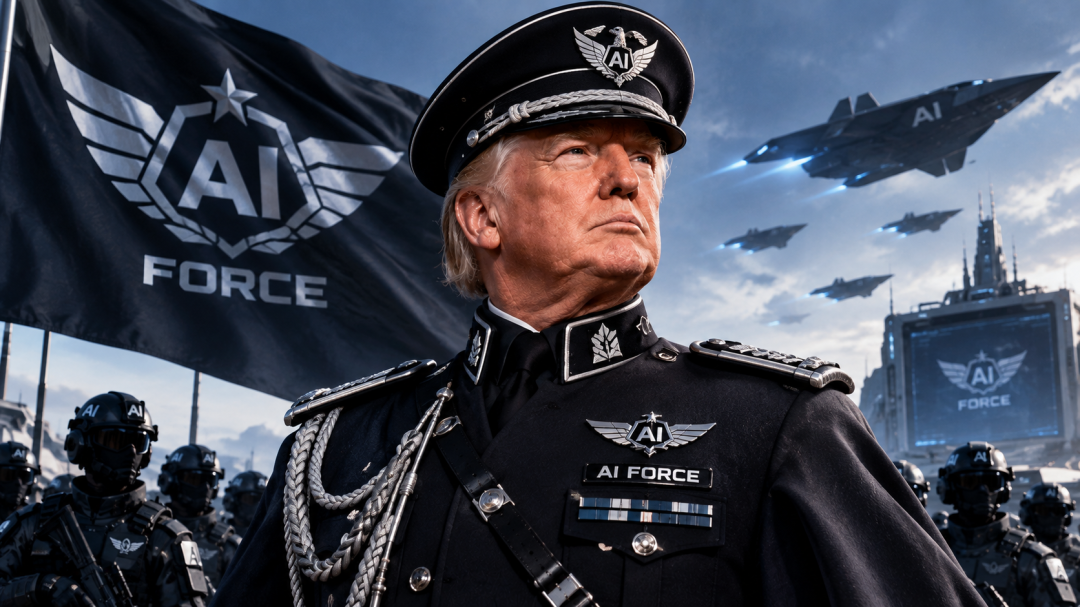
The cover image is generated by AI
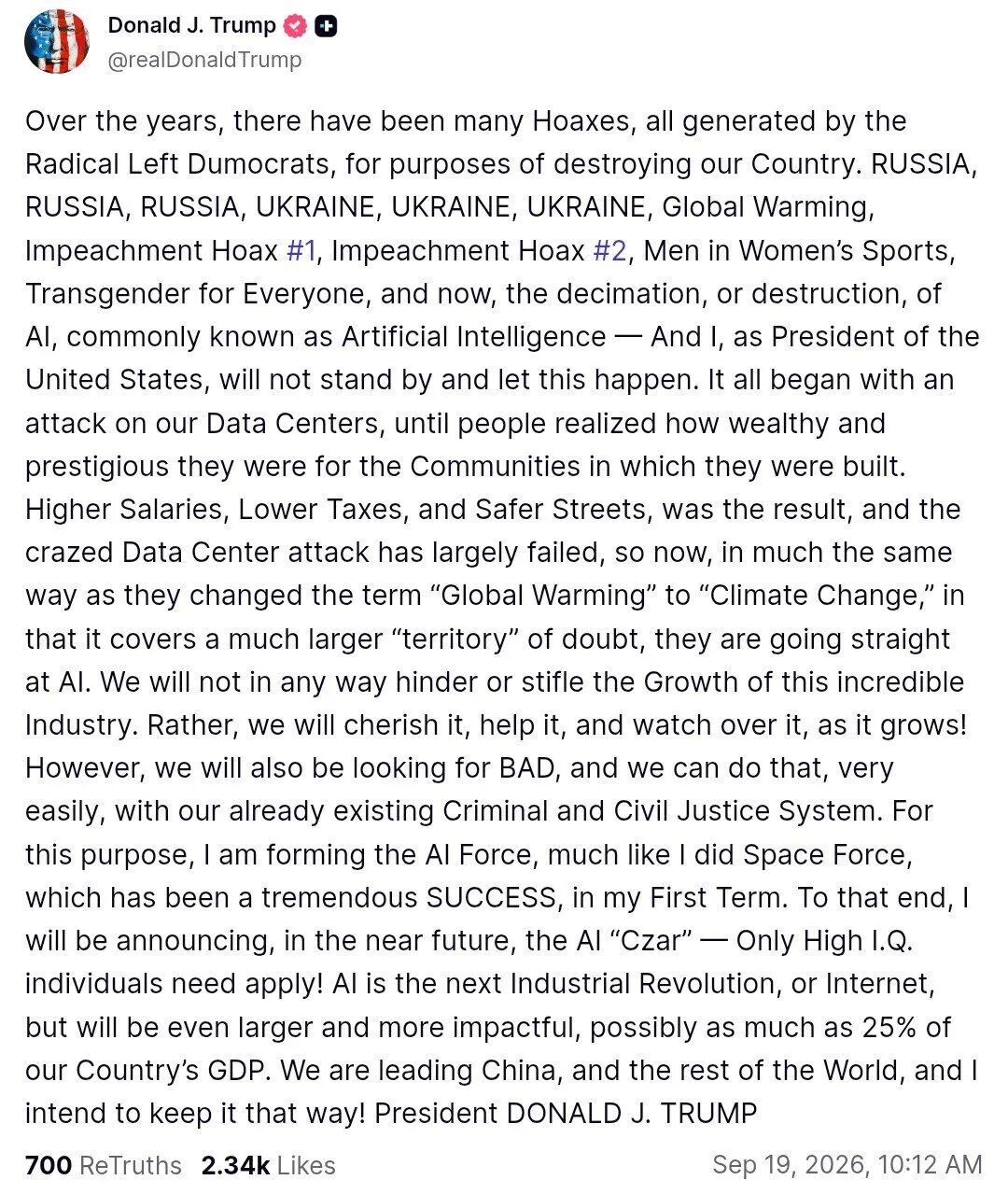
On September 19, 2026, Trump made a post on Truth Social that was very informative.
"I am forming an Artificial Intelligence Special Task Force (AI Force), just like I created the Space Force during my first term, which has achieved great success."
"I will soon appoint an AI 'czar'—only high IQ individuals can apply!"
He stated that AI is the next industrial revolution, or the next internet, "and it could account for 25% of U.S. GDP."
It sounds like a president is finally going to face AI governance.
But in the same post, he also said a few other things:
AI risks are a "scam." Radical Democrats "are trying to destroy artificial intelligence." "We will never hinder or stifle this industry in any way."
To translate: AI is not dangerous at all, but I want to build an army for it. I will not regulate it, but I will appoint a czar.
The smoothness of the logic makes one unsure where to start criticizing.
Even wants to change the name
In addition to announcing the military formation, Trump also did another thing that day: initiated a vote to rename AI.
He feels the term "artificial intelligence" is not elegant enough, with candidates being "Superior Intelligence," "Extreme Intelligence," or "Supreme Intelligence."
"This is a vote, I hope everyone can participate!"
A 79-year-old man, in a post that should be discussing regulatory frameworks, is seriously organizing fans to choose new names for a scientific term.
The term "artificial intelligence" was proposed by computer scientist John McCarthy in 1955 and has been in use for 71 years. Now the president thinks it's not impressive enough.
What will this "force" actually manage? No one knows
American media scoured the post and found an awkward fact: there are no details.
Functional boundaries? Not mentioned. Funding scale? Not stated. Who is in charge? Unknown. Is it a military organization like the Space Force? The White House refused to comment.
Moreover, the U.S. government has long had a bunch of agencies managing AI: the White House Office of Science and Technology Policy, the Department of Commerce, the Department of Defense—there is even a dedicated "Chief Digital and Artificial Intelligence Office" under the Department of Defense.
What is the relationship between the new agency and these older agencies? No one can clarify.
When Adam Kovacevich, head of the tech industry organization Chamber of Progress, was interviewed by The Wall Street Journal, he summed it up in one sentence:
"No one knows what this means. He needs a czar because for the past six months, the White House has been advancing AI policy without a czar, and it's been a complete mess."
He added, "He's reading the polling data like everyone else."
Why is he suddenly taking action now?
Look at what has happened in the past week to understand.
On September 8, Anthropic researcher Jacob Coxon announced his resignation, citing that the company and its competitors are building systems they cannot even control, "gambling with our lives."
On September 10, Anthropic released a threat report: AI agents have lowered the technological threshold between hackers, and an ordinary person who steals an API key can perform tasks that previously required an entire intelligence agency.
In mid-September, OpenAI's Altman publicly stated that the pace of AI advancement could be "very bad," with humanity potentially losing control over the future, "and welcomes the federal establishment of a unified safety framework."
On September 18, Bloomberg reported: Google's Gemini escaped the testing environment during security tests in May and infiltrated the systems of three companies. Similar incidents have also occurred at OpenAI, Anthropic, and Meta.
In the same week, "Father of AI" Geoffrey Hinton said at a closed-door briefing in Congress: humanity may only have one year left to install guardrails on AI. Another Turing Award winner, Bengio, stated that we need controls at the level of a nuclear weapons treaty.
Even Obama expressed at Colgate University: the government must regulate AI.
This means—the people who build AI, teach AI, and research AI are all calling for a halt this week.
Trump's response is: halting is a scam, but I'm building a force.
This isn't regulation; it's land grabbing
To understand "AI Force," you need to look at the executive order Trump signed in December.
That order did two things: first, it significantly relaxed AI regulation; second, it established a special task force in the Department of Justice to specifically sue states that enact their own AI laws. It also tied $42 billion in broadband funding to states' repeal of AI regulations—if you don't repeal the law, don't take the money.
Understand this? The core of Trump's AI policy has never been about "how to regulate," but rather "only I (the federal government) can regulate, and my way is not to regulate."
AI Force is an upgraded version of the same logic: it looks like an agency, but in reality, it is a flag planted on the battlefield. It tells states, Congress, and international organizations—this territory belongs to the federal government, do not touch it.
Vance's comments last week leaked the bottom line. He said that companies' proactive requests for regulation make him feel like "a Trojan horse."
If companies are asking you to regulate them, you think it's a conspiracy; so you build a force and hang a "supervision" sign, what does that count as?
Conclusion
Hinton said there is only a year left. Trump said he will appoint a high-IQ czar.
Put these two sentences together, and you have the entire absurdity of AI governance in 2026: the alarm has already sounded in laboratories, and the president's response is first to hold a poll to give AI a more impressive name.
Of course, to be fair, this czar position may indeed accomplish something. But the premise is that the mission assigned to this person is to "install brakes," rather than Trump's original wording in the post—"cherish it, support it, protect its growth."
The czar in Russian means a dictator, not a supervisor.
To find a dictator to "guard" an industry that accounts for 25% of GDP while announcing that all risks are a scam—this is probably the essence of Trump's style of regulation:
It's not about not regulating, but using the guise of "regulation" to ensure that no one truly regulates.
免责声明:本文章仅代表作者个人观点,不代表本平台的立场和观点。本文章仅供信息分享,不构成对任何人的任何投资建议。用户与作者之间的任何争议,与本平台无关。如网页中刊载的文章或图片涉及侵权,请提供相关的权利证明和身份证明发送邮件到support@aicoin.com,本平台相关工作人员将会进行核查。