Author|Dong Daoli
WeChat|ddl941110
In the past few days, a model that has been highly discussed in the AI circle is not a new version of GPT, Claude, or Gemini, but a nearly silent Jev.
After its release on September 15, it was quickly integrated into the Vercel AI Gateway. According to data released by Vercel, within 24 hours of going live on the Gateway, nearly 13% of paid teams had already used it, making it the fastest model release in the platform's history. For a model that had not been publicly showcased before, this opening is quite impressive. Of course, how many users it retains after the initial experience will need time to test.
What developers are interested in is incorporating Jev into model routing, whether the Agent continues to execute, risk screening, output checks, and other processes. TypeSafe's definition of it is also quite unique: the first “System One Model.” Give it a piece of state and several questions, and it directly returns choices, scores, or true-false judgments, along with corresponding probabilities for software invocation.
This is very different from the model releases people are most familiar with in the past few years. Everyone has become accustomed to waiting for an AI that answers questions better, explains itself more, and excels at lengthy reasoning; Jev, however, simply removes text generation. Its task is to judge what to do next, decided by the program.
1
A model that doesn't quite resemble a large model
The usage of Jev is very simple: first provide the model with a state, which is the context that needs to be judged; then give it a set of questions, predefined for each question's answer type.
For example, if a customer service system receives a user message, the program can simultaneously ask:
● Is this an urgent issue?
● Does the user have the intention to purchase?
● Which processing category should this be assigned to?
● What is the severity level?
We can compare the differences between Jev and language models using pseudocode.
jev("I have been charged multiple times, please refund.", {department: choice({billing: "Refund",technical: "Product Fault",sales: "Purchase Inquiry"}),urgency: score(["Can wait", "Handle today", "Handle immediately"]),refund_requested: probability("Customer clearly requests a refund")})
response = llm(`Analyze buyer message: “I have been charged multiple times, please refund.”Return three fields:department: billing (Refund), technical (Product Fault), sales (Purchase Inquiry)urgency: 0 (Can wait), 1 (Handle today), 2 (Handle immediately), allow decimalsrefund_requested: the probability of the customer clearly requesting a refund, range from 0 to 1Only return JSON, do not explain.`)result = JSON.parse(response)
When called through the Vercel AI SDK, these questions can be set as Choice, Score, or Boolean respectively. Choice selects an option, Score rates according to given criteria, and Boolean returns a true-false probability. Once the model has processed, the program can read the results.
A typical large model can also perform these judgments and can be instructed to output only JSON. In common conversational requests, it still needs to generate this result token by token. Jev narrows its product goal to pre-declared judgments, not generating a block of text to deliver answers.
TypeSafe officially states that Jev uses a new model architecture, parallel sampling, and Reinforcement Learning for Calibrated Decisions (RLCD) training method. It processes pre-declared questions in parallel, and the output space is also predefined, so there will be no type errors outside of the schema. The name System One comes from Daniel Kahneman's "Thinking, Fast and Slow," referring to quick, intuitive judgment.
However, the official claim of "not hallucinating" may not mean what you think it does.
It will not randomly generate a non-existent option, nor will it write results that should be numbers as text. But this does not mean it won’t make mistakes in judgment. For instance, if you ask it to choose one from options A, B, and C, it may still choose incorrectly; it just won’t produce D. TypeSafe explained in its release article that its "zero hallucination" figure comes from its guarantee of output structure.
The model’s degree of freedom is compressed, and the judgments themselves can still be wrong. These two issues need to be viewed separately.
1
Testing: Fast is indeed fast, but it's not that strong
To see what Jev can actually achieve, we conducted a simple but practical business-related test.
The question arose from an e-commerce customer service scenario, from which we gathered a set of data consisting of 50 Chinese customer service questions. Each question required the model to make four judgments: urgency, pre-sale probability, processing category, and severity. Scoring was straightforward: only when all four met the manual labeling requirements was the question considered correct.

We divided the models into three groups. The first group consisted of cheaper small models, including DeepSeek V4 Flash, GPT-5 nano, and Gemini 2.5 Flash Lite; the second group consisted of domestic models, including GLM 5.3 Flash, DeepSeek V4 Pro, Qwen 3.8 Flash, Kimi K3, and MiniMax M3; the third group included GPT-5.5, Claude Opus 5, Claude Sonnet 5, and Gemini 3.1 Pro Preview. Jev was compared in the first group.
The results showed no "new model overwhelming old models" scenario.
Jev's average score was around 32 to 32.6 points, with a complete accuracy rate of about 64% to 65.2% for the 50 questions. It ranked second within the cheap small model group, just 1.2 points behind DeepSeek V4 Flash. Looking only at this set of questions, Jev did not show particularly strong judgment capability.
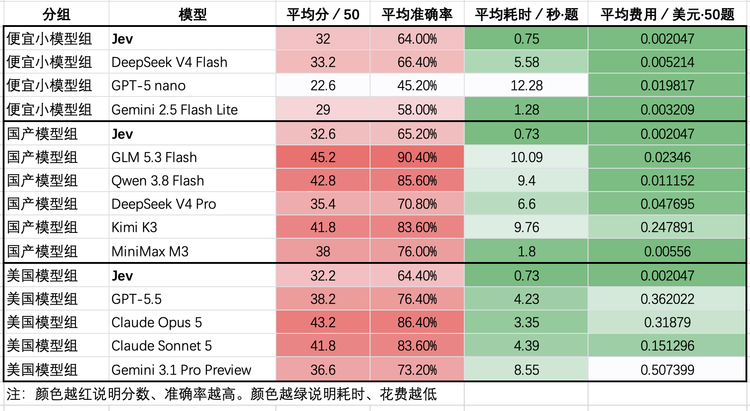
However, speed and cost are another matter. Jev averaged a complete response time of about 0.73 to 0.75 seconds per question, with a total cost of about $0.002 for the 50 questions, both being the lowest values in our testing. While DeepSeek V4 Flash scored slightly higher, it required an average of 5.58 seconds per question, costing approximately 2.5 times that of Jev.
When placed among stronger models, the gap in accuracy became even more pronounced. Jev scored the lowest. MiniMax M3 averaged about 38 points, answering approximately 5.4 more questions correctly than Jev, with a complete accuracy rate higher by about 10.8 percentage points.
However, the corresponding cost difference is not as significant as one might think: for 50 questions, MiniMax M3 only spent about $0.0035 more, with an average response time of about 1.80 seconds per question. For this set of tasks, spending a little more money for more correct answers is also a consideration.
Thus, this set of tests does not support the conclusion that "Jev is a smarter model." It demonstrates a set of specific trade-offs: waiting a little less, spending a little less, while accepting a certain accuracy gap. Whether it's worth it depends on how much the business cares about latency and what the cost of making an erroneous judgment is. These 50 Chinese customer service samples do not represent its performance across all tasks.
Another interesting phenomenon in the tests was that Jev had some score losses around the threshold.
For instance, if the manual labeling indicates that the severity lower limit for a certain customer service message should be 2.00, but Jev gives 1.99; for a question about expiring food where the manual urgency is 0.75, Jev's result is around 0.71 to 0.72. The numerical difference is small, but if the business rule states that “only those reaching 2.00 will be escalated for manual handling,” then 1.99 and 2.00 will be treated as completely different signals by the program. We conducted repeated testing 15 times, with 3 questions alternating between passes and losses.
This suggests that the model returning a number precise to the decimal point does not automatically make business rules reliable. Especially near thresholds, developers still need to handle fluctuations and decide when to review.
TypeSafe hopes to further address this by making probabilities themselves reliable signals for software. They list probability calibration as a training goal: if a batch of judgments gives an 80% probability, then over the long term, the corresponding results should be valid around 80% of the time. This is a verifiable goal; we cannot simply assume it has been achieved based on the model returning probabilities.
In the product, Choice and Score will come with probability distributions, along with confidence calculated from the distribution, making it easier for programs to decide whether to execute automatically, supplement information, or hand off to a human. The confidence here is a different measure than “how many points severity scored,” and our scoring tests by question cannot verify how well probability calibration is performed.
What Jev hopes to deliver to software includes not only answers but also clues for handling uncertainties. This is useful, but there's still a considerable distance from "can be reliably entrusted to it."
1
The contrast and new inspiration brought by the star team
Based solely on this report card, it is clear that it does not explain Jev's popularity. There are already plenty of cheap small models; Jev did not achieve the highest accuracy in our tests. Yet, it remains popular.
One key behind this is definitely its team.
TypeSafe's co-founder and CEO Diogo Almeida previously participated in InstructGPT research at OpenAI. He is one of the authors of the 2022 paper "Training language models to follow instructions with human feedback." This research trained models using human feedback to better adhere to human intentions, and it was also an important milestone on the path to ChatGPT.

There is a particularly telling result in the paper: in the prompts and human assessments used in the study, the trained 1.3 billion parameter InstructGPT was preferred by evaluators over the 175 billion parameter GPT-3. The model is more than 100 times smaller, and changing the training objective still allows it to better meet user needs.
Now, Almeida is beginning to question the successful route he helped promote.
At the beginning of Jev's release article, he directly asks: “Models have been surpassing humans in chat for several years now; where is the automation?” This touches upon a promise of the large model craze that has yet to be fully realized.
His team also has a distinctive engineering background. Co-founder and COO Sasha Sheng previously worked at Meta/FAIR on News Feed, AI product experience, and research; CTO Erik Gafni has worked on multimodal AI startups aimed at DNA sequencing and was an early employee at Invitae and Freenome. According to their official website, the team also includes members from Google Brain, Stripe, Airbnb, Plaid, Docker, and other companies.
These credentials certainly add meaning to this pivot. A researcher who personally participated in turning language models into useful assistants now hopes the model will switch its service object: putting the software's own needs first.
In TypeSafe's technical introduction, the team even presents a quite radical expectation: in the future of large-scale AI automation, 99% of interactions may occur between machines, with only 1% directed at humans. This is their bet, far from the reality that has already occurred. Following this judgment leads to pondering the delivery method that models habitually adopt today, which indeed deserves reconsideration.
An Agent working on behalf of the user may ultimately only need to present a result to the person, but before reaching that result, it must make many small decisions: Can this request be handed over to a cheap model? Are the retrieved results relevant? Which tool to invoke? Should the task continue or retry? Is the answer provided by another model trustworthy? The recipients of these processes are all programs. They require a judgment that can be used for the next step, usually without needing a beautifully written explanation.
If each step calls a general large model, waiting for it to organize a response, the costs and delays of the entire task will accumulate continuously. Jev offers a more defined division of labor: writing, code generation, and complex reasoning can still be entrusted to models that excel in these tasks; a large number of clear boundary small judgments can be attempted to be assigned to specialized optimized components. The model starts to serve the execution process of AI tasks and does not need to present itself in front of the user every time.
This idea is not mysterious. Developer Sean Goedecke has already used the existing Qwen3-8B, combined with single token selection and batch processing, to create a similar interface, even recreating the Doom and Wikiracing demonstrations.
What makes it so popular now is exactly what the current AI circle needs: a bit of stimulation.
Model releases are still dense, progress is still ongoing, but the release stories have become increasingly familiar: higher scores, longer contexts, stronger reasoning, and then waiting for the next round of ranking. For many who continuously pay attention to AI, the perception of progress has begun to slow down.
On the application side, there is similar fatigue. Beyond chatting, programming, image, and video generation, people are still waiting for more new products that can immediately be named and clearly change working methods. Putting a chat window into old software is already difficult to spark the excitement felt during the first encounter with ChatGPT; making a whole set of business processes genuinely automated in more industries is far more challenging than creating a demonstration. The models are still updating, but those promises about how the world will be changed require longer to be perceived.
Almeida's conveyed dissatisfaction coincides perfectly with this sentiment. TypeSafe states in its declaration that existing models already have sufficient ability to create economic value, while the difficulty lies in people's continued challenge of building reliable software with them.
On the Jev website, they write: "Build Prod, Not God," creating products that can be put into practical use rather than trying to create a deity. Almeida's Jev may not yet be the model that proves this statement, but he is undoubtedly the person best suited to voice this increasingly evident shared sentiment in the industry. In this sense, the stimulation brought by Jev may continue to ferment.
免责声明:本文章仅代表作者个人观点,不代表本平台的立场和观点。本文章仅供信息分享,不构成对任何人的任何投资建议。用户与作者之间的任何争议,与本平台无关。如网页中刊载的文章或图片涉及侵权,请提供相关的权利证明和身份证明发送邮件到support@aicoin.com,本平台相关工作人员将会进行核查。


