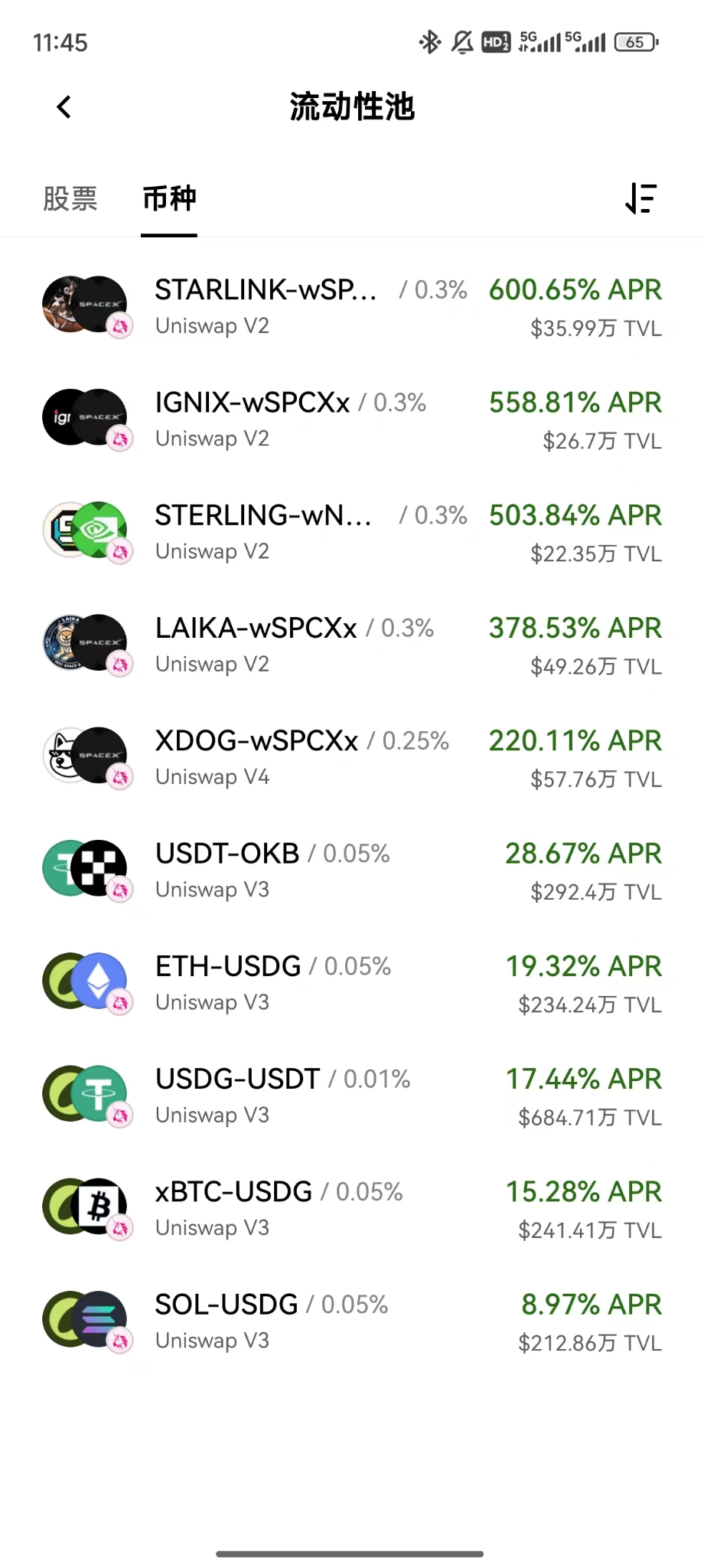
Open the OKX Web3 liquidity pool, and the most eye-catching number is 600.65% APR.
On the same page, IGNIX-wSPCXx shows 558.81%, COINx-xETH shows 147.73%, and BMNRx-xETH also has 132.41%. Even for common pairs like ETH-USDG, the APR at the time of the screenshot reaches 19.32%.
Hundreds of points on an annualized basis can easily tempt people.
 LP earns transaction fees
LP stands for Liquidity Provider.
Taking ETH-USDG as an example, the pool holds both ETH and USDG. When someone buys ETH, they pay USDG to the pool and take ETH; when someone sells ETH, the direction of the transaction reverses. Each exchange generates fees, and the LPs providing liquidity in the pool share the income according to their effective liquidity proportion.
Assuming a trade amount of 1000U and a fee rate of 0.3%, the pool would receive about 3U in fees. There is a total of 100,000U in effective liquidity around the current price, of which 10,000U belongs to you, accounting for 10%, so you would earn approximately 0.3U from this transaction.
The income from a single transaction is limited; earnings need to accumulate slowly through continuous transactions. When the market is active, the pool collects fees more frequently, and the income obtained by LPs will also increase.
How do hundreds of points APR appear?
LP annualization is mainly affected by trading volume, effective liquidity, and project rewards.
Frequent transactions allow the pool to collect more fees. With the same trading volume, fewer funds participating in the distribution means that each portion of funds will receive a higher share of the fees. The additional tokens or stablecoin rewards provided by projects will also reflect in the page's annualized returns.
The screenshot shows STARLINK-wSPCXx displaying 600.65% APR with a TVL of approximately $359,900; ETH-USDG showing 19.32% APR with a TVL of approximately $2,342,400.
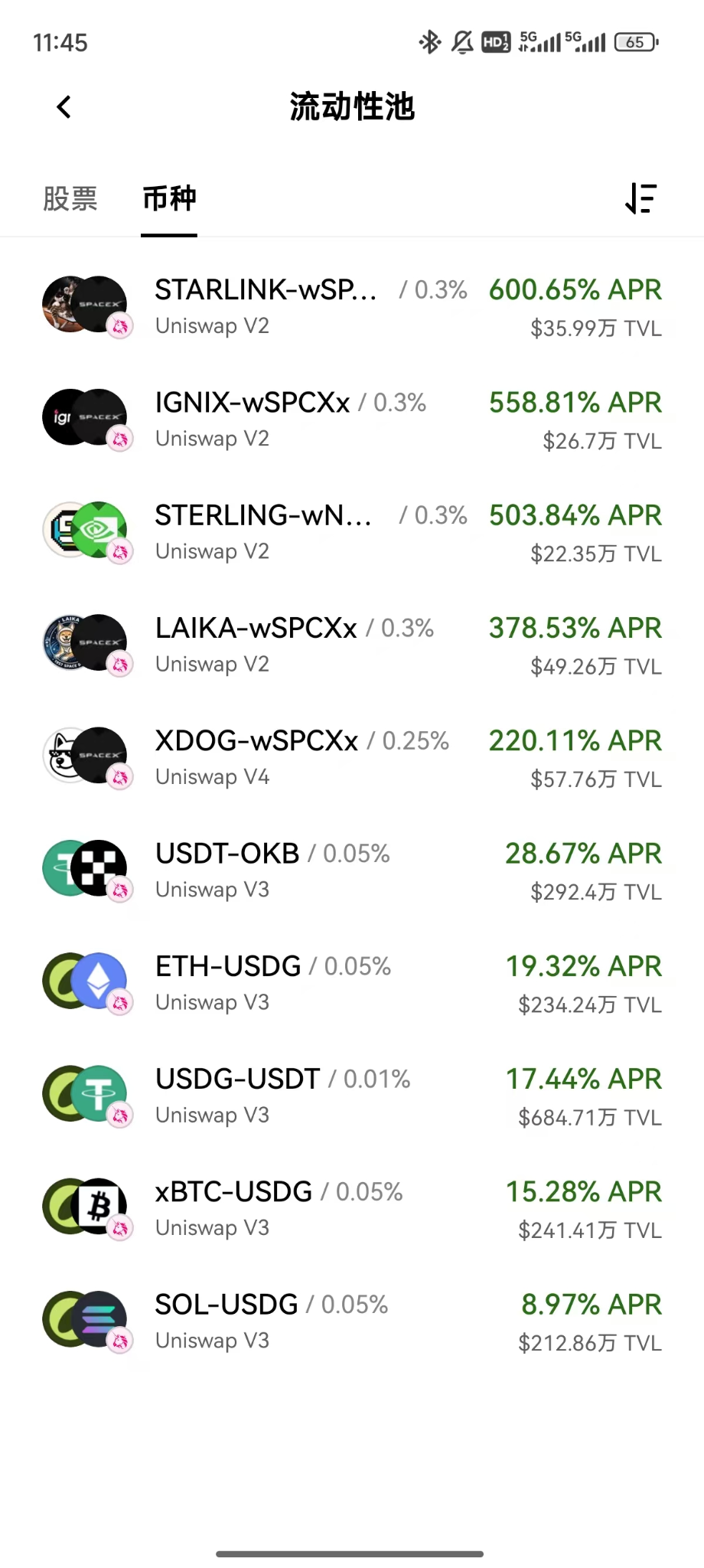
STARLINK-wSPCXx has a smaller fund scale. With the same trading volume, each portion of funds may receive more fees, but participants need to bear the price volatility of both STARLINK and wSPCXx.
On one side of ETH-USDG is ETH, and the other side is the USDG pegged to the dollar. The position risk mainly comes from ETH price changes, USDG decoupling, and the impermanent loss incurred by LPs.
When comparing both pools, it is necessary to calculate fees, rewards, and asset prices together. 600.65% and 19.32% only represent the rate of return near the time of the screenshot; actual annualization may change as trading volume decreases or more funds enter.
How can ordinary users engage in LP?
When selecting trading pairs, first check if both assets are within your holding range.
LPs automatically adjust asset proportions with trading. When ETH rises, the ETH in the pool gradually decreases, and USDG gradually increases; when ETH falls, more ETH accumulates in the pool. If the price exceeds the boundary and the position mainly turns into one of the assets, the user needs to bear the subsequent price changes of that asset.
On one side of ETH-USDG, xBTC-USDG, and SOL-USDG are mainstream crypto assets, while the other side is the USDG pegged to the dollar. When calculating returns, you can focus on observing the price of mainstream coins, whether stablecoins have decoupled, fee income, and impermanent losses.
Pools like STARLINK-wSPCXx may see significant fluctuations in both assets. Even if the page's APR reaches 600%, a substantial drop in either token could offset fees and promotional rewards.
After selecting the assets, check the TVL and trading volume. Pools with lower TVL may yield higher fee efficiency but will also be significantly affected by the inflow and outflow of funds. If trading volume decreases recently, the fees collected by the pool will correspondingly decrease, and the page's APR may quickly drop.
Stock-like liquidity pools also require such calculations. The screenshot shows COINx-xETH at 147.73% APR, SHEINx-USDG at 116.16% APY, with several pools' annualization exceeding 100%.
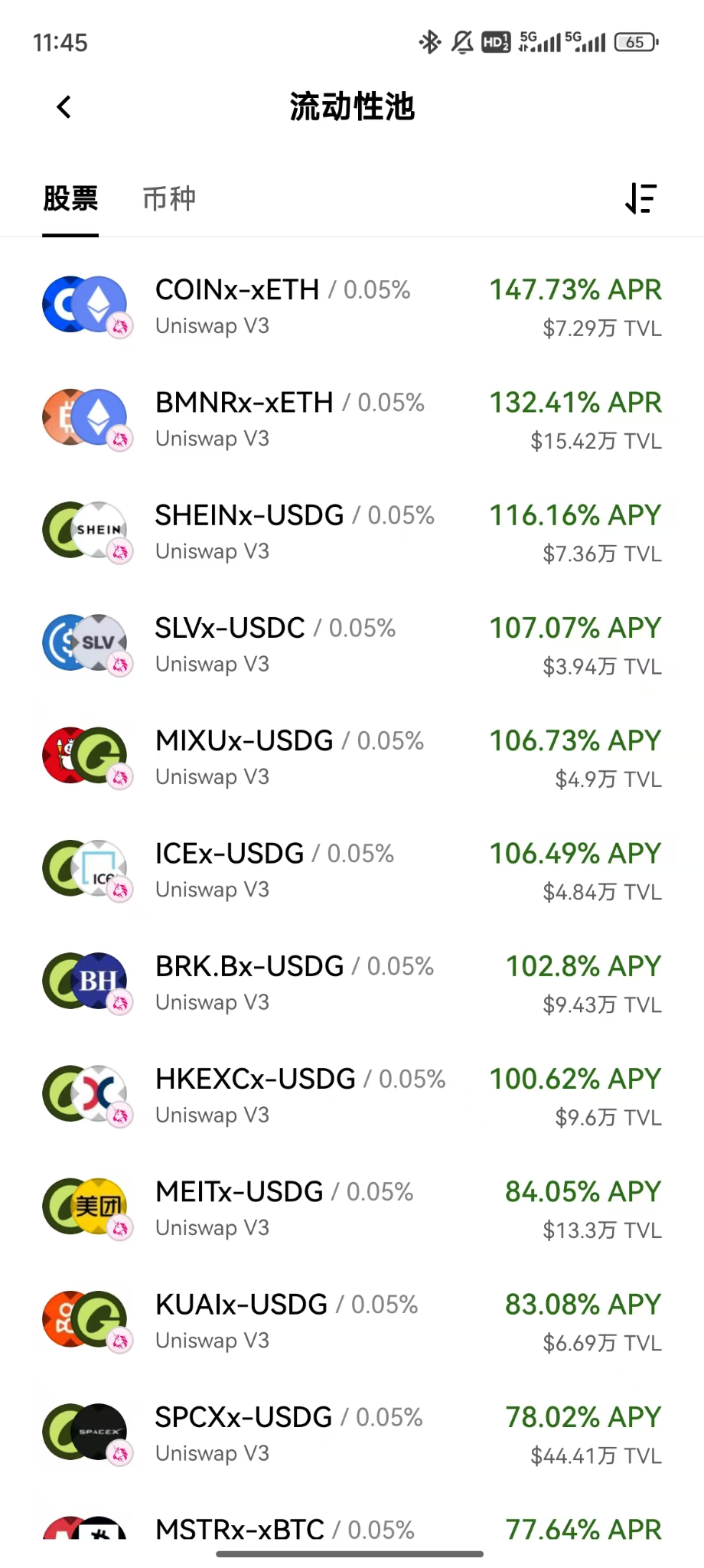 The TVL of these pools is generally low, so unit funds can earn higher fee income. Participants must confirm the pricing method and liquidity source of the corresponding assets before joining and estimate the potential capital changes due to price fluctuations.
Set price ranges to decide where the funds will work
Concentrated liquidity allows users to place funds within a specific price range.
As the range narrows, funds will concentrate near the current price, potentially increasing the fee efficiency per unit of funds, while the probability of exceeding the price boundary increases. As the range widens, the position can cover a larger amplitude of fluctuations, and the fee efficiency per unit of funds typically decreases.
When the price crosses the boundary, the position will gradually turn into one asset, while new range fees will cease to accumulate. Exceeding the boundary will not trigger a liquidation, but users need to reassess whether to adjust the range.
LPs are more likely to accumulate fees during phases of repeated price fluctuations and sustained trading. In strong one-sided markets, ascending assets will be gradually swapped out, while descending assets will increase in the pool, leading to an overall result that may lag behind direct holding.
The value difference between LPs and direct holdings during the same period is the impermanent loss. Determining whether an LP is worthwhile requires considering both the final value of the account and how much the original asset could have earned if held.
After fees and rewards cover impermanent losses, gas, and slippage costs, LPs have a chance to outperform direct holding.
Participating now can also stack activity rewards
OKX Web3 recently launched the X Liquidity event, with a total reward pool of $1,035,000, of which $345,000 is allocated to liquidity providers.
The event distributes LP rewards based on the proportion of personal fee income to total fee income. If the position is within the effective range, the more trades that actually participate, the higher the corresponding fee contribution ratio will be.
Some products have set requirements for price ranges. The range width for RWA LP must reach 8%, RWA MEME must reach 50%, XDoge needs to be set to 100%; USDT-USDG has no range limitations.
Participants can understand the final result with the following formula:
LP final income = trading fees + activity rewards - impermanent loss - gas and slippage costs
The event requires users to enter the corresponding product from the designated X Liquidity page, and operations completed through other websites cannot be counted towards rewards. Currently, there are no direct links to provide for the activity, so participants need to find the X Liquidity page in the OKX wallet and confirm the activity period, product scope, and range requirements.
If you want to participate in LP, you can first register and enter the OKX wallet:
OKX wallet registration link:
https://web3.okx.com/zh-hans/join/aicoin88
The page's APR, APY, and TVL are all data points at the time of the screenshot, and actual values will change with market fluctuations. LP involves asset price volatility, impermanent loss, range breaches, and contract risks. Please verify product information and activity rules in the OKX wallet before participating. The above content is for introducing LP mechanisms and activity information and does not constitute investment advice.
免责声明:本文章仅代表作者个人观点,不代表本平台的立场和观点。本文章仅供信息分享,不构成对任何人的任何投资建议。用户与作者之间的任何争议,与本平台无关。如网页中刊载的文章或图片涉及侵权,请提供相关的权利证明和身份证明发送邮件到support@aicoin.com,本平台相关工作人员将会进行核查。