

Text|Li Zhaofeng Wang Xinyi
Editor|Zhang Yuxin
In Shenzhen, the AI startup company where Lin Zhou works has only ten people, and most of the work relies on AI to complete——hundreds of Agents operate simultaneously every day, writing code and conducting research separately.
The driving force behind these Agents has always been OpenAI's GPT series models.
However, as the team assigned more and more tasks to the Agents, Lin Zhou found that GPT could not keep up——the GPT 5.6 they were using could only handle two or three tasks at the same time. “The concurrent tasks that GPT can handle are limited, which delays our work progress.” Lin Zhou said that the team started looking for models that could run more tasks simultaneously and with lower invocation costs.
DeepSeek V4.1 Flash became the new choice. Since September, the team has tried Claude and several domestic models, finally selecting V4.1 Flash: it can complete the development tasks at hand, has faster feedback, and the invocation cost is lower. Lin Zhou said this is their current “most cost-effective” choice.
Earlier this year, Google CEO Sundar Pichai announced at the Google I/O conference that, according to what he learned, some companies had nearly exhausted their annual Token budget by May. Taking Google as an example, its internal AI programming tools consumed Tokens from 500 billion in March to over 3 trillion in May.
During this conference, Google launched the faster and cheaper Gemini 3.5 Flash, targeting more everyday development and work scenarios——since this year, the “lobster” craze brought by OpenClaw has led ordinary users to start using Agents to handle various work tasks, which is a more everyday, lower-threshold, and higher-frequency demand than programming.
Meanwhile, more and more small parameter models have begun to appear. Because there are more tasks, the invocation of the models will be more frequent; using flagship models with several hundred billion or even twenty to thirty trillion parameters will incur very high costs for the users; moreover, the speed of large parameter models cannot be improved significantly, which greatly increases user waiting time.
Model manufacturers, especially Chinese model manufacturers, are continuously launching Flash versions of small parameter models, competing for the tasks that were previously performed by flagship models.Flash means “lightning.” Manufacturers usually use this naming to indicate faster and cheaper model versions: they use fewer parameters for each invocation, making them suitable for repeatedly handling everyday tasks; while complex problems can still be handed over to flagship models like Pro.
On July 31, DeepSeek released the official version of V4 Flash; on August 26, Alibaba's Qwen team launched Qwen3.8-Flash-Next and Zhichun’s GLM-5.3-Flash on the same day; in September, DeepSeek launched V4.1 Flash. These models have varying sizes of parameters, all in the hundreds of billions range (from 100B-500B), significantly smaller than the trillion-level parameters of the current flagship models.
Two months ago,when DeepSeek V4 Flash was officially released, a developer plotted its evaluation scores and task completion costs on a graph, proposing the so-called “kill line”: those models that performed worse than V4 Flash yet cost more for the same tasks were thus "killed."
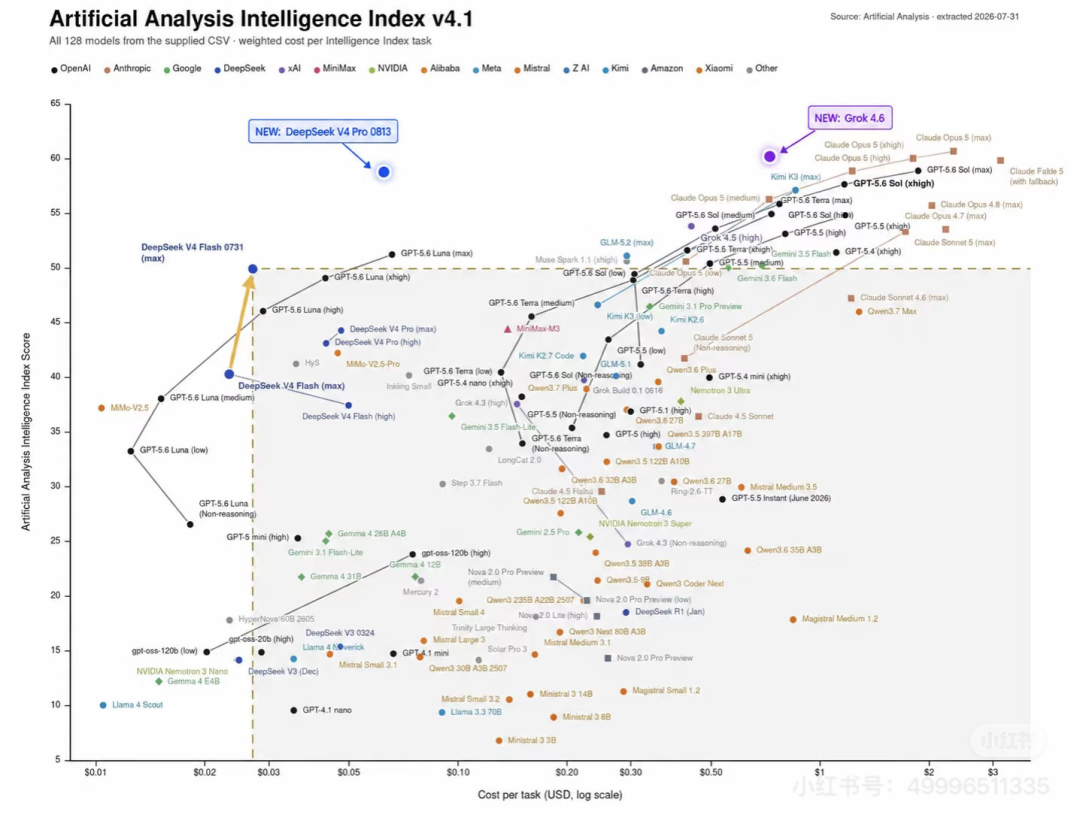
Caption: Models in the gray area were killed by DeepSeek V4 Flash, source: Artificial Analysis
In late August, the American programming Agent platform Cline began offering a yet-to-be-disclosed model for free. Cline stated that within a week, this model accounted for over 11% of the platform's inference volume. Subsequently, Zhichun claimed this model, which later became the GLM-5.3-Flash. Previously, Zhichun's founder Tang Jie mentioned in a performance meeting about the next generation models, stating that the company “would not create a large and useless model.”
In fact, the “small model” camp is continuously expanding.Intelligent Emergence has learned thatDark Side of the Moonand Tencent Hongyuanare bothpromoting the development of Flash model versions.
On the other hand, since the beginning of this year, the capital market has already placed a high stake on Chinese model companies, and under this backdrop, commercialization has become a more pressing issue.
Public data shows that by August this year, Zhichun's ARR (Annual Recurring Revenue) was approximately 1.6 billion dollars, with a market-to-sales ratio as high as 46 times; the yet-to-be-listed DeepSeek is valued at an astounding 163 times its estimated annual revenue. Across the ocean, Anthropic has a market-to-sales ratio of about 20 times. Chinese model companies still have a long way to go in commercialization.
Therefore,the competition between Chinese and American models has revealed another main line: while continuing to pursue AGI and competing for the upper limits of model capabilities, who can make cost-effective models complete more real tasks and serve more users?Who can use cost-effective models to open larger markets and create more revenue?

A Revolution in Model Efficiency
After switching models, one major improvement in Lin Zhou’s experienceis that the model's responseis much faster.
The team often needs dozens of Agents to write code simultaneously, and he adjusts the instructions while observing the progress; if he finds the direction is wrong, he immediately directs the model to make changes. Previously using Codex, he often had to wait for the model to output a long text before he could intervene to correct it. “Whether you use CLI format or its native App, the response takes a long time.” Once he encounters long projects, the models need to sort through previous conversation contents, and when using GPT-5.6, he has to wait even longer. “But after switching to V4.1 Flash, whatever you tell it, it can respond to you immediately.”
Since the beginning of this year, Scaling Law has still been the main line for large model research and development. The Qwen3.8-Max released this year has a total of 2.4 trillion parameters (T stands for trillion), and the Kimi K3 has 2.8 trillion. According to the comparison revealed by Elon Musk in April, Claude Opus at that time had about 5 trillion parameters, although Anthropic has not confirmed this number.
These supermodels indeed touch upon higher intelligence, but a larger base requires more training and deployment resources; when repeatedly invoking models in agent scenarios, the cost of using these models will increase exponentially.
After switching to V4.1 Flash,Lin Zhounoted another obviousfeelingis thatthe invocation costhas greatlydecreased. He provided an example from the team developing small applications: a colleague completed the development alone, “it cost about three to four dollars, and a small app was created.”
The model service platform Requesty’s weekly leaderboard in August showed thatDeepSeek V4 Flash accounted forabout one-third of the actual Token usage on the platform, ranking first among all models. In previous third-party evaluations,its comprehensive score was close to that of the US GPT-5.6 Luna high inference version, with task completion costs lower by about sixty percent.
“Model companies are also starting to pay more attention to real market demands, and will listen more to developers’ voices.” A baseline model researcher told Intelligent Emergence. The time and resources required for one round of training for small models are less, allowing users to see faster whether what they produce with the models is feasible and if adjustments are needed.“Usingsmall models for development enables faster version iterations and quicker cognition.”
In daily work, this researcher also selects models based on task needs. He gave an example: for simple yet labor-intensive tasks like modifying experimental scripts, it may take about 20 minutes for GPT to handle, while using DeepSeek V4 Flash only takes 2 minutes. “Since the task is not that difficult, I just hope the model finishes the task quickly.”
Driven by such user scenarios,recently published Flash models by various companies are mostly below 400B (B stands for billion parameters): DeepSeek V4 Flash has a total of 284B parameters; GLM-5.3-Flash has a total of 320B parameters; and the main model of Qwen3.8-Flash-Next has 125B.
“From a training perspective, models around 300B and those slightly larger may not differ much in capability.” This researcher mentioned that he has conducted training experiments with different sizes. Under the data and training scheme he used,approximately 300B models are already capable of learning long reasoning chains produced by larger model outputs.
A 2025 study published in Nature Machine Intelligence analyzed 51 open-source models and found that fewer parameters are needed to achieve similar results in five tests involving knowledge, reasoning, mathematics, and code. Researchers called this an increase in “capability density”: models of the same size can accomplish more tasks.
Qwen3.8-27B is a recent example. In the group tests conducted by Qwen, it scored 61.7 in the programming test SWE-bench Pro, compared to 53.5 for the previous generation model of the same size; it scored 70.7 in the long-range office test CoWorkBench, compared to 61.0 for the previous generation.
The problems that models need to solve also change with users. This researcher noted that programming products often answer programmers' questions about writing code and managing projects; in office scenarios, the questions change to “What do I do if I can't remember my Excel formulas?” and “How do I write this paper?”
The underlying work may still involve writing code, but the complexity of the actual work to be completed may be reduced. From Code to Work, a revolution in model efficiency and costs is taking place.

From "Programming" to "Everyday Office Work"
“I think there will be two paths.” A Code Agent entrepreneur commented on the emerging differentiation between “programming” and “office” products. Both programming and office products require models to understand instructions, write code, and invoke tools, but their target user groups are different. He believes,office products aimed at ordinary people “must be extremely cost-effective, with an extreme cost-performance ratio.”
In January this year, Tencent Hongyuan leader Yao Shunyu discussed the differences in user demands at the AGI-Next summit: enterprises are still willing to use the most powerful models for productivity tasks, while ordinary users most of the time do not need that.
The way the two types of users select models is also different. “Programmers can tell which tasks require more expensive models and which can utilize cheaper ones.” Ordinary users may not understand the strength of models needed to handle spreadsheets or write reports. The aforementioned entrepreneur stated: “This is a problem that office Agent product managers need to find a solution for.”
In January this year, Anthropic launched Claude Cowork, allowing an Agent that originally assisted mainly with code writing to also handle desktop office tasks. OpenAI later launched ChatGPT Work, allowing users to directly assign a task without having to ask questions step by step in a dialogue box.
Meanwhile, domestic products are also transitioning from programming to office work. In March, Tencent Cloud's CodeBuddy team launched WorkBuddy; in August, Alibaba integrated QoderWork, Wukong, and MuleRun to launch Qianwen Office; and around the same time, ByteDance integrated office capabilities from Feishu, TRAE Work, and other products into Doubao, launching “Doubao Work.”
According to a report by QuestMobile, by July 2026, Tencent WorkBuddy had 6.582 million monthly active users; PC client users averaged 19 uses in that month.
Facing the daily tasks repeatedly assigned by millions of users, office Agents cannot only select models based on complex programming standards. In some WorkBuddy user communities, users have commented on DeepSeek V4 Flash and GLM-5.3-Flash: “These two Flash models are basically sufficient for work.” In the enterprise end, a person close to Zhichun stated that after the release of GLM-5.3-Flash, many enterprise clients showed strong interest in this model with a total of 320B parameters.
In real office Agent usage scenarios, models executing tasks can even be smaller, down to hundreds of millions of parameters.
The startup focusing on office Agents, Yuankong Intelligence, has already utilized dozens of billion parameters models in Yuankong AI Work. The team conducts post-training based on open-source models to enable handling of more vertical tasks; general tasks call upon mixed models in the cloud.
When users assign tasks, the product selects the model for them. In this mode, the Yuankong team has observed that users are actually very sensitive to the speed of interaction. A team member stated:“If our system is slightly slow, users come to us within a minute.”
In fact, some office tasks do not even require the highest reasoning intensity available from DeepSeek Flash. A member of the Yuankong team mentioned that doing so for some tasks is “actually excessive, resulting in a very large number of Tokens being outputted, thus wasting a lot of costs.”
Yuankong Intelligence balances task effectiveness and Token consumption; Qianwen Office also divides tasks into two tiers: standard mode handles daily office work, and advanced mode addresses more complex issues. At the end of August, Qianwen Office applied Qwen3.8-Flash to standard mode.
According to the test results released by Qianwen Office, the speed of completing single tasks in standard mode increased by about double, and average Token consumption decreased by 75%; this mode can complete about 95% of its defined daily tasks, while more difficult tasks are assigned to the advanced mode.

A Larger, Yet More Competitive Market
Several months ago, the American startup Lindy announced it began using a Chinese model——switching the majority of daily work Agents managed by the platform from Claude Sonnet and Gemini to DeepSeek V4 Flash. The company disclosed that after switching, the model costs for this portion of calls decreased by about ninety percent.
“This is the largest adjustment to the cost structure since the company's establishment, and product quality has not been affected.” said Lindy's founder Flo Crivello.
In late August, an anonymous model named Ox-Alpha made its way into overseas programming Agent platforms OpenCode and model platform OpenRouter, immediately sparking widespread discussion.
The American programming Agent company Cline tested it using real bugs from its codebase: both Ox-Alpha and another model fixed the issues, but the former consumed only about one-third of the output Tokens of the latter.
This model, jokingly referred to as “Niu Lai” by Chinese users, saw around 500,000 users on OpenCode in less than a week since its launch; on August 26, Zhichun claimed this model—GLM-5.3-Flash. The “Niu Lai” model pairs with Zhichun’s flagship GLM-5.3—difficult tasks go to the flagship, while everyday tasks are given to the Flash version.
Offering developers a free trial is just the first step. Clearly,Chinese model companies hope to use the capabilities and prices of Flash to enter the global Agent product market, transforming more daily tasks of users to their models.
This is almost a market stirred up by DeepSeek. Globally, since the release of V4 Flash, DeepSeek has maintained a high invocation volume. Data from OpenRouter in June showed that DeepSeek's share of Token usage on that platform rose from 9% at the beginning of the year to 18% by early June; the increase primarily came from Agent tasks. By the end of May, V4 Flash accounted for 70% of the Token usage for DeepSeek’s series of Agent tasks.
DeepSeek has shown other model manufacturers the vast market potential of Flash models in the 300B-500B range——this is a new market that has been opened up.
Different types of models targeting different positioned markets also increase the chances of model manufacturers making profits.
From a market perspective, flagship models and Flash models are forming different battlefields. However, from the perspective of large model research and development teams, this does not seem to be two opposing strategies.
An industry insider expressed that flagship models still have training value. He compared it to racing cars in the auto industry: “They may not necessarily go into mass production, but some technologies will be transferred.” In his opinion, the capabilities and training experiences discovered by flagship models can ultimately be applied to smaller models serving a wider user base.
For example, Zhichun disclosed last week that an Infra Agent powered by GLM-5.3 participated in building and optimizing the inference service for GLM-5.3-Flash, successfully deploying GLM-5.3-Flash onto domestic chips. From initial adaptation to production-ready, it took less than two weeks; after optimization, the capability of the same service to handle requests increased to about three times the initial.
On the other hand, Flash models have also become a testing ground for the next-generation models. Qwen first used a new architecture intended for Qwen4 in Qwen3.8-Flash-Next; according to the team, the training computing power required for this model is about one-ninth of that for Qwen3.7-Plus.
This competition is not only happening among Chinese manufacturers; American model companies are also getting involved.
A price war has already started.
In July, OpenAI reduced the price of its lighter GPT-5.6 Luna by 80%. In feedback released by OpenAI, the American office Agent company Dust stated that after switching to Luna for similar tasks, speed improved by 40%, and costs decreased by 40%. Clearly, across the globe, model manufacturers are attempting to attract Agent customers with smaller models, leveraging speed and price advantages.
OpenAI’s Chief Financial Officer Sarah Friar stated, “As long as the quality is up to standard, low-cost models will be used for more tasks.” The revenue feedback that “models handle more tasks” will likely become visible in the next quarter.
*Lin Zhou is a pseudonym
Image Source|AI Generated
免责声明:本文章仅代表作者个人观点,不代表本平台的立场和观点。本文章仅供信息分享,不构成对任何人的任何投资建议。用户与作者之间的任何争议,与本平台无关。如网页中刊载的文章或图片涉及侵权,请提供相关的权利证明和身份证明发送邮件到support@aicoin.com,本平台相关工作人员将会进行核查。


