Author|Sun Rui
WeChat|lombredeau
In "The Truman Show", Fiji is a distant place.
It exists in the protagonist Truman's imagination of the real world. As long as he leaves Seahaven and crosses that sea, he can reach this “place of escape” in his heart.
In reality, Fiji consists of over 300 scattered islands in the southwestern Pacific Ocean. Agriculture and tourism are important economic pillars for this country. However, for farmers living on remote islands, agricultural production is not easy. Small farms are scattered across different islands, with limited transportation and infrastructure, and they also face natural disasters such as hurricanes and droughts.
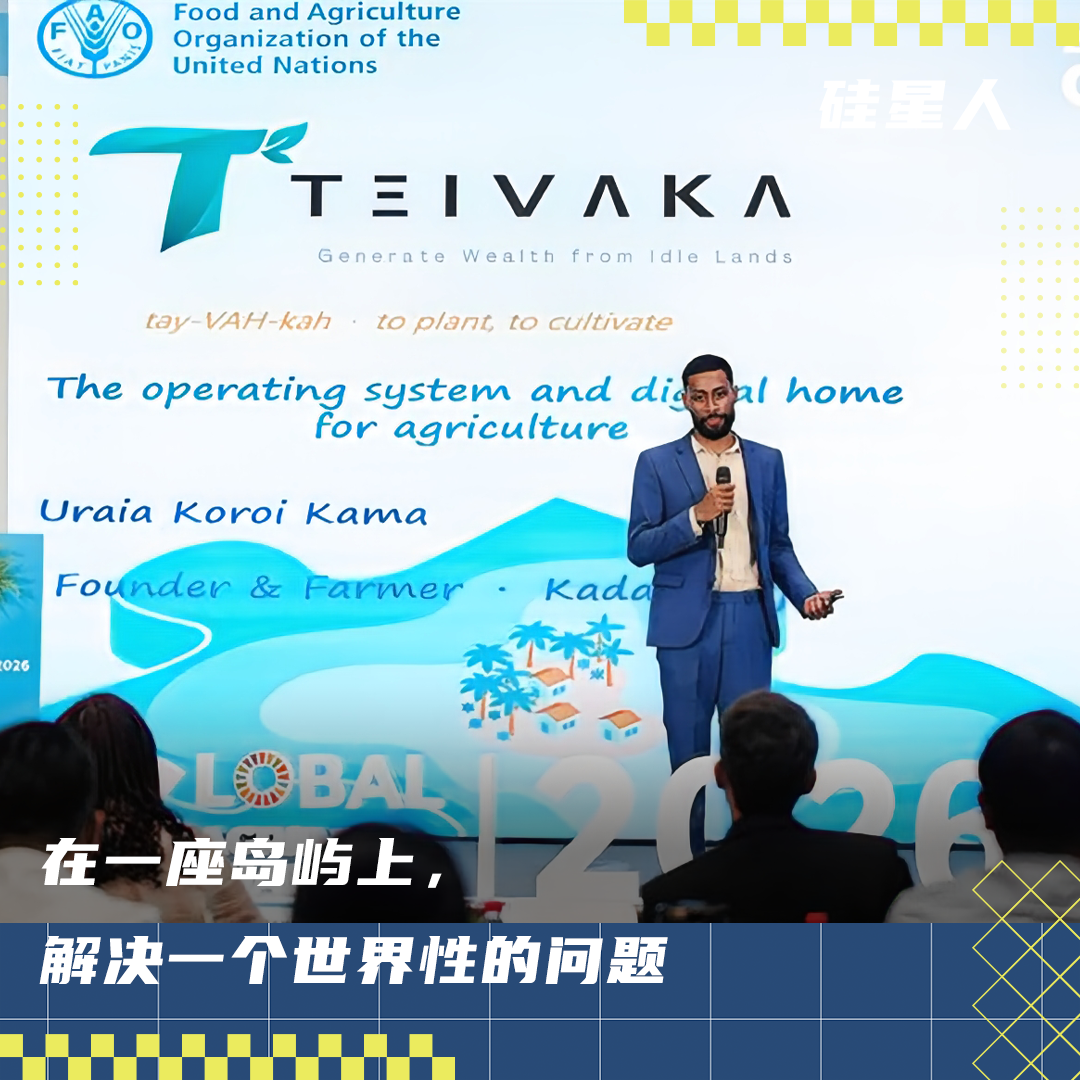
Cody comes from here. He is a farmer and the founder of the agricultural reliable digital identity platform Teivaka.
In September, he traveled alone from Fiji to Hangzhou, China, with Teivaka to participate in the 2026 Global Agripreneur Competition. In Fijian, Teivaka means “to cultivate the land”.
In Fiji, farmers often do not have complete planting records and find it hard to obtain loans, technology, and market information. What Cody does with Teivaka is to help farmers record their daily planting, harvesting, and sales, forming their agricultural files, allowing their previously hard-to-prove labor to be documented, and enabling these labor records to be seen and verified by banks, buyers, and others, thereby helping farmers establish connections in finance, insurance, and sales.
1
Why would a farmer create a digital platform by himself?
Cody's father, Taniela Kama, has been farming for 40 years. He has won the title of "Farmer of the Year" on Kandavu Island three times and received the "Livestock Farmer of the Year" award in the eastern region. Now, he is responsible for managing the first pilot farm of Teivaka on Kandavu Island.
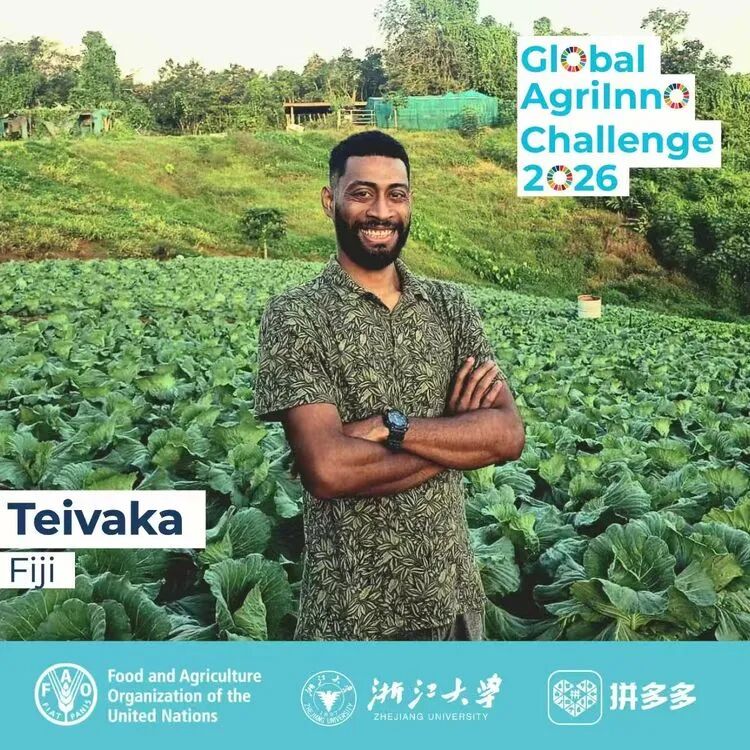
Cody grew up on such a farm. After leaving university, he spent 7 years exploring agriculture on his own, experiencing failures, and re-examining his father's decades of experience.
After several years of farming, he found that something seemed to be missing here—a system that could connect agricultural records with the upstream and downstream of agriculture.
“I have watched the people I care about work tirelessly on the land, yet their efforts have never been recorded or seen.” Cody realized there were some issues here.
In his eyes, a farmer could work the land for 40 years, experiencing hurricanes, droughts, and various accidents, but after 40 years, they might still not have anything in hand that could prove that experience.
Without complete records, there is no history, and there isn’t a set of agricultural identity that can be recognized by others. When such a farmer walks into a bank to seek a loan, they are practically “empty-handed.”
Cody himself was such a farmer. He had been rejected before due to a lack of records and had seen neighboring farmers face the same problem and be rejected by banks, government departments, and subsidy projects.
From sowing to fertilizing, spraying, harvesting, and selling, all these activities exist in reality, but there wasn’t a platform to help them record them.
This was also the original starting point of Cody's creation of Teivaka. It aims to turn farmers' daily labor into a continuous digital record and further form an "agricultural ID card".
This ID card would record what land a farmer owns or uses, what crops are planted on that land, how much money they made, and the time and history of these events.
But Cody emphasizes that this is not a platform for scoring farmers’ credit. Teivaka does not decide who is worthy of loans, nor does it make judgments for banks. It merely records the real labor that farmers have performed and allows institutions to verify it.
The farmers’ data also belong to the farmers themselves. Only after obtaining the authorization from the farmers can the banks view the relevant information.
1
Technology and Users, Problems Follow
The first problem Cody encountered while creating the platform was that he did not know how to make software at all.
He had not studied computer science, did not have any tech-savvy friends to consult, and did not have a budget to form a technical team.
He learned programming during busy agricultural seasons. Many times, he worked in the fields during the day and sat in front of the computer at night. To create this platform, Cody made various attempts. It was during this time that AI entered his view.
After coming into contact with AI, Cody used Claude to help himself learn software development, getting it to explain code, assist in writing code, check problems, and find errors.
If there were no AI, Cody estimates that a system like Teivaka would typically require around ten engineers and years of funding investment.
He describes AI more like a teacher he could not originally afford. He could repeatedly ask the same question at two in the morning without worrying about being laughed at for asking elementary questions.
However, Cody did not regard AI as a panacea. He is cautious about AI.
Cody set some restrictions for Teivaka. For instance, it can only call upon knowledge verified by agricultural experts, and it must provide sources. If it cannot explain where the answer comes from, it refuses to answer.
For farmers, a wrong answer could cost an entire growing season.
Now, Teivaka's AI assistant can read farmers' own farm records, agricultural courses on the platform, and supply-demand information within the platform's ecosystem.
When a farmer asks what went wrong with their crops, the AI provides answers that are not generic but can integrate with their planting records, find relevant courses on the platform, and tell the user who is currently purchasing that product.
In Teivaka, farm management, agricultural knowledge, market connections, and agricultural identity are all in the same system.
After Teivaka was created, Cody realized that technology might not be the most difficult problem.
Many rural users actually use the internet and smartphones regularly. Cody mentioned that the internet usage rate in rural Fiji is quite high, and WhatsApp is also a very familiar tool for the locals.
But when he wanted to introduce Teivaka to these farmers, they weren’t interested.
“I have been farming for 20 years and have never recorded these things. Why should I start now?” a farmer retorted to him.
This is a very hard question to refute. Because keeping records means more work, but it doesn't bring short-term value.
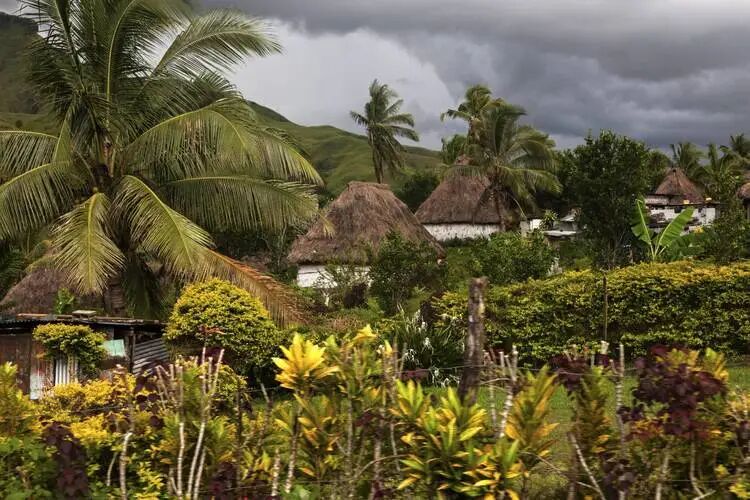
Cody answered this question through personal practice. He recorded production on his own farm, putting every planting, spraying, harvesting, and sales process into Teivaka, ultimately forming a complete agricultural production record.
Cody told us that when he scrolled through the results of this planting season on the screen, his eyes even got a bit moist.
This was the first time he saw everything he had done being preserved.
Another problem Teivaka faced was that farmers did not know how to use it. Initially, Teivaka contained many technical terms. Farmers viewed these words and did not understand how they related to themselves.
As a result, Cody removed all technical language. He stopped using terms like “system” and “data” and directly wrote “your farm”, “your harvest”, “your money”.
Cody set a very simple standard for himself: any terms that the village elders do not understand cannot be included in Teivaka.
1
Stepping out of Fiji
Besides technology and users, Cody also had to solve another problem—money.
The monthly cost of Teivaka is close to 1000 dollars (about 2200 Fijian dollars), covering server, AI, communication, and platform operating expenses, all of which are borne by the money earned from Cody's own farm.
Cody told us that last year, his farm's revenue was about 50,000 Fijian dollars (about 150,000 RMB), and approximately 29,000 Fijian dollars (about 87,000 RMB) was finally deposited in the bank.
The income from the farm not only supports his family but also maintains a platform that has not yet generated revenue. For long-term operations, Teivaka needs to be seen by more people.
He brought his project to participate in the Fiji Agri-Innovate Competition. In this competition, Teivaka was seen by more people. Ruobin and Joann, representatives from the Food and Agriculture Organization of the United Nations in Fiji and the Pacific region, approached Cody, hoping he would represent Fiji and the Pacific region in the competition.
“(The first reaction was) this is not intended for people like me.” Cody recalled his feelings at the time, “I am just a small farmer from Kandavu Island, and these hands have to do both farming and writing code. Now I can stand on the global stage alongside entrepreneurial companies and research teams with funding support? Of course, I would hesitate.”
But the original intention of Teivaka is to make farmers’ labor seen—those in the fields are not inferior to those in offices; it’s just that their labor has been recorded less.
With this belief, Cody applied to participate in the 2026 Global Agripreneur Competition. The competition is co-hosted by the Food and Agriculture Organization of the United Nations, Zhejiang University, and Pinduoduo.
This is a stage to showcase the innovative achievements of young agricultural tech entrepreneurs worldwide, allowing these entrepreneurs from the agricultural frontlines the opportunity to connect with broader agricultural institutions, industry resources, and market experiences.
“For me, this is a door.” Cody said.
On the other side of the door, there are agricultural institutions, governments, investors, and companies like Pinduoduo that continuously connect small farmers with agricultural product circulation markets.
1
The Problem of Fiji is also a Global Problem
There are 8 people in Cody's team. This time, only Cody came to China. Because he was the only one who sorted out his passport before the deadline.
This is Cody's first time in China. His previous impression of China was “massive scale, rapidly developing technology, and a city that never stops.”
After arriving in China, he found that it was indeed as he imagined. But what he did not expect was that China takes agriculture so seriously as a frontier field.
Especially Pinduoduo, one of the organizers, took it seriously even when agriculture was not yet a hot field—linking a large number of farmers and bringing a vast amount of agricultural products to consumers in various places; continually increasing investment in agricultural research based on the "100 Billion Support" plan.
In this competition, Cody brought his project to the forefront.
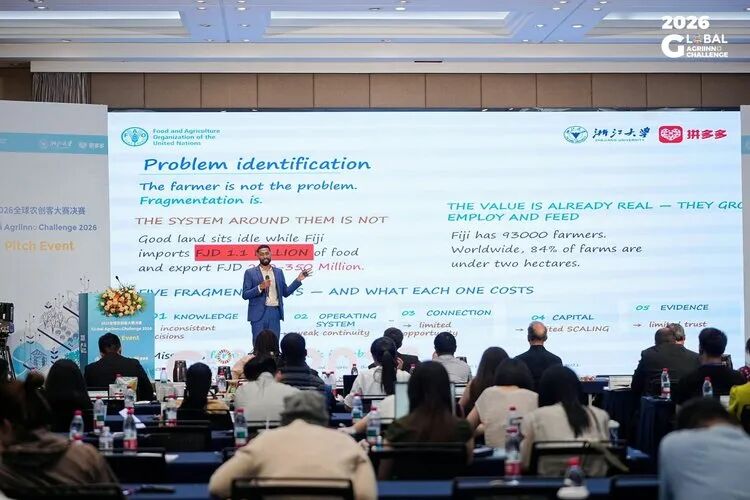
Although he was one of the smallest teams present, he saw that the problems he faced were not limited to Fiji. Small farmers across the globe may face similar predicaments. Some own land but have no records; some have agricultural products but lack stable market connections; some have been farming for decades but find it difficult to prove their labor results to banks, resulting in being unable to secure loans.
Different countries have different land systems, infrastructure, and market environments, but the inability of farmers' labor to continually accumulate into an asset recognized by the system is not an issue unique to Fiji.
“We are not solving an island issue; we are addressing a global problem on an island.” Cody described this to us after the competition.
And connecting small farmers to large markets is something that has indeed been achieved in China through e-commerce platforms like Pinduoduo.
After returning to Kandavu Island, Cody will continue to farm and also continue coding.
For him, what Teivaka ultimately wants to do is to make a farmer's successful cultivation recordable; allowing them to walk into the bank not only to speak verbally but to present evidence; and also to ensure that when the next generation takes over this land, they inherit not only the farms left by their parents but also an agricultural history that can be seen and understood.


Click a“Heart” before you go
免责声明:本文章仅代表作者个人观点,不代表本平台的立场和观点。本文章仅供信息分享,不构成对任何人的任何投资建议。用户与作者之间的任何争议,与本平台无关。如网页中刊载的文章或图片涉及侵权,请提供相关的权利证明和身份证明发送邮件到support@aicoin.com,本平台相关工作人员将会进行核查。


