Microsoft employees discussed whether OpenAI's use of news articles amounted to "the largest theft of labor in human history," and could set off a "doom loop" that degraded the models they were building, according to court documents unsealed on Thursday and reported by the New York Times.
The filings come from the suit the Times brought against both companies in late 2023, since joined by eleven other publishers. OpenAI has contested the claims throughout, and the case has already forced it to preserve 20 million ChatGPT conversation logs. Judge Sidney Stein of the Southern District of New York is weighing summary judgment motions, and documents are being unsealed as he does.
"Millions of people around the world will soon consider large models 'hoovering up' all their work to be an astonishing theft of unprecedented proportions," one internal Microsoft document from 2023 said. Large AI models "are a product that destroys its supply chain," the same author wrote.
Microsoft says those memos were written by Brent Hecht, a director of applied science who also held a Northwestern University post, and do not represent company views. He was not a decision maker and was employed to "present divergent and asymmetric perspectives," it said in a filing.
“Leaving a mess on the carpet”
Satya Nadella, Microsoft's chief executive, testified that "anything that is paywalled should be licensed by anyone who wants to use it," and said that had he known OpenAI was training on paywalled content he would have exercised Microsoft's right to make it retrain its models. A spokesman said he "spoke to broad principles" regarding how people find and consume information.
At OpenAI, a staffer told president Greg Brockman about building "hack” to bypass the NYT paywall. Brockman replied: "ah nice."
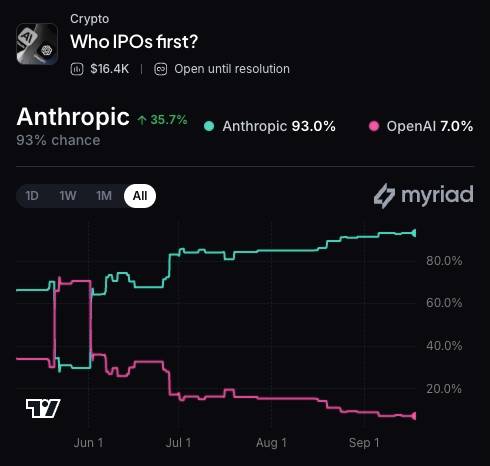
Myriad: OpenAI or Anthropic IPOs first? Click to make your prediction.
Nick Turley, who ran the ChatGPT team, wrote in June 2023 that AI posed an "existential threat" to publishers, and in February 2024 that AI products "will get more and more substitutive as they get better." Elsewhere he wrote that AI "products are largely substitutive, period."
An OpenAI engineer wrote in February 2023 that "no matter how prominently we show the links, users won't click," a finding that cuts against the argument chatbots send traffic back to publishers.
In a 2020 memo to Brockman and Sam Altman, then-policy director Jack Clark warned the company was "creating systems that substitute for the labor of the people that define the 'culture' of society," and would "become the symbol of how Silicon Valley is thoughtlessly stepping into other parts of life and leaving a mess on the carpet." Clark left to co-found Anthropic, which referred a request for comment from the Times to OpenAI.
Both Microsoft and OpenAI argue the training was fair use, transforming articles into new work rather than substituting for the originals. "The world can see what OpenAI and Microsoft thought all along about the fairness of their own behavior," said Steven Lieberman, who represents the New York Daily News and seven other papers.
The Times, a plaintiff in the case, declined to comment to its own reporters, who said OpenAI did not respond to requests for comment.
免责声明:本文章仅代表作者个人观点,不代表本平台的立场和观点。本文章仅供信息分享,不构成对任何人的任何投资建议。用户与作者之间的任何争议,与本平台无关。如网页中刊载的文章或图片涉及侵权,请提供相关的权利证明和身份证明发送邮件到support@aicoin.com,本平台相关工作人员将会进行核查。


