
“AI4S also has a trillion-dollar future in Coding.””
Written by|Hu Xiangyun
Edited by|Hai Ruojing

In May of this year, 28-year-old Zhang Zaiqi ended his postdoctoral research at Princeton and returned to China. Several doors opened before him: a faculty position at an American university, chief scientist at an AI tech giant, and a salary of millions. In the end, he chose to become an assistant professor at the Hong Kong University of Science and Technology and entered the narrow gate of entrepreneurship, founding AI for Science company Scinetics.
According to exclusive information from Dark Waves, Scinetics recently completed nearly 50 million RMB in financing. The round was led by Innovation Works and followed by Yijing Capital, Xiaomiao Langcheng, and Lingge Venture Capital.
This may be one of the few crossroads in his past life. From the Young Scholars Program at the University of Science and Technology of China, direct doctoral admission, to joint training at Harvard Medical School, and then going to Princeton to join Wang Mengdi's postdoctoral team. A young PI researching AI for Science is now one of the favorite profiles of investors in the venture capital market.
However, he also struggled with the decision to start a business.
Joining a big company means more substantial computing power, data, and talent allocation; whereas becoming a university PI and starting a business requires relatively independent efforts to find people, money, and resources with uncertainties in both technology and business.
Ultimately, what solidified Zhang Zaiqi's decision was the desire for “autonomy in work.” He wanted to lead his research direction rather than be constrained by a more significant corporate structure. He enjoys the process of building a system from scratch.
Before starting the company, Zhang Zaiqi and his team developed a scientific agent named Stella. Last year, after Stella went live, it served over a thousand research users, more than 70% of whom came from prestigious universities like Stanford and Princeton and top laboratories. Compared to self-trained foundation models, deploying agents is quicker and easier to integrate into existing research processes for commercialization.
However, this lightweight approach still has limitations. By using large language models as inference engines, scientific agents first translate problems into “natural language” when encountering data such as protein structures or nucleic acid sequences and then pass text instructions to the models for execution. Detailed 3D structures and modal relationships may experience “loss” during several translation conversions, and agents cannot escape errors even after numerous interactions.
During his doctoral studies, Zhang Zaiqi developed molecular screening models such as MGSSL and drug molecule generation models like FLAG, achieving SOTA in several niche fields. However, he judged that single-point capabilities are still insufficient; the future AI for Science industry will collectively trend towards multimodal. Thus, the core of Scinetics is to develop a multimodal long-range inference foundation model.
He proposed the concept of “Science Token,” hoping to transform scientific data such as small molecules, nucleic acids, and protein structures into a unified representation unit for models without going through human language translation, allowing models to reason in their native scientific modes and complete scientific tasks.
In the short term, they will focus on the life sciences, where commercialization paths are clearest, gradually expanding into materials, engineering, and other scientific fields in the future.
When talking about the future, Zhang Zaiqi believes that AI for Science will certainly have its GPT moment and Coding moment, and this could be a market that surpasses Coding; he also believes that his small team has the capability to develop a “unified” scientific foundation model, becoming a company that benchmarks against DeepSeek and Anthropic in the AI for Science field.
In the early stage of a technological revolution, the routes have not converged, so entrepreneurs have the opportunity to “bet big with small actions.” Recently, we chatted with Zhang Zaiqi about what future he hopes to gamble on by entering the AI for Science entrepreneurship.
Dialogue (edited):
Part01
AI for Science, a trillion-dollar market comparable to Coding
Dark Waves: In 2019, at 21, you chose AI for Science as your doctoral research direction. Looking back now, it seems very prescient. How has your perception changed as this field has heated up?
Zhang Zaiqi: Indeed, I am quite fortunate. My career transition happened to intersect with the industry's windfall.
During my doctoral phase, this was a non-consensus track; the understanding in the industry was “Science + AI,” where AI was merely an additional algorithmic tool for improving operational efficiency. Projects needed to be deeply bound to specific drug pipelines, such as focusing on peptide drugs or only making protein-specific vertical models.
Now, AI for Science is evolving toward a general direction, and the market generally believes this direction will usher in its “Coding moment.” Writing code has endowed humans with the ability to create things in the digital world; AI for Science is transforming humans' foundational ability for scientific exploration and discovery of new knowledge; its market value could rival or even surpass Coding.
From the iterations of Alpha Fold from 1 to 4, we can clearly see that AI capability is rapidly strengthening. The scientific problems that need to be addressed have not significantly changed, but new algorithms provide conditions for solving tasks that were previously difficult to model or predict; the inclusion of more scientific modalities substantially enhances model capabilities.
Dark Waves: Science actually covers a very broad direction. What are the prevailing technical routes in entrepreneurial investment, and is there a convergence trend in technical paths?
Zhang Zaiqi: Objectively speaking, the current AI for Science track has considerable noise. Practitioners mainly base their deployments on their previous backgrounds and have yet to reach a consensus on technical routes, making it difficult to determine superiority.
First is scientific agents, which mainly rely on external tools to complete scientific tasks. The advantage lies in quick deployment, easily embedding into existing R&D processes with short commercial validation cycles, resulting in the birth of many startups.
Large companies are also doing this, such as Anthropic's Claude Science and OpenAI's GPT-Rosalind. However, their main battlegrounds remain more general directions like Coding; scientific directions are merely placeholder arrangements and tentative explorations.
Second is virtual cells. Influenced by related work and papers from Arc Institute, interest in virtual cells skyrocketed last year. In theory, they simulate cellular changes in response to drugs or gene edits on a computer, allowing for the early batch screening of ineffective candidates, thus shortening R&D time and costs. The industry has high expectations for this and is developing rapidly.
Third is the AI for Science foundation model direction we have chosen. This is a “bottom-up” route focusing on the interactions of fundamental molecules and deriving higher-level phenomena such as diseases and gene regulatory networks from molecular mechanisms.
Dark Waves: Last year you launched the scientific agent Stella, which reportedly received good feedback. Why not choose this lighter route?
Zhang Zaiqi: After launching in the past year, Stella has served thousands of research users, more than 70% of whom come from prestigious schools and top laboratories like Stanford and Princeton, including Professor Zhang Feng from MIT.
However, we discovered a fundamental issue with the scientific agent paradigm:
It essentially translates scientific questions into natural language for the model to understand, and then translates back into structured instructions for tools to execute. Many fine 3D structural information and subtle connections between modalities are lost during the translation process.
This is a ceiling of the paradigm itself. You can certainly keep adding tools and processes within the agent framework, but as long as the underlying reasoning is still based on text, this bottleneck will always exist.
Dark Waves: Can you give an example of something an agent cannot accomplish?
Zhang Zaiqi: For instance, optimizing the local structure of a protein. To rotate a particular side chain by a specific angle of 5 degrees to form hydrogen bonds or other molecular interactions, this highly depends on precise reasoning designs in 3D space.
If using agents, it would be letting a large language model output text instructions, then calling a structural diffusion model like RF diffusion to execute them. But the structural model itself cannot well understand the text information; the tool's output results then need to be converted back into strings or screenshots, and fed back to the large language model—leading to confusion as the agent reads it. It may seem correct but isn't quite right, forcing further iterations.
Just this step has involved trying many agents over dozens of interactions, wasting a large number of tokens and resulting in many unusable outputs. The root cause is the lack of native scientific modal reasoning ability.
Part02
A brilliant child's big dream: multimodal scientific foundation model
Dark Waves: So you believe developing an AI for Science foundation model is essential? With a foundation model, can the “cross-modal translation” problem be solved?
Zhang Zaiqi: Since translation brings about losses, let’s not translate; allow the model to directly perform long-range inference (Chain of Science Tokens) in the native scientific modal space. This foundation model is also the core product of our company.
We have developed discrete tokenization schemes for various scientific modalities such as omics, protein structures, molecular formulas, and nucleic acid sequences, converting various scientific information into unified Science Token inputs for models, no longer relying on human natural language for abstract translation, but closer to the essence of science.
Model training consists of three phases: pre-training, mid-training, and post-training. In pre-training, a multimodal life science representation is established; mid-training focuses on learning cross-layer rules from sequences to structures, functions, and cell phenotypes; post-training emphasizes enhancing long-range reasoning abilities.
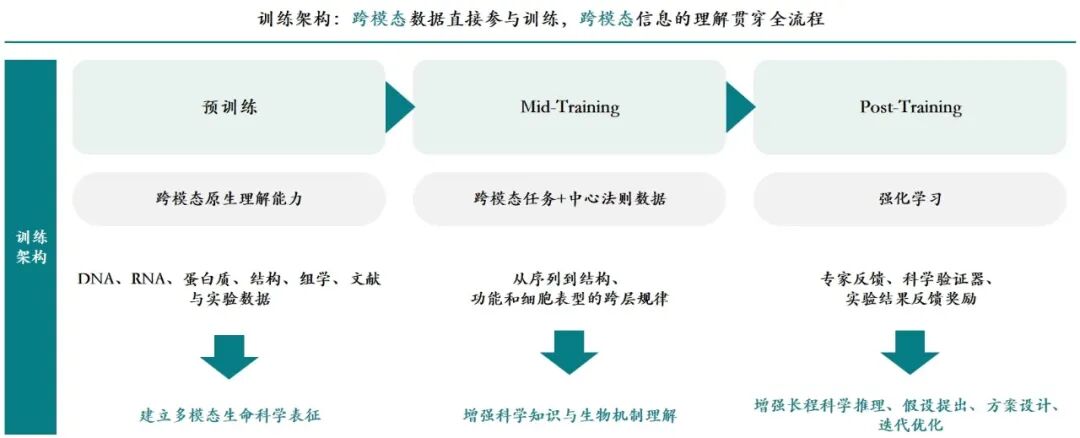
AI for Science foundational model training framework (Image source: Scinetics)
Dark Waves: How does this long-range reasoning differ from previous vertical small models solving single-point tasks?
Zhang Zaiqi: For example, in enzyme design, instead of producing results in one step, it reasons step-by-step like a human scientist: first builds the active center of the enzyme, which determines the core area of catalytic function; then builds the protein scaffold to support the active center; finally adds side chains and fine-tunes details.
This long-chain reasoning ability is something traditional vertical models and tool-calling agents do not possess.
Dark Waves: Converting various scientific information into a “unified” Science Token sounds attractive, but small molecules, nucleic acids, and proteins have very different data structures. How can your team achieve this?
Zhang Zaiqi: The first thing to address with Science Token is to ensure the model understands different scientific modalities.
In the past, we developed corresponding foundation models for small molecules, nucleic acids, proteins, complexes, and cross-modal text. We meticulously went through data collection, model construction, and training. Thus, the team understands how to encode each type of scientific data and how to align different modalities.
At the same time, while developing agents like Stella and BioClaw, we accumulated a large amount of long-chain reasoning data and explored methods to enhance reasoning capabilities through post-training.
Additionally, dry and wet loops are essential. Stella, besides computational and algorithmic modules, also integrated automated wet experiments. We ran dry and wet loop cases in tasks such as target discovery, antibody optimization, and small nucleic acid design. Therefore, we understand how AI should connect with real research tasks and link with automated experimental equipment.
Model evolution requires actively acquiring large quantities of high-quality data. Dry and wet experimental loops can support our continuous acquisition of training data and ongoing iteration.
Dark Waves: Based on current exploratory results, how capable is this foundation model?
Zhang Zaiqi: We have achieved good results in specific tasks such as protein structure prediction, protein function annotation, RNA secondary structure prediction, and DNA mutation prediction.
We are not very surprised by this outcome, as the scientific system itself is a complex multimodal system. If we can include multimodal information into the model and perform design searches from a global perspective, we are naturally more likely to obtain better solutions.
Currently, we are exploring next-generation model training methods, such as attempting AI for AI and Recursive training paradigms to uncover inherent scientific laws, expand more modalities, or enhance the model's parameter count, thereby strengthening long-range scientific reasoning capabilities. We look forward to achieving the ChatGPT moment for the AI for Science foundation model along this path.
Part03
Business model based on Science Token
Dark Waves: From pricing and commercialization perspectives, will Science Token bring new business models?
Zhang Zaiqi: Yes. However, the pricing logic for Science Tokens differs from that of text tokens. The latter’s pricing mainly references computing power and electricity costs, but for Science Tokens, in addition to considering these basic costs, we must also assess the scientific value behind them. In some fields, such as small nucleic acids, data is extremely scarce, and the corresponding token value is naturally higher; the pricing must reflect actual business value.
We hope to become a foundation model company in the AI for Science field on par with DeepSeek and Anthropic, exploring a commercial model based on Science Tokens as billing units.
Dark Waves: In a model using Science Tokens for billing, who would be the ideal buyer, and in what specific scenarios would it be used?
Zhang Zaiqi: For example, pharmaceutical companies. Once our model capabilities are strong enough, we will not need to exert significant effort in business development to bind individual pipelines for delivery. Antibody pipelines, peptide pipelines, small nucleic acid pipelines—various tasks can be undertaken.
At this point, the pricing unit can be based on “how many Science Tokens were consumed to solve this drug design problem.” Just like coding, pricing won’t depend on the number of lines of code or modules; clients trust the model's capabilities, directly calling for services and being charged based on the number of tokens consumed. This can save a considerable amount of negotiation work in business development.
Dark Waves: If this model can be realized, will it become the common commercialization path for AI for Science foundation model companies?
Zhang Zaiqi: Science Token is still our unique concept; as for the standards for measuring the quality of long-chain scientific reasoning data and their pricing standards, there are no mature solutions across the industry. When we discussed this with several major AI companies, they also hadn't fully pondered this. Thus, it remains a very early commercial idea that requires common industry efforts to form a consensus.
Dark Waves: From an early-stage market perspective, we are seeing significant investment institutions and funds pouring in, but the current financing volume in this direction still falls short compared to large models and embodied AI. Where do you think the divergences lie?
Zhang Zaiqi: There are two extreme mentalities in the market that can lead to hesitancy in investment decisions.
One group of investors recognizes the trillion-dollar market of AI for Science, believes in AI science equality, and hopes everyone can unleash their imagination to participate in scientific exploration, but their doubting point is whether the current technological capabilities can accomplish this. Another group perceives the AI for Science market as relatively small, thinking that customers consist mainly of university faculty and students as well as PIs, with weak payment capabilities.
Historically, the market has a clear understanding of vertical models, but investors have stricter standards when assessing “unified” scientific foundation models. They believe that coupling Harness with vertical small models is sufficient to address research needs. From the user side, many researchers aspire to a more intelligent foundation model but, due to inertia, are accustomed to calling specialized tool models, which is a point of contradiction.
Dark Waves: What kind of investment institutions are more willing to bet on AI for Science foundation models?
Zhang Zaiqi: Some market-oriented funds focused on technology and certain investors with deep backgrounds in the pharmaceutical field. They understand the “historical technical debt” in the existing R&D system, akin to “spaghetti code”: pharmaceutical companies internally integrate hundreds of small models, and there's information loss in every step, leading to very high maintenance costs.
Thus, from a systems engineering perspective, they judge that AI will be the strongest force to transform these practices. Such investors are more willing to place bets on foundation model routes.
The consensus requirement from investors is: models must be iterated quickly to seize the leading position. In terms of team configuration, we have gathered essential talent from past academic circles and some major industrial players involved in AI for Science foundational model R&D, establishing a solid technical accumulation. We initially hoped to achieve some commercial orders in the next one to two years, but investors feel that in the short term, there is no need to excessively focus on that; prioritizing model capabilities is more important.
免责声明:本文章仅代表作者个人观点,不代表本平台的立场和观点。本文章仅供信息分享,不构成对任何人的任何投资建议。用户与作者之间的任何争议,与本平台无关。如网页中刊载的文章或图片涉及侵权,请提供相关的权利证明和身份证明发送邮件到support@aicoin.com,本平台相关工作人员将会进行核查。


