Recently, my Codex quota has reached a level that's starting to become unaffordable for me.
As everyone might know, I've created an AI hot news product called AIHOT.

What I've been working on recently is primarily about optimizing the underlying layer of AIHOT, one is to lower costs as much as possible, and the other is to enhance the system's underlying performance.
It's all about reducing API costs for models, lowering scraping costs, using algorithms to replace models, identifying over-design, finding performance bottlenecks, etc. Recently, because we surpassed 1 million monthly active users, the traffic and request costs have reached a point I can't bear anymore. I'm frantically looking for ways to compress data transmission and cut costs, almost to the extreme of using edge caching...
Then, to create a heat ranking list, I've added nearly 2,000 monitoring data sources, which leads to daily API costs for large models of several hundred bucks...
So basically, I'm burning through one $200 Pro account per day, quickly turning into daily disposable ones, rotating between three accounts, switching to another as soon as one runs out to continue completing tasks.
On one hand, AIHOT is burning money madly every day on the backend, while on the other hand, I'm burning money on Codex daily to optimize the expenses of AIHOT. I feel like I wake up every day and fall into some kind of cyber cycle, with money just disappearing like running water...
Especially since I don't really understand code, I can only act as a product manager, planning the process architecture, knowing what my goals are, but how exactly to achieve them? Is there any more breakthrough method to implement that? If you expect me, this foolish human brain, to think about it, I definitely can't manage it. So I need a very strong large model to research all our past log data based on my needs and goals, and provide a great development plan for me to execute later.
Recently, I've frequently been using GPT-6 Astra Max for analysis and planning. For two cost-cutting tasks, I went straight to GPT-6 Astra Ultra, and after completing the plan, I implemented it using GPT-6 Astra High.

So the Codex quota is not sustainable, and a significant portion of the quota consumption comes from earlier analysis and planning. Using Ultra for analysis and planning once can consume directly 10% of my $200 membership weekly quota.
Poverty breeds innovation.
Once a person is driven to a corner by quotas, their mind will become exceptionally active.
So I started thinking about how to maximize the use of the ChatGPT web version, because everyone knows that the ChatGPT web version has a super strong model, GPT-6 Pro, and this is actually a hidden benefit of the ChatGPT Pro membership that is very easily overlooked.

Because its quota is separate from Codex, it does not consume your Codex quota.
A $200 Pro membership has 200 Pro conversation quotas per week.
To be honest, this has always been an extremely useful model in my mind. Back in July when there was no GPT 6, only GPT 5.6 Sol, I mentioned that this model's review level and depth are very strong.
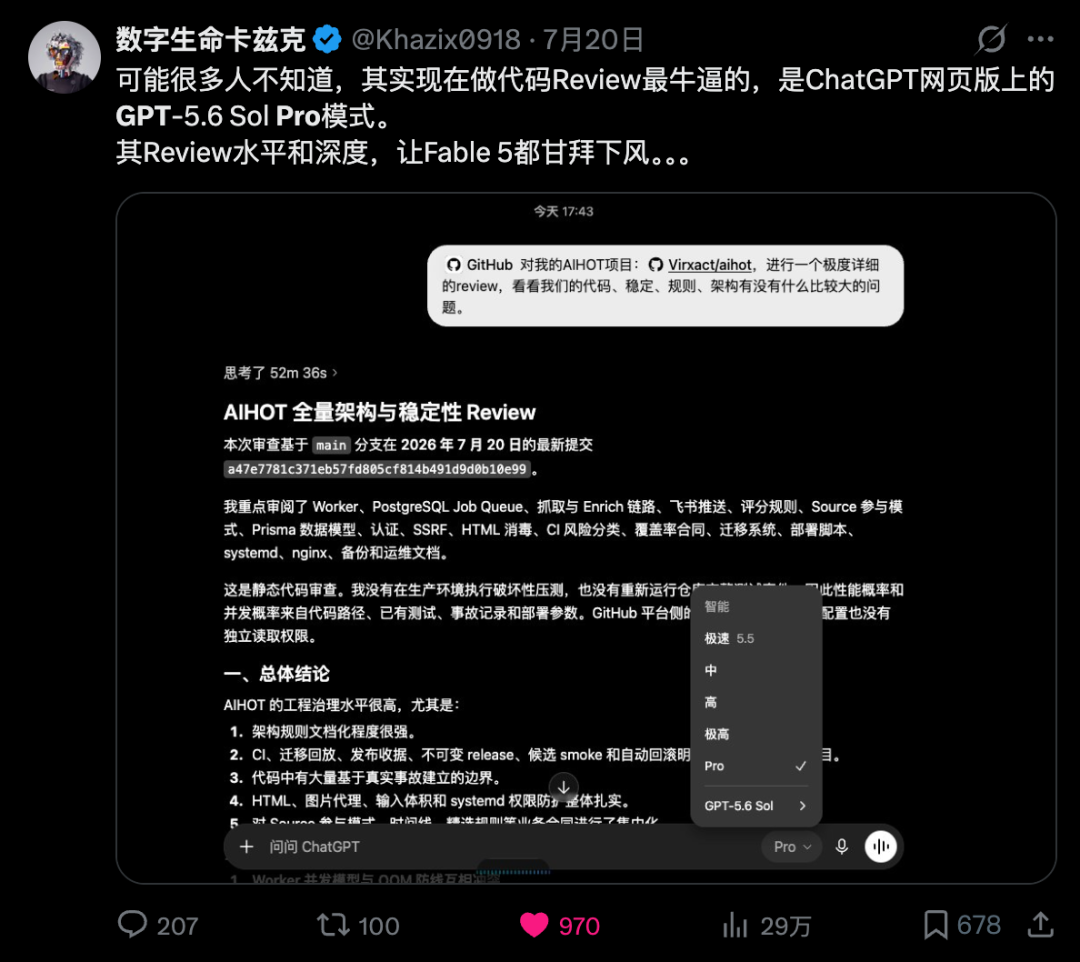
However, the GPT Pro model has always had one issue: it cannot see my real business data and scenarios. It can link to my Github through plugins, accessing all my PR records and actual code, but it still cannot see all my server log records from these past months, nor my real online database.
If you can't see these things, how can you analyze the data and infer some underlying breakthroughs to provide a real planning solution for us?
For example, how many data entries came in yesterday? What are our peak data numbers each day?
How much does each model call cost per day, and where is the money spent? What is the cache hit rate, etc.
So essentially,
Code tells AI how this system should theoretically run.
Production data tells AI how this system actually runs.
PR history tells AI why it has become this pile of garbage over time.
This is the biggest pain point I faced using GPT-6 Pro for planning in the past; everything could only be speculated based on my existing code, and it couldn't analyze historical data for backtesting.
Therefore, I've always been thinking about ways to solve this issue. Of course, I know there are various bridging methods to pull the GPT 6 Pro quota into Codex locally and use it for processing.
But countless experiences in the past have told me that this method has risks, and I'm not too keen on taking such risks.
Then I recalled something, MCP.
In the ChatGPT web version's chat mode, plugins can be called, but Skills cannot. The underlying of the plugins is actually MCP.
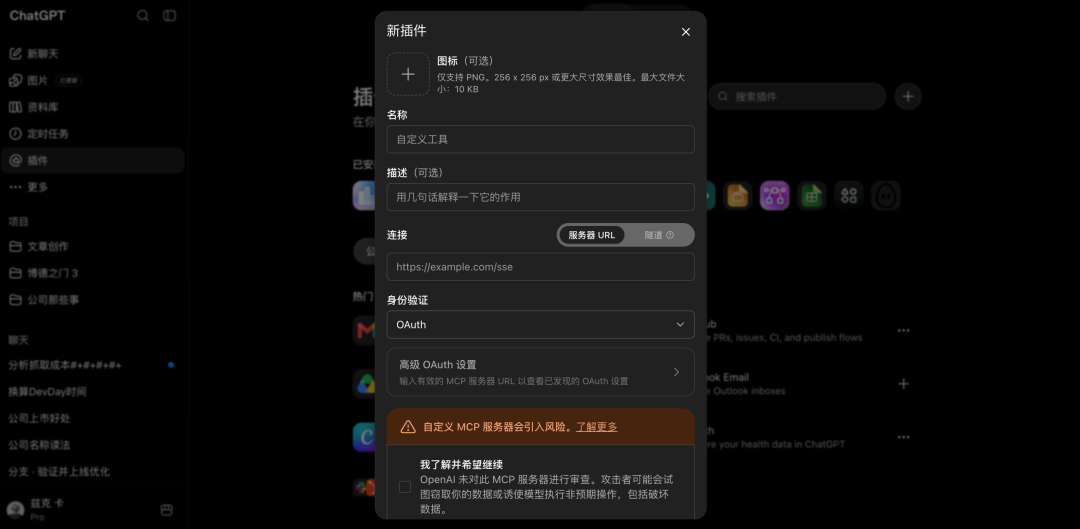
So what if... I package my server directly as MCP and turn it into a plugin, allowing GPT-6 Pro to read all my server data using the MCP protocol, wouldn't that work???
Without hesitation, I sent a message to Codex.
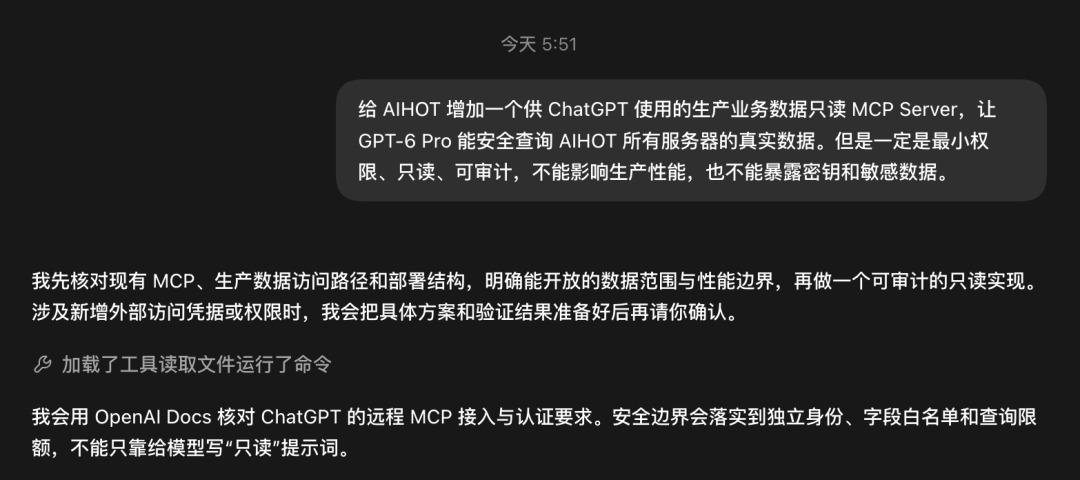
Yes, just this sentence: “Add a read-only MCP Server for ChatGPT using AIHOT’s production business data, allowing GPT-6 Pro to safely query all real data from AIHOT’s servers. But it must have minimal permissions, be read-only, auditable, not affect production performance, and not expose keys or sensitive data.”
It packaged it automatically.
To protect our server security, I only granted read-only permissions. It can't perform any operations on my server, it can only read data, but cannot manipulate data.
Additionally, to protect the security of our private MCP data, it also raised the question that OAuth login service is needed. That’s too simple since we use Feishu, and I had previously developed a whole Feishu authentication center for our colleagues in the company. I directly integrated Feishu’s authentication, so it can only be used after logging in with my own Feishu account.

About half an hour later, Codex finished developing it for me.
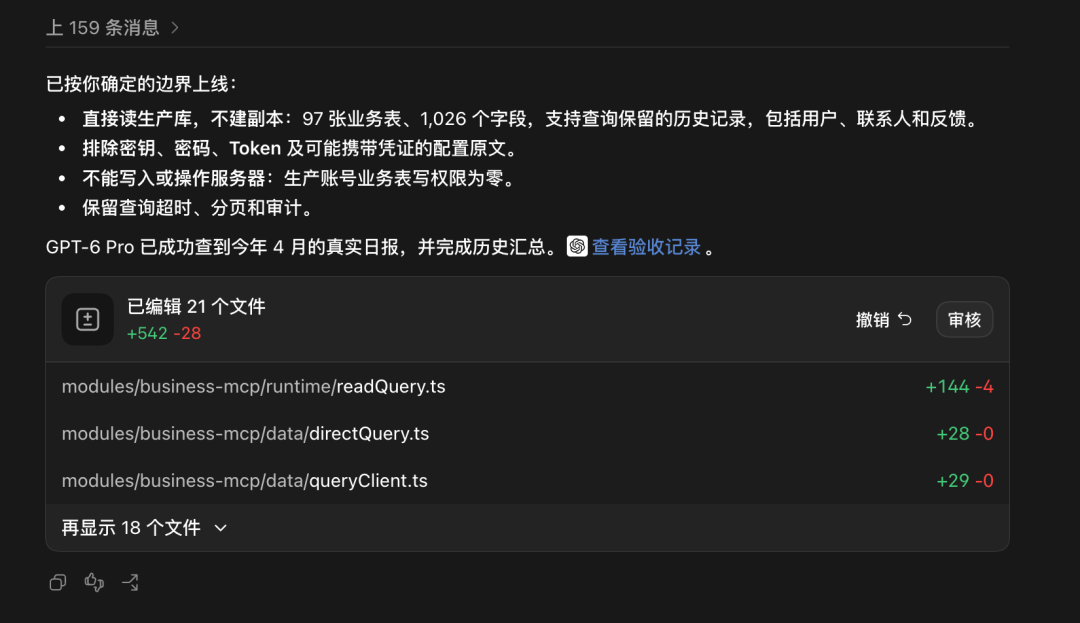
Due to its powerful Computer use capabilities, it even uploaded it directly and completed the experiment itself.

It worked.
MCP is a great thing, really, everything can be MCP. You can package anything from your local computer or server into MCP, then make it your private plugin, allowing GPT-6 Pro to access it. Just imagine how vast this potential is and how much can be done; I believe everyone’s imagination is richer than mine.
Next, let’s talk about how to use it and how to better coordinate with Codex.
Open our Codex and click the Quick Chat button in the top left corner.
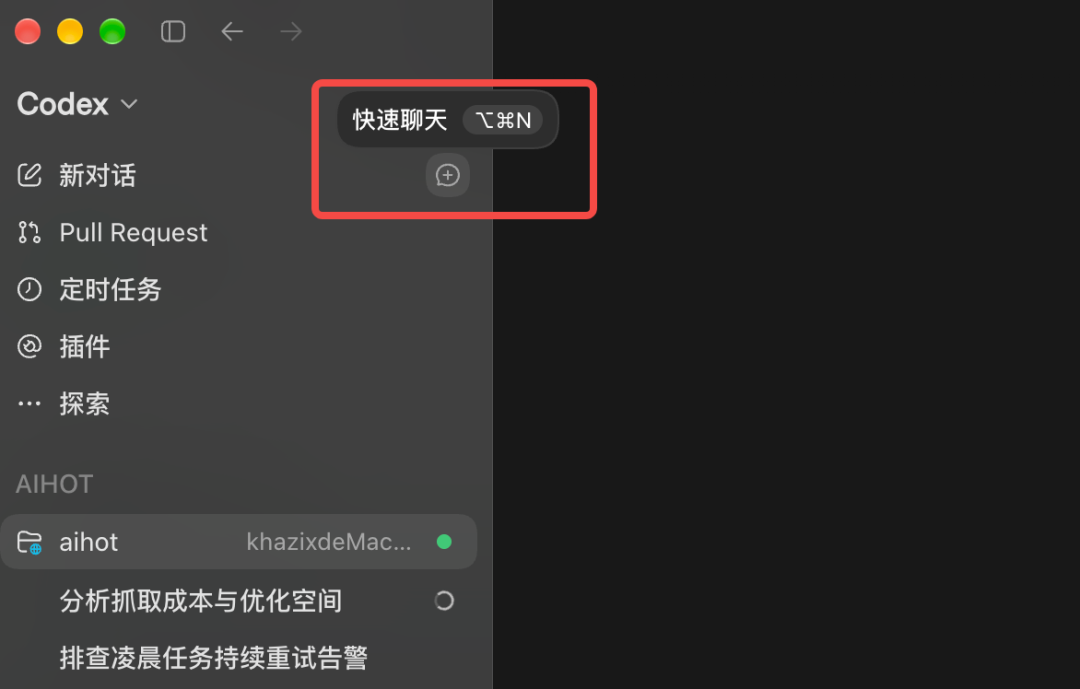
Open the ChatGPT chat mode.
At this moment, a window will pop up on the bottom right, set the model to GPT-6 Pro, click the plus sign, and select your own plugin.

Since I need both data and code along with PR records, I call both my own plugin and the Github plugin simultaneously.

At this point, you can express your needs.
For example, I say I hope to continue to cut costs.

It will directly read all our data and start running.
After about 40 minutes of thinking and reasoning, GPT-6 Pro finally finished running and provided me with a very detailed plan. I looked it over, and the quality was indeed extremely high.

This time, if you run directly using GPT-6 Astra in Codex, I think the weekly quota can actually be cut down by 10%, so this method really saved me 10% of the weekly quota, and it fully complies with all OpenAI's rules without doing anything out of line.
After getting this plan, how do we put it into Codex for direct execution?
The method is very simple; you don’t need to download the md document and plan and then upload it again. You can simply click “Add to Codex” in the chat window.

You will find that this conversation has already arrived in your Codex window.

Next, write a universal prompt for execution:
“Help me verify and implement all the optimizations mentioned here that are worth doing, and deploy them uniformly.”

I personally prefer to set the reasoning level to "High" during execution; others can set it to "Medium," but I don’t recommend using "Light," as at least for me, the results aren’t particularly effective. Sometimes it can lead to repeated failures or validations, which complicates things a lot.
GPT-6 Sol will most likely kick in right away. Once GPT-6 Sol is up, for execution, I might mindlessly switch to GPT-6 Sol, only using GPT-6 Astra for some high-difficulty tasks.
After writing the above prompt, just send it; I don't know how long it took because I went to sleep.

When I woke up and checked, the development was complete.

This task seemed to have only cost about 4% of my weekly quota.
Still quite satisfying.
To be fair, GPT-6 Pro is so powerful and provides me with 200 quotas each week. Letting it sit there gathering dust while I burn through a Codex account every day feels unsustainable.
As long as you are a Pro member, whether you have a $100 account (which can use GPT-6 Pro quota 50 times a week) or a $200 one, you should give it a try. Package your real data and business as MCP for GPT-6 Pro to use; it should significantly reduce your Codex token consumption.
Additionally, I must emphasize that this MCP method and plugin calling approach that complies with the rules are 99.99% risk-free and won't lower your IQ or subject you to risk control. However, if you use third-party bridging plugins to reverse-proxy GPT-6 Pro's quota and develop through Codex, and get caught by risk control, don't come to me = =
Account security first...
Finally, let's summarize this workflow.
The GPT-6 Pro on ChatGPT connects the real world through MCP for detailed analysis, planning, and architecture.
Then, Codex's GPT-6 Astra High is responsible for the specific development execution.
Saving money, effort, and time.
I just need to express my needs and make decisions.
Oh wait, I still have to pay.
...
AI.
Really fun.
免责声明:本文章仅代表作者个人观点,不代表本平台的立场和观点。本文章仅供信息分享,不构成对任何人的任何投资建议。用户与作者之间的任何争议,与本平台无关。如网页中刊载的文章或图片涉及侵权,请提供相关的权利证明和身份证明发送邮件到support@aicoin.com,本平台相关工作人员将会进行核查。


