In the past, many people's way of participating in memes was actually very simple:
See a new coin → Look at the increase → Find a contract → Buy it.
But as the number of new coins in an ecosystem increases, the real difficult question becomes: with so many new coins every day, what should we be looking at? Especially in emerging meme ecosystems like Robinhood Chain, where project lifecycles are very short and market changes happen rapidly. A token may initially go unnoticed, and just minutes later, trading volume suddenly expands, quickly coming into the sight of more people. This means that meme trading is really testing not just "do you dare to buy," but also: can you detect changes earlier and make quick judgments.
This is also why studying Robinhood Chain memes cannot just focus on one token, but should establish a complete process of discovering → observing → verifying → trading.
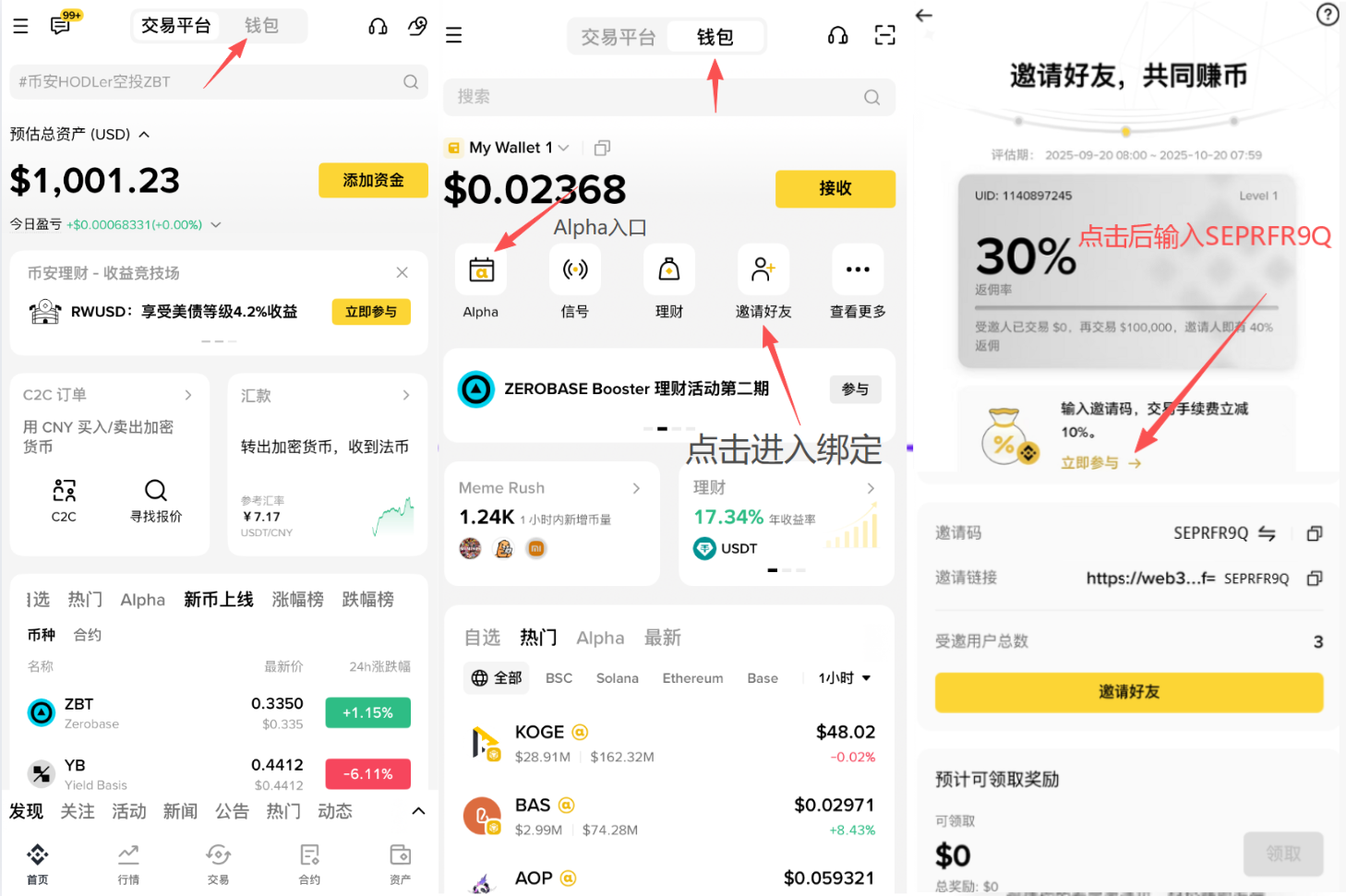
Currently, this process can start directly from the Binance Wallet meme page.
Binance Wallet Meme Trading Entry
01|Why Pay Attention to Robinhood Chain Meme?
The uniqueness of Robinhood Chain lies in its extension from a brand ecosystem primarily focused on traditional finance users to on-chain assets and meme trading scenarios.
It is important to note that the Robinhood Chain mentioned here is not simply a concept of "a few meme tokens listed on a stock trading app" that everyone is familiar with.
What really deserves attention is:
When the Robinhood brand, user entry, and on-chain meme culture connect, a new market for meme liquidity and attention is being formed.
New Chain = New Capital + New Narrative + New Opportunity Window
A mature on-chain ecosystem typically has many projects, traders, and established capital already in place. This means that competition is also more intense. In a relatively early-stage ecosystem, the market often sees a phenomenon: the information gap is greater than the technology gap.
When others have not noticed yet, you have already discovered it; when others begin to discuss, you have completed the first round of verification; when a large number of users start to pay attention, the market may have already entered the next stage.
Therefore, what meme players really need to study is not: "Which coin can rise 100 times?" But should reframe the question: "What exactly happens when a meme goes from being unnoticed to starting to gain market attention?"
This is where the true value of chain scanning lies.
Opportunities in Memes Are Often Hidden in "Changes"
Many novices, after opening the meme page, first look at: the increase. But if you really want to establish your trading system, merely looking at the increase is not enough. Because a token has already risen 500%, it only shows that: an increase occurred in the past. It does not directly tell you: whether there will be further increases.
On the contrary, we should pay more attention to some data that are changing:
- Is the trading volume suddenly increasing?
- Is the number of holders rapidly increasing?
- Is liquidity increasing?
- Is the buying capital starting to increase?
- Are there new addresses continuously participating?
- Is the project's community and narrative starting to spread?
- Are there significant changes in early holding addresses?
In other words: Do not just look at the "results," but also pay attention to the "process." This is why meme chain scanning is becoming increasingly important.
From "finding a coin" to upgrading to "searching for ongoing changes."
Imagine 100 new coins appearing simultaneously.
Among them:
- 20 have almost no trading;
- 30 have very low trading volumes;
- 20 have only a few addresses participating;
- 15 see a short spike followed by a rapid decline;
- Finally, only a few begin to show synchronized changes in trading volume, holders, and capital.
What is really worth further study is often not those "already having risen the most" coins, but rather: the coins that are transitioning from low attention to high attention. This is the core of meme chain scanning.
Thus, the entire process can simply be understood as: Many new coins -> Discover data anomalies -> Filter out low-quality projects -> Further verify capital and chips -> Observe whether the market forms a resonance -> Then decide whether to participate.
This is completely different from the simple thought of "seeing an increase and buying."
02|Binance Wallet: Starting from Discovering New Coins
The question arises. If we proceed according to the above approach, ordinary users will soon encounter another problem: Where do I find this data? Previously, doing on-chain memes may require opening:
- New coin discovery tools;
- Market tools;
- On-chain browsers;
- Wallets;
- Address tracking tools;
- Social media;
- DEXs;
A project might require switching between several pages from discovery to trading. This, for meme markets characterized by high frequency and rapid changes, is in itself an efficiency problem.
Therefore, a good meme tool does not primarily require "the more functions, the better," but rather: Can it help me discover opportunities faster and complete the first round of judgments quickly?
This is also why the Binance Wallet meme page is worth paying attention to.
The Binance Wallet has now provided a dedicated entry for meme scenarios, concentrating features such as new coin discovery, meme rankings, and trading into the same user scenario. Recently, Binance Wallet has also updated the Meme Rank to support unified ranking for Robinhood Chain and BNB Chain.
Enter:
First Understand the Three Areas in Binance Wallet
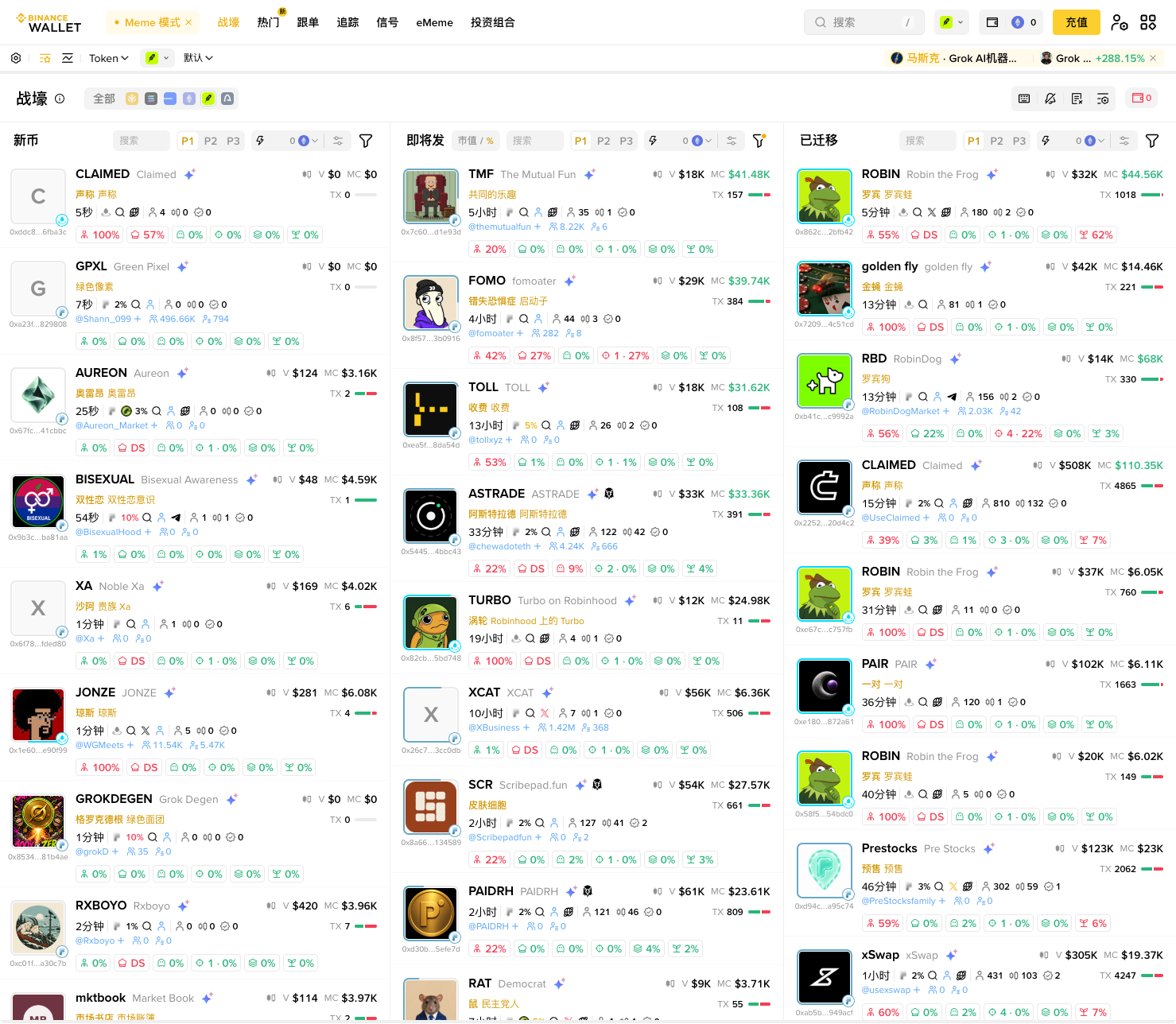
You can currently see three core areas: New Coins, Upcoming Issuance, Migrated
These three areas correspond to different lifecycles of memes.
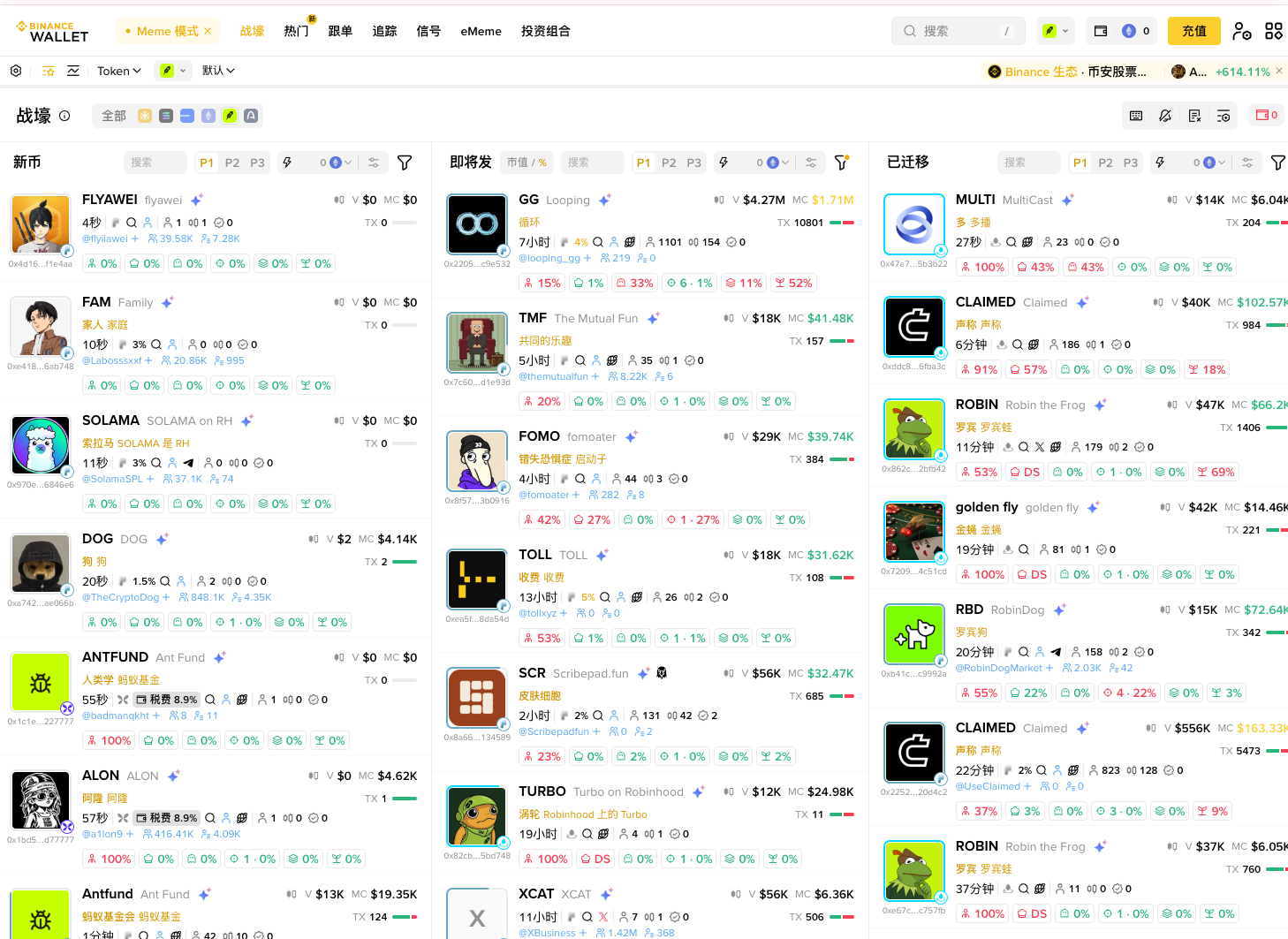
① New Coins: Searching for Early Market Changes
New coins are the starting point of the entire process. Here, the greatest value is not: "Discover a coin and buy it immediately." But rather: finding objects worthy of further study among numerous newly appeared projects. For example, you see a project that just emerged a few minutes ago. At this point, do not rush to place an order.
At first glance, you can first observe:
MC: Market Capitalization
V: Trading Volume
TX: Number of Trades
And:
- Number of holders
- Buying and selling situation
- Liquidity
- Community information
- Wallet distribution
These data combined can help you judge: whether this project is just "newly created" or has already begun to exhibit real market activity.
② Upcoming Issuance: Observing Projects Entering the Market Attention Range
Compared to purely new coins, "upcoming issuance" is more suitable for observing projects that have begun to gain some market attention.
This stage is especially worth focusing on: changes in trading volume
And not just looking at the price.
For example, a coin:
Yesterday, its trading volume was only a few tens of thousands of dollars,
Today it suddenly increases to hundreds of thousands of dollars,
At the same time:
- Number of holders increases;
- Number of buying addresses increases;
- Community starts to have discussions;
- Liquidity changes synchronously.
At this point, the key to study is: Why has capital started to enter?
And not simply asking: "How much has it risen?"
③ Migrated: Projects Entering the Next Stage
Finally, we have: migrated.
For meme players, these types of projects can serve as another observation pool.
Because the projects have moved from the earliest stage to the next stage, the market usually has accumulated some trading data.
But it is crucial to note: migration does not equal safety.
It also does not mean: that a rise is guaranteed after migration.
It more implies:
You now have more historical data for further analysis.
So at this stage, the focus of study should also shift from: "Who is it?"
Gradually evolving to: "What is happening now?"
The Real Advanced Play: Don’t Just Stare at a List, Look at "Changes"
If you simply open the Binance Wallet meme page and see which coin has risen the most, it is actually not much different from looking at an ordinary increase chart.
The truly valuable usage is: to treat the meme page as a filter.
After opening it every day, first search through a large number of projects for: projects with unusually increased trading volume, rapidly increasing holders, significant changes in liquidity, changes in buying and selling behaviors, and projects that begin to attract sustained capital attention.
Then enter the second stage: on-chain verification.
This is when you start further studying:
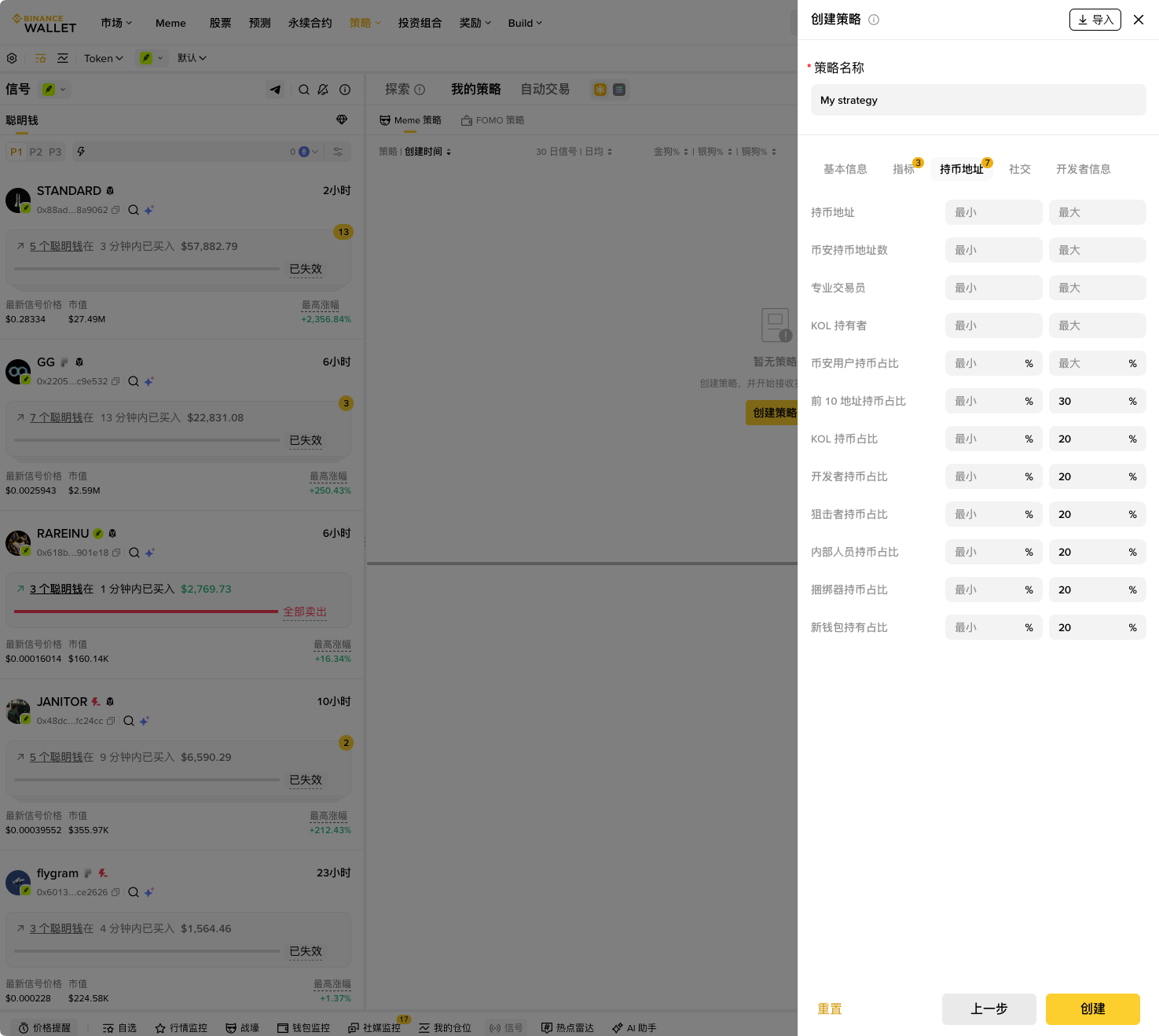
- Top Holder
- Dev Wallet
- Early Buyers
- Large Holder Addresses
- Smart Money
- Transaction Records
- Liquidity
- Community
Thus, the entire process becomes:
Binance Wallet Meme Page -> Discover New Coins -> Observe Data Changes -> Filter Worthy Projects for Research -> Further On-chain Verification -> Finally Enter Trading Decisions.
This is the method I believe is more suitable for ordinary users to learn about Robinhood Chain memes.
An Important Recognition
Meme trading is not about finding "certainly rising" coins.
Because there is no indicator that can tell you in advance: "This coin will definitely rise."
What can truly be done is to gradually filter out a massive number of projects through multidimensional data.
So: The difference between advanced meme players and ordinary meme players is not necessarily who is more daring to bet, but who has a better information filtering process.
And the significance of Binance Wallet also lies here: it helps you make the "finding a coin" step more efficient.
As for whether a project is worth further research, the next step must enter the real core section: how to further filter a new coin from "worthy of attention" to "worthy of research" through trading volume, liquidity, holding distribution, Dev wallets, and Smart Money.
Exclusive Benefits for AiCoin Users
👉 Enter invitation code SEPRFR9Q when using Binance Wallet to enjoy 10% fee rebate, making meme play cheaper and more profitable.
🔗 Exclusive Link:
https://web3.binance.com/referral?ref=SEPRFR9Q
免责声明:本文章仅代表作者个人观点,不代表本平台的立场和观点。本文章仅供信息分享,不构成对任何人的任何投资建议。用户与作者之间的任何争议,与本平台无关。如网页中刊载的文章或图片涉及侵权,请提供相关的权利证明和身份证明发送邮件到support@aicoin.com,本平台相关工作人员将会进行核查。