Despite Celestica Inc. (CLS) recently exceeding expectations in its financial report and the broader market rebounding from the lows at the end of July, the company's stock price remains under pressure as investors digest the stock issuance in August. Specifically, the company issued over 11.1 million new shares at a price of $310 per share this quarter, raising nearly $3.5 billion in total funds.
However, the company has recently disclosed a series of high-quality collaborations with Advanced Micro Devices (AMD) and OpenAI, further highlighting that Celestica's competitive position in capturing the rapidly changing demand trends in computing is continuously strengthening.
Specifically, the rise of AI Agents is accelerating the shift in computing demand from training-dominated workloads to high-capacity inference. Meanwhile, the deployment scope of Agentic AI has also begun to expand from being primarily focused on enterprise environments to the mass consumer market, as demonstrated by Meta Platforms’ (META) latest launch of Muse.
The increasing intensity of inference is also correspondingly raising the data transfer volumes between chips. With power budgets naturally limited, this further heightens the urgency to maximize performance per watt (perf/W). Therefore, the demand for low-latency, high-bandwidth networks is continuously increasing, especially for scale-up fabrics, as they are responsible for interconnect within the same computing domain, with interconnect density about ten times that of rack-scale-out architectures.
Celestica's recent collaboration with AMD and OpenAI also indicates that the company is further expanding its coverage in related opportunities, extending its current growth momentum in scale-out networks to scale-up networks, and further delving into the integration at the "board, rack, and system" level. This means Celestica can capture a larger share of value in the expanding AI infrastructure total addressable market (TAM), strengthening its accelerating growth trajectory while also supporting its Connectivity & Cloud Solutions (CCS) business with the expansion of its higher value Hardware Platform Solutions (HPS) business. The resultant upside potential for earnings and long-term free cash flow growth will be crucial in offsetting the equity dilution caused by the recent issuance, and the ongoing expansion of demand for Agentic Inference still leaves the company with further upside potential.
The Rise of AI Agents is Driving Increased Network Intensity
The accelerated transformation of Agentic AI has altered the economic priorities of AI development. As discussed in my previous articles, the continuous inference loops, tool calls, model calls, and context retrieval required by Agentic workloads will fundamentally increase the consumption of inference tokens. As Meta has recently launched Muse, the deployment scope of Agentic AI is further expanding from its previous concentration on enterprise environments to the mass consumer market.
Specifically, early adoption of Agentic AI has been mainly focused on programming, engineering, data science, and other enterprise workflows. Industry predictions indicate that these enterprise workflows account for about 60% and 90% of OpenAI and Anthropic’s (ANTHRO) annual recurring revenue (ARR) structure, respectively. However, the launch of Muse is expected to broaden consumer adoption of Agentic AI. While Muse's deployment is currently limited to the United States, considering Meta's past ability to successfully distribute new features to global users through its Family of Apps, which currently reaches 3.6 billion daily active users (DAU), once Muse expands into overseas markets, it could unleash billions of new users. Meanwhile, as more competitors enter this field, the adoption of Agentic AI in consumer scenarios is also likely to further expand.
This aligns with recent industry data. Currently, the industry estimates that inference workloads account for "about two-thirds" of total computing demand, up from one-third in 2023 and half in 2025. Dell (DELL) has recently estimated that as Agentic AI accelerates, the number of inference tokens will increase by 87 times by 2030, reaching 36 trillion. However, power remains a core constraint, as the pace of grid capacity expansion still lags behind GPU deployment. Therefore, under fixed power budgets, the growing volume of inference is driving the next generation of AI system designs to increasingly prioritize performance per watt optimization.
This also correspondingly increases network intensity, as optimizing perf/W under fixed power budgets increasingly relies on higher bandwidth and lower latency interconnects to reduce communication bottlenecks between chips and maximize system utilization and uptime. Cisco (CSCO) has recently quantified this intensity, showing that when performing the same tasks, AI Agents can generate network traffic up to 450% higher than humans. This reflects that the adoption of Agentic AI not only heightens the urgency for new computing deployments but also synchronously increases the demand for supporting network infrastructure. A recent report released by AMD also corroborates this, labeling networks as "a key factor determining AI performance and economics." Hence, this context further strengthens Celestica's future opportunities in both scale-out and scale-up domains, indicating that the company's growth and profit outlook still have further upside potential.
Helios and Jalapeno Validate Celestica's Scale-Up Inflection Point
Celestica's continued growth in 400G and 800G switches, as well as the upcoming ramp-up of its 1.6T project, has confirmed that the company is continuously expanding its share in the AI scale-out market. Specifically, the rapid ramp-up of 800G switches and strong resilience in 400G demand are significant drivers of growth in the HPS business in the second quarter. Meanwhile, with ten active projects entering the ramp-up phase between the second half of 2026 and 2027, the company's shift to 1.6T is likely to further strengthen Celestica's competitive position, as the 1.6T roadmap aligns well with the higher bandwidth and capacity needed for increasingly large AI cluster deployments.
However, a more critical point regarding the orders the company has recently won is that it shows Celestica is increasing its value share closer to the computing core itself. As discussed earlier, the transition from training-dominant workloads to inference acceleration is significantly raising the bandwidth and latency requirements for scale-up networks, as scale-up networks connect CPUs, GPUs, and ASICs within the same computing domain. This aligns with management’s judgment, as the company expects significant growth in the scale-up TAM in the next three years, and Celestica's recent project wins—including its collaboration with AMD—indicate the company has effectively captured this trend.
Specifically, Celestica is collaborating with AMD on the latter's first Helios rack-level system, which is about to be deployed. Celestica will be responsible for the R&D, design, and manufacturing of the "scale-up network switches" that form the "interconnect backbone" of each Helios rack. This indicates that the company’s business roadmap is pivoting towards areas that are closer to the computing core and have higher value. Management anticipates that this collaboration will yield multi-billion-dollar business opportunities, with the Helios deployment pipeline currently locked in by AMD further enhancing visibility. This includes: Anthropic committing to deploy up to 2GW of AMD Instinct MI450 series GPUs, running in the Helios racks, with the first 1GW set to ship in the first half of 2027; Meta committing to deploy up to 6GW of AMD Instinct GPUs across multiple generations of products, with the first 1GW belonging to Helios destined for shipment in the second half of 2026; and OpenAI also making similar multi-generation product commitments to deploy up to 6GW of AMD GPUs, with the first 1GW corresponding to the MI450 series Helios racks and slated for the second half of 2026; Oracle (ORCL) is set to deploy its first Helios AI supercluster containing 50,000 AMD MI450 GPUs in the third quarter of 2026. All these projects are expected to be supported by Celestica's scale-up network switches.
**Thanos Moschopoulos, BMO Capital Markets Equity Research:** So can we assume you're involved in most of these projects? Or is it ultimately up to the hyperscale cloud providers to decide the specific configurations of the racks?
**Robert Mionis, CEO and Chairman:** No, we are involved in all of these projects.
Source: Celestica Q2 2026 earnings call.
Celestica's deeper penetration into the AI infrastructure TAM has also been validated by its recent collaboration with OpenAI on the Jalapeno project. The company will contribute its "expertise in boards, racks, and systems" to the Jalapeno architecture, including system-level integration of the Jalapeno’s "Katsu" CPU Host and "Vindaloo" ASIC racks, which are connected via PCIe direct attach copper cables (DAC). In fact, this allows Celestica's scale-up exposure to extend beyond just general GPU-based systems, further building on the customized ASIC business foundation the company established while being the preferred manufacturing partner for Google (GOOG/GOOGL)'s TPU.
In summary, these recently won projects indicate that Celestica is simultaneously deepening its penetration of both scale-up and scale-out market opportunities. These orders also validate the company’s confidence in the eventual conversion of its ongoing "multiple scale-up project negotiations and collaborations," and management expects that with the arrival of 1.6T, these opportunities will receive further momentum. This also means that Celestica's higher-value HPS business will extend beyond merely networking to encompass rack and system-level configurations. Meanwhile, this progress further compounds the accelerating momentum observed in enterprise AI/ML server and storage business during the second quarter, indicating that the company is extracting more content value from the next-generation architecture, thereby supporting the upward potential for Celestica's fundamentals.
Fundamental Considerations
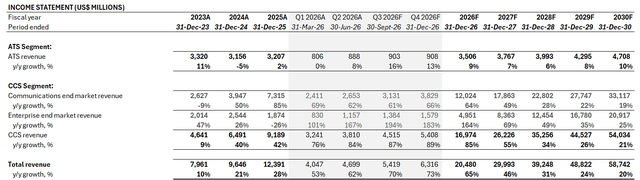
After adjusting my previous forecast based on Celestica's actual Q2 performance and forward guidance, while also considering the recent new orders and the changing structure of AI infrastructure demand, I expect the company's revenue to grow 65% year-over-year this year, reaching $20.5 billion. Subsequently, the company's revenue is projected to achieve a CAGR of approximately 37% over the five-year period ending 2030. This growth will primarily be driven by the CCS business, while recent disclosed orders have improved demand visibility, and the newly emerging scale-up market opportunities are expected to gain further momentum after Celestica enters its 1.6T ramp-up phase.
[Original Image Location: Celestica Fundamental Analysis, Growth Forecasts and Earnings Estimates (Author)]
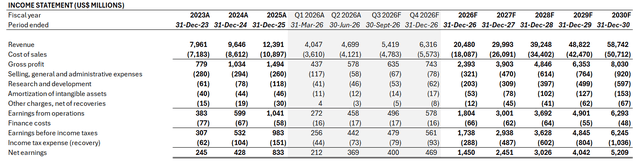
As discussed in the earlier analysis, Celestica's expansion into the scale-up market is expected to further broaden its coverage of the increasingly valuable HPS business in the growing AI infrastructure TAM. This will drive further improvement in the CCS product portfolio, as management has previously noted, Celestica's "non-HPS business margins are not as high as HPS products." Meanwhile, as the scale-up penetration increases and the 1.6T ramp-up drives overall shipment growth, operational leverage is expected to further enhance, continually pushing profit margins upward during the scale-up process.
[Original Image Location: Celestica Fundamental Analysis, Growth Forecasts and Earnings Estimates (Author)]
Stock Price Considerations
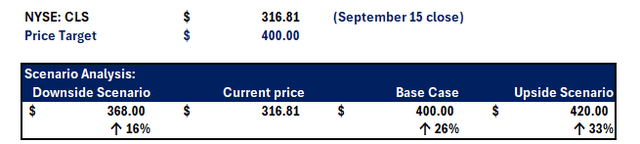
Overall, my updated forecast supports a target price of $400 per share for Celestica, up from the previous $384 per share. This target price corresponds to an intrinsic value of approximately $51 billion for the company, meaning there is still about $11 billion of potential market capitalization upside compared to current levels following the recent stock dilution and the uncertainty surrounding infrastructure spending that has led to a decline in stock price.
[Original Image Location: Celestica Valuation Analysis and Price Target (Author)]
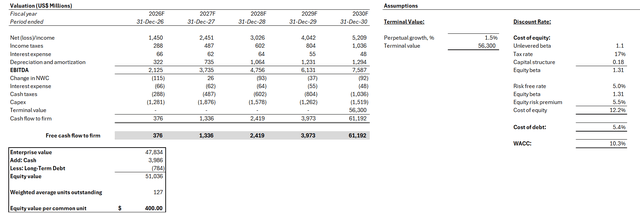
This target price is derived from a discounted cash flow model, which uses forecasts consistent with the aforementioned fundamental analysis. The terminal value is calculated using a 1.5% perpetual growth rate applied to the projected EBITDA for 2030. The 1.5% perpetual growth assumption reflects the expected pace of long-term economic expansion in Celestica's core market and serves as a reasonable proxy for the sustainable growth rate of cash flows after the company enters a stable phase. All cash flow forecasts, including terminal value, are discounted using a WACC of 10.3%, consistent with Celestica's capital structure and risk profile. The per-share value is based on the diluted share count disclosed in the company's Q2 2026 10-Q, plus the additional shares issued in August.
[Original Image Location: Celestica Price Target Valuation Analysis (Author)]
Risks to Consider
Recent concerns regarding AI safety issues, along with calls within the industry to "slow down the pace of cutting-edge AI development," have once again brought volatility to the entire AI infrastructure trades. This has already been reflected in Celestica's stock price: on Monday, September 14, the stock price gapped down by 6.9% at the open, eventually closing with a decline of 8.8%, significantly underperforming the market, as investors assess the potential impacts of a slowdown in cutting-edge AI development.
However, Celestica has since regained part of the losses, as Nvidia (NVDA) CEO Jensen Huang disagreed with the implied logic that one must choose between rapidly advancing AI and safety, including concerns about extinction risks. He stated that companies should "run forward as fast as possible... but stop at times to ensure doing things right" to ensure product safety. Meta CEO Mark Zuckerberg also expressed a similar viewpoint, stating that "every lab has the responsibility and motivation to advance at a safe pace necessary for training models, while also having the ability to take actions to ensure this," and does not need to deliberately slow down the process or establish a unified governance framework at the federal level.
Recent developments further highlight that Celestica remains exposed to heightened market volatility, as investors reassess the long-term sustainability of high levels of capital expenditure in AI infrastructure while also digesting the impact of recent equity dilution. Nevertheless, the company continues to demonstrate stable execution, especially with its expanding order collaborations, which have improved the visibility of its growth and profit outlook. Even amidst ongoing uncertainty surrounding the "slow down in cutting-edge AI development," this is expected to remain a significant factor in mitigating investment risk for the company.
Final Thoughts
Overall, the market has likely significantly underestimated Celestica's upside potential because the company is experiencing a scale-up inflection point that will further compound the already strong momentum in scale-out networks and AI/ML server growth. Specifically, the recent wins of the Helios and Jalapeno projects provide strong validation for Celestica's increasing content value share in the next-generation AI architecture. This will be further propelled by the upcoming transition to 1.6T, and management anticipates that 1.6T will accelerate the company's scale-up opportunities and drive more order conversion into its higher-value HPS pipeline.
Looking forward, the upcoming 1.6T ramp-up phase, along with the initial product shipments of the Helios and Jalapeno projects, will serve as important catalysts for the stock price, as they will enhance market visibility of the company's scale-up opportunities. Meanwhile, Celestica's product portfolio continues to pivot towards higher-value HPS sales, alongside the ongoing release of operational leverage, which is also expected to elevate its profit and free cash flow growth trajectory further. In summary, these factors should bolster the likelihood of the company being revalued upward from current valuation levels while offsetting the short-term equity dilution effects from recent stock issuances.
免责声明:本文章仅代表作者个人观点,不代表本平台的立场和观点。本文章仅供信息分享,不构成对任何人的任何投资建议。用户与作者之间的任何争议,与本平台无关。如网页中刊载的文章或图片涉及侵权,请提供相关的权利证明和身份证明发送邮件到support@aicoin.com,本平台相关工作人员将会进行核查。