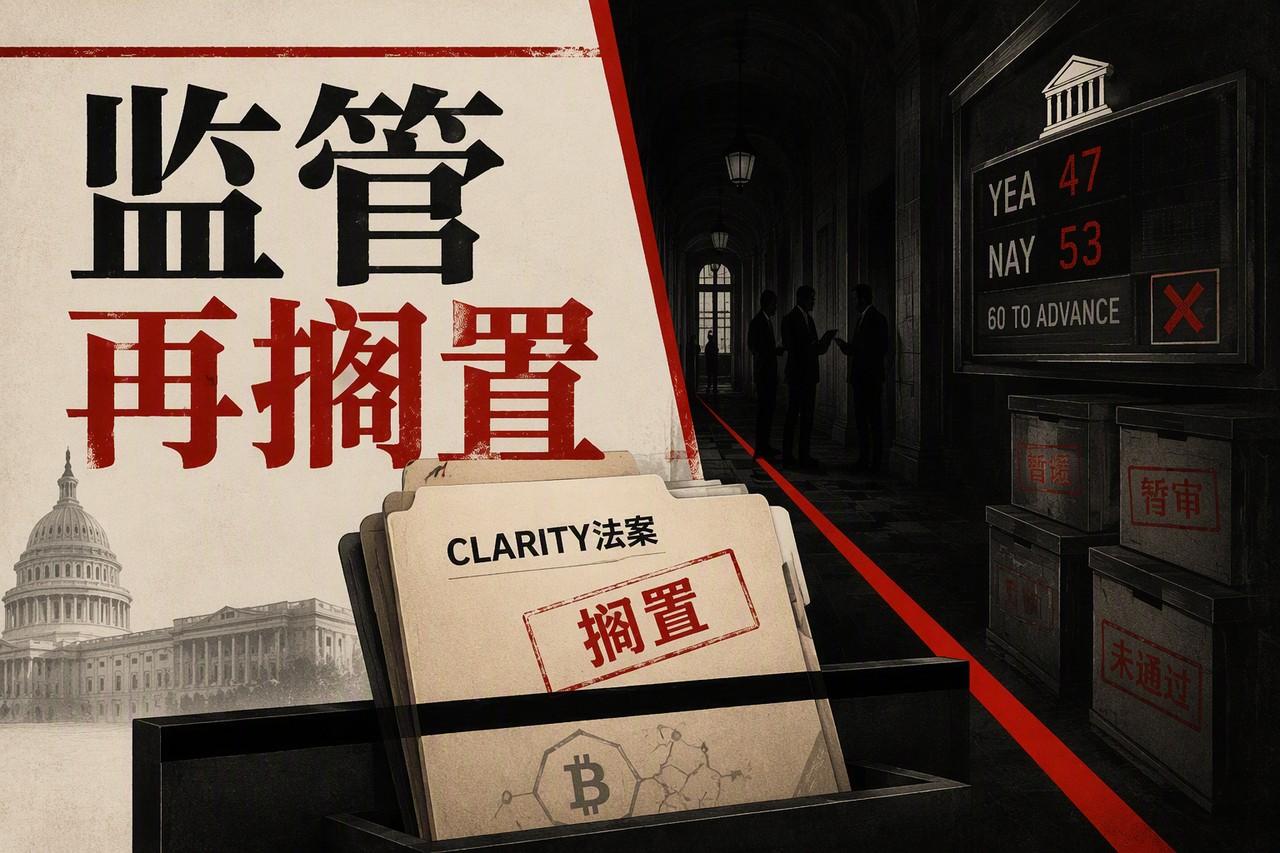
The U.S. Congress is at a crossroads in crypto regulation, moving first with a “tax” measure. Recently, the U.S. House of Representatives' Committee on Ways and Means passed the "Digital Asset Taxation Certainty Act" with a vote of 38 in favor and 5 against. In a committee that traditionally emphasizes technical details rather than political statements, such a score indicates substantial bipartisan support—but not without controversy, as some Democratic lawmakers have publicly questioned whether this provides a “special tax treatment” for the crypto industry. With the vote concluded, the bill was quickly submitted to the full House for further consideration and potential voting. It aims to establish a comprehensive tax handling framework for small payments related to digital assets, income recognition, asset transfers, wash trading rules, mining, staking, and brokers' reporting, and according to a single source, may even set a $10 tax-free threshold for small payments (this detail has not been widely verified). More dramatically, this step occurred less than 24 hours after the "Clarity Act"—legislation concerning crypto market structure and viewed by the industry as an "infrastructure bill"—stalled in the Senate: structural rules were put on hold while tax certainty advanced, revealing a clear yet tense direction for U.S. legislation on crypto—first, clarify how much tax is owed on every transaction before discussing what the market should ultimately look like.
A High Vote of 38 to 5: A Legislative Signal of Tax Priority
The 38 to 5 vote result itself is a clear political signal: within the House Committee on Ways and Means, the "Digital Asset Taxation Certainty Act" crossed party lines, achieving a "let’s agree to settle accounts first" consensus among the majority of both parties. Supporters' reasoning is straightforward—despite the market structure still being chaotic, providing the tax treatment with an executable framework is better than leaving the IRS, platforms, and users fumbling in a gray area. The opposing votes were primarily from some Democratic lawmakers who openly questioned whether this bill, under the current lack of a comprehensive regulatory framework, might be seen by the industry as a form of “special tax treatment,” effectively reserving a relatively friendly tax pathway for a certain asset class without fully examining the systemic risks.
This divergence stands in stark contrast to the setback of the "Clarity Act" in the Senate: when it comes to whether “a dedicated system should be established for market structure,” it is hard for the legislative body to reach a stable consensus in a short time; however, when returning to the technical issue of “how to tax,” the political resistance significantly diminishes. The tax bill is advancing in the House, while the structural bill is stalled in the Senate, reflecting a rhythm of “first collect taxes, then discuss rules”—lawmakers are willing to include every type of transaction and every income form within an auditable and enforceable tax framework before leaving the difficult negotiations on market access and business boundaries for later. This means that any future rule negotiations in the crypto industry will unfold within a framework where the tax base has already been established.
A $10 Tax-Free Threshold: A Compliance Rewrite for On-chain Small Payments
Under the legislative rhythm of "first collect taxes, then discuss rules," a single source has disclosed that the "Digital Asset Taxation Certainty Act" has specifically carved out a line for small on-chain payments—a $10 tax-free threshold. This information currently comes from a single report and has not been verified in public texts or through multiple channels, but it is enough to prompt the entire payment chain—from developers to retail investors—to start rehearsing a new compliance routine: every coffee bought through a scan, in-app subscription payment, or money transfer to friends must first be evaluated against this tax red line.
Under the existing framework in the U.S., crypto assets are generally considered property, and theoretically, every "disposition" could trigger a tax obligation, making everyday small payments nearly unusable. The $10 tax-free concept aims to alleviate the tax reporting burden on retail investors, ensuring that on-chain payments do not require individual transaction records per report; however, once the threshold is written into law, it means users' burdens shift from "whether to pay taxes" to "whether to stay under the tax-free limit," with tax reporting pressures not disappearing but transforming into continuous judgments about payment amounts, asset types, and transaction purposes.
For payment projects, merchants, and wallet service providers, this threshold will directly translate into technical parameters within product and risk control systems. Product teams will need to make it clear in front-end interactions: which payments may require subsequent tax reporting for users, and which fall within the tax-free range; risk control and compliance teams will need to re-establish monitoring thresholds, transforming small on-chain payments from "all blurry risks" to "layered management with $10 as the dividing line." And with the specific execution methods for the $10 tax exemption, applicable scope, and how it connects with existing tax reporting processes yet to be publicly disclosed, all these designs can only be pre-built based on predictions and assumptions, with necessary corrections being made upon regulatory implementation. The still-unfinalized $10 tax line has already preemptively rewritten the product logic and compliance coordinates for on-chain small payments.
Mining, Staking, and Wash Trading: Income Recognition Walking Out of the Gray Area
If small payments are a rewrite of front-end scenarios, then mining, staking income, and wash trading rules represent the legislation's moves on the asset "production side" and "trading side." The draft clearly incorporates tax handling for mining and staking, income recognition for digital assets, asset transfers, and wash trading rules into a unified framework, directly addressing some of the most challenging gray areas from the past few years: at what moment does the miner recognize income, at “the moment of block creation” or “the moment of sale”; how the staking service providers draw the line between self-operated and customer profits; when transfers of self-owned assets between on-chain addresses will be viewed as taxable events; and whether frequent buying and selling or deliberately incurring losses for offsetting other profits still has leeway. Lawmakers' intentions are simple—to reduce the space for tax "technical optimization" based on vague rules and turn these report paths that relied on varying interpretations into clear classifications that can be directly referenced against the text.
For the industry, this round of redefinition is not just a matter of "paying more or less tax" but a restructuring of compliance responsibilities and planning tools. Miners must now face systematic income recognition and reporting pressures, and staking service providers need to reserve clear profit attribution and accounting logic at the product design level. Exchanges and brokers are explicitly named within the reporting range, which means the entire chain from transaction facilitation to tax data submission will be viewed by regulators as a whole, where data quality and submission frequency will become subjects of audit. For institutional and high-net-worth users, the "legitimate loss" and "cross-platform transfer" schemes built around asset transfers and wash trading must be reevaluated under the new framework—enhanced certainty will compress some aggressive planning space but also provide a more solid anchor for conservative yet sustainable structured arrangements, all of which depend on how the final text delineates that tax boundary determining compliance costs between different types of income and transactions.
The Senate Stalemate and the Countdown of This Legislative Window
The stalemate of structural legislation in the Senate has sounded a time alarm for this round of rewriting crypto rules. The "Clarity Act" as a core market structure bill faces setbacks in the Senate and has yet to progress to a smooth voting stage, effectively telling everyone: even if the technical issues are clear, political and procedural hurdles can still keep the entire set of rules at the door. In stark contrast, the "Digital Asset Taxation Certainty Act" passed swiftly in the House Committee on Ways and Means with 38 votes in favor and 5 against, and less than 24 hours later it was submitted to the full House, shifting the legislative focus from “market structure” to “tax priority.” However, this seemingly more feasible path also has to traverse the complete process of the Senate and presidential signing.
The issue is that the remaining legislative time for this U.S. Congress has been publicly defined as limited, and this tax law currently only remains at the stage of passing in the House committee: when it will be scheduled in the full House, whether the Senate will provide a corresponding version, and under what agenda it will be discussed, there is no public information available for forecasting. In such a window filled with procedural uncertainties, trading platforms cannot decisively determine the rhythm of reconstructing the next round of reporting systems, and miners, staking providers, and brokers can only conduct pressure-test-style planning between “possibly landing this year” and “possibly being postponed entirely,” while cross-entity structures and asset transfer arrangements on the corporate side must retain multiple alternative plans until Congress provides actual voting results to clarify whether this tax law is an achievement of the current session or an unresolved proposal that the next session will take over.
Tax Certainty May Not Be Beneficial: Compliance Costs and New Boundaries
From the perspective of retail investors, the "Digital Asset Taxation Certainty Act" attempts to "reduce burdens" by establishing small payment thresholds and clarifying income recognition rules. According to the currently disclosed version from a single source, the small payment tax-free threshold is set at $10, but this detail has not been widely verified and may be readjusted in subsequent reviews. Once the threshold is implemented, everyday small payments and some low-frequency transactions indeed have the opportunity to avoid the high friction of individual calculations and reporting, but a clearer tax framework also means that tax authorities will possess more direct textual basis during audits, inquiries, or even sanctions. Scenarios that previously allowed "rule vagueness" as an interpretative space will gradually be minimized. For trading platforms, mining and staking service providers, and brokers, once mining income, staking distributions, asset transfers, wash trading operations, and client reporting have been relegated from a gray area into explicit norms, it is no longer just a matter of "whether to pay taxes" but a comprehensive cost reassessment that permeates product design, cross-entity structures, reporting systems, and risk control models. The already tight compliance budget will need to carve out a firmer expenditure for tax compliance separately. The real uncertainty lies in whether the bill can complete the full process of House, Senate, and presidential signing in this session, and when the specific effectiveness date and implementation timeline will be disclosed remain unresolved variables. In such a legislative vacuum and a regulatory hiatus, the crypto industry can only treat the upcoming tax rules as definite constraints, viewing specific values and execution rhythms as risk parameters to be verified, and proactively making conservative yet clear contingency plans around the changes in tax costs, business layouts, and potential judicial liabilities.
Join our community to discuss and become stronger together!
AiCoin exclusive Hyperliquid benefits: https://app.hyperliquid.xyz/join/AICOIN88
AiCoin exclusive Aster benefits: https://www.asterdex.com/zh-CN/referral/9C50e2
On-chain Telegram community: https://t.me/AiCoinWhaleData
On-chain community: https://www.aicoin.com/link/chat?cid=N6OVMor5g
AiCoin on-chain Twitter: https://x.com/aicoinwhaledata
免责声明:本文章仅代表作者个人观点,不代表本平台的立场和观点。本文章仅供信息分享,不构成对任何人的任何投资建议。用户与作者之间的任何争议,与本平台无关。如网页中刊载的文章或图片涉及侵权,请提供相关的权利证明和身份证明发送邮件到support@aicoin.com,本平台相关工作人员将会进行核查。