Tonight at 2 AM, the Federal Reserve’s interest rate decision will be announced, and the market has already priced in an 88% probability of a 25bp rate hike, so this is basically a foregone conclusion!
But everyone is looking in the wrong direction. 🧐
The real question is not "whether to raise or not," but "how many times to raise." The dot plot from June showed that the Fed expects the median interest rate at the end of 2026 to be 3.8%. If a 25bp hike occurs tonight, the midpoint would reach 3.875%, which is already close to the annual target. So tonight's core focus is: Will the updated dot plot hint at another rate hike in December?
If the dot plot raises the year-end interest rate expectation to 4.1%, it would mean there is "one more hike," whereas if it stays around 3.9%, it indicates "let's see the data after this hike."
Currently, the 10-year U.S. Treasury yield has exceeded 5%, the highest level since 2007. The Shiller CAPE ratio for the S&P 500 is nearing its second-highest level before the dot-com bubble burst in 2000.
High interest rates + high valuations have historically never been a good omen.
Moreover, investments in AI infrastructure are extremely sensitive to "cost of capital." Major AI cloud players like Google, Microsoft, and Amazon are spending hundreds of billions this year on Capex. Every 100bp increase in interest rates delays the payback period for their capital investment by an additional 1-2 years.
From historical data:
• After the Fed begins a rate hike cycle, the S&P 500 averages a 2% drop in the first three months.
• In the case of rapid consecutive rate hikes (like in the 2022-2023 period), the drop can reach 17%.
The current logic for tech stocks is "AI narrative supports high valuations," but if interest rates continue to rise and the monetization of AI cannot keep pace with the growth of Capex, valuations will be repriced by the market.
Rate hikes primarily hurt those with weak cash flows, relying on low-cost financing to survive the "story narrative." When interest rates remain high and liquidity premium tightens, large funds will only rush to acquire the most scarce and irreplaceable hard assets.
However, there is one sector that has become more valuable due to rate hikes: energy and utility stocks, which we have repeatedly mentioned as a direction.
The logic is simple: The electricity demand for AI is inelastic, and the supply gap is widening.
The current physical bottleneck for AI is neither algorithms nor the number of GPUs, but power and grid capacity. Without electricity, the most advanced Blackwell chips can only be left in warehouses as decorations.
Let's take a look at the electricity shortage data in the U.S.:
• The electricity demand from data centers in the U.S. is expected to double from 2025 to 2030.
• But expanding the grid will take 3-5 years.
• The queue for traditional grid interconnection applications can last 3-5 years.
This gap will not disappear because of rising interest rates. Microsoft, Amazon, and Meta have already signed 20-year power purchase agreements, essentially securing the capacity of nuclear power plants.
Computing power is electricity. The Capex of tech giants is being forced to shift from "buying chips" to "buying power plants and building grids."
📝 Why is "Energy + AI" currently the hardest hedge and offensive asset?
First, it is resistant to inflation and prevents rate hikes. Energy has a natural inflation-resistant property, and the long-term power purchase agreements of data centers lock in highly certain cash flow for the coming years.
Second, supply is inelastic. The grid approval wall makes "off-grid onsite generation" and "direct connection of nuclear power" a necessity among necessities.
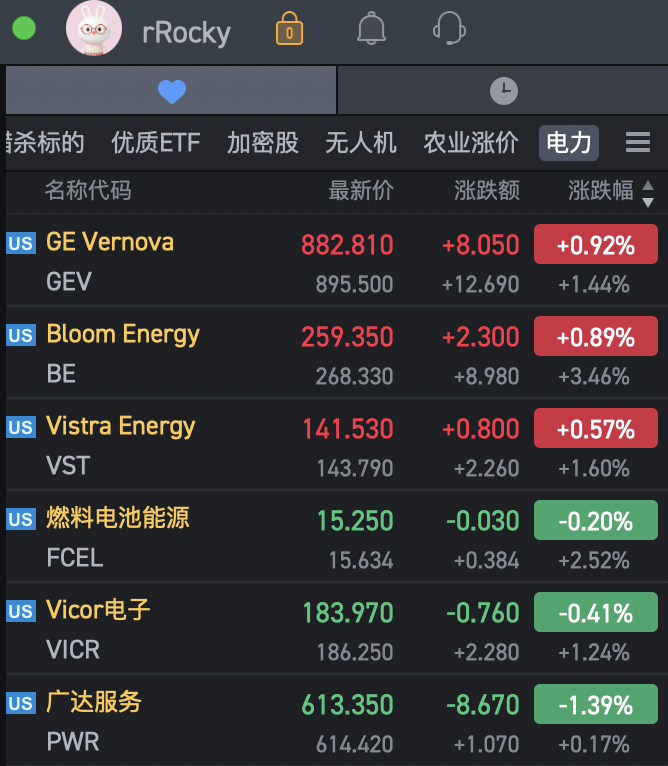
I have outlined a few companies in this industry chain that we are very optimistic about:
📍 Off-grid power generation (solving the grid queue bottleneck)
• $BE (Bloom Energy): Solid oxide fuel cells. Extremely fast deployment speed, capable of monthly deployments, making it the only lifeline for data centers when they can't access grid capacity. Q2 revenue has exceeded $1B for the first time, a year-on-year increase of 166%, with 25GW of orders on hand, equivalent to several billion dollars in future revenue. Their selling point is that they can be operational within 6-12 months, while the grid takes 3-5 years to wait.
• $FCEL (FuelCell Energy): Molten carbonate fuel cells, focused on power generation + carbon capture, matching the ESG necessities of low-carbon AI data centers.
📍 Traditional baseload and direct connection of nuclear power (the most scarce zero-carbon electricity available 24/7)
• $VST (Vistra Corp): A leading nuclear power and generation company in North America. It possesses extremely scarce nuclear direct connection resources and is the absolute first choice for tech giants signing long-term PPAs. Its 3809 MW nuclear power capacity is locked into 20-year contracts with Amazon and Meta, representing cash flow at the "money printing level."
• $GEV (GE Vernova): A dual powerhouse for gas turbines and high-voltage grid infrastructure. It dominates key equipment for baseload natural gas power generation and substations.
📍 Grid transmission and distribution and the last mile (monopolists doing the heavy lifting)
• $PWR (Quanta Services): The largest grid EPC contractor in North America, monopolizing the technical labor force for high-voltage transmission lines and substation construction. Without it, electricity from power plants cannot reach data centers. The backlog is close to $50B, and work for the next 2-3 years has already been secured. Orders for the transformation of the U.S. grid are backed up until 2030.
📍 Chip-level vertical power supply (the physical limit at the hardware level)
• $VICR (Vicor): A leader in high-density power modules. Vertical Power Distribution (VPD) technology directly addresses the on-chip resistance losses and heat bottlenecks for kilowatt-level chips (like Blackwell/next-gen GPUs). The backlog has skyrocketed by 145%, providing the last inch of power supply for AI chips, but production capacity is severely inadequate, and they are acquiring new factories to expand production.
The common characteristics of these companies are: orders have already been signed, they have extremely high revenue visibility, and they do not rely on "AI narratives"; what they provide are essentials for AI operations, not AI itself.
🤔 The impact of rate hikes on energy stocks is completely opposite to that on tech stocks:
• Cash flow certainty: 20-year PPAs, a $50B backlog, all are solid contracts, not "expectations" or "narratives." The rise in interest rates instead highlights the scarcity of this certainty.
• Asset revaluation: Electricity infrastructure prices will appreciate during supply tightness. The replacement costs of nuclear power plants, gas turbines, and grid equipment are extremely high, and the cycles are long; if Vistra’s nuclear plants were to be rebuilt now, the cost would be 3-5 times that of the previous year.
• Inflation hedge: Energy prices correlate positively with inflation, and the Fed’s rate hikes are precisely because inflation pressures have not subsided. Energy stocks are a natural inflation hedge.
• No dependence on VC funding: Tech stocks (especially AI startups) are highly reliant on venture capital, and rising interest rates will shrink VC funding; however, energy stocks' clients are cloud giants and governments, providing stable funding sources.
In summary, if the Fed raises interest rates tonight and the dot plot suggests another hike in December, tech stocks are likely to remain under pressure, as the market will begin to worry about a "series of rate hike cycles."
However, energy and utility stocks may face a re-evaluation opportunity:
• Relative valuation advantage: The Shiller CAPE for tech stocks is close to bubble territory, while many energy stocks are still below the historical median valuation.
• Defensive attributes: During rate hike cycles, investors shift from "growth stocks" to "value stocks with stable cash flows."
• Essentials for AI infrastructure: Even if the AI bubble bursts, data centers will still need electricity; the demand inelasticity will not change.
The market is still using the linear thinking of "AI prosperity → tech stocks will always go up," but it overlooks a fact:
The biggest beneficiaries of AI prosperity may not be the companies creating AI but those supplying power and building the infrastructure for AI.
Just like in the gold rush era, the real money was made not by the gold miners but by the people selling shovels and jeans.
After the Fed's rate hike announcement tonight, tech stocks may face a 1-2 month adjustment period (the historical average drop is 2%, and it could be deeper in a series of rate hike cycles).
On the other hand, energy and utility stocks may now be the most undervalued they have been in the past 18 months, as everyone is chasing AI chips and computing power, while no one cares about "where the electricity comes from."
But one day, when a certain cloud giant delays the launch of a data center due to insufficient power, the market will realize: energy infrastructure is indeed the bottleneck of the AI era.
But by then, it will be too late to buy.
In this macro reshaping, the supply and demand imbalance of computing power and electricity is pushing the energy and utility sector towards the hardest alpha logic for the next 3-5 years. In an era where computing power equals power, those who control energy and transformers are the real tax collectors, DYOR 🙏
To trade U.S. stocks, I choose the #RWA U.S. stock tokenization platform #MSX. Let's invest together in the U.S. stock market: http://msx.com/?code=Vu2v44
Early fans and partners of U.S. stock investment can private message me to fill out the form and can enter the U.S. stock communication and discussion community for free (currently only limited to 10 people per week, with assistant review, which may take some time, thank you 🙏)!
免责声明:本文章仅代表作者个人观点,不代表本平台的立场和观点。本文章仅供信息分享,不构成对任何人的任何投资建议。用户与作者之间的任何争议,与本平台无关。如网页中刊载的文章或图片涉及侵权,请提供相关的权利证明和身份证明发送邮件到support@aicoin.com,本平台相关工作人员将会进行核查。


