Investment View
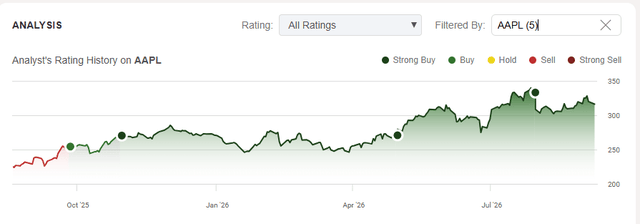
I remain optimistic about Apple Inc. (AAPL) stock. I continue to assign a "Strong Buy" rating to the stock and maintain a target price of $372 (representing approximately 18% potential upside based on the current stock price). I believe there are several reasons why there is still further upward potential for Apple’s stock price.
**High-End iPhone Sales:** Apple has clearly committed to driving sales of the Pro series or higher-priced products, which can support the average selling price (ASP) even if iPhone sales do not experience explosive growth.
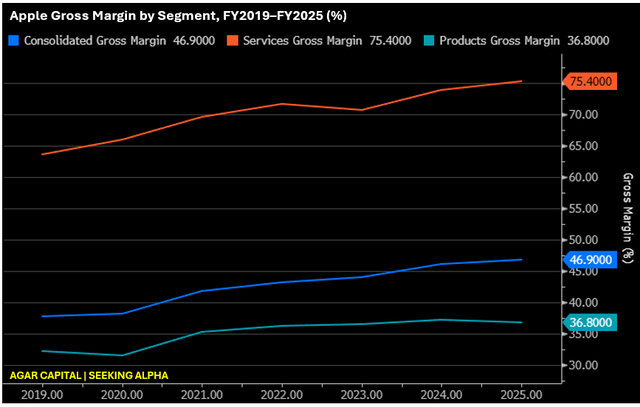
**Gross Margin:** While many companies find it difficult to fully absorb the pressure from rapidly rising costs such as commodity prices, Apple's vast scale, highly integrated supply chain, and strong pricing power provide it with a unique advantage. Therefore, even if the macroeconomic environment becomes less favorable, Apple remains in a very advantageous position to maintain high gross margins.
**Artificial Intelligence:** I do not have particularly strong opinions on Apple’s artificial intelligence strategy—namely, Apple Intelligence on devices—but these features may indeed enhance user stickiness within the Apple ecosystem, making it harder for users to leave Apple, thereby improving customer loyalty and supporting a new cycle of iPhone upgrades. Currently, I view AI as a largely defensive strategy, despite certain potentials.
The same logic applies when you see the services business growing with high margins while accessories continuously enhance the entire ecosystem. The real essence of the advantage comes from every new device or service that continues to connect users further to the Apple ecosystem.
Of course, there are also risks involved, and I am well aware of these risks. For example, a slowdown in global economic growth could lead to a decrease in iPhone demand, while Android still holds a very large market share in the low-end market. However, it is here that Apple's vulnerability is relatively lower. Therefore, we believe the risk-reward relationship remains very attractive.
What Changed Today
Many have been eagerly awaiting this event, and since Apple held the "Surprise & Shine" event, my overall view on the stock has not really changed.
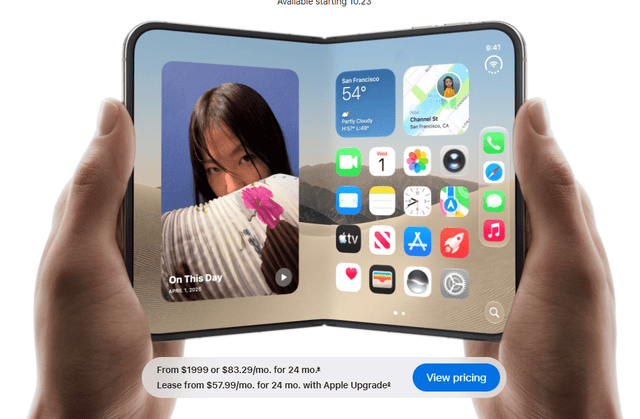
New CEO John Ternus has now started moving Apple forward, and investors are asking themselves, "What direction does Apple plan to take with the iPhone in the coming years?" According to today’s announcements, the answer is very clear. The Duo starts at $1,999, with the 2TB version reaching up to $3,199. The iPhone 18 Pro starts at $1,199, while the Pro Max starts at $1,299.
[Image Placeholder: New Apple iPhone Products and Pricing]
Additionally, I don't know if you noticed, but Apple did not release a "standard version" of the iPhone 18. In other words, the standard iPhone 18, 18e, and Air 2 will be launched later. Therefore, in the coming months, consumers looking to purchase an iPhone will have relatively limited model options, primarily only the Pro series or Duo.
Thus, I increasingly feel that Apple aims to shift its product structure towards higher-priced products and raise the average selling price without needing to sell noticeably more iPhones.
iPhone Duo
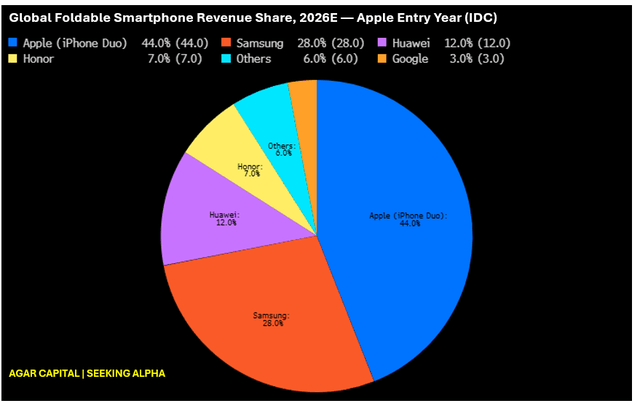
Let’s talk specifically about the Duo. As we know, foldable phones are not a new concept; there have long been foldable smartphones in the market. Specifically, Samsung (SSNLF) released the Galaxy Fold back in 2019. Additionally, some companies have begun producing triple-fold phones with dual hinges. However, after a decent start, the entire industry has seen a decline. According to IDC data, shipments of foldable phones dropped by 15% in the first six months of this year. While Apple’s entry into the foldable phone market has been widely anticipated for months, analysts believe that Apple’s entry will significantly uplift the entire industry. Specifically, it is expected that by 2026, Apple will account for 44% of total global sales revenue of foldable smartphones.
[Image Placeholder: Foldable Smartphone Market Data (Agar Capital, Bloomberg Terminal)]
From a financial perspective, I am very curious how much of this pricing power will ultimately translate into gross profit. As memory and storage costs rise, the company’s costs are also climbing. While Apple has only raised the price of the Pro models by $100, this could become a very interesting test. For me, the real question is: will the higher prices completely offset all additional costs arising from the increase in memory and storage costs, or will gross margins still face some pressure?
Artificial Intelligence
Regarding artificial intelligence (AI), I am much more conservative about the vision presented here. Apple refers to the iPhone as a "Personal Intelligence Hub." This personal intelligence hub includes device-side AI, cloud-based AI, and Siri capable of connecting to over 300,000 applications. The real value of these features currently lies more in their ability to help drive the iPhone upgrade cycle and further enhance user retention within the Apple ecosystem. The A20 Pro also aligns very well with these goals: featuring a 2nm process, twice the performance of the previous generation Neural Engine, enhanced graphics capability, and better sustained performance. Apple has developed the chips and operating systems necessary to realize these technologies. In addition, Apple has strong distribution channels and over 1 billion end-users who can utilize these technologies. In my view, this provides a very robust foundation for the company to build a larger AI platform in the long term.
Apple Watch and AirPods
My view on the Apple Watch and AirPods is similar. The latest health monitoring technologies, environmental intelligence, and Siri-based innovations add value to the entire ecosystem far exceeding mere increases in sales of each product. Each product gives users another reason to stay within the Apple ecosystem. User loyalty has always been Apple’s most important advantage. If you are reading this article on an iPhone, you might well understand what I am saying.
High-End iPhone Sales
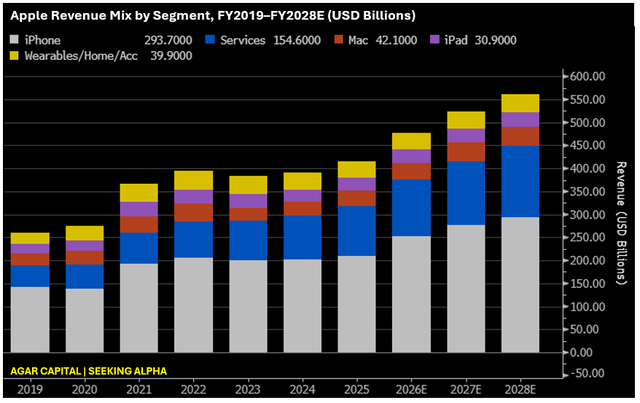
About half of Apple’s revenue comes from iPhones, so if you want to know where the company might head next, you must start your analysis from iPhones. Over the past few years, Apple has been pushing the "Pro" models, and after the September 9 announcement, this strategy has become very clear.
[Image Placeholder: Apple iPhone Revenue and Product Structure (Agar Capital, Bloomberg Terminal)]
With the new generation iPhone product line priced significantly higher than in the past—starting at $1,199 for the iPhone 18 Pro, $1,299 for the Pro Max, and nearly $2,000 for the new Duo—even if the company sells the same number of iPhones as before, or even slightly less, as long as the selling price of each device is significantly higher, overall profitability is still likely to increase. This is where the average selling price (ASP) comes into play.
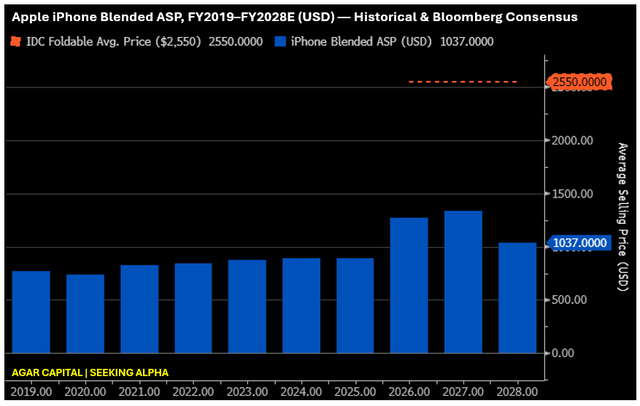
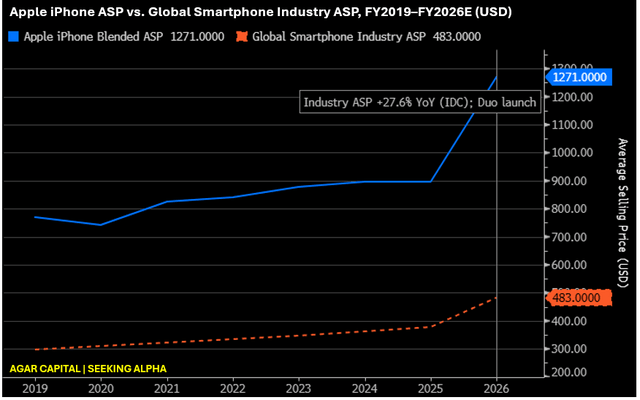
As you know, the ASP of iPhones has been steadily increasing over the past few years. Analysts expect that the trend of consumers migrating to Pro models will continue to support iPhone ASP growth into 2026. Since the Duo will enter a completely new pricing range, and analysts expect the average price of foldable phones to exceed $2,550, this will further increase the share of high-priced devices in Apple’s product mix.
[Image Placeholder: iPhone Average Selling Price Trend (Agar Capital, Bloomberg Terminal)]
This means that overall, even if the global smartphone market growth slows, as long as more consumers choose the Pro, Pro Max, or Duo, iPhone revenues can continue to grow. In other words, Apple is working to earn more profit from every device sold.
Shortages in memory chips have also forced many companies in the industry to raise their average selling prices. According to IDC data, it is expected that the global smartphone ASP will increase by 27.6% by 2026. Since Apple primarily produces high-end devices, compared to manufacturers selling both high-end and low-end devices, the company faces significantly less pressure to lower prices on these products.
[Image Placeholder: Global Smartphone ASP Forecast (Agar Capital, Bloomberg Terminal)]
iPhone Duo: Market Scenario Analysis
The Duo represents Apple’s first entry into the foldable screen market, and we cannot yet ascertain how quickly consumers will accept an iPhone priced over $2,000. Thus, I prefer to construct expectations through different "scenarios" rather than making a single prediction in the absence of sufficient evidence.
In a pessimistic scenario, I expect consumer responses to be relatively tepid. Apple ultimately captures about 10% of the global foldable smartphone market, selling approximately 2 to 3 million Duos annually. At an average price of $2,300, this means Apple could generate around $5 to $7 billion in revenue from this product each year. Therefore, although this would be a very good performance for a brand new product, its impact on Apple’s overall profit would still be relatively limited. Many are concerned about a repeat of the Vision Pro situation.
The baseline scenario is the one I believe is most likely to occur, with projected annual Duo sales of about 5 to 7 million units, translating to annual revenues of approximately $14 to $18 billion.
Then there is the optimistic scenario. In this case, Apple follows its historical pattern: entering a new product category later than other manufacturers and then quickly gaining dominance. According to IDC predictions, if Apple can capture close to 40% of the foldable screen market, it could sell 9 to 11 million Duos annually. If the average price rises to $2,700 or higher, the corresponding revenue could reach around $25 to $30 billion.
Scenario | 2026 Duo Sales (Million Units) | 2027 Duo Sales (Million Units) | ASP (USD) | 2027 Duo Revenue (Billion USD) | Percentage of 2027 Apple Sales |
|---|---|---|---|---|---|
Pessimistic (10% Share) | ~2.3M | ~2.7M | 2,300 | ~6.2 | ~1.2% |
Baseline (25% Share) | ~5.7M | ~6.8M | 2,550 | ~17.2 | ~3.3% |
Optimistic (40% Share) | ~9.2M | ~10.8M | 2,700 | ~29.2 | ~5.6% |
From these numbers, it is very clear that the baseline scenario projection is realistic, corresponding to revenue of about 3% of Apple’s overall revenue. On the other hand, the upper limit of the optimistic scenario could approach 6%.
Margin and Component Cost Analysis
In terms of margin, Apple still has an extremely strong foundation. Apple’s vast scale allows it to purchase components at volumes that many other companies cannot match, and historically, the company has been able to achieve significant economies of scale in its cost structure. As a result, product business gross margins typically remain between 30%-35%, while service business gross margins exceed 70%. Driven by a better product mix and effective cost management, the company's overall gross margin improved to 44.1% in FY2023.
[Image Placeholder: Apple Gross Margin Trends (Agar Capital, Bloomberg Terminal)]
The major issue Apple currently faces comes from memory costs. RAM (Random Access Memory) and NAND (NAND Flash)—the chips used for data storage and processing in iPhones—have seen significant price increases since last year. According to some forecasts cited in a recent Wall Street Journal article, the costs of memory chips for some configurations of the iPhone 18 Pro may have risen three to four times. Viewed solely from the perspective of individual component costs, such a magnitude of cost increase clearly poses a significant challenge to any business model.
Fortunately, Apple has two ways to mitigate this impact. A portion of the rising memory costs can be absorbed directly by Apple, which will appear as lower operating profit margins. The other way is to pass all or part of the costs onto consumers by raising prices. From the latest generation iPhone product line, it appears that this is precisely what Apple is doing. Specifically, the prices of the Pro and Pro Max have increased, and there is evidence that the product mix is further shifting towards higher-priced premium models and the Duo.
Factor | iPhone 17 Pro | iPhone 18 Pro (Estimated) |
|---|---|---|
Base Launch Price | $1,099 | $1,199 (+9.1%) |
RAM + NAND Costs | $52 (256GB) | $77 (256GB)↑ |
Other Component Costs | ~$200 | ~$200 |
Expected Gross Margin | ~37% | ~36%-38% |
In this scenario, the calculations are relatively straightforward. Although the memory costs may rise by several tens of dollars, if the final selling price of an iPhone only increases by about 10%, then Apple could likely retain most or even all of the profits it might otherwise lose, potentially even achieving improvements in profit per unit sold. My high-end pricing investment logic includes several important aspects, but perhaps none is more critical than its ability to protect margins when raw material costs escalate.
Thus, I believe that even with increases in bill of materials (BOM) costs, Apple can still largely protect its gross margins in the future.
Valuation
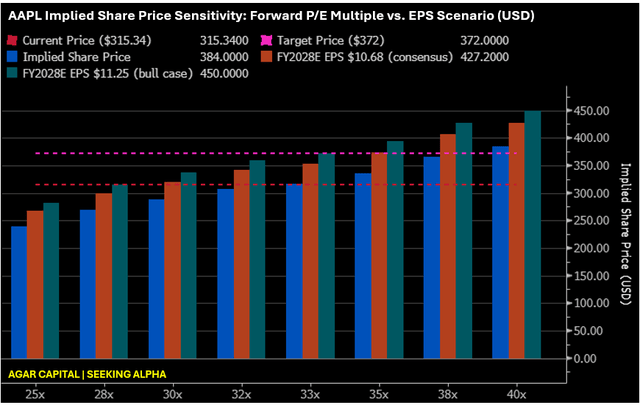
I do not believe Apple needs to dramatically increase iPhone sales to fulfill its potential. What the company really needs to do is increase the revenue generated by each device, expand its services business, and reduce the total number of outstanding shares through stock buybacks. These strategies should drive continued earnings per share (EPS) growth.
Based on Bloomberg’s consensus estimate of FY2028 EPS of $10.68, I assign a valuation of about 35 times earnings, resulting in a valuation of $373.80 per share, which is essentially consistent with my target price of $372.
[Image Placeholder: Apple FY2028 EPS and Target Price Valuation (Agar Capital, Bloomberg Terminal)]
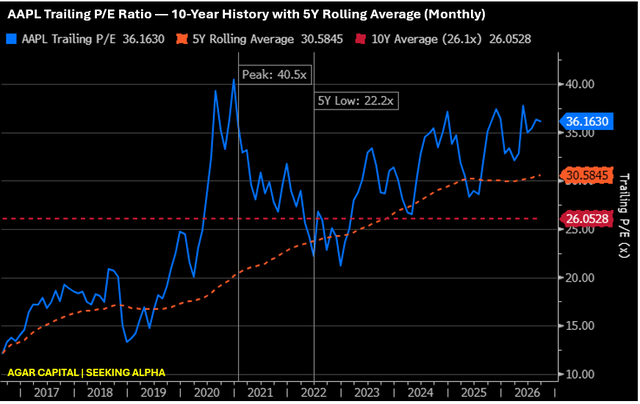
A 35 times earnings multiple is clearly a very high valuation. However, Apple's current forward P/E is about 33 times, while the average over the past five years is around 30 times.
[Image Placeholder: Apple Forward P/E and Five-Year Average Valuation (Agar Capital, Bloomberg Terminal)]
Therefore, to reach my target price, I am not assuming that the market will completely revalue Apple from scratch. Instead, I simply expect the valuation multiple to expand modestly, while earnings continue to show some incremental growth.
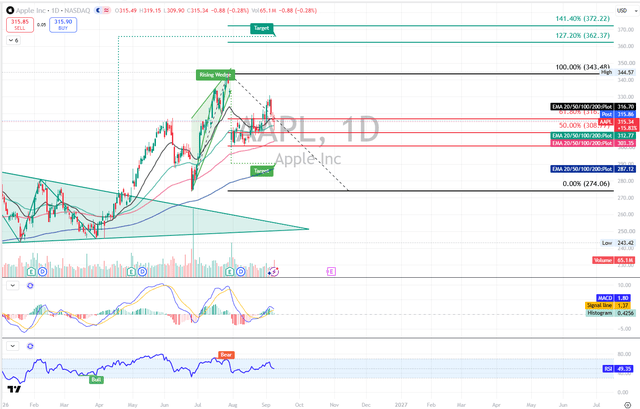
[Image Placeholder: Apple Stock Price Chart (TradingView)]
Conclusion
I will maintain my "Strong Buy" rating and keep the target price at $372. For now, let's set aside the foldable iPhone and Apple's applications of AI and observe how Apple is acquiring more revenue through its entire ecosystem itself. With each new generation of iPhones released, Apple is raising the average selling price of the iPhone. At the same time, the revenue that the company can generate from each user through its services business has also been increasing.
[Image Placeholder: Apple Ecosystem and Valuation Related Data (Seeking Alpha)]
For me, the real investment story begins here. Apple might not need to sell significantly more devices each year than it currently does. What it really needs to do is protect margins by increasing the overall economic value per customer. At the same time, Apple needs to further convert its large installed user base into more consistent recurring revenue.
The market has clearly recognized many of Apple’s outstanding attributes. As Apple's current valuation multiples are very high, there is not much room for error. However, if Apple can execute well on pricing, margins, services, and the Duo, then I believe the potential upside of about 18% from the current price is still sufficient to cover the corresponding risks.
免责声明:本文章仅代表作者个人观点,不代表本平台的立场和观点。本文章仅供信息分享,不构成对任何人的任何投资建议。用户与作者之间的任何争议,与本平台无关。如网页中刊载的文章或图片涉及侵权,请提供相关的权利证明和身份证明发送邮件到support@aicoin.com,本平台相关工作人员将会进行核查。