Today, the turnover of A-shares is only 16.253 trillion, decreasing by 20 billion compared to the previous period, and the lowest for the year is 16.236 trillion on April 7. This means if tomorrow decreases by another 2 billion, the turnover will hit a new low for the year, truly approaching the lowest point of sentiment. According to the gauge from Guolian Minsheng Securities, which I follow, the latest A-share thermometer shows that the temperature has already reached a new low for the year, as mentioned at the end of the article.
Let's just keep adding ice slowly. It's better than adding it when it's overheated, and honestly be patient with capital  .
.
Let's talk directly about the market.
1. Last night, the global AI leader, Philadelphia Semiconductor, dropped 6 points, already nearing a phase new low.
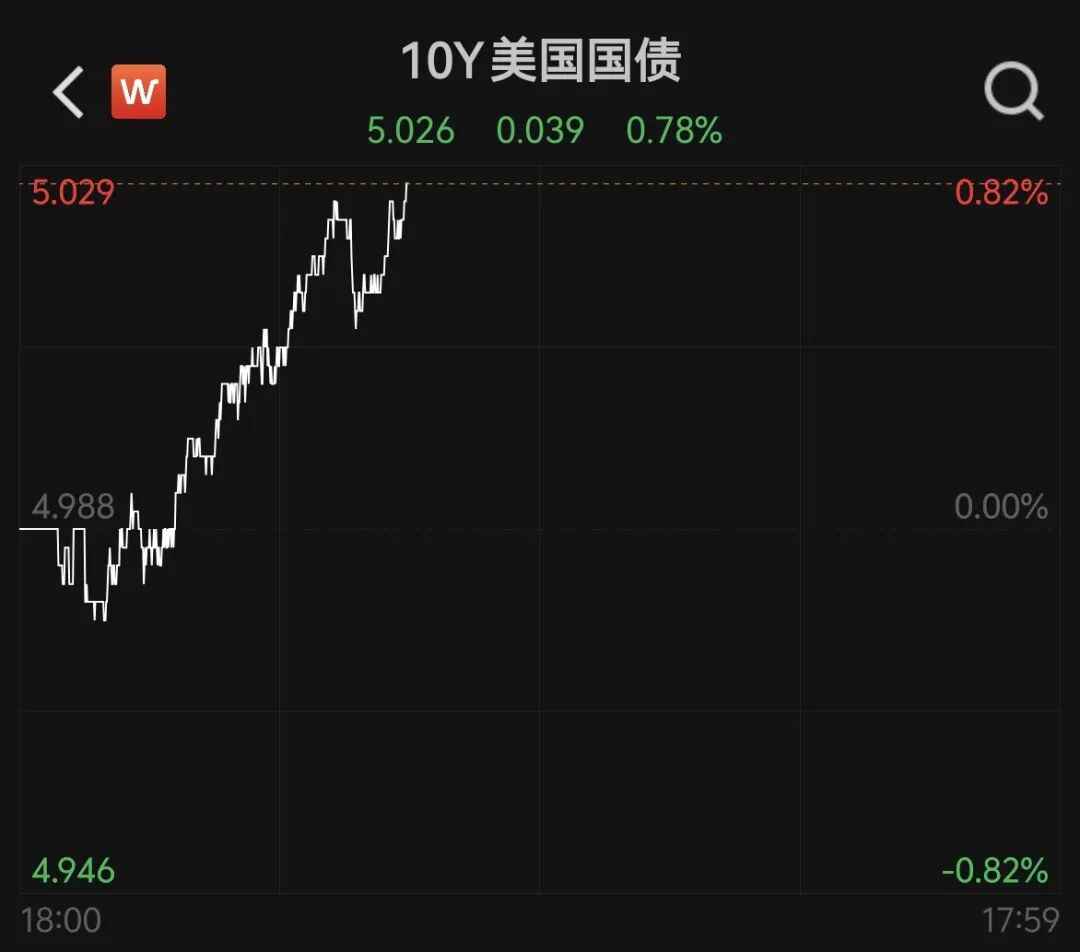
Today, the Asia-Pacific market actually showed signs of warming at the opening, but collectively plunged in the afternoon, mainly due to the global asset pricing anchor, 10-year U.S. Treasury bonds, "collapsing" again, soaring instantly, breaking 5.02% as shown in the chart below.
2. What does it mean to rise above 5.02%?
The chart below shows that over the past 20 years, the highest point of U.S. Treasury bonds was 5.33% in 2007, and the second highest is 5.021% in 2023, meaning today broke through the 2023 level and is already a new high since 2007.
Congratulations, everyone, at a young age, you are witnessing a decade-long market.
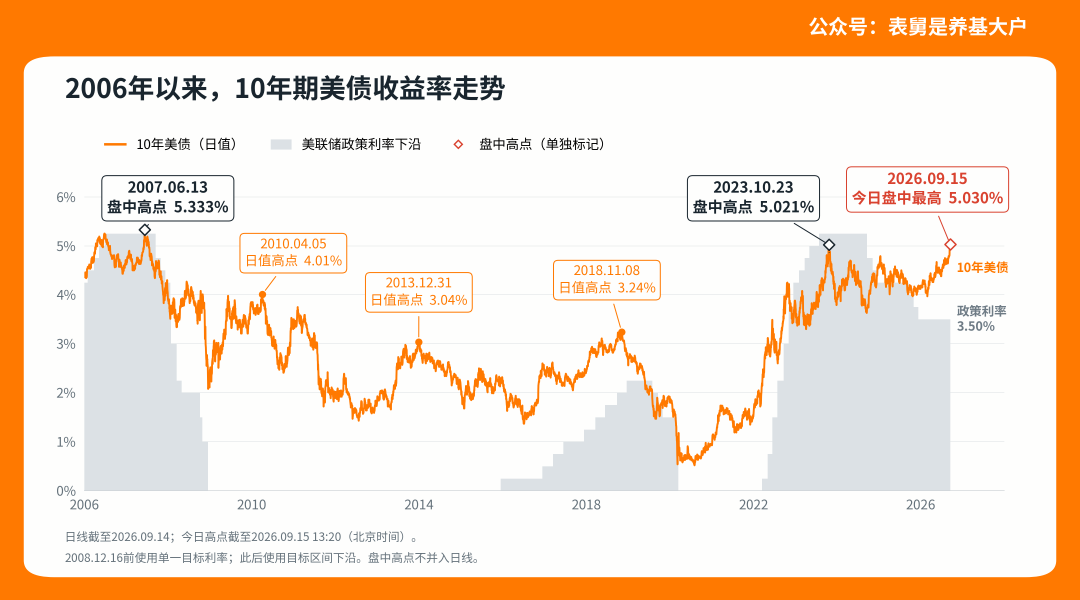
Additionally, in the chart above, the gray shadow area at the bottom represents the policy interest rate of the Federal Reserve (lower bound). It is obvious that the long-term interest rates are generally following the policy interest rate up and down. However, since this year, it has clearly been a rather abrupt range—while the policy rate has remained stable, market rates have been rising rapidly.
3. Tonight, the Director of the White House National Economic Council (equivalent to a big advisor + overall coordinator of economic policies), Hassett, said in an interview with CNN:
“if Kevin and the committee decide whatever they're going to decide...
we will 100 percent support them.”
This means that regardless of what Walsh decides, the President and I will fully support him.
A few days ago, he also mentioned that both the President and he see no reason to raise interest rates.
The situation is stronger than the person.
I admit, my Moutai probably won't hold up, so prepare to draw on Thursday night.
4. Overseas interest rates are the biggest uncertainty in the market for the second half of the year. I won't elaborate on this; just refer to the previous article titled “The Biggest Risk Has Arrived.”
We always mention one logic:
The risk of overseas long bonds is fundamentally an issue with U.S. Treasury bonds;
The issue with U.S. Treasury bonds is fundamentally about fiscal sustainability;
The problem of fiscal sustainability in the U.S. is a structural issue with no short-term solution.
We often refer to the “structural problem”, which is actually a loanword; the original English term is structural problem.
The so-called structural problem refers to issues caused by a system or institution itself rather than a specific person or event—more figuratively, it means the problem is embedded in the main structure (built into the structure), making it difficult to extricate.
Thus, the direct translation of the Chinese “structural problem” is quite poor; at least using terms like “systemic” or “endogenous” would be a bit better, but still not optimal—consider it a little scientific education.
5. In chaotic times, heavy penalties are necessary, and strong medicine for chronic diseases. Previously, we mentioned that Bessenet's repurchase of long bonds is not effective because it is essentially scratching the surface of an itch, treating the symptoms rather than the root cause.
Last time, I gave an example of the U.S. military spending to help visualize this.
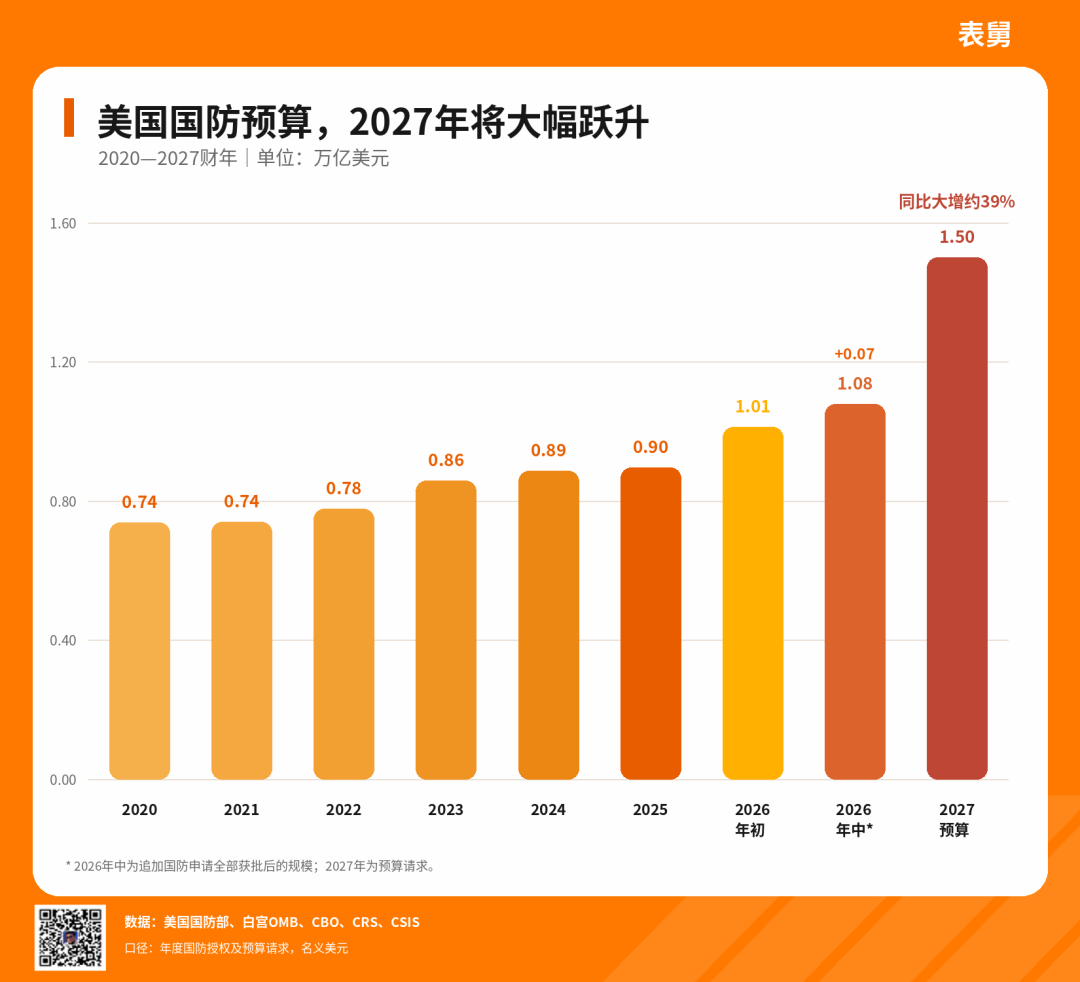
The chart below shows that in 2020, the U.S. defense budget was 740 billion dollars, rising to just over 1 trillion dollars at the beginning of this year, and then after actual conflict with Iran, it increased to 1.08 trillion by mid-year, and next year, it will directly reach 1.5 trillion dollars.
How can investors believe in your fiscal discipline when you do this?
Including the head of Anthropic saying they need to slow down the R&D of cutting-edge AI models, why are the President and the AI Tsar strongly opposed?
Because AI has activated the upstream and downstream industrial chains in the process of expanding capital expenditures, bringing about increases in investment and tax revenues, which is the money the President's government uses to pay off debt. By slowing this down, the government will not agree first.
After all, a few days ago, the President was still headstrong, claiming that economic growth would solve the deficit problem.
6. The surge in long bonds has multiple effects, for example:
On one hand, rising U.S. Treasury bonds drive Japanese bonds up as well, accelerating Japan's interest rate hikes, leading to the unwinding of trades using low-interest yen for carry, which amounts to over 2 trillion dollars. A marginal small change could impact the market.
On the other hand, it suppresses stock market valuations. The chart below is an update from my planet today, showing a measure of overseas asset tracking and thermometer (for a full interpretation, please refer to the original article from this afternoon). You can see, from the equity risk premium of U.S. stocks, as of last Friday, it has already fallen below 0.3%, and after the continued rise in long bonds today, it has actually dipped to around 0.2%.
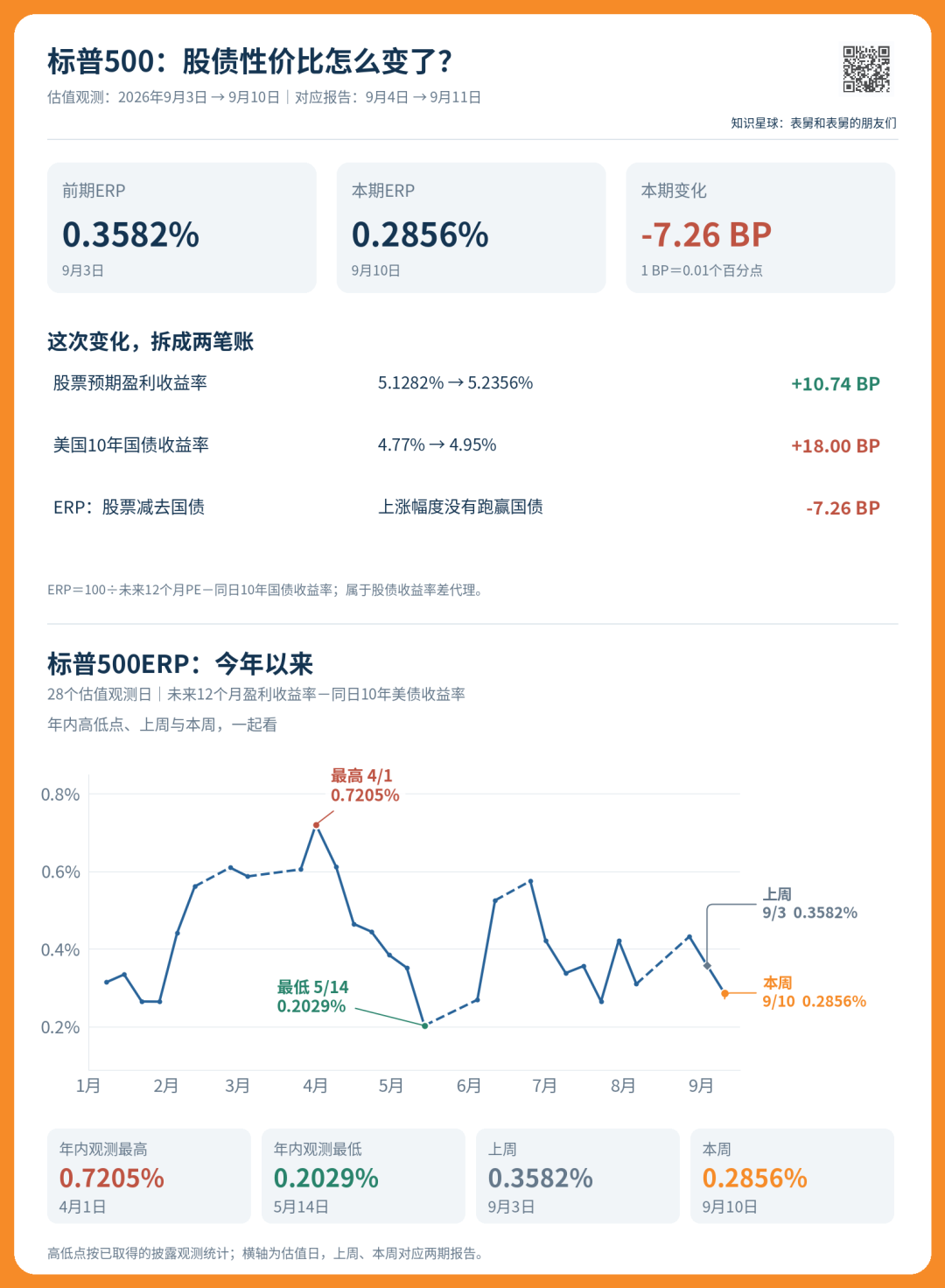
Equity risk premium can be summarized as “what extra benefits you gain for taking on the volatility risk of the stock market compared to buying government bonds.”
Under normal circumstances, buying stocks should yield 3%-5% more return than buying government bonds as compensation for taking on volatility risk, but now this extra compensation is almost zero.
It is tantamount to this: walking on a pedestrian bridge (buying government bonds) is very safe, but you have to detour a bit, while crossing the street (buying stocks) is fast, but there are no traffic lights, and you could get hit. Normally, crossing the street should be much faster than walking the bridge, that’s why you would take that risk. But now crossing the street only saves you two steps compared to the bridge; then why take the risk of getting hit just to save those two steps?
With such a high risk-free interest rate, if the U.S. also wants to support the development of small and medium fund companies, I estimate the amortized cost method for bond funds must have sold out.
7. Equity risk premium = inverse of forward price-to-earnings ratio (A) - 10-year Treasury yield (B).
When the equity-debt cost-performance ratio drops to a historical low, if it is to recover, there can be three scenarios.
The first scenario is that the stock market directly declines, leading to smaller price-to-earnings ratios, which makes the inverse (or A) larger, thereby raising the risk premium;
The second scenario is that the bond yields decline, meaning B becomes smaller, which can also elevate the risk premium;
The third scenario is sustained sideways action, where through profit growth, under the condition that stock prices do not decline, the price-to-earnings ratio decreases, eventually A will also gradually increase.
The chart below shows that the Nasdaq 100 has been sideways for four months since early May, representing the third scenario.
Talking About Risks in U.S. Stocks,” so we repeatedly remind you not to rush; you can wait for a period when overseas volatility increases, based on these fundamental principles of equity-debt cost-performance ratio.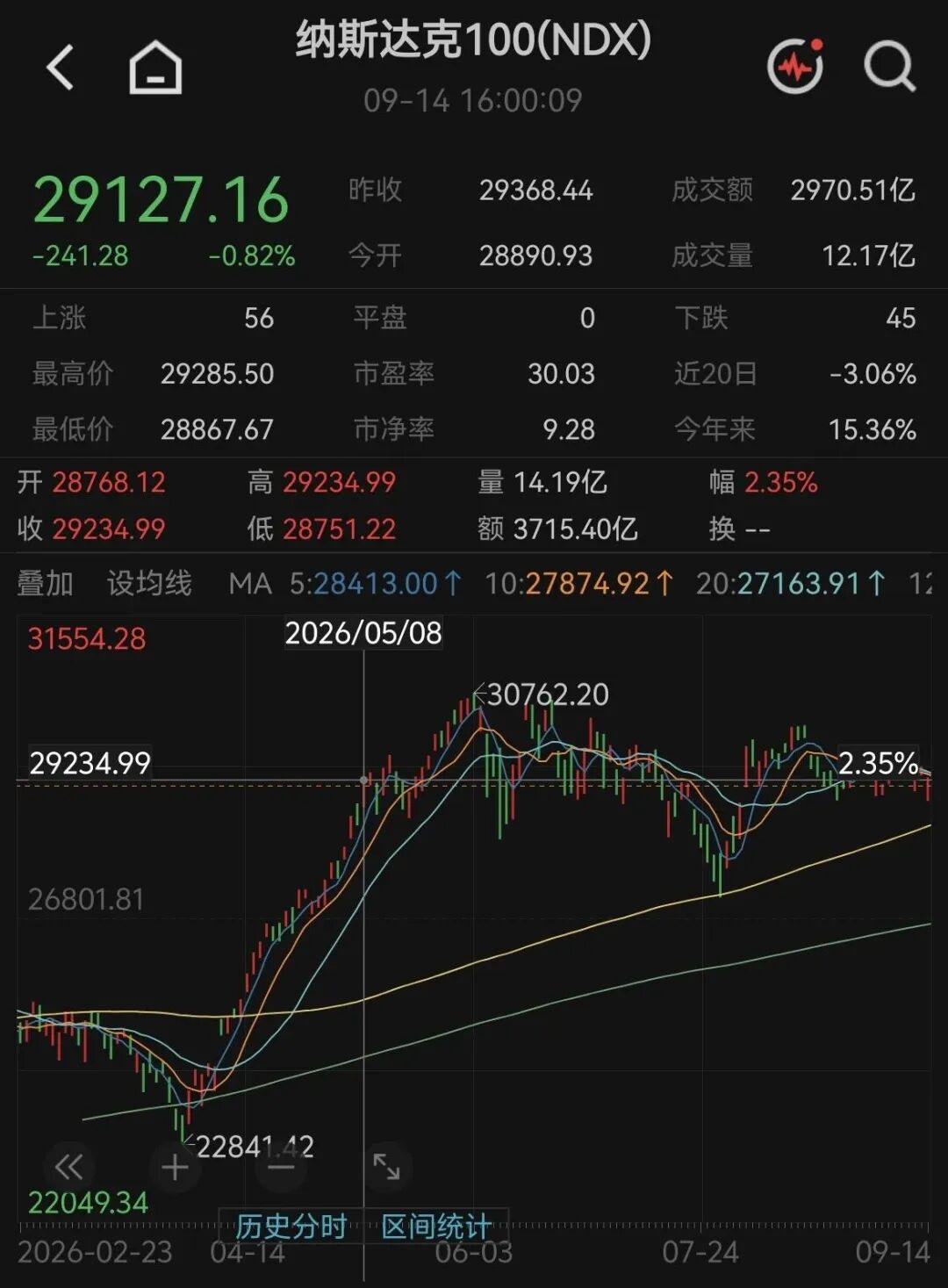
8. Finally, let’s talk about hotspots in A-shares.
It’s also related to the “collapse”—the cooperation model between Seres and a certain company has been adjusted.
In the chart below, now that you see "structural adjustment," you know what it means, right? 
This is not a small matter; it is being forced to change by the current market situation.

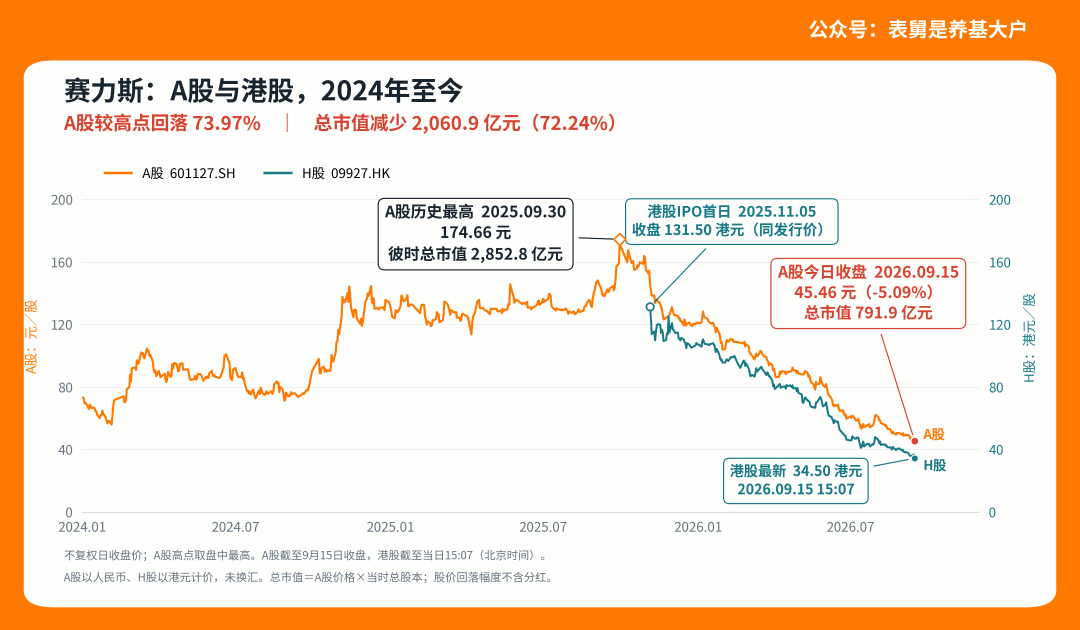
The chart below shows Seres' A-shares and Hong Kong stocks, with trends since 2024. You can observe:
At its peak, the total market value was over 280 billion, and after today's drop, it fell below 80 billion, hardly a fraction left;
The Hong Kong IPO was in November last year, essentially just after the highest point of A-shares, subsequently experiencing a continuous decline with no rebounds.
I visited Seres' factory in 2024, and it still exhibited a flourishing scene, the sellers painted a grand picture, but just two years later, its appearance has drastically changed. It can only be said that the new energy vehicle sector is too competitive, the current business model for electric vehicles is too poor and resembles that of large models (iteration is too fast, and the barriers to entry are too shallow), while a certain company’s broad net approach eventually led to strategic disfocus, pleasing no one.
Second-hand electric vehicles were never worth much, and now the older models of Wuling—who knows how much they're worth.
......
That's all for now.
免责声明:本文章仅代表作者个人观点,不代表本平台的立场和观点。本文章仅供信息分享,不构成对任何人的任何投资建议。用户与作者之间的任何争议,与本平台无关。如网页中刊载的文章或图片涉及侵权,请提供相关的权利证明和身份证明发送邮件到support@aicoin.com,本平台相关工作人员将会进行核查。


