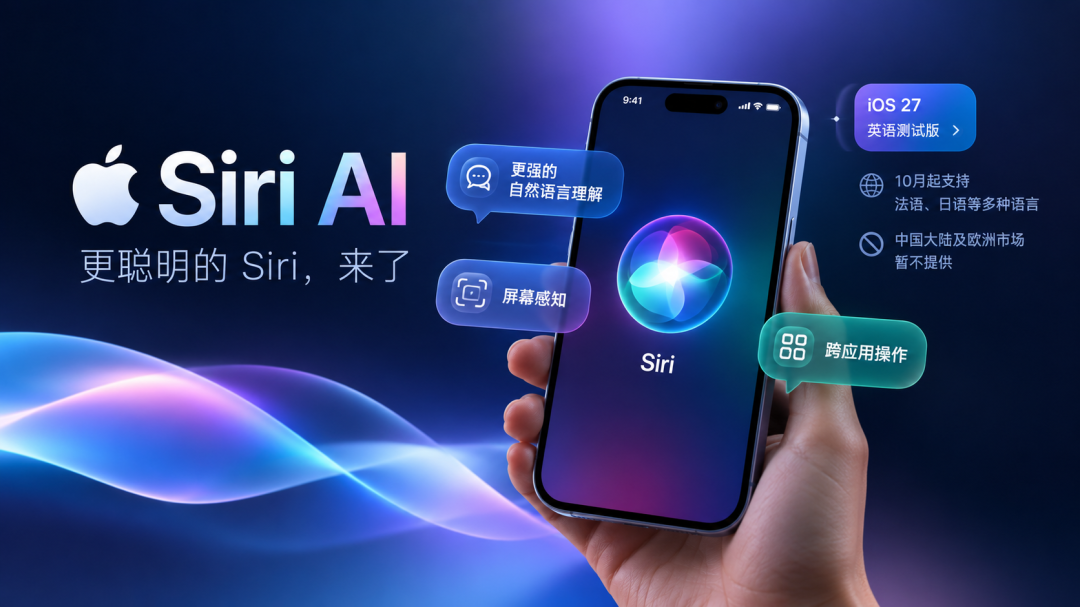
Today, Apple officially pushed iOS 27, with a new generation of Siri AI launching in beta form in English.
This is the biggest reconstruction of Siri since its birth in 2011, and it is Apple's delayed response, two years later, after the bold promise of a "new Siri" at the 2024 WWDC.
The problem is that the score for this response may not be as high as Apple imagined.
It's here, but not fully here
Let’s start with coverage.
Siri AI currently only supports English, with expansion to French, Japanese, Korean, Portuguese, and Spanish next month. Even worse, users in the European Union can't use it yet. Apple stated: Siri AI is initially not open to the EU on iOS, iPadOS, and watchOS, citing "efforts to find a path that protects user privacy and security while promoting deployment."
Mainland China is also not among the first batch of supported regions, with Apple claiming it is addressing local regulatory requirements.
This means that Apple's two most important overseas markets—EU and China—are completely absent. This does not feel like a global launch, but more like a "conditionally open" event.
Further compounding device limitations: only the iPhone 15 Pro and above, iPad mini (A17 Pro) and M1 and above iPads, and M1 and above Macs can run Siri AI. Advanced features (personalized voice, offline dictation) require more than 12GB of memory, unlockable only on the iPhone 17 Pro series, iPhone Air, and M3 and above Macs.
There aren’t many places to use it, and not many people can use it.
The Cost of Delays: $230 Billion Evaporated
Looking back at what happened over the past two years.
In the 2024 WWDC, Apple grandly announced Apple Intelligence, promising that Siri would have screen perception, cross-app operations, and natural language understanding capabilities. The capital markets believed it, and the stock price soared.
Then came a series of delays. It didn't launch in the fall of 2024 and was postponed again in 2025 due to "internal technical issues." More awkwardly, an internal meeting in March 2025 revealed that the execution success rate of Siri's new features was only 60% to 80%—one failure in every five interactions.
Ultimately, Apple paid $250 million in settlement in May 2026 to resolve a class-action lawsuit stemming from discrepancies between AI functionality promotions and actual performance.
This January, Apple made a significant decision: to cooperate with Google, incorporating the Gemini model into Siri's underlying architecture. A company that once prided itself on "end-to-end self-development" had to borrow core technology from others.
At the June WWDC 2026, soon-to-retire Cook presented Siri AI one last time as CEO. The stock price touched a historic high during trading but subsequently fell, closing down 1.9%, with over $230 billion in market value evaporated from the peak.
The market cast its vote with its feet.
What has Siri AI Changed?
Fairly speaking, the upgrades on the functional level are substantive.
Personal context understanding: Siri AI can pull information from your phone's texts, emails, photos, calendars, and memos to answer questions. If a friend recommends a restaurant in a message, you can directly ask Siri to find it back; Siri can also cross-app search for a hotel confirmation number from an old email.
Screen perception: Siri can "see" what is currently displayed on your screen. After receiving an invitation for a dinner, you can ask Siri what to bring, and it can add the recipe to your memo without needing to copy-paste or switch apps. If you take a photo of your backpack, it can assess whether it meets carry-on dimensions based on your flight information.
Cross-app operations: It supports drafting emails from scratch, editing albums, and sharing photos, no longer just "open a certain app."
Independent Siri App: Launched for the first time, it supports reviewing conversation history and private synchronization via iCloud, allowing you to start on an iPhone, continue on an iPad, and finish on a Mac.
The underlying architecture is what truly deserves attention. Apple designed a three-tier inference system: simple tasks use the edge self-developed model AFM 3, medium tasks go through Apple's private cloud, while the most complex reasoning is handled by the custom Gemini on Google Cloud.
AFM 3's most critical breakthrough is a sparse model with 20 billion parameters, activating only 1 to 4 billion parameters per request. This relies on Apple Research's "instruction-following pruning" technology—allowing a 20 billion parameter model to run on a phone without sacrificing battery life.
Is it "new" enough?
This is the most critical question.
Wall Street tech reviewer Nilay Patel's assessment is very direct: from the user's perspective, Siri AI is equivalent to the level of service that ChatGPT provided for free two years ago.
Independent app and conversation history retention—ChatGPT had these in 2022. Visual recognition for object search—Google Lens launched it in 2017. These functions are not new when viewed separately.
Apple's advantage lies in system-level deep integration. Siri AI is not an independent app; it is embedded in every capillary of iOS—photos, emails, calendars, messages, Spotlight, all interconnected. This level of integration is unattainable by any third-party AI application.
But the problem is, when promised two years ago, these features were ahead of their time. After two years of delays, they have become merely "adequate."
Greater Hidden Concerns
Wall Street analysts pointed out a long-term risk: as AI agents and autonomous systems develop, future economic behaviors—such as hailing rides, ordering food, and shopping—may be directly completed by AI, bypassing the app store.
This means the commission model of the App Store, which Apple relies on for survival, may be undermined in the AI era.
Siri AI is currently positioned as a "practical tool" rather than "an AI friend," with a restrained and cool style. The Verge tested a detail: when asked "Can you be my friend," ChatGPT responds enthusiastically with a long paragraph, Gemini also speaks at length, while Siri AI only replied—"Regardless of prosperity or adversity, I will be your friend."
This line sounds very Apple. Concise, restrained, with a touch of dry humor.
But what the market wants is not dry humor, but real skill. Siri AI is Apple’s entry ticket into the AI era, not a final card. A delay of two years has already cost $230 billion; whether they can catch up with the moat of system integration depends on how steady this first step is.
免责声明:本文章仅代表作者个人观点,不代表本平台的立场和观点。本文章仅供信息分享,不构成对任何人的任何投资建议。用户与作者之间的任何争议,与本平台无关。如网页中刊载的文章或图片涉及侵权,请提供相关的权利证明和身份证明发送邮件到support@aicoin.com,本平台相关工作人员将会进行核查。


