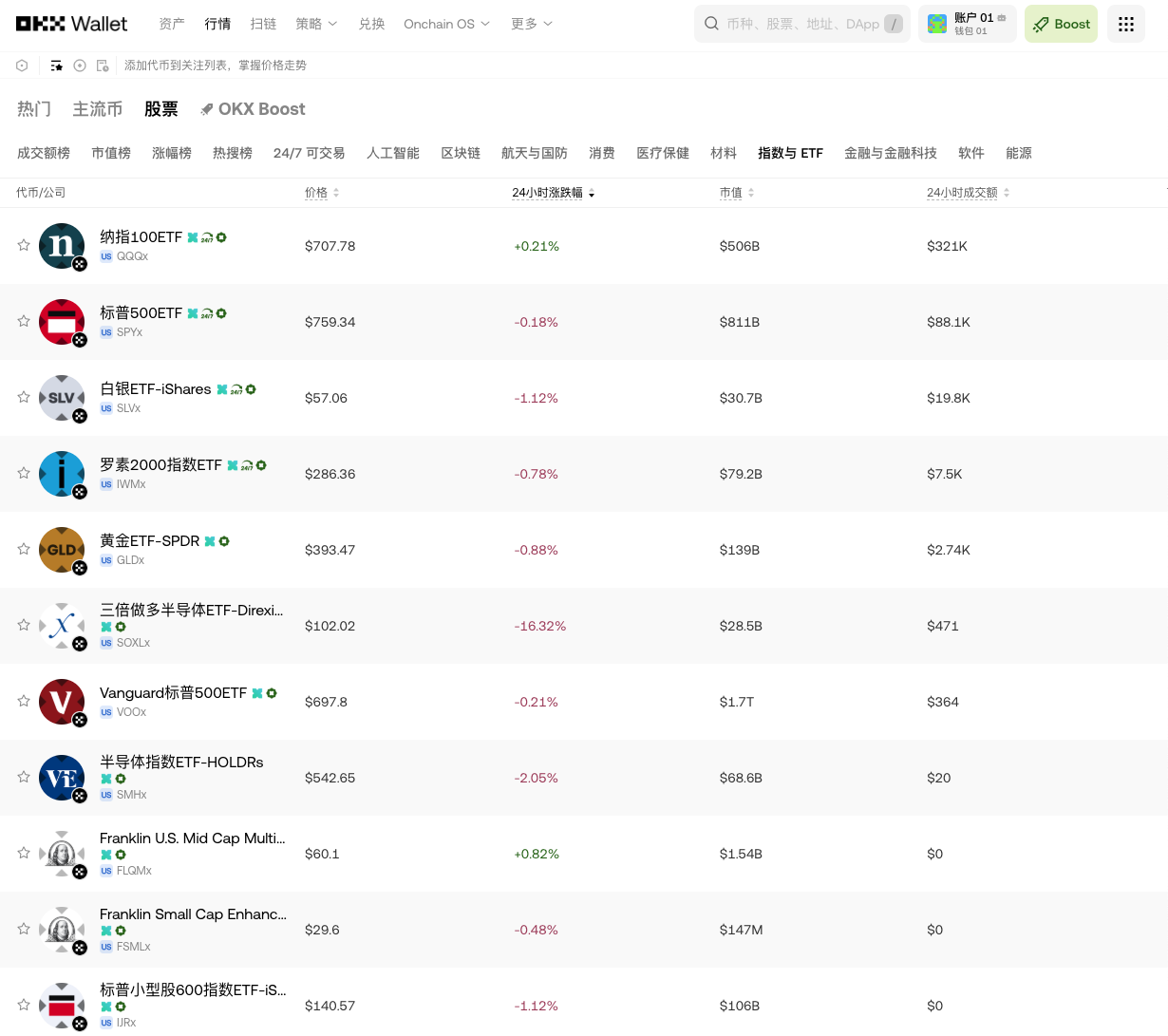
Swiping OKX's Web3 wallet, I was directly stunned by the huge annualized yield when I entered the DeFi page. Today, we will thoroughly discuss LP liquidity mining.
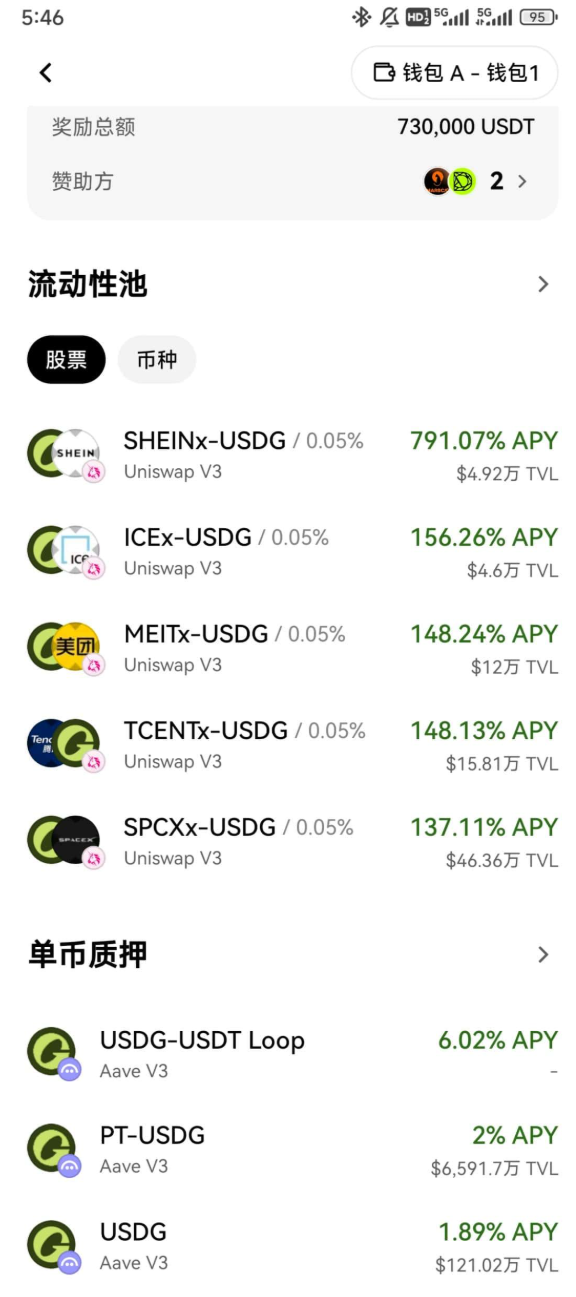
Many friends who are new to LP will have an intuitive idea: deposit coins, and as others trade, I just sit back and collect fees. Isn’t that a guaranteed profit? Today, we will clarify step by step: what is LP, where the profits come from, why it can also lead to losses, and what impermanent loss is. Finally, we will demonstrate the OKX DeFi page in practice and teach beginners how to select pools.
First, let’s explain the concept. LP stands for Liquidity Provider, meaning liquidity provider. It sounds professional, but the logic is actually very simple. Taking the ETH‑USDG liquidity pool as an example, both types of assets are stored in the pool simultaneously. When someone wants to buy ETH, they throw USDG into the pool to exchange for ETH; when someone wants to sell ETH, they deposit ETH to exchange for USDG. The entire exchange process is automatically executed by smart contracts.
The ETH and USDG in the pool partly come from us, the ordinary users who provide liquidity. Everyone deposits the two types of assets into the pool, providing trading chips for the market. Every user exchange generates a fee, and all LPs in the pool will share this fee according to their proportion.
In simple terms, LP is about providing liquidity to earn fees. The level of income is mainly determined by three factors: First is trading volume; the more active the trading, the more fees are generated, which is easy to understand. Second is the number of people sharing the fees. For the same fee, the smaller the total amount of funds in the pool, the higher the share of income per unit of capital; this can be understood upon reflection. Third, and most crucial: additional incentives from the project. Some pools offer extra tokens and stablecoin rewards, directly raising the displayed annualized yield on the page very high! This explains the outrageous yield difference in the screenshot.
As shown in the screenshot, the equity asset pool SHEINx‑USDG once had an APY soaring to 791.07%,
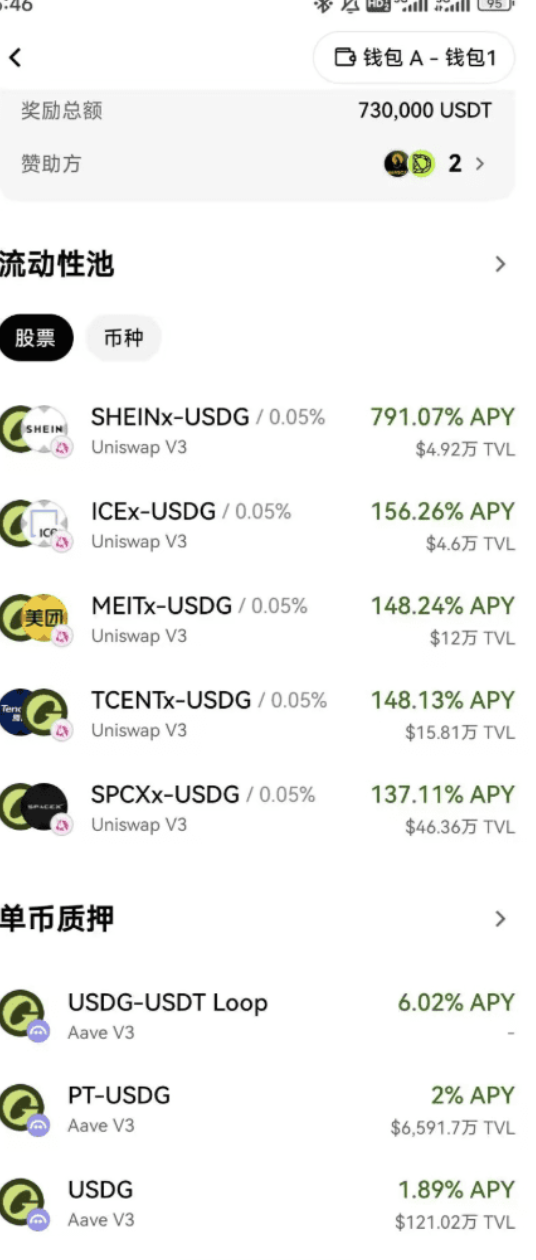
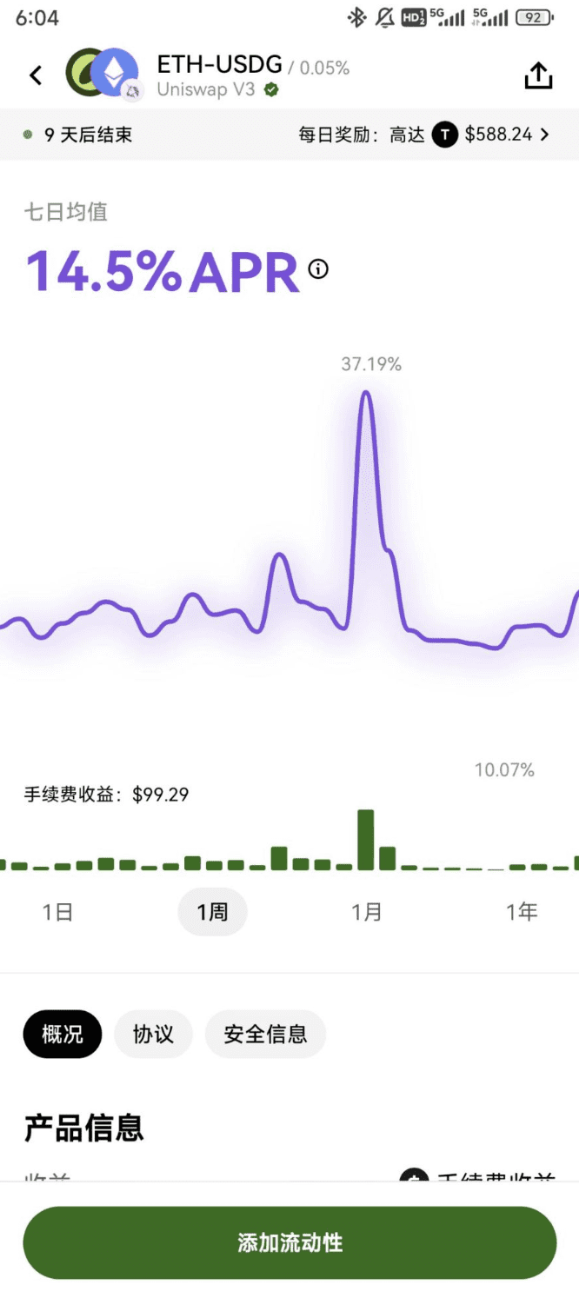
But the pool's TVL was only about $49,200. On the other hand, the ETH‑USDG pool showed an APR of 14.5%, but its TVL was as high as $2,228,900.
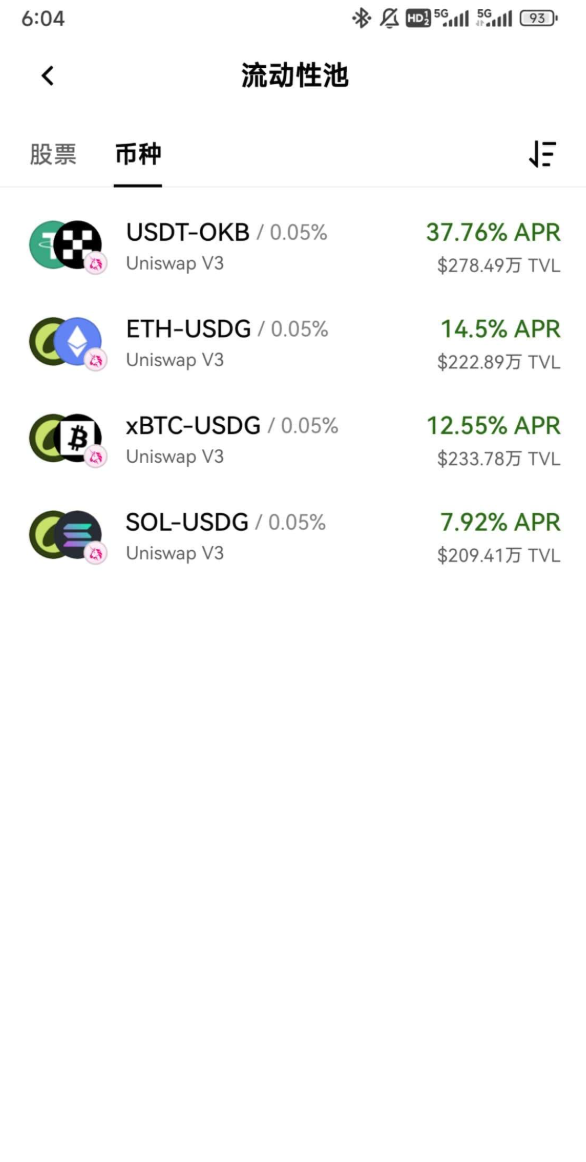
Here, it’s important to emphasize: the displayed APY on the page is just an estimate based on recent earnings and does not guarantee that you will earn that for an entire year in the future. When the annualized rate on the page exceeds 50%, the risks often rise simultaneously.
Understanding the logic, let’s talk about which market conditions are suitable for LP. Suppose you plan to hold ETH and stablecoins long-term; simply holding the coins means you can only hope for the price of ETH to rise to make a profit. But if you take a portion of the funds to form LP, as long as the price fluctuates within the set range and the market continues to trade, you can earn an additional income from fees. Hence, LP is best suited for a volatile market. For example, if ETH rises and then falls back to its original point in a month, simply holding coins results in no change in price. However, during that month, there will be continuous trading from chasing upward movements, stopping losses, and arbitrage. As long as the LP position remains within the effective range, you can continuously collect fees.
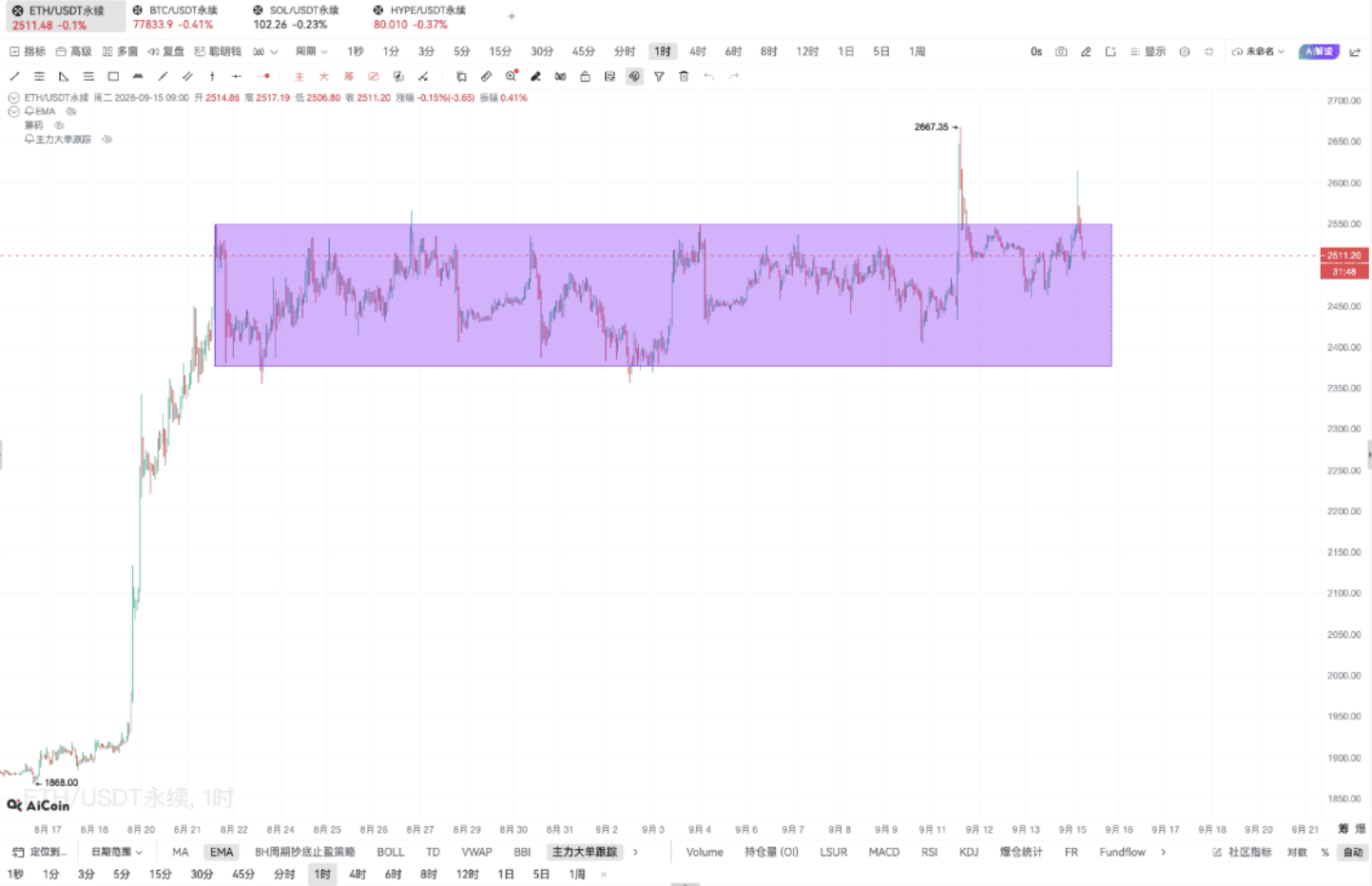
Looking at the ETH/USDT hourly chart, between late August and mid-September, ETH mostly fluctuated between $2,350 and $2,550, occasionally breaking through briefly without showing a one-sided big trend. During this time, configuring LP covering that range means as long as the position does not exit the range, you can continuously accumulate fees. When the fees can cover impermanent losses and entry/exit costs, the final profit may outpace simply holding the coins.
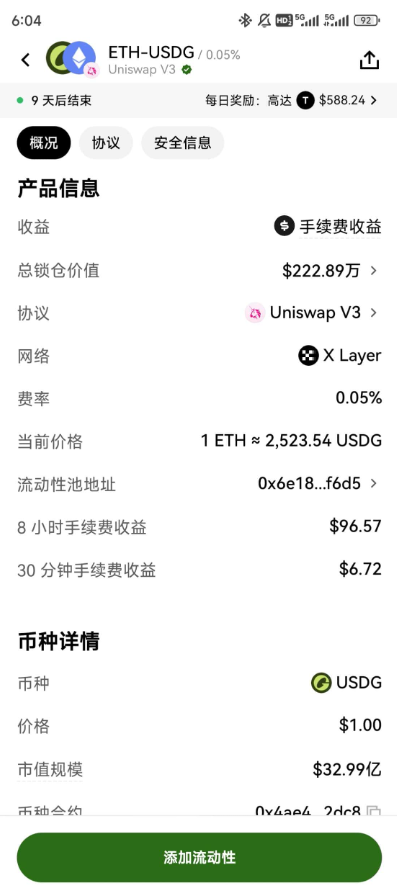
Taking the rules of Uniswap V3 as an example, the fees are directly deducted from the trader's currency. For instance, if you earn 0.001 ETH plus 2 USDG, based on the current ETH price of $2,520, the page will show the fee income as $4.52. But what you actually receive remains as the two tokens ETH and USDG.
Highlighting an important point: The LP page displays earnings in US dollars, but the fees are distributed in the native tokens of the pool, not directly giving you dollars or stablecoins.
Let’s simplify the calculations to help understand impermanent loss. You take out 0.2 ETH (worth 500U) paired with 500U stablecoins, totaling an investment of 1,000U. After a while, ETH rises from 2,500U to 3,100U.
👉 Path A: Direct holding. 0.2 ETH becomes 620U, adding 500U stablecoins for a total asset value of 1,120U.
👉 Path B: LP. While ETH continues to rise, the pool automatically sells some ETH to swap for more stablecoins. In a simplified model, the LP position becomes 0.1796 ETH + 557U stablecoins, worth a total of 1,114U.
Excluding fees for now, direct holding amounts to 1,120U, while the LP combination is 1,114U, showing a difference of 6U, which is the impermanent loss. Assuming fees earned during this period total 5U, and there’s a 2U cost to exit, the final LP net value becomes 1,117U. Comparing this to the initial investment earns 117U, but it is still 3U less than simply holding the coins.
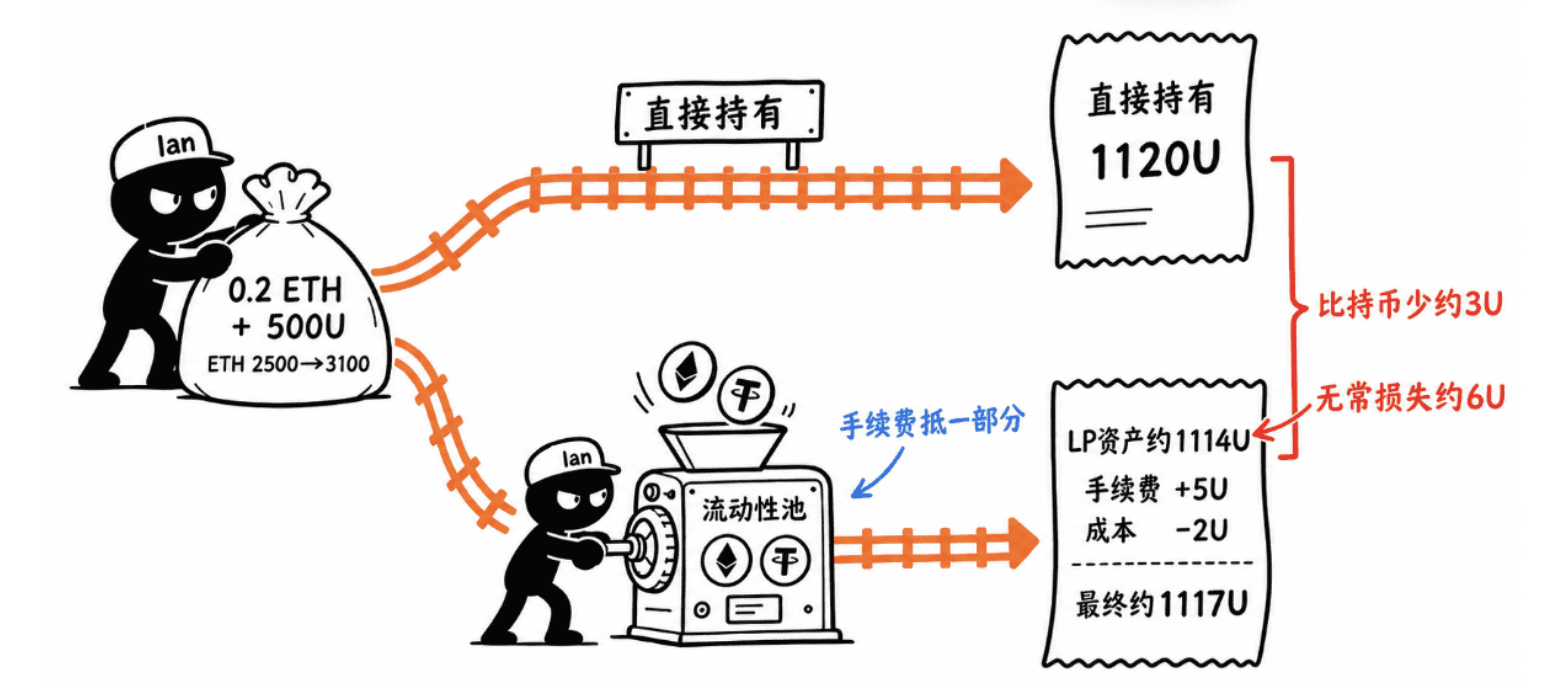
This is impermanent loss, where "impermanent" indicates that this difference fluctuates with the relative price changes of the coins. If ETH drops back to 2,500U, this difference will shrink again. Only by completely exiting LP can the profits and losses be definitively locked to your account.
Changes in coin prices bring shifts in total asset value, which fall under ordinary market profits and losses; the difference generated by comparing LP to direct holding is impermanent loss.
Here are two simple criteria for judgment:
- Upon exiting LP, subtract the invested principal from the total funds returned to assess whether you made a profit or a loss overall.
- Compare final LP assets to the value of directly holding the two coins at the same time to determine if choosing LP is worthwhile.
Both dimensions should be considered together. Focusing solely on fees may lead to overestimating the earnings; solely fearing impermanent loss may overlook the fees already received.
Newbie Practical Steps to Select LP Pools: Look at Assets First, then the Pool, and Lastly the Yield
Do not immediately click on the pool with the highest annualized rate!
Step One: Confirm the Two Currencies in the Pool, whether they are ones you are willing to hold. Taking ETH‑USDG, xBTC‑USDG, SOL‑USDG as examples, think carefully: if after market fluctuations your position becomes entirely one of those coins, can you accept it? If there is any currency in the pool that you absolutely do not want to hold long-term, this pool is not suitable for your first LP. Altcoin pools carry higher risks; beginners should prioritize mainstream coin combinations.
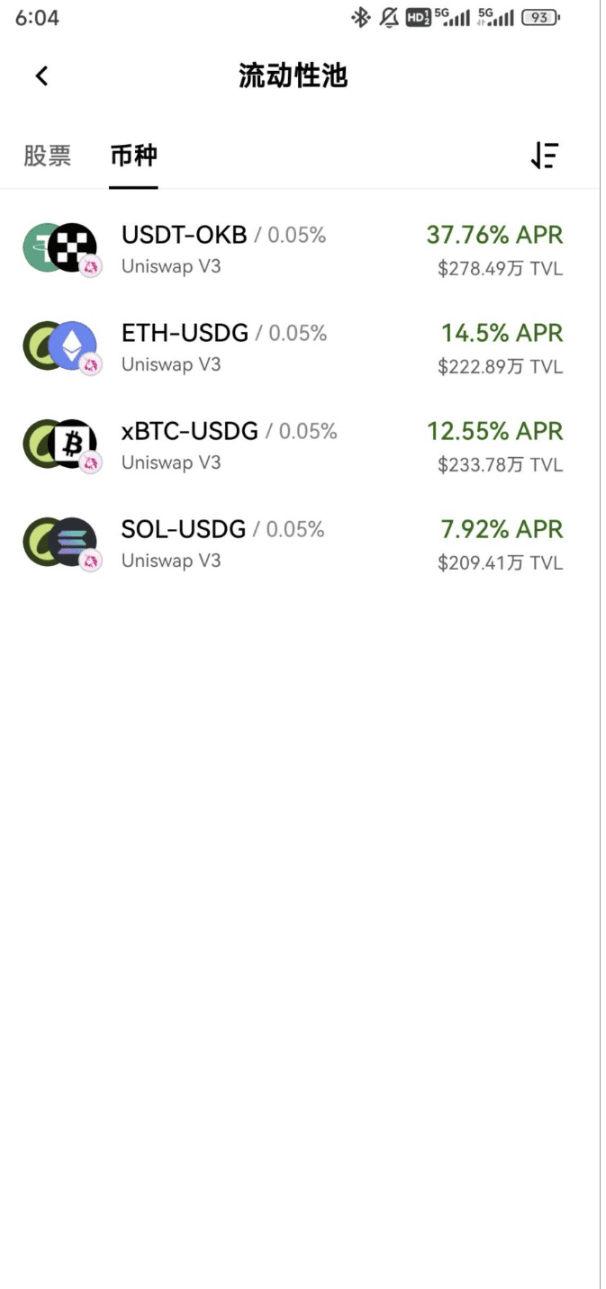
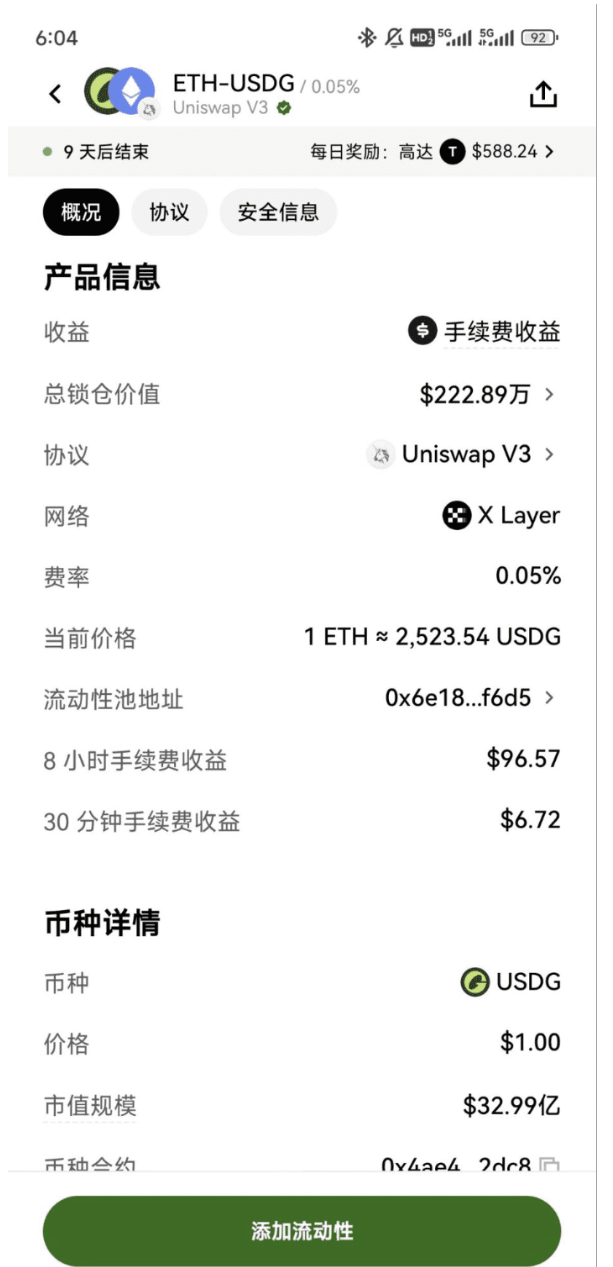
Step Two: Check the Basic Information of the Pool Focus on confirming the underlying protocol, the blockchain it belongs to, TVL locked amount, time since launch, contract address, and security audit-related materials.
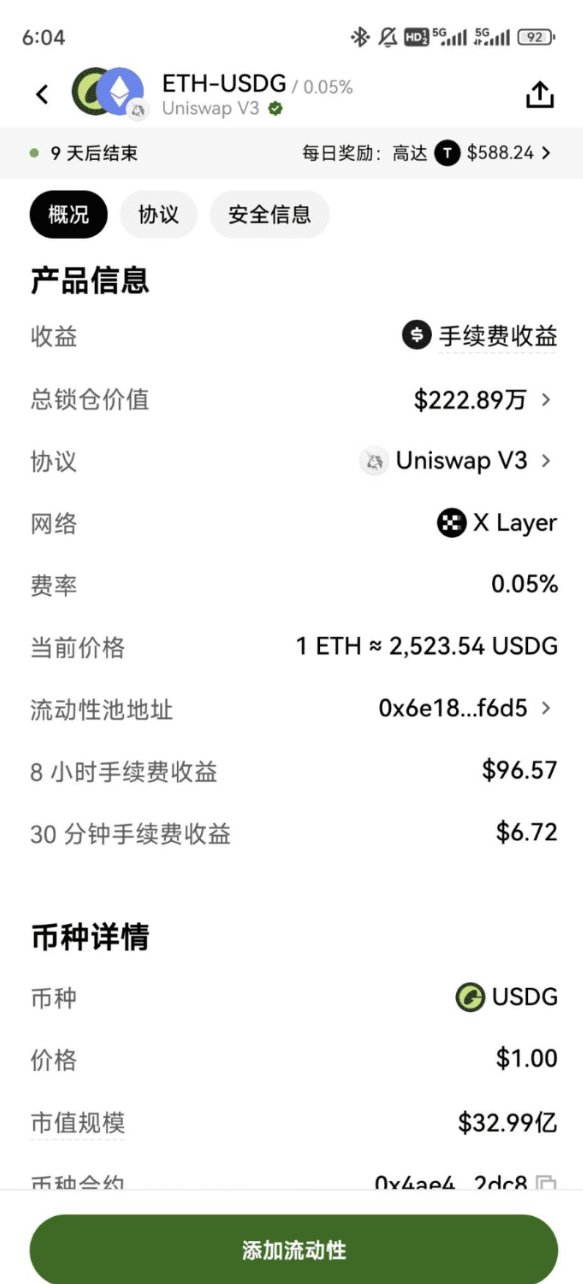
This information will clarify where the funds are truly going. Security ratings and audit reports can only assist in assessing risks and do not guarantee complete safety of the principal.
Step Three: Distinguish the Sources of Income. Fees generated from actual trades have sustainability. High rewards from activities, once the activity ends, the annualized yield will quickly plummet. As mentioned earlier, the ETH‑USDG shows 14.5% APR while SHEINx‑USDG is as high as 791.07%. The latter may appear very enticing, but the TVL is only $49,200, increasing asset uncertainty. For beginners, a comprehensible 14.5% is far more suitable for practice than an incomprehensible 791%.
Step Four: Evaluate How Manageable the Price Range Is. The narrower the range setting, the higher the concentration of funds, and the more efficient the fee earnings per unit of principal, but if the price runs out of the range, it stops generating fee income; with a wider setting, efficiency will drop, but managing it becomes much easier. Beginners should not narrow the range too much at the start; prioritize understanding and managing it effectively to avoid the price breaking through the range in one market movement. I previously fell into this pit while doing LP for JTO. This Lp approach is best suited for volatile markets.
Let’s walk through the operation process using ETH as an example. Enter the liquidity pool detail page, confirm that the underlying protocol is Uniswap V3, the deployment network is X Layer, verify the pool address, token contract, and security-related information, confirm that there are no mistakes, and click to add liquidity.
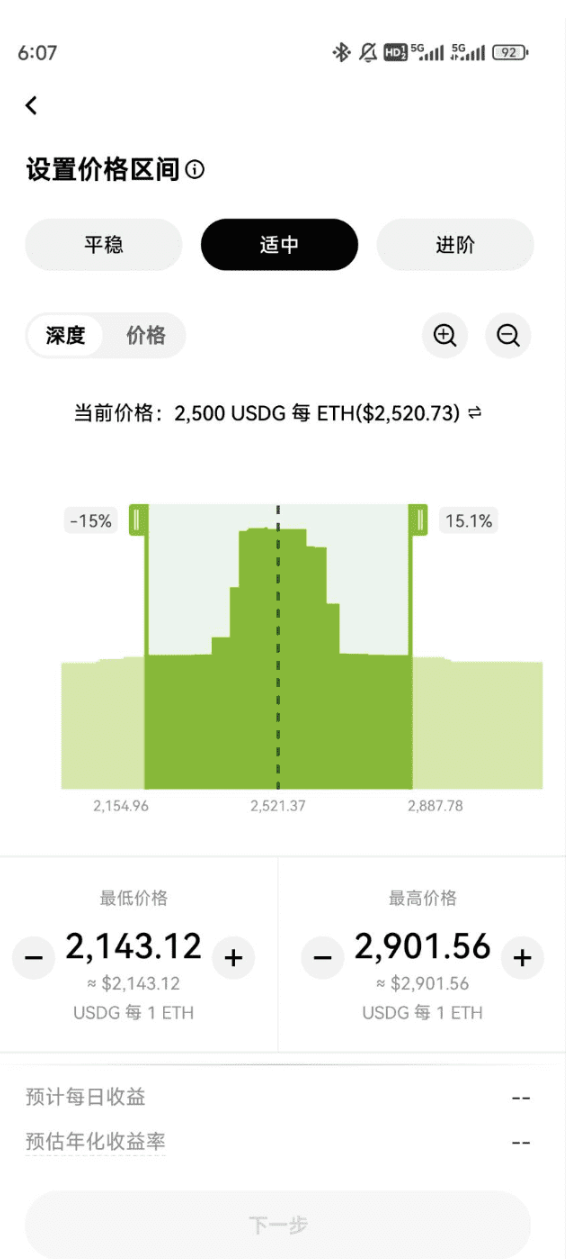
With ETH's current price at 2520.73U, the page indicates a “moderate” bracket providing a range of 2143.12U‑2901.56U. As long as the price is within this range, normal market making can take place to earn fees; once it breaks out of the upper or lower boundary, the position will convert to a single asset type, no longer generating fee income. Stable, moderate, and advanced are just strategies for setting range width, not guarantees of risk level.
Next, input the assets being invested, for example, investing 1 ETH + 2913.409162 USDG. The page estimates a daily income of $3.41, annualized at 41.48%. These values will fluctuate with coin prices, trading volumes, and rewards; they can only serve as estimated references and not as fixed earnings.
Who is suitable for LP: Investors who can accept holding two types of currencies at the same time, anticipate that the market will most likely fluctuate, and are willing to regularly check their positions. If you are confident the currency will rise significantly, holding directly is more suitable to capture all the upsides. If you can only accept the risks of stablecoins or lack the time to maintain the price range, consider simpler single-currency investments first.
It is advised for beginners to participate with small amounts and avoid leveraging. Keep records of fees, position net value, and comparisons with pure coin holding during the same period. Completing one full process of entering and exiting the pool will help you understand how much actual income the displayed annualization will yield.
Register for OKX through the AiCoin cooperative entry:
👉https://jump.do/zh‑Hans/xlink?checkProxy=true&proxyId=2
Registration grants a permanent 20% commission.
Live broadcasts are happening every day; feel free to continue following AiCoin! Book in advance 👇
https://www.aicoin.com/zh-Hans/live/list?tab=upcoming
Join our community to discuss and grow stronger together!
Official Telegram community: https://t.me/aicoincn
AiCoin Chinese Twitter: https://x.com/AiCoinzh
Aster Commission:
https://www.asterdex.com/zh-CN/referral/9C50e2
Hype Commission:
https://app.hyperliquid.xyz/join/AICOIN88
Binance Commission:
https://jump.do/zh-Hans/xlink-proxy?id=3
Invitation Code: aicoin668
Coinbase Commission:
https://jump.do/xlink?checkProxy=true&proxyId=25
Invitation Code: Y8L23JL
免责声明:本文章仅代表作者个人观点,不代表本平台的立场和观点。本文章仅供信息分享,不构成对任何人的任何投资建议。用户与作者之间的任何争议,与本平台无关。如网页中刊载的文章或图片涉及侵权,请提供相关的权利证明和身份证明发送邮件到support@aicoin.com,本平台相关工作人员将会进行核查。