Just now, Feishu and Doubao Work held their brand new press conference together.
After discussing many of the new upgrades Feishu has made for agents, as well as the product capabilities developed through deep integration with Doubao Work, they finally launched a brand new feature that I have really enjoyed during the testing phase.
Doubao Work Partner.
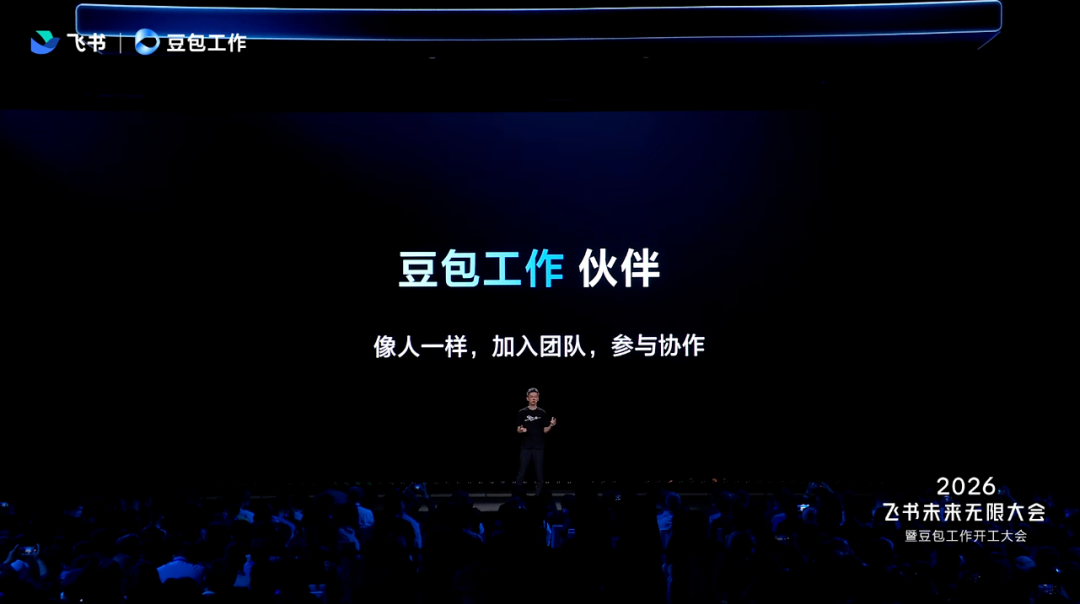
To be honest, Feishu is the first to create this in the domestic market, so I'm not surprised at all.
Completely different from the previous Doubao Work Partner, this time, you can bring your Doubao Work Partner into any group chat within the company, becoming a team-shared AI work partner.
It has an independent persona, a unique name, and an independent organizational identity; for example, I renamed it to a rather sexy name, called Father.
It can be brought into groups, participate in company meetings, read all documents, code, and so on, and can actively promote everyone’s work. This is what it looks like.
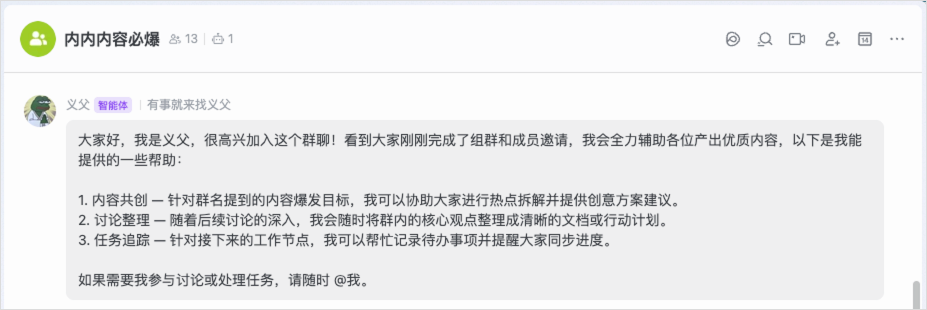
If you remember, you might think that this Doubao Work Partner is quite similar to Claude Tag.
Yes, it does look very much alike.
I believe that to understand what Doubao Work Partner truly is, the best way is really to first understand Claude Tag.
In June of this year, Anthropic released Claude Tag.
This thing has been referred to by Kaparthy as the third paradigm of AI in user experience.
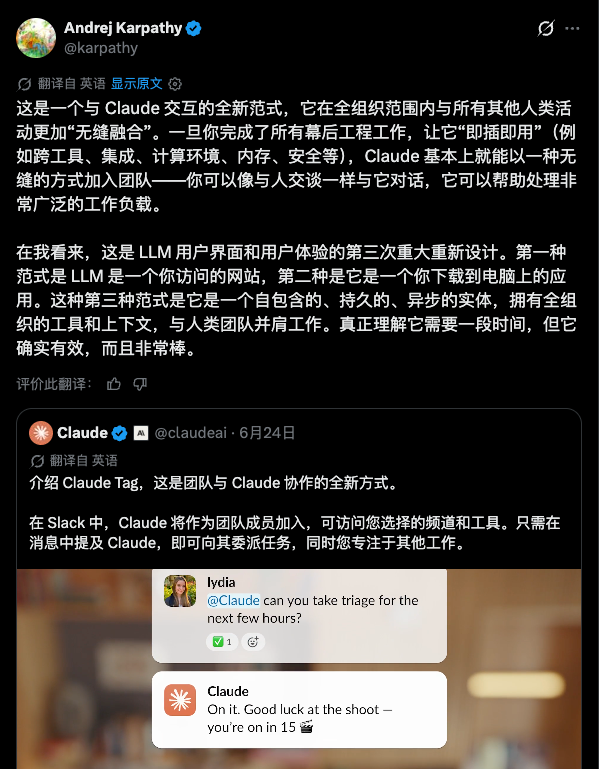
I think it can be explained in one very simple sentence.
Ordinary agents are capable agents that belong to you.
Whereas products like Claude Tag and Doubao Work Partner are akin to giving this agent an independent identity, allowing it to work securely and controllably with everyone in the company.
This sentence basically explains it all.
Most agents we have encountered in the past, whether Claude Code, Codex, or various agents you created yourself, essentially share a common point.
They primarily work around "you."
In contrast, forms like Claude Tag and Doubao Work Partner represent a completely different form.
You can understand it as having its own identity, permissions, memory, etc., stationed long-term within the company's organizational software. Claude Tag stays in Slack, while Doubao Work Partner resides in Feishu.
Anyone in the company can work with it.
It knows what has happened in the group before, is aware of what everyone has been discussing lately, understands what business the company is in, what each person is responsible for, and what projects everyone has on hand. It can also connect to systems like GitHub, multi-dimensional spreadsheets, knowledge bases, etc.
Often, you might not even need to call for it actively.
It will judge by itself:
Should I do something about this?
See, this relationship has completely changed.
Previously in the organization, our relationship with AI was roughly:
Person, Person, Person, Person.
↓ ↓ ↓ ↓
AI, AI, AI, AI.
Now it has changed to:
Person, Person, Person, Person.
↓
AI.
Everyone shares the same AI colleague, enabling a team intelligence that significantly reduces various communication and loss costs, allowing our partners to have more time to focus on those truly important tasks that AI cannot replace.
This is what I believe makes this type of product truly outstanding for organizations.
In Slack, the role Claude Tag can play is not as significant as Doubao Work Partner in Feishu, primarily because the infrastructure and foundation laid by Feishu over the past decade are really formidable.
Group chats, meetings, documents, calendars, tasks, projects, OKRs, etc., even various types of business data in multi-dimensional spreadsheets, are incredibly rich.
So yesterday, I even made a small decision internally to fully migrate our company communication from WeChat to Feishu.
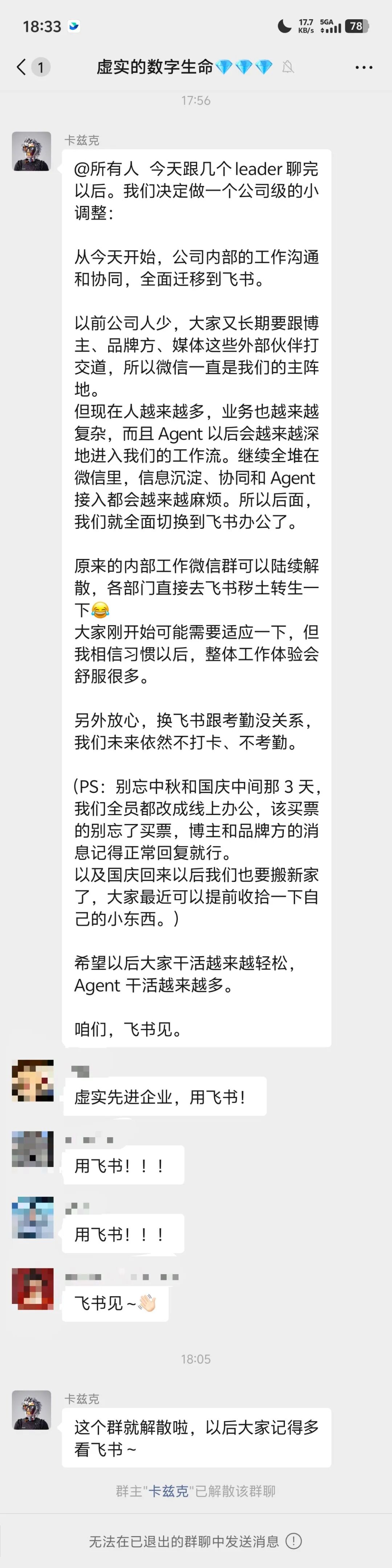
A small milestone for the company, finally switching fully from WeChat to Feishu.
This year has flown by too quickly, many foundations are still not in place, and we were just going through the motions, but after reflecting yesterday, I made the firm decision.
For the organizational aspect of the company, we must fully embrace infrastructure born for the future.
Feishu is essentially born for agents. Although it is just a small change in the way we work, it does signify a move towards the future.
This decision is actually closely related to the recent internal testing of Doubao Work Partner.
Speaking of Doubao Work Partner, it is currently still in an invite-only co-creation testing phase. Due to our somewhat unique identity, we received access to the internal test a few days ago. For those eager to use it, you may need to wait a bit longer. However, there are still some things I think are worth showing everyone.
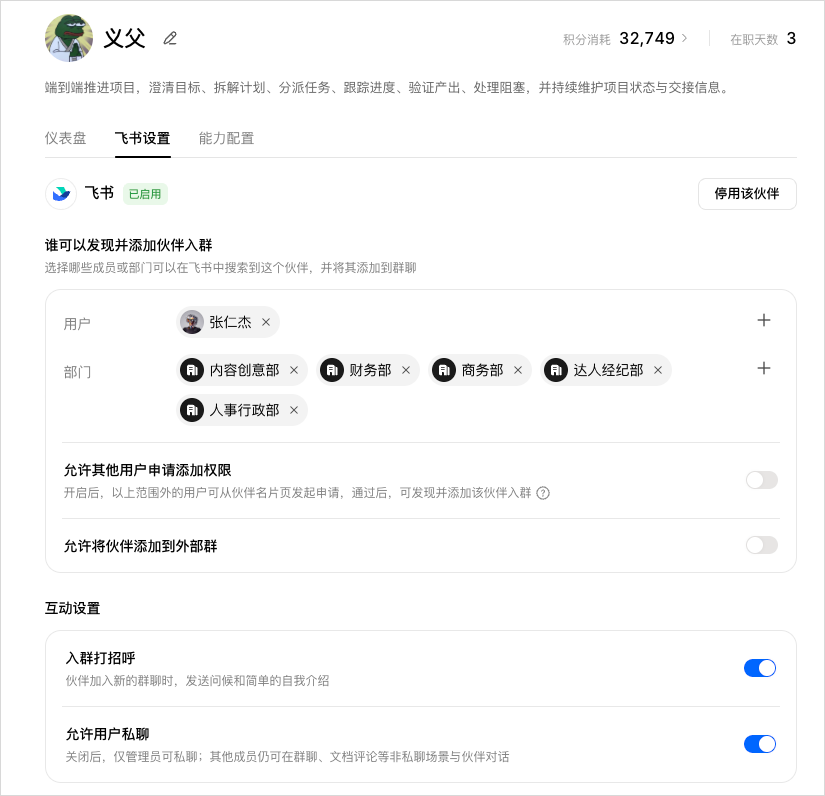
Once you have access to Doubao Work Partner, you can see its settings page in the backend, where you can view its persona, automation, assets, memory, and more.
You can change it however you like; for example, I renamed it to Father.
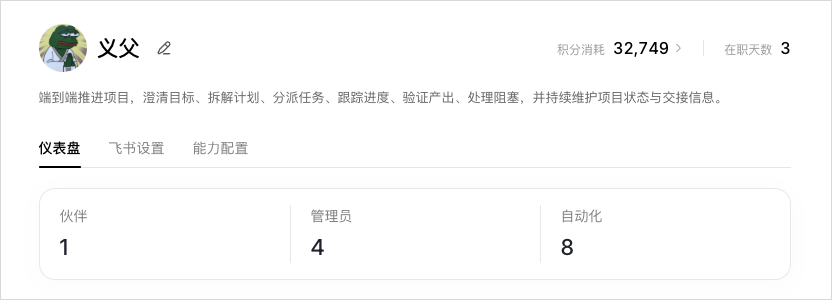
So whenever we need it to help with tasks, we just need to @Father in the group...

Of course, you can also create multiple different work partners, giving them different abilities and personalities.
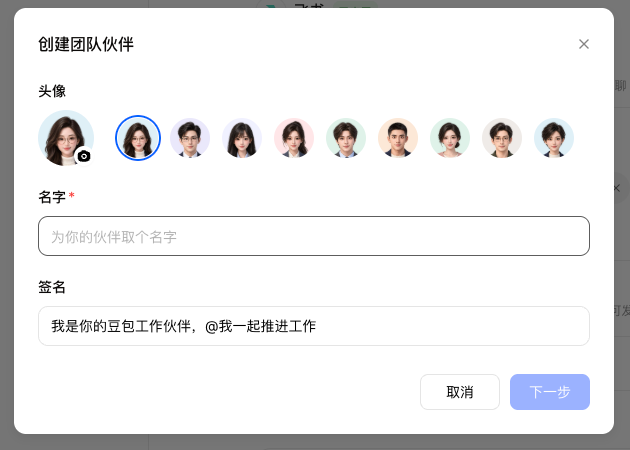
Let me give you an example.
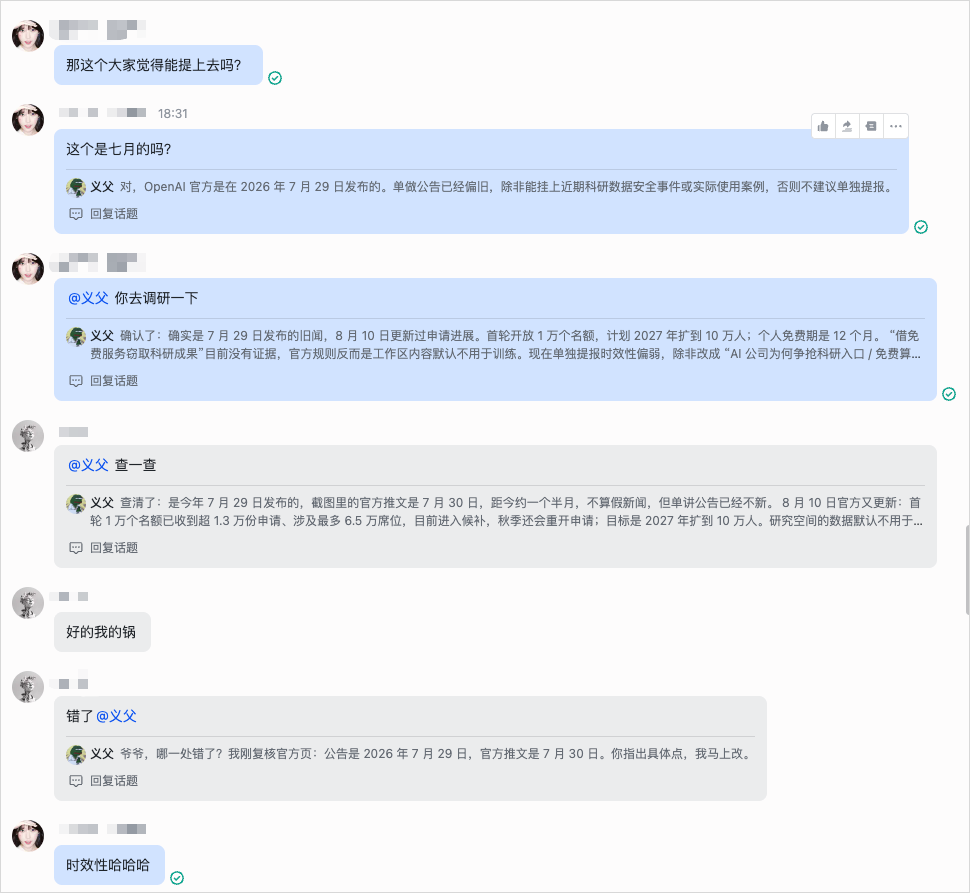
Our partners are experimenting with using Father to discuss topic selection.
When they come across interesting content, they directly throw it into the topic selection group, where everyone chats about whether it can be done.
For instance, today they saw this potted plant and hand-cranked token generator.

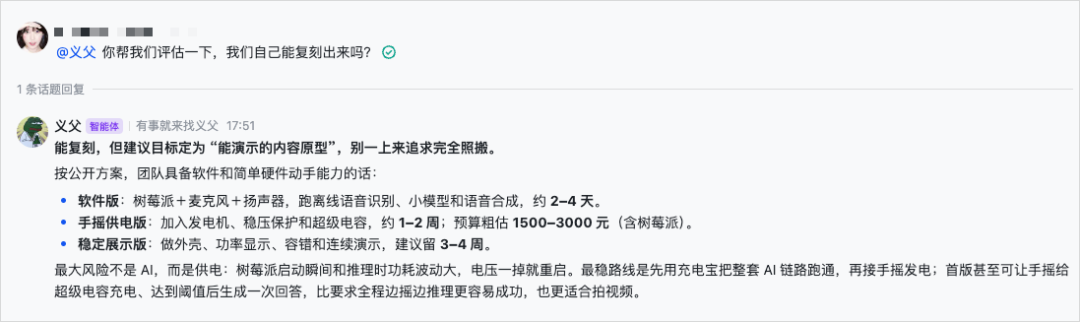
They can @Father in the group to have it research how to implement it technically and if it can be replicated.
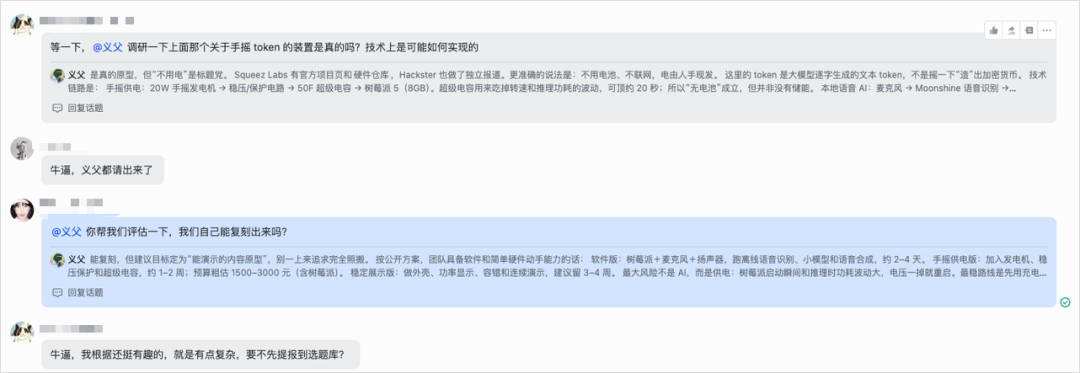
It can immediately provide suggestions, making preliminary estimates on timelines, budgets, and potential problems.
They can also have Father verify some information in the group.
Then there's a topic regarding the start of school. They asked if it would be possible to use ChatGPT as a language teacher.
They sent a screenshot to the group for Father to review.
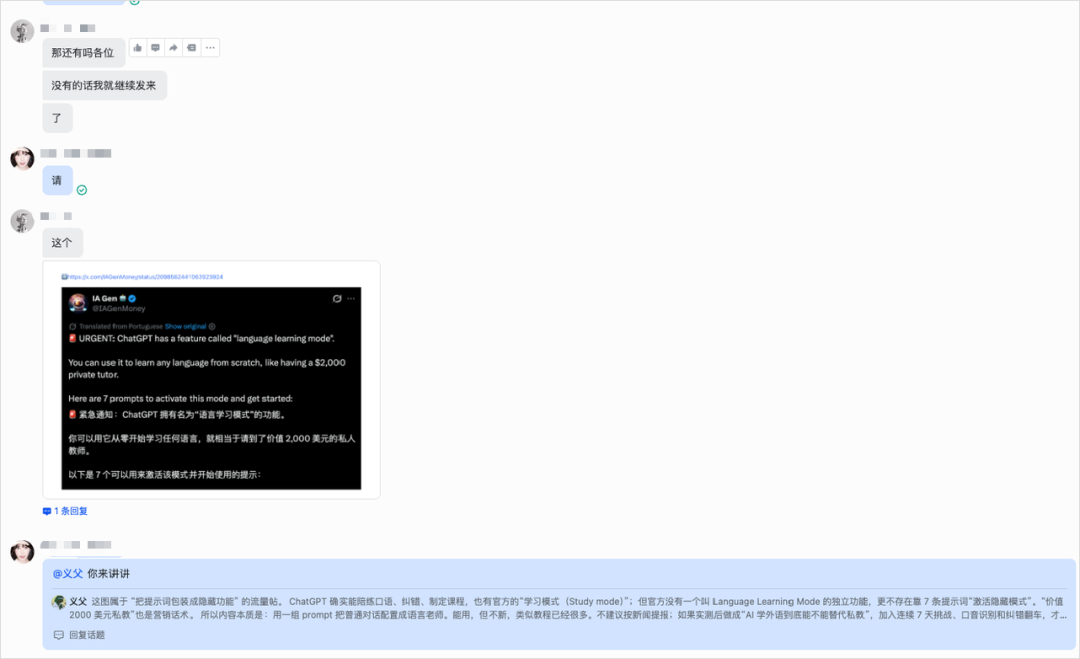
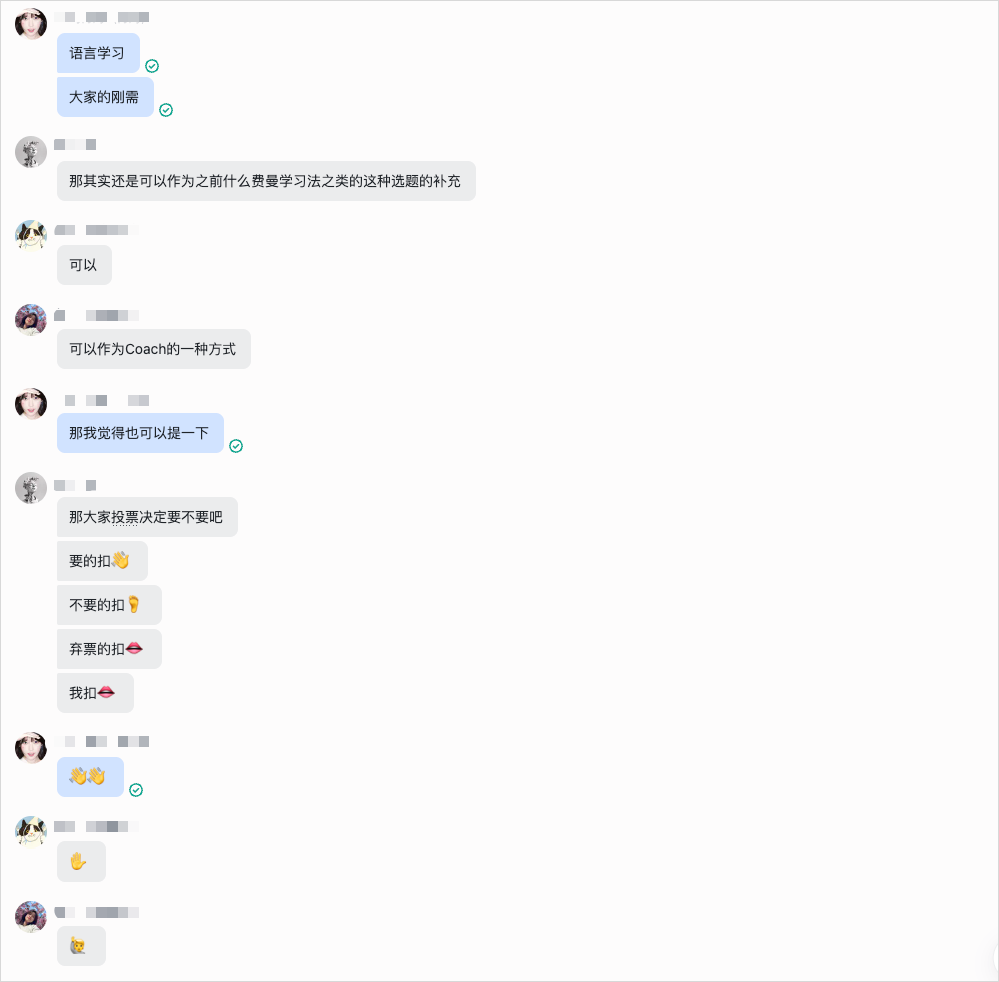
After chatting with Father, everyone can continue to discuss fully and then vote.
After the discussion, they had Father organize the previous conversations into a topic summary card.
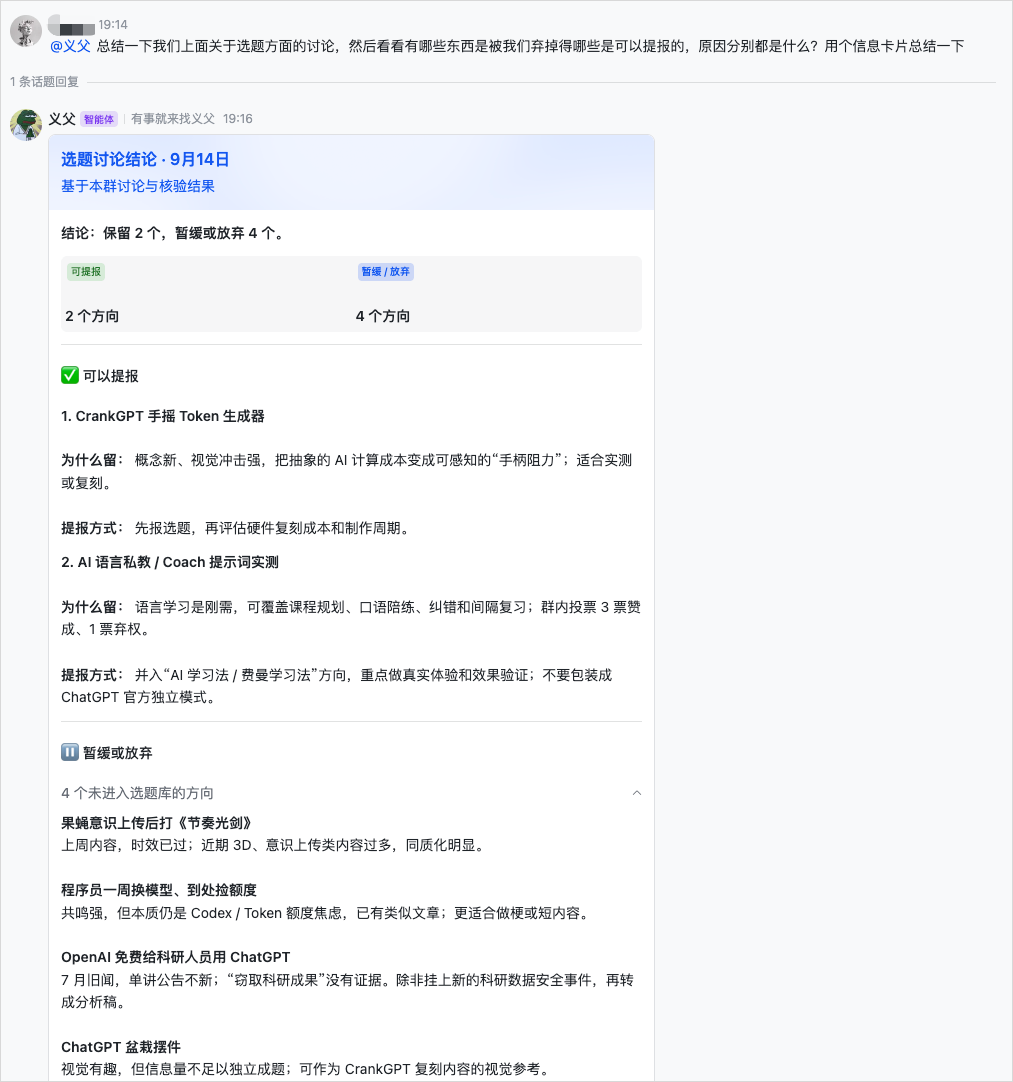
After topic discussions, our process involves having the content team submit suitable directions to the topic library, and then I screen them to determine which can be done.
Now with Father, they can truly share, discuss, and let Father throw ideas into the topic library at any time.

Then I can see that Father has recorded the two directions discussed earlier into the topic library, setting their status as pending for me to review and decide.

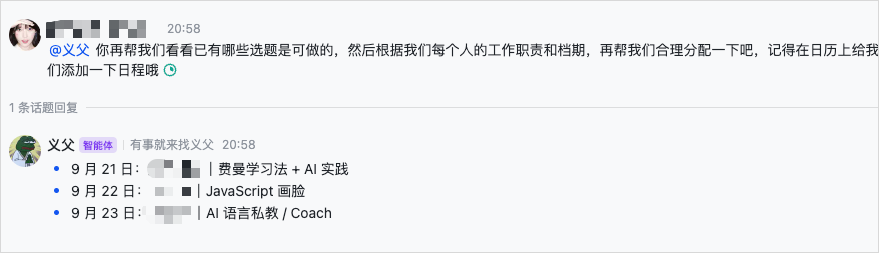
Next, I had it sort the schedule based on the topics in the library that had been confirmed for production.
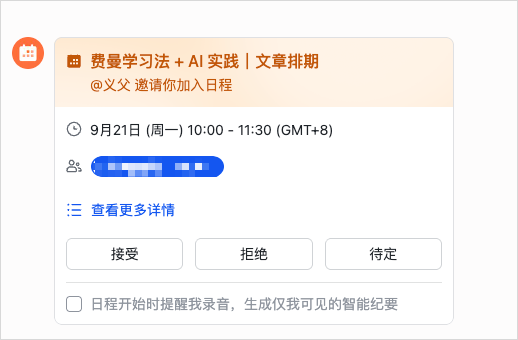
Considering everyone’s work distribution and existing schedule, it arranges who will do what and when, and adds the corresponding arrangements to the calendar.
Once confirmed, it can directly send meeting invites to the corresponding teammates.
With Doubao Work Partner, our workflow and collaboration have visibly changed because this is an agent that belongs to everyone, a colleague for all of us.
It can also schedule meetings based on everyone’s availability.
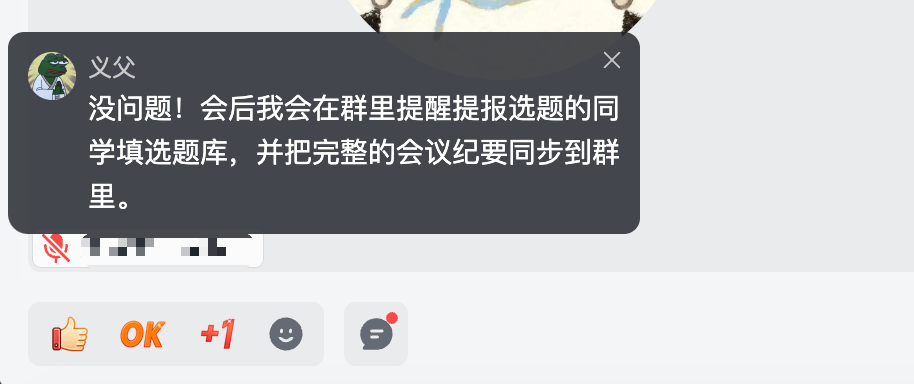
It can attend meetings with us...
This colleague will also have memories related to each colleague based on interactions.
Various permissions can also be configured for it.
There are incredibly many fun things and interesting scenarios that feel like they will be slowly discovered in the future.
All of Feishu's past accumulations in robotics, AI, and agents have converged into Doubao Work Partner.
This is one of the most interesting agents I have used for so long.
However, this is definitely not easy to accomplish, as agents, large models, and collaborative office work must cooperate deeply to provide a good process experience, and token consumption may also be substantial, but it is undoubtedly a trend for the future.
In fact, in the past, I have been pondering a proposition.
How should companies fundamentally change when AI truly enters an organization?
Because we all know that within a company, a lot of costs are often wasted on communication and collaboration.
For example, many annoying questions I hear: “Have you synced with A? Did A tell B? Does B know C has already made changes?”
And countless similar situations make me feel like killing someone.
In the past, when I was part of the internet middle class, truly, often a task that might only require two hours to complete would end up taking three days after dragging in ten people, holding three meetings, and sending hundreds of messages, while syncing back and forth.
So now, I strongly agree with one formula:
Team efficiency = total of everyone's individual efficiency, minus collaborative costs.
The past AI has been crazily enhancing only the first half, but the collaborative costs rely almost entirely on organizational management methodologies and the collaborative tools used.
But now, products like Doubao Work Partner seem to be starting to significantly reduce collaboration costs.
Yet, fundamentally, the core is still the outstanding infrastructure of Feishu.
As I mentioned earlier, this is also why I ultimately decided to migrate our company's internal work communication entirely to Feishu.
This is certainly just a small change.
But I also just want to make our company's work approach more oriented towards agents.
For organizations, they must fully embrace the infrastructure born for the future.
We have discussed AI's impact on individuals for three years.
Next, we should start talking about how AI will change companies.
This future is inevitably coming, and how we communicate internally, how we consolidate all our knowledge and experience, how we manage projects, how we organize data, and how we truly integrate agents into companies are things every organization must consider.
Although I have praised Feishu countless times in the past, I really don't want to repeat it.
But I still want to sincerely say one thing.
Believe me, companies should embrace AI.
Start with Feishu.
Just like what Xie Xin said at the end of the press conference:
“Give excellent tools to people, and they will create the extraordinary.”
免责声明:本文章仅代表作者个人观点,不代表本平台的立场和观点。本文章仅供信息分享,不构成对任何人的任何投资建议。用户与作者之间的任何争议,与本平台无关。如网页中刊载的文章或图片涉及侵权,请提供相关的权利证明和身份证明发送邮件到support@aicoin.com,本平台相关工作人员将会进行核查。


