The Federal Reserve and the Bank of Japan may raise interest rates together in the same week
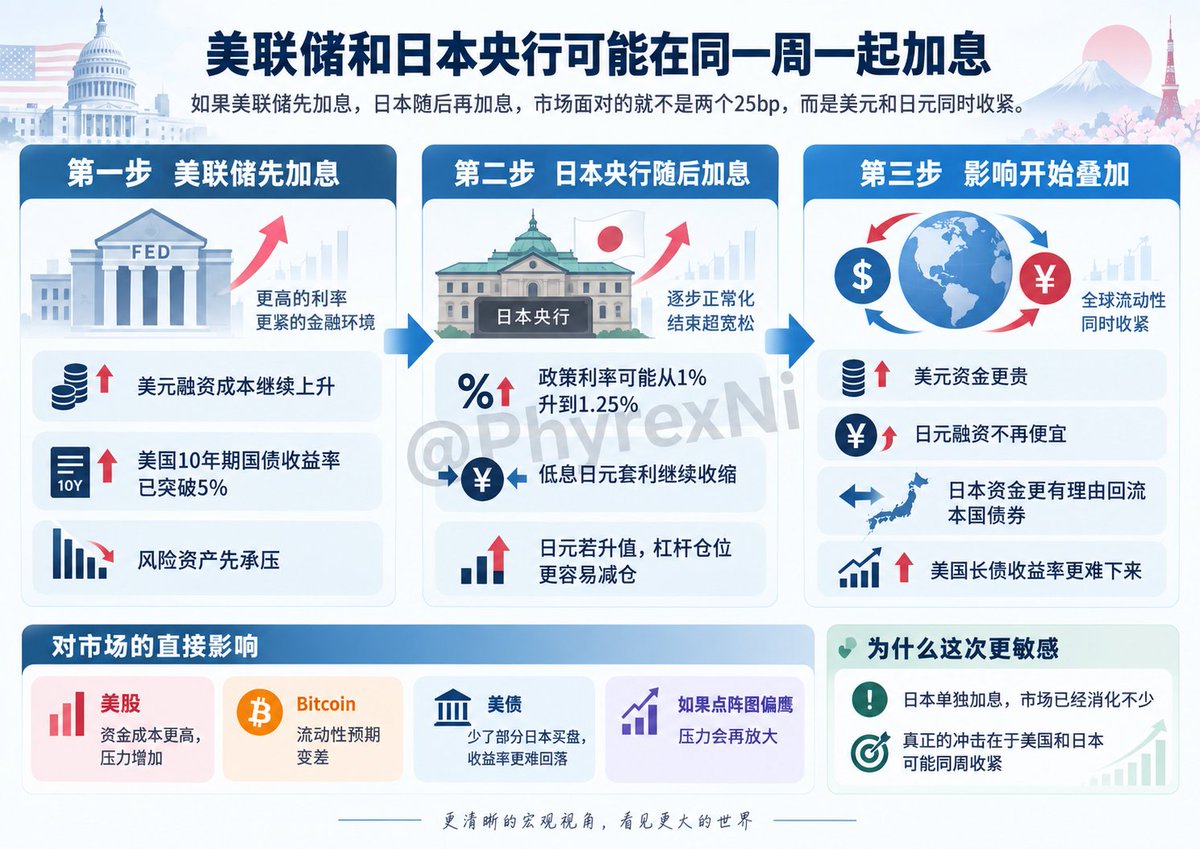
I previously wrote that the Bank of Japan's rate hike of 25 basis points in September has already been largely absorbed by the market. The yield on Japanese 10-year government bonds has already exceeded 3%, and the yen has also reflected part of the rate hike expectations in advance, so I don't think a single rate hike by Japan will bring a particularly large shock to the market. However, if the Federal Reserve raises rates first this week, and then the Bank of Japan raises rates from 1% to 1.25%, the impact on the market would be more severe.
After the Federal Reserve raises rates, the cost of dollar financing will continue to rise, and the yield on U.S. 10-year government bonds has now surpassed 5%. At this time, if Japan also raises rates, it means that the two most important funding currencies in the world have become more expensive at the same time. Borrowing money in dollars becomes more expensive, and the long-standing low-interest arbitrage with the yen will continue to shrink. Many institutions used to borrow low-interest yen to buy U.S. stocks, U.S. bonds, and other risk assets. Now that Japanese rates are increasing, if the yen appreciates further, these positions will not only face increased financing costs, but also begin to lose money on exchange rates, prompting highly leveraged funds to naturally choose to reduce positions.
Another impact is on Japan's own funds. In the past, domestic yields in Japan were too low, and a large amount of insurance, bank, and pension funds could only go overseas to seek yield. Now the yield on Japanese 10-year government bonds has surpassed 3%. If the Bank of Japan continues to raise rates, the attractiveness of domestic bonds will continue to increase, and there will be less necessity for Japanese funds to buy U.S. government bonds. Coincidentally, the U.S. now also needs to issue a large amount of debt. With a reduction in Japanese buying, it will be even harder for U.S. bond yields to come down.
Therefore, if the Federal Reserve raises rates first, followed by the Bank of Japan, the cost of dollar funding will become more expensive, yen arbitrage will shrink, Japanese funds will return, and U.S. long bond yields will remain high. These events will occur simultaneously. Especially since there is also the Fed's dot plot this week; if the dot plot is hawkish as well, it will really be uncomfortable.
@Gate Crypto, U.S. stocks, Hong Kong stocks, South Korean stocks, gold, CFD, one-stop trading in prediction markets
免责声明:本文章仅代表作者个人观点,不代表本平台的立场和观点。本文章仅供信息分享,不构成对任何人的任何投资建议。用户与作者之间的任何争议,与本平台无关。如网页中刊载的文章或图片涉及侵权,请提供相关的权利证明和身份证明发送邮件到support@aicoin.com,本平台相关工作人员将会进行核查。


