On September 15, 2026, the U.S. Senate will hold a key procedural vote on the Digital Asset Market Clarity Act (CLARITY Act, H.R. 3633) — a cloture vote. This requires at least 60 votes in support to formally bring the bill into debate on the floor. The Republicans currently hold 53 seats, meaning at least 7 Democratic or Independent votes are needed for support.
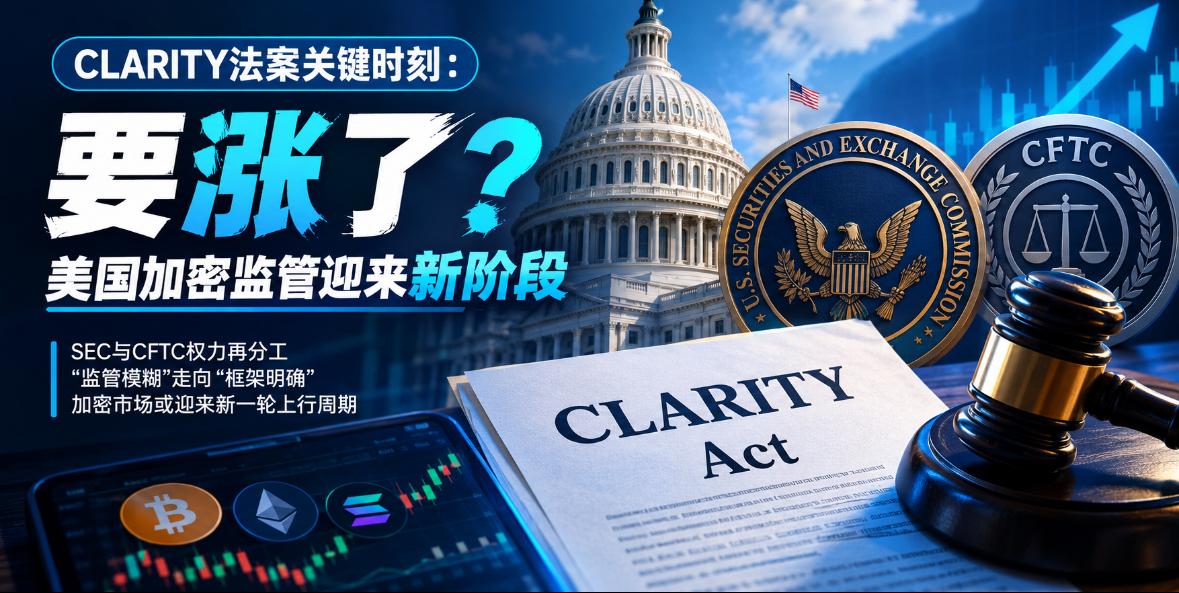
Less than 24 hours before the vote, Senate Democrats were still holding meetings to discuss the bill. This reflects that negotiations have not yet fully secured votes. On the Republican side, a so-called "final draft" was released late on the weekend, claiming that 126 substantial amendments proposed by Democrats had been incorporated. Trump himself has also generally accepted the strengthened ethical provisions (about 80% of the content of the Tillis-Gallego proposal). This series of actions has pushed this legislative tug-of-war, ongoing for more than a year, to a climax.
1. The Long Journey from "Regulatory Ambiguity" to "Infrastructure Legislation"
The core goal of the CLARITY Act is to end the long-standing jurisdictional dispute between the SEC and CFTC. It seeks to clearly define which digital assets are considered "digital commodities" (regulated by the CFTC in the spot market) and which still fall under the category of investment contracts/securities (under SEC jurisdiction); it also aims to establish a registration framework and customer protection for exchanges, brokers, and market makers, while providing a safe harbor for truly decentralized developers.
The bill passed the House back in July 2025 with a bipartisan advantage of 294-134. After being approved by the Senate Banking Committee in May 2026 with a vote of 15-9, it fell into a prolonged stalemate in the Senate due to issues surrounding ethical provisions, stablecoin yields, the range of protections for DeFi developers, and concerns about bank deposit outflow. Now in September 2026, the focus of negotiations has completely shifted from "whether to regulate cryptocurrency" to "what kind of guardrails should be used to incorporate it into the U.S. financial system." As some observers have pointed out, U.S. cryptocurrency policy has progressed through the stages of resistance → ambiguity → open support → the need for regulation in a new industry. After CLARITY, cryptocurrency is likely to officially become part of the U.S. financial infrastructure.
2. Key Compromises in the Final Draft and Remaining Fractures
The core concessions in the latest text focus on several long-standing sticking points:
- Strengthened Ethical Provisions: Requires federal officials with significant crypto interests (including the President, Vice President, lawmakers, judges, and their spouses) to divest or place assets into qualified blind trusts; grants state attorneys general a certain law enforcement role; removes some previous sunset clauses. Trump's acceptance is seen as a significant breakthrough, given that he and his family have significant interests in cryptocurrency.
- Stablecoin Yield Restrictions: Grants the Secretary of the Treasury "circuit breaker" authority — if payment stablecoins result in mass deposit outflows from community banks, passive earning can be temporarily restricted. This is a significant response to banking lobbyists.
- Narrower Developer Protections: Modifications were made to the language related to the Blockchain Regulatory Certainty Act, protecting non-custodial developers while addressing enforcement concerns over illegal financing.
- Intermediary and Consumer Protection: Strengthened rules on related-party transactions and conflicts of interest, clarifying the applicability of state consumer protection laws.
Republicans have called this the "genuine bipartisan text." However, there are still voices within the Democratic Party expressing concerns that the ethical provisions are "not stringent enough," and that there are still gaps regarding enforcement, illegal financing prevention, and details of stablecoins. At the same time, attorneys general from 18 states have jointly expressed concerns about weakening state-level regulation. This is the reason for the ongoing "bill discussions" on the eve of the vote: one possibility is a genuine effort to exchange the bill for a vote on cloture first, with amendments later; another possibility is using the bill as an excuse for vetoing. A couple of votes short could cause the bill to stall again.
3. Market and Industry Impact of Passage or Failure
If cloture succeeds and it eventually becomes law, the U.S. will have a relatively complete set of digital asset market structure regulations for the first time. This will significantly reduce compliance uncertainty, attract more institutional capital and developer returns, and enhance the global competitiveness of U.S. dollar stablecoins and trading infrastructure. With clearer boundaries between the SEC and CFTC, the model of "regulation through enforcement" will significantly decrease, allowing project teams to plan products and fundraising with more confidence. Conversely, if the vote fails by a narrow margin today, market sentiment may pressure in the short term, but the broader direction will not reverse. The White House has made it clear: even if Congress fails, the SEC and CFTC will still utilize their regulatory authority to advance the framework. The status of cryptocurrency as a fundamental U.S. national policy has largely been established — the U.S. needs cryptocurrency, rather than the other way around.
Regardless of the outcome, this legislative process has already sent a strong signal: the debate's focus is no longer "should cryptocurrency exist," but rather "how to set up guardrails to ensure it healthily becomes part of financial infrastructure."
4. Long-term Perspective: The Real Winners After Regulatory Clarity
The true beneficiaries will be those already operating within the compliance boundaries, using technology to solve trust and efficiency issues in infrastructure. As rules become clearer, capital will accelerate towards protocols that genuinely possess performance, transparency, and decentralization.
In this process, Hyperliquid is showcasing a remarkable leading edge. It is built on a self-developed high-performance Layer 1, achieving a fully on-chain order book, sub-second finality, and zero gas trading experience while maintaining user asset self-custody. Daily trading volume consistently ranks among the top in the decentralized perpetual contract market, with open interest and fee income steadily rising, gradually expanding into broader financial scenarios such as commodities, stocks, and prediction markets.
Hyperliquid has not relied on traditional VC large-scale financing but has built momentum through community airdrops and the capture of actual trading value. In an era of gradually clarifying regulations, this architecture, which combines CEX-level performance with the core spirit of DeFi, aligns precisely with the future needs of institutions and retail participants for "trustworthy, efficient, borderless" trading venues. It is not only one of the strongest perpetual DEXs currently but also has the potential to become the core liquidity layer of on-chain finance.
It can be said that Hyperliquid represents the true future direction of the cryptocurrency space — not merely a trading venue but a high-performance, transparent, scalable decentralized financial infrastructure. As CLARITY clears the rules fog for the industry, projects like Hyperliquid, which are already ahead, will be the first to attract institutional-level funding and global liquidity.
Today's vote, regardless of the outcome, is merely a checkpoint in a long race. The real competition lies in who can continuously deliver reliable technology and user experience after the rules are established. Hyperliquid stands at the forefront of this new phase.
Exclusive Benefits for AiCoin Users
👉 Enter the invitation code AICOIN88 when binding your Hyperliquid account to enjoy a 4% fee rebate.
🔗 Exclusive registration link:
https://app.hyperliquid.xyz/join/AICOIN88
📖 Beginner Tutorial:
- "AiCoin PC Hyperliquid Authorization Trading Tutorial":
https://www.aicoin.com/zh-Hans/article/514197
- "AiCoin Mobile Hyperliquid Authorization Trading Tutorial":
https://www.aicoin.com/zh-Hans/article/541383
- "Beginner's Guide! Hyperliquid First Trading Super Detailed Illustrated Tutorial":
https://www.aicoin.com/zh-Hans/article/510225
📖 Community Communication:
- Telegram:
- Discord:
- AiCoin Group Chat:
https://www.aicoin.com/link/chat?cid=N6OVMor5g
The content of this article represents the author's personal views and does not reflect the platform's stance. The views, conclusions, and suggestions in the article are for investors' reference only and do not constitute any investment advice related to this platform. Investing in U.S. stocks still requires assuming market risks, regulatory risks, and local legal compliance risks (especially foreign exchange controls, overseas investment declarations, etc.).
免责声明:本文章仅代表作者个人观点,不代表本平台的立场和观点。本文章仅供信息分享,不构成对任何人的任何投资建议。用户与作者之间的任何争议,与本平台无关。如网页中刊载的文章或图片涉及侵权,请提供相关的权利证明和身份证明发送邮件到support@aicoin.com,本平台相关工作人员将会进行核查。