Written by: Gandalf, Techub News

Introduction
September 14, 2026 — The United States Senate is about to hold a key procedural vote on the Digital Asset Market CLARITY Act (hereinafter referred to as "CLARITY Act"). During the final round of negotiations, ethical restrictions concerning the participation of senior government officials and their affiliates in crypto-related businesses have become the focal point for determining whether the bill can garner bipartisan support.
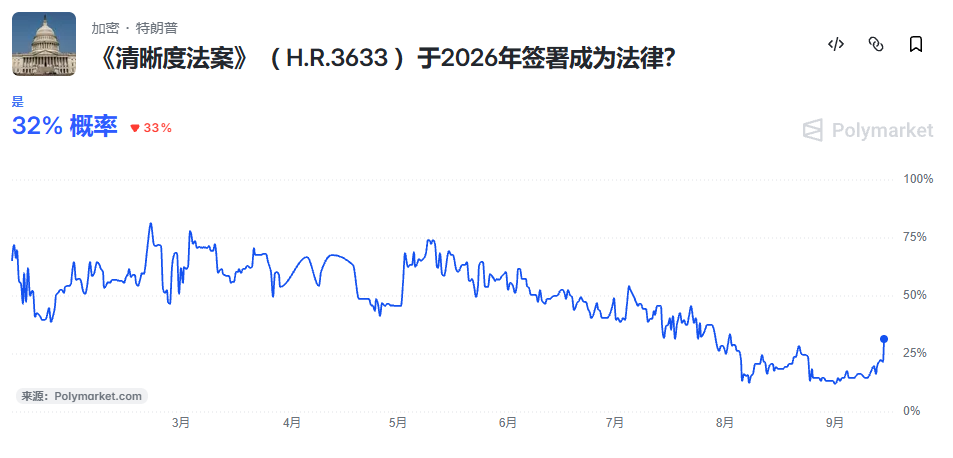
The latest revised text reportedly includes adjustments related to ethical rules, stablecoin operations, and developer responsibilities. The market has consequently raised its expectations for the bill becoming law within the year: as of publication, predictions on Polymarket regarding whether the "CLARITY Act will become law in 2026" showed an implied probability of about 32% on September 14.
However, the vote before the Senate is not the final vote. Even if the procedural motion passes, the CLARITY Act still needs to go through Senate debates, amendments, and final approval, as well as coordination with the House of Representatives, before it could be sent to the President for signing. For the legislative process, September 15 is a critical entry point rather than an endpoint.
Core Summary
- The U.S. Senate will hold a key procedural vote on the Digital Asset Market CLARITY Act (CLARITY Act) on September 15, which will determine whether the bill can advance to formal discussions; this is not a final approval vote, nor does it mean the bill has become law.
- The primary political hurdle in advancing the bill revolves around the ethics and conflicts of interest concerning the President and senior officials’ involvement or benefits from crypto projects. Reports indicate that Trump has discussed related compromise proposals with advisors, but the final text, scope, and enforcement mechanisms still need formal confirmation.
- The amendment negotiations also cover several substantial issues: stablecoin yield arrangements and their impact on community bank deposits, compliance responsibilities of decentralized protocols and developers, vertical integration of trading platforms, and the division of regulatory authority between the SEC and CFTC.
- Polymarket's predictions for the bill becoming law within 2026 rose to about 32% on September 14, reflecting traders' improved expectations for negotiation progress; however, this probability is not a prediction of Senate votes, nor does it equate to the bill having the conditions to pass.
- Even if the procedural vote is successful, the bill must go through Senate amendments and final votes, coordination with the House version, passage by both chambers, and presidential signing. Therefore, the CLARITY Act is at an important turning point, but there is still significant uncertainty about actual legislation.
- For the crypto market, if the bill progresses, it is expected to bring a clearer federal regulatory framework and reduce long-term policy uncertainty; however, stricter registration, disclosure, anti-money laundering, and conflict of interest rules may also increase compliance costs for trading platforms, stablecoin issuers, and some decentralized projects.
The Procedural Vote Determines Whether the Bill Can Enter Discussion
The Senate is expected to handle the procedural motion to advance the CLARITY Act on September 15. The core of this step is to determine whether the Senate can formally enter into the bill's discussion and subsequent debate procedures; under the current political landscape, supporters typically need to secure 60 votes to overcome the obstruction threshold.
This distinction directly affects the market's interpretation of the news. If the procedural motion passes, it does not mean the bill has received final approval from the Senate; if the procedural motion fails, it does not necessarily mean the topic is completely over; negotiations may continue around the text, voting arrangements, and bipartisan support.
Therefore, labeling this week's vote as "the CLARITY Act will pass" is not precise. A more accurate statement is: the Senate will test whether the bill has enough political support to enter formal legislative deliberation.
Ethical Provisions Become the Core of Negotiations
The CLARITY Act originally focused primarily on the regulatory structure of the U.S. digital asset market, including the jurisdictional boundaries of the Securities and Exchange Commission (SEC) and the Commodity Futures Trading Commission (CFTC), the obligations of digital asset trading platforms, the classification of tokens, and compliance issues related to stablecoins and decentralized finance businesses.
However, as the vote approaches, the negotiations have expanded to include potential conflicts of interest arising from government officials' participation in or benefits from digital asset projects. Democratic legislators demand that any legislation aimed at advancing a crypto market regulatory framework also respond to the financial interests, promotional activities, and related transactional risks of the President, Vice President, and senior officials in the digital asset sector.
Reports indicate that Trump has discussed how to handle relevant ethical language with advisors. Updated texts introduced by Senate Republicans are also described as containing ethical proposals approved by Trump. However, as of the time of publication, which specific restrictions will be included in the final voteable version, which individuals and affiliated entities are covered, how enforcement will occur, and what consequences will apply for violations still need to be based on formally published bill texts and congressional procedures.
This is also why the bill's future remains unclear. Industry supporters hope that clearer federal regulatory rules can reduce long-term uncertainty; Democrats are concerned that if there are no enforceable and adequately comprehensive conflict of interest constraints, the legislation may provide certainty for the industry while amplifying regulatory risks associated with officials and their related business interests.
The Revised Text Tries to Balance Banks and the Crypto Industry
Public reports show that recent revision discussions not only involve ethical issues but also touch on long-standing areas of disagreement between traditional financial institutions and crypto platforms.
First, stablecoin yield arrangements remain one of the points of contention. Banking groups are concerned that stablecoin issuers or trading platforms attracting customers through yields, rewards, or similar interest accrual mechanisms might encourage deposits to flow from community banks to digital asset platforms, thereby weakening local credit supply. The crypto industry believes that overly strict restrictions could undermine the competitiveness and innovative capacity of dollar stablecoins.
Second, the updated text reportedly introduces protective arrangements against potential deposit outflows. The policy goal of such provisions is to reserve tools for the Treasury Department or relevant regulatory bodies to respond to systemic risks amid the rapid expansion of the stablecoin market. For banks, this can be seen as a risk buffer; for the industry, it means an expansion of the space for regulatory intervention.
Third, the scope of developer protections is also being narrowed. Provisions under discussion reportedly will limit relevant protections more explicitly to the Bank Secrecy Act and certain civil enforcement issues, rather than providing blanket exemptions for all potential criminal liability. This move aims to address concerns regarding enforcement and anti-money laundering but may lead decentralized finance and open-source software developers to remain cautious about compliance boundaries.
Furthermore, the bill is also addressing issues related to the vertical integration of trading platforms, related party transactions, and conflicts of interest. Such provisions involve whether exchanges, brokers, custodians, and token issuers can simultaneously undertake multiple roles, representing one of the most technical aspects of U.S. crypto market structure regulation that is likely to impact business models.
Prediction Market Raises Probability of Legislation This Year
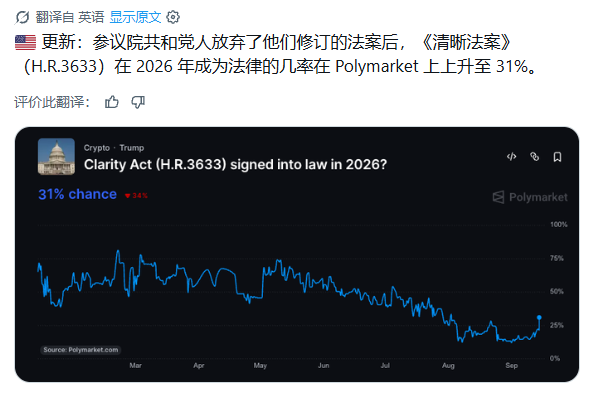
After new developments in political negotiations, the prediction market reacted quickly. Polymarket's related contracts are settled on whether the bill becomes law before December 31, 2026. On September 14, several media outlets recorded the "yes" price for this prediction at about 30% to 31%.
This quote reflects participants' probability judgment regarding the complete legislative path, rather than an immediate vote count for any one Senate vote. To meet the "becomes law" settlement standard, the bill still needs to pass in both houses of Congress, resolve differences between versions, and obtain presidential signing.
For market participants, prediction markets have informational value but should not be seen as polling, formal vote counts, or definitive conclusions. Prices may change rapidly with the release of texts, statements by legislators, media coverage, and trading liquidity. Even with contract prices rising to about 30%, it means traders still generally believe that the possibility of the bill not becoming law within the year is higher than the possibility of successful legislation.
The Market is Waiting for Not Just a Vote, But a Set of Rules
What the CLARITY Act carries is not merely a short-term forecast for cryptocurrency market conditions. If the bill can advance, it could provide a more systematic federal regulatory framework for token issuance, trading, custody, decentralized finance, and the digital goods market, while further clarifying the regulatory boundaries between the SEC and CFTC.
This is also why the crypto industry continues to lobby Congress: businesses hope to reduce compliance costs and enforcement uncertainties arising from inconsistent rules among different regulatory agencies, state governments, and courts. Traditional financial institutions are concerned about whether the new framework will change the competitive relationship between deposits, payments, custody, and capital market operations.
However, regulatory clarification does not necessarily equate to "comprehensive benefits." Stricter requirements for registration, disclosure, market surveillance, anti-money laundering, consumer protection, and conflict of interest management may increase the operational costs for trading platforms, token projects, and stablecoin issuers. Some business arrangements that rely on regulatory gray areas may face shrinkage once the rules are implemented.
Therefore, the real significance of this vote does not lie in whether it can immediately trigger an increase in a certain asset, but in whether the U.S. Congress can establish an executable balance for innovation, investor protection, banking system stability, and public ethics as the crypto market has deeply integrated into the financial system.
What to Focus on Next
In the coming days, the following signals will determine whether the CLARITY Act enters substantive deliberation or falls back into a negotiating deadlock:
- Whether the Senate procedural motion can reach the required votes to advance discussions;
- Whether the final ethical provisions can be publicly disclosed in a complete, verifiable text;
- Whether key Democratic and independent senators publicly support it;
- Whether a reasonable compromise can be formed regarding stablecoin yields, developer responsibilities, trading platform integrations, and the division of regulatory authority;
- Whether the House and Senate can retain political space for subsequent coordination.
As of now, the negotiations on the CLARITY Act are closer to a real voting test than they were months ago, but there are still multiple procedural and political hurdles before it becomes law. Market optimism has rebounded; whether Congress can translate this sentiment into a bipartisan majority remains to be seen in the legislative process on September 15 and beyond.
Editor's Note
This article views prediction market prices as real-time market pricing, not as legislative vote counting or definitive conclusions; concerning the provisions of the bill, voting procedures, and final ethical arrangements, the official documents of the U.S. Congress, Senate schedules, and publicly published bill texts shall be the final basis, and this article does not constitute any investment advice.
免责声明:本文章仅代表作者个人观点,不代表本平台的立场和观点。本文章仅供信息分享,不构成对任何人的任何投资建议。用户与作者之间的任何争议,与本平台无关。如网页中刊载的文章或图片涉及侵权,请提供相关的权利证明和身份证明发送邮件到support@aicoin.com,本平台相关工作人员将会进行核查。


