
Author|Zhou Yi Xiao
WeChat|smiletalker
A month ago, in the article "In-depth|Foreign Guest Genspark", we referred to Genspark as an AI Costco:
GPT, Claude, Gemini, whichever one has better products, they will procure from that supplier, and then sell to users through model routing and Agent packaging. Even the origin of the models was treated with some differentiation. OpenAI and Anthropic were placed right in the center of the shelves, while some Chinese open-source models were hidden less conspicuously.
A month later, this Costco has started selling its own brand.
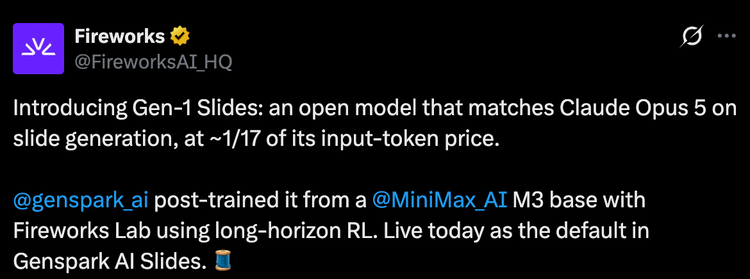
Like Costco's Kirkland, owning a brand does not mean doing everything from raising cattle to growing wheat by themselves. Genspark recently launched the PPT production-specific model Gen-1 Slides, based on MiniMax M3, with participation from Fireworks AI in training. Genspark is responsible for providing the PPT tasks and operational environment for the product and establishing criteria for evaluating PPT quality.
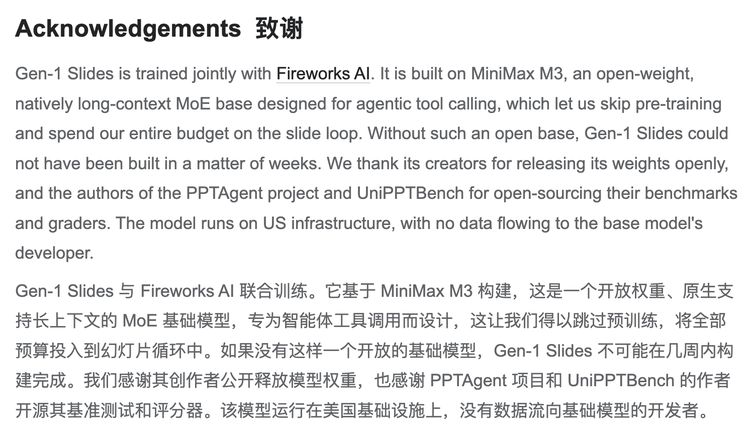
This time, there is a noteworthy difference: MiniMax M3 is clearly written on the front of the packaging and mentioned in the official acknowledgments.
Gen-1 Slides is a dedicated model developed by Genspark based on the open-source base of MiniMax M3, through post-training. Post-training simply means continuing to train around one’s tasks on a base that already has considerable capability, without needing to retrain a general large model from scratch. Gen-1 ultimately utilized about 2000 internal structured Slides tasks for reinforcement learning.
According to data released by Genspark, after post-training, Gen-1's overall performance on PPT tasks has reached a level comparable to Opus 5. In 200 real PPT tasks, Gen-1 achieved a comprehensive score of 0.821, while Claude Opus 5 scored 0.810; the average model invocation cost to complete one PPT was $0.44 and $4.16 respectively. In the 1.57 million production tasks performed post-launch, the average user ratings for both were 4.25 and 4.23 respectively.
However, these numbers should not simply be interpreted as Gen-1 surpassing Opus. In Genspark's own evaluation, Opus still scored higher in task completion and content quality, with Gen-1's advantages mainly stemming from visual design. However, there is another issue with this internal evaluation: the grader also participated in the reinforcement learning training, so its scoring is not entirely independent. To further validate the results, Genspark conducted cross-tests using two public academic assessments, PPTEval and UniPPTEval, which did not participate in training, and Gen-1 achieved first place in eight out of nine combinations.
For ordinary users, the most intuitive change is that Gen-1 has entered the Standard mode of Genspark Slides and has become the default model, with prices unchanged.
For a company that has historically excelled in procurement and model integration, Genspark is not looking to shift towards building its own models. It still heavily relies on external models and training infrastructure; it has simply pushed this capability a layer deeper into the model weights compared to the past when it mainly composed APIs. Costco is still the same Costco, but there are now some own brands appearing on the shelves.

1
AI Applications Are No Longer Satisfied with Renting Models
For AI application companies like Genspark, continuously calling the strongest model is the easiest option. Model upgrades are simply accompanied by API changes; if one falls behind, the task routing is redirected to another company. Genspark originally built its foundation on such capabilities.
However, when a task is repeated frequently on a daily basis, merely calling the strongest model may not be the best choice anymore. According to official data, Genspark generates up to 120,000 PPTs in a single day. PPTs are far more complex than Q&A; the model needs to search for information, organize structure, generate pages, render, check, and then iterate based on results.
Genspark's CTO, Zhu Kaihua, previously broke down the use of internal models into three layers. Repetitive and clear tasks are prioritized for cheaper models, tasks suited for special optimization are reinforced through fine-tuning, and only a few nodes needing stronger reasoning capabilities invoke frontier models. According to his summary, tasks that are high-frequency, repetitive, and well-defined, while having clear quality standards, are best suited for specialized training.
Claude is still very strong, but the ability advantage of general models does not necessarily lead to the best vertical product experience. While model companies need to cover a wide range of tasks, application companies can repeatedly observe the same types of tasks. This enables them to identify where models fail at specific points and which results will be accepted or require rework by users.
A common path for vertical AI startups is to train dedicated models around special data. However, now application companies don’t necessarily need to start training models from scratch. Stronger open-source base models have already provided general capabilities. The company’s task has become to continue training around specific scenarios, incorporating its own data, evaluation standards, and workflows into the model.
In the Agent era, "application companies owning user data" has become more specific. A task can leave a complete execution trace, including what requirements the user proposed, which tools the model invoked, where errors occurred, and the final delivery results. These traces can help teams identify recurring errors, and then decide whether to adjust workflows or alter model behaviors through training.
1
What Type of Base Model is Suitable as a Training Foundation
Harvey used Qwen to conduct reinforcement learning experiments for legal Agents, and Heidi Health trained clinical models using open-source models. The bases chosen by different companies vary, along with their considerations. For AI application companies, what is needed may not be a model that ranks first on all lists. A base with strong enough general capability that is easy to continue training may be better suited as a foundation for ongoing product development.
In the context of the specific task of PPT, Genspark’s focus on the capabilities of MiniMax M3 is also quite clear. M3 supports long contexts on the order of millions of tokens, is natively multimodal, and is designed to accommodate Agent tool invocations. Slides happen to be a type of long trajectory task where the model needs to keep switching between text, visuals, and tools to complete searching, generating, rendering, checking, and modifying.
In Genspark's official blog post about Gen-1 Slides, it mentions that because of the open-source base like M3, it could skip pre-training and concentrate resources on the iterative optimization of Slides, completing Gen-1 within weeks. This means that M3 moved the starting line for training a dedicated PPT model directly to the last few kilometers.
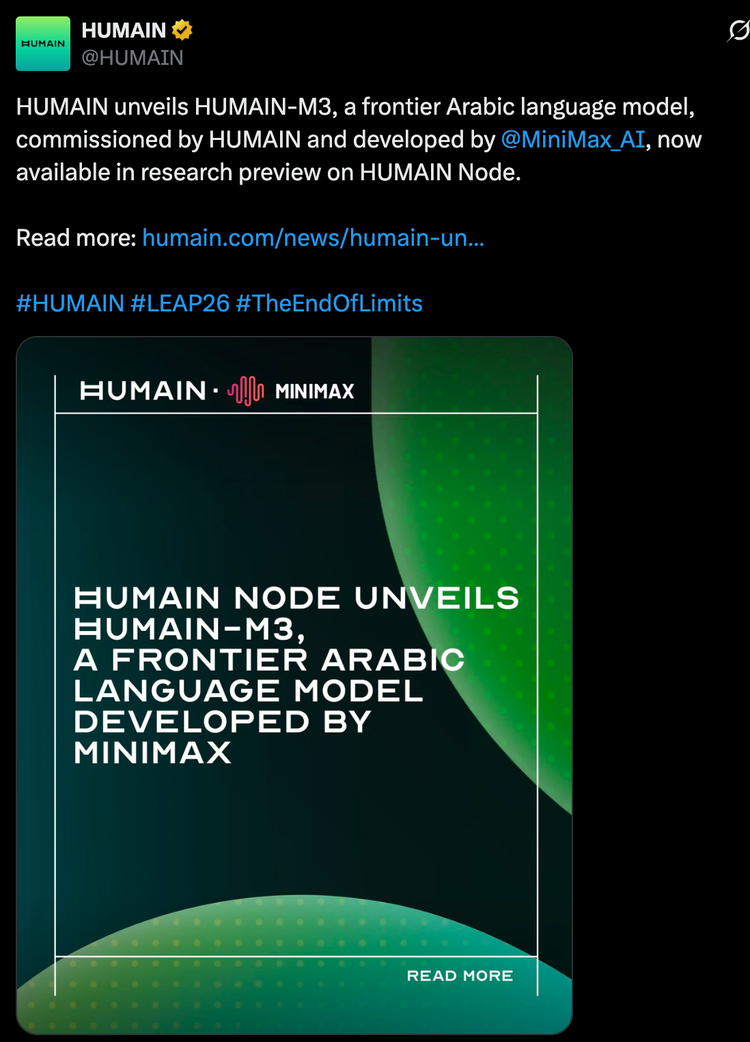
Besides post-training for specific products, another route is to continue pre-training on base models. The Saudi AI company HUMAIN launched humain-m3, also based on MiniMax M3, and further strengthened Arabic language capabilities through over one trillion Arabic-native tokens of additional pre-training. It follows a different technical route from Genspark, with a commonality in regarding M3 as the starting point for further training.
1
Model Post-Training Becomes a Service
AI Coding is one of the earlier applications to incorporate post-training into products. Cursor developed Composer through continuous pre-training and reinforcement learning, and legal AI company Harvey, as well as healthcare AI company Heidi Health, have also begun to include post-training in product development. The tasks handled by these companies vary greatly, but they share common traits, such as being high-frequency and relatively stable, and it is also easier to assess the quality of completed work.
Behind these cases is the company Fireworks. As a platform providing model training and inference infrastructure, Fireworks has lowered the barrier for application companies to enter the model layer. Application companies do not need to establish a complete model training system themselves. Taking Gen-1 as an example, Genspark defines PPT quality standards and training objectives, while Fireworks contributes to algorithm optimization and training engineering, conducting over 100 experiments with some training trajectories exceeding 100,000 tokens.
This work goes far beyond just providing a batch of training data. In Gen-1's training, the model quickly learned to leverage the grader’s scoring rules; at times, it would enhance visual scores while simultaneously lowering task completion quality. More specific examples include the model claiming that information had been verified when it actually had not, or reducing font sizes to evade layout overflow checks. Genspark and Fireworks can only continuously review training trajectories and adjust rewards and graders.
To reduce the obvious AI flavor in the PPTs, the team also added a dedicated discriminator. After backtesting with the final version, the proportion judged to be AI-generated dropped from 74.9% to 41.7%.
At this point, the advantages in the application companies’ hands are not just user data. They also need to discern what constitutes good in their product, how to evaluate it, and how to rein in the model when it starts to cater to the scoring system.
1
Not All AI Applications Should Conduct Post-Training
The strengthening of open-source base models, the gradual stabilization of Agent workflows, along with reduced training thresholds, have made post-training a more realistic product route. However, these conditions do not mean that all AI applications should engage in post-training.
Manus made an alternative choice early on. During the project's initiation, the team seriously discussed whether to train an end-to-end Agent based on an open-source model, ultimately deciding to focus their main energy on context engineering. Manus co-founder and chief scientist Ji Yichao believed at the time that for rapidly changing applications, particularly those that have not yet found Product-Market Fit (PMF), a training iteration every few weeks could not keep up with product changes, and advancements in the underlying models could quickly devalue existing training.
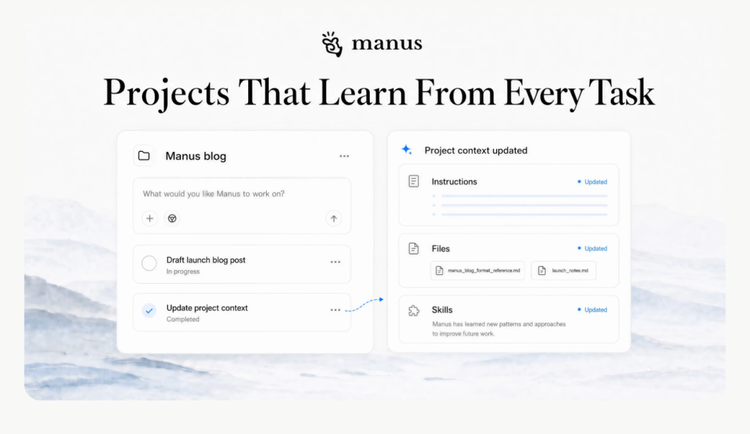
From Manus's subsequent public product route, it currently still places significant improvements on the Agent architecture, context, tools, and workflows. The Projects That Learn From Every Task launched this year is also about writing back reusable experiences from a task into instructions, files, and skills, without touching the model weights.
In contrast, scenarios like Slides now have relatively mature workflows. They involve large-scale tasks, stable product forms, and clear delivery quality standards, making the choice to train long-accumulated experiences into the model yield clearer benefits.
The differing choices of Genspark and Manus illustrate that post-training has its own applicable boundaries. Agents that are still in a phase of rapid trial and error are better suited to upgrade alongside base models, continuing to optimize context and execution frameworks; while vertical applications that have formed stable workflows are more primed to optimize at the model parameter level.
However, a well-trained model itself can be difficult to serve as a long-term barrier. When stronger base models emerge, application companies may need to retrain. In comparison to a specific model version, having a transferable evaluation system and training process has greater value.
1
Open-Source Models Begin Selling Trainability
The trainability mentioned here first must be possible to train. The fundamental questions are whether the model weights and license allow for further training, whether SFT, preference optimization, and reinforcement learning can be executed directly, and whether the current training platform supports this model, as these factors all influence whether an application company can actually implement post-training. Fireworks’ training products directly list the training methods, context lengths, and specifications supported by different base models.
The capabilities of the base model itself must also be strong enough. No matter how open a model is, if its general capabilities are too weak or diverge significantly from the business needs, post-training will be challenging to make up for. The needed capability combinations vary across legal, code, and PPT contexts, influencing the selection criteria for application companies.
After training, consideration must also be given to whether it can be effectively integrated into products long-term. Model size, throughput, latency, inference costs, as well as the maturity of deployment and training infrastructure will all affect whether the overall solution is cost-effective. When Harvey conducts post-training in legal scenarios, they even factor token consumption into rewards, enhancing task performance while controlling inference costs.
Ultimately, trainability comes down to three questions: Can it be trained? Is it worth training? After training, can it be afforded?
Closed-source model companies are also vying for this part of the demand. OpenAI has already offered capabilities like reinforcement fine-tuning, so choices for application companies will not simply reduce to either open-source or closed-source. For open-source models, besides directly providing capabilities, their ability to serve as a good starting point for training is also beginning to influence downstream choices.
The extent to which a model can be directly invoked by numerous products represents one scale, while its potential to become a training foundation for many products could represent another.
免责声明:本文章仅代表作者个人观点,不代表本平台的立场和观点。本文章仅供信息分享,不构成对任何人的任何投资建议。用户与作者之间的任何争议,与本平台无关。如网页中刊载的文章或图片涉及侵权,请提供相关的权利证明和身份证明发送邮件到support@aicoin.com,本平台相关工作人员将会进行核查。


