The hype around Apple's autumn launch event was significant, but the market reaction was not particularly excited.
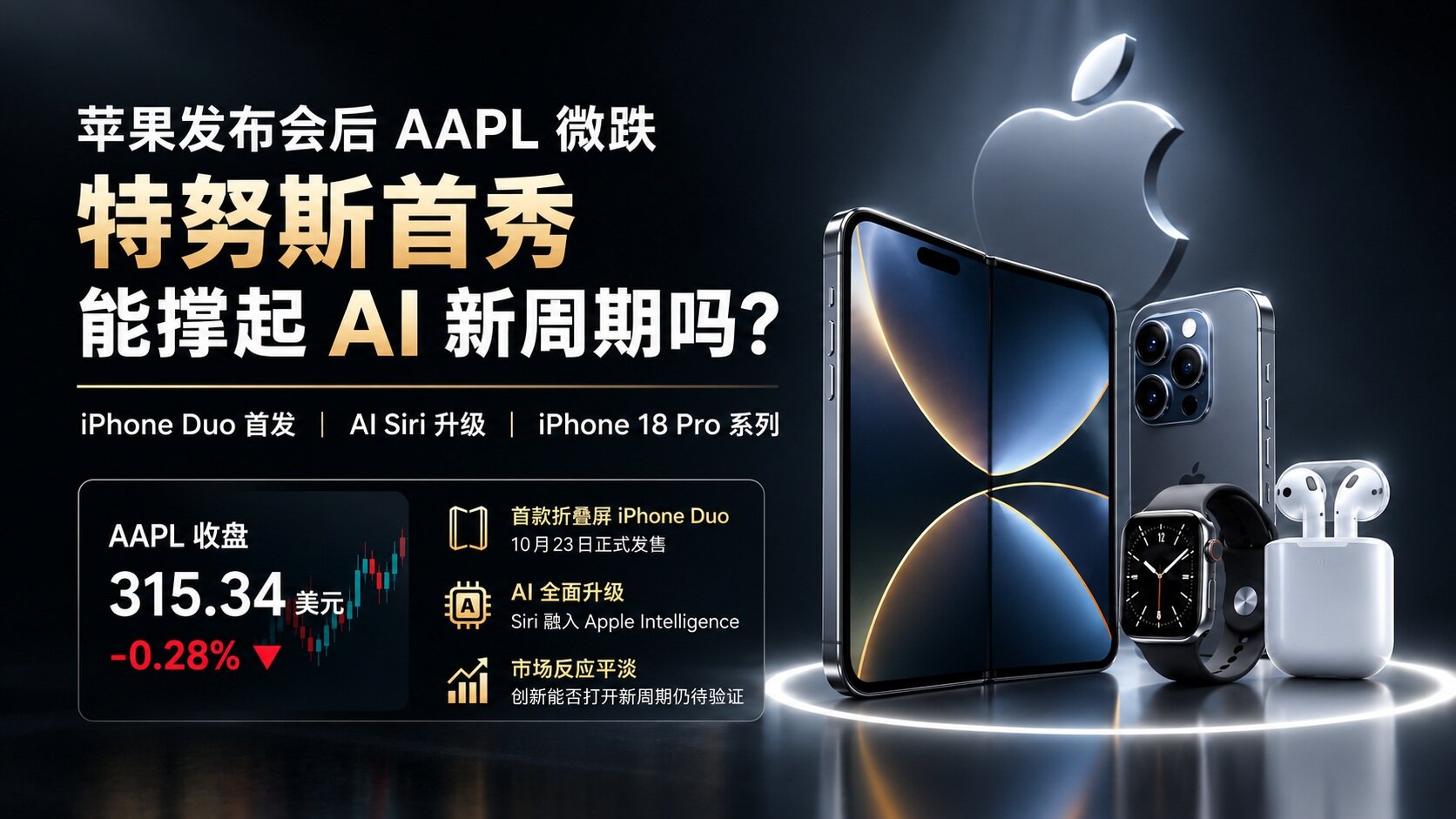
On September 9, Apple unveiled its first foldable smartphone, the iPhone Duo, alongside the iPhone 18 Pro, iPhone 18 Pro Max, Apple Watch Series 12, and AirPods 5. The event was not conservative; the foldable iPhone marks Apple's first foray into a brand new hardware category in many years.
However, the stock price reaction was not as enthusiastic as the new product launch. BiyaPay's data shows that AAPL closed at $315.34 that day, down 0.28%.
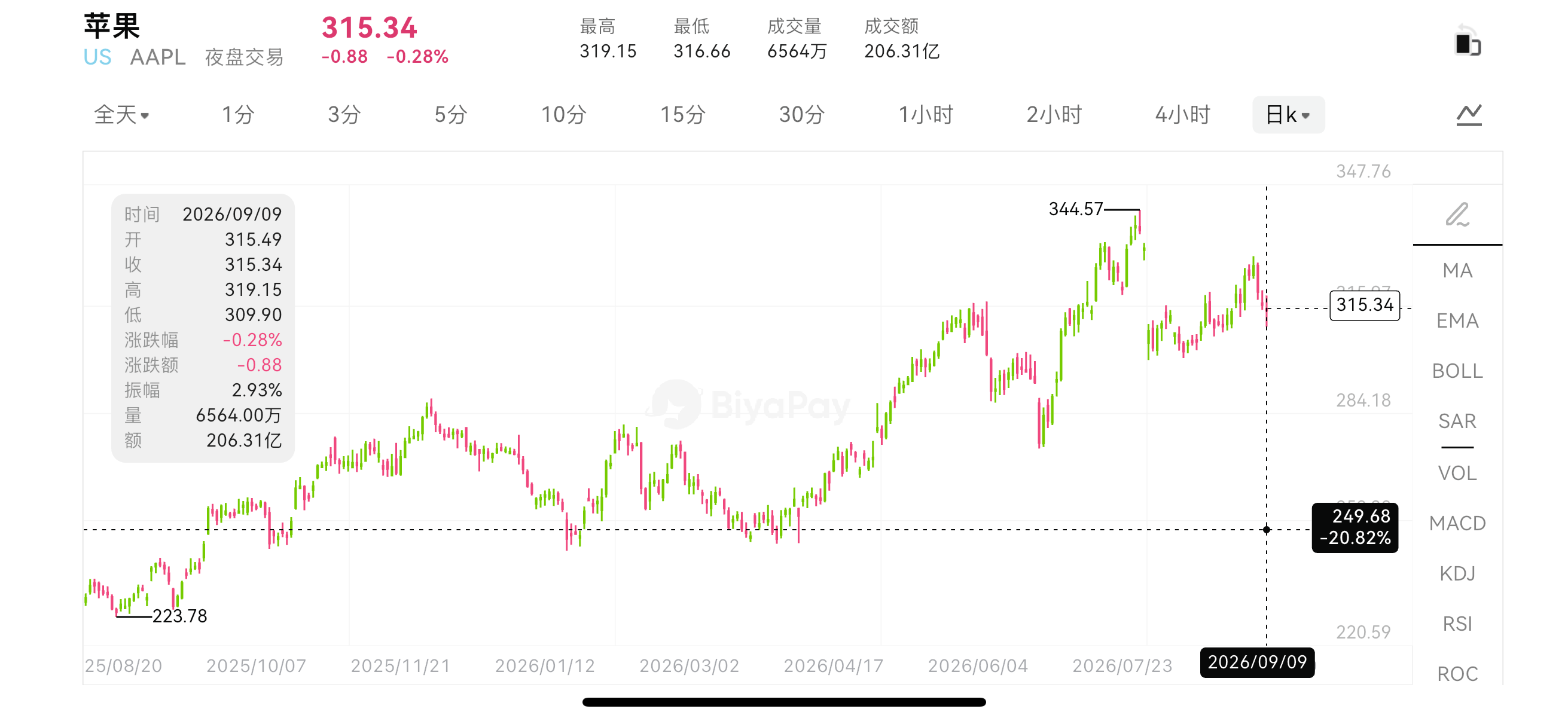
This is quite interesting.
If we only focus on the launch, Apple finally introduced a foldable screen, addressing a product form that has been debated externally for years. If we look at the stock price, the market clearly is not in a hurry to give it a higher valuation. The reason is not complicated. Apple is not facing the question of "whether there are new products," but whether the new products can initiate a new upgrade cycle, whether AI can genuinely enhance user experience, and whether Tenus can prove that Apple's next phase is not just a continuation of Cook's supply chain and service income era but a re-entry into a product innovation cycle.
When I watch this kind of launch event, I don’t just focus on AAPL alone. In the BiyaPay app, I can simultaneously view the market trends of AAPL, other US tech stocks, Hong Kong consumer electronics supply chains, as well as assets like BTC and ETH. As a global one-stop asset allocation platform, BiyaPay covers multiple asset scenarios including digital assets, US stocks, Hong Kong stocks, and fiat currency exchange. For information-intensive markets surrounding launch events, closely observing price reactions across different markets makes it easier to discern whether capital is trading on new product expectations, AI narratives, or changes in overall risk appetite.
Tenus' debut: the market is not just looking at presence
The focus of this launch event was not primarily the iPhone, but rather the person presenting it.
After Tenus took over from Cook, Apple entered a new narrative phase. Under Cook's era, Apple's strengths lay in supply chain, profit margins, inventory management, service ecosystem, and shareholder returns. Apple's ability to maintain high profitability over the long term is primarily due to Cook's operational skills. However, in recent years, the market's biggest concern about Apple has been clear: the pace of hardware innovation has slowed, the implementation of AI has lagged behind that of Microsoft, Google, Meta, and Nvidia ecosystems, and iPhone growth increasingly depends on existing users upgrading.
Therefore, as Tenus hosted the event for the first time, the market wasn't focused on whether he spoke smoothly, but whether Apple had genuinely changed its approach.
Looking at his background, Tenus has a hardware engineering background and has been involved in significant product lines like Mac, iPad, and Apple Silicon. This background leads to natural expectations that he would steer Apple back to a "product-driven" narrative. The debut of the foldable iPhone Duo in his first presentation indeed carries symbolic significance. It does not resemble a typical upgrade but instead signals to the market that there are new forms for the iPhone, and Apple is willing to enter a category it hasn't previously defined hands-on.
However, the capital market will not pay just for symbolic significance. Whether the foldable screen can sell well, whether the price point can hold, supply chain yield, and whether users are willing to pay a premium for the new form—these are the real issues that will determine AAPL's trajectory going forward.
The iPhone Duo is a highlight and a test of high pricing
According to official information, the iPhone Duo is Apple's first foldable iPhone, featuring a 7.6-inch inner screen and a 5.4-inch outer screen, powered by the A20 Pro chip, supporting multitasking, with a starting price of $1999, available for pre-order on October 16 and officially released on October 23.
The significance of this product is not only that Apple has finally made a foldable phone, but also that it consolidates certain use cases of the iPhone and iPad into one device. The foldable screen has long been a narrative from the Android camp, but the issues are clear: thickness, creases, app adaptation, durability, and pricing have all limited its transition from niche to mainstream. Apple's entry now has advantages in integrated hardware and software, ecosystem adaptability, and a high-end user base; however, the pressure is also evident since the starting price of $1999 is significantly higher than that of typical flagship phones.
This feels more like a test in the high-end market.
If the iPhone Duo can generate demand within its core user group, it will bring two changes. First, Apple can continue to push the average selling price of iPhones up, alleviating the issue of slowed smartphone shipment growth. Second, the foldable shape may provide new entry points for multitasking, gaming, video, office work, and AI assistants, enhancing the stickiness of the Apple ecosystem.
But if sales only represent an early trial without forming a sustained upgrade wave, then its contribution to Apple's performance will be quite limited. The market did not significantly raise the stock price following the launch because of this assessment. The new product is indeed innovative but has yet to prove it can usher in a new cycle.
AI finally takes the stage, but it's not enough to reassure the market
Another key word from this launch event was AI.
Apple has enhanced Apple Intelligence and Siri AI in the iPhone Duo, iPhone 18 Pro series, and iOS 27. According to Apple's official introduction, Siri AI will be released in beta with iOS 27, focusing on personal contextual understanding, screen content awareness, cross-application operations, as well as privacy and edge processing capabilities.
This approach differs from Microsoft, Google, and Meta. Apple is not first developing a large model platform nor treating AI as a cloud service to be sold to businesses; instead, it is trying to integrate AI back into its terminal ecosystem. It emphasizes "not the biggest model," but "most relevant to personal usage scenarios." Strategically, this aligns well with Apple's DNA. The iPhone, Apple Watch, AirPods, Mac, and iCloud together form a high-frequency terminal network; if Apple can genuinely integrate AI into these devices, it will theoretically be more aligned with everyday needs than just a chat tool.
The issue lies in the fact that the market is now less willing to only listen to AI stories.
In the past year, AI trading has shifted from "who has the models" to "who can monetize," from "who dares to invest" to "who can generate returns." Microsoft has cloud revenue and Copilot, Google has search, cloud, and Gemini, Meta has improved advertising efficiency, NVIDIA has chip orders and data center revenue. Apple's AI logic is slower, relying more on future device upgrades and service ecosystem penetration. It's not without value, but the realization cycle is longer.
This also explains the lackluster performance of AAPL post-launch. The market acknowledges Apple's advantages in AI terminals but wants to see clearer indicators, such as whether iPhone upgrade rates can improve, service revenue can accelerate, whether Siri AI truly changes user habits, and whether high-priced hardware can consistently boost profits.
Why didn’t AAPL rise? It's not about a lack of new products, but rather overly high expectations
The slight decline in stock price post-Apple's launch does not indicate that the market rejects the new products. More accurately, many details had already been factored into previous trading.
Foldable screens, increased prices for the iPhone 18 Pro, AI Siri, new Apple Watch, and AirPods had all built up high expectations prior. By the time the launch event actually took place, funds would reassess two questions: was the surprise big enough, and did the risks diminish. Apple introduced a new form and a new AI entry point this time, but it did not immediately address the performance elasticity issue that the market cares most about.
Currently, AAPL's valuation is not cheap. Public market data shows that Apple's market capitalization remains above $4 trillion, with a relatively high price-to-earnings ratio. At this position, the market’s demands of Apple are higher than those of ordinary companies. A typical company may see its stock rise on the announcement of an innovative product; investors in a large company like Apple will question whether this product can support revenue growth in the coming years, expand the ecosystem profit pool, and enhance long-term competitiveness in the AI era.
So, Apple is not lacking attention; it lacks a new growth answer that can be verified by its financial reports.
The supply chain and Hong Kong stocks will also be re-evaluated
Apple’s new product launches impact the US stock market not only through AAPL itself but also transmit through the supply chain and the Hong Kong consumer electronics supply chain.
If the iPhone Duo sells well, the most directly affected sectors will be foldable screen panels, hinges, titanium structural components, heat dissipation, camera modules, batteries, and advanced packaging, among others. The continued upgrading of the iPhone 18 Pro series regarding cameras, chips, and heat dissipation will also draw the market's attention to companies within the Apple chain that have stronger bargaining power and higher technological barriers. Many consumer electronics companies in the Hong Kong and A-shares markets often experience short-term fluctuations aligned with Apple's new product expectations.
However, this line cannot be evaluated solely on the enthusiasm of the launch event. The core of the Apple supply chain is not about having concepts but relies on order volume, yield rates, unit value, and profit margins. If foldable screens only represent small batches of high-end products, the impact on the supply chain will be more structural; only if they begin to enter a broader product line next year will the resilience of the supply chain become more evident.
For the market, the Apple launch event is more like a starting point. The real validation will come when pre-order data, sales performance, supply chain production scheduling, and the next quarterly financial report arrive.
Apple needs to answer the real questions ahead
After this launch event, Apple needs to address three questions.
First, can the foldable screen open a high-end upgrade cycle? The $1999 starting price ensures that the iPhone Duo will not be a mass-market model; it is more like Apple's exploration of the ultra-high-end market. If early demand is strong, Apple can achieve a higher ASP and stronger brand premium; if demand is mediocre, it is more likely to just be a branding product.
Second, can AI translate into usage frequency rather than just being a launch vocabulary? Apple's AI advantages lie in terminals and privacy, but what the market ultimately cares about is not the functionality's name but whether users genuinely use it daily, whether developers are willing to adapt, and whether service revenue benefits as a result.
Third, can Tenus establish new investor trust? In Cook's era, the market believed Apple could make profits; in Tenus's era, the market needs to believe Apple can redefine products. This transformation won't be accomplished with one launch event, but at least this event provided a window for observation.
Thus, the Apple launch event was not without highlights. The iPhone Duo is a rare new form from Apple in many years, the iPhone 18 Pro series continues to strengthen the high-end route, and Siri AI finally elevates AI to a more central position within Apple. However, the lack of significant stock price increase for AAPL also indicates that the market has entered a more rational phase.
For Apple, the launch event is responsible for creating expectations, while the stock price tests those expectations. Tenus's debut has been accomplished, but the real exam is just beginning. Moving forward, preorder data, sales performance, AI functionality feedback, and the next quarterly financial report will determine whether Apple is initiating a new cycle or merely presenting a familiar story in a more attractive way.
免责声明:本文章仅代表作者个人观点,不代表本平台的立场和观点。本文章仅供信息分享,不构成对任何人的任何投资建议。用户与作者之间的任何争议,与本平台无关。如网页中刊载的文章或图片涉及侵权,请提供相关的权利证明和身份证明发送邮件到support@aicoin.com,本平台相关工作人员将会进行核查。


