The US stock market reopened after the long holiday, and the market did not directly continue the previous risk appetite.
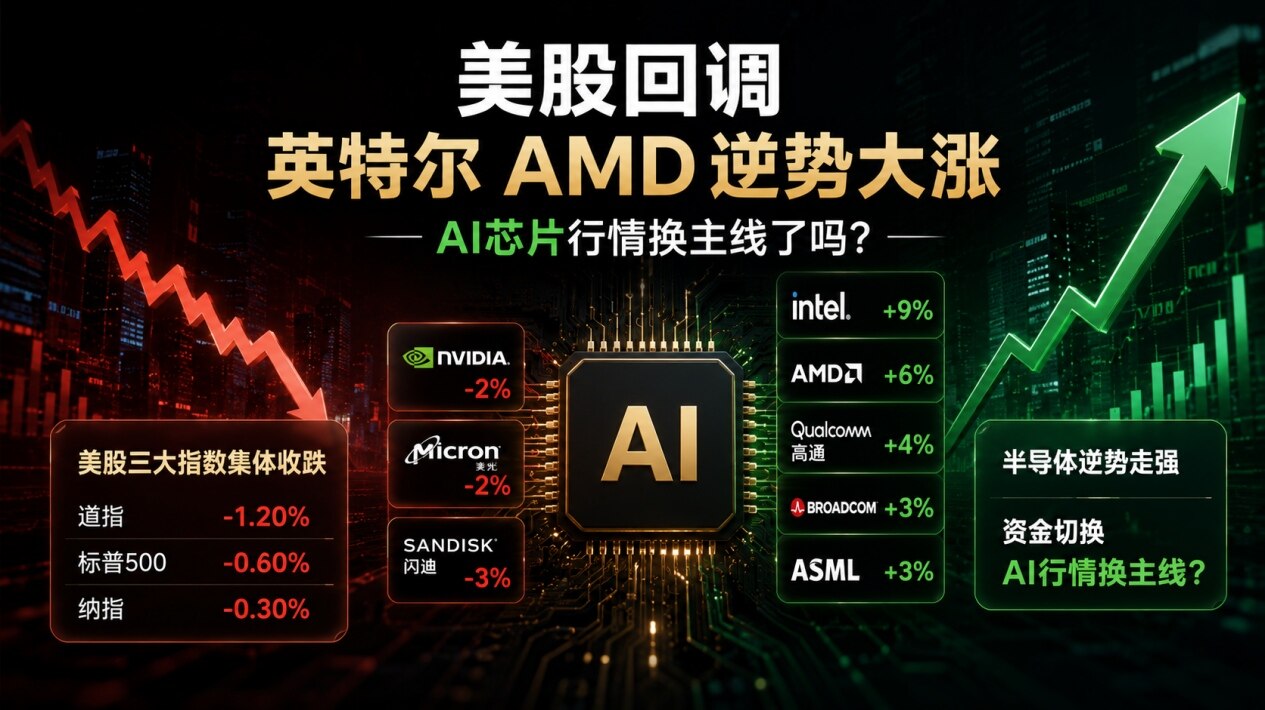
On September 8, BiyaPay market data showed that the three major US stock indices collectively closed lower, with the Dow down 1.2%, the S&P 500 down 0.6%, and the Nasdaq down 0.3%. On the surface, this appears to be a normal pullback, but what is truly interesting is that while the indices weakened, the semiconductor sector showed significant divergence. Intel surged nearly 9%, AMD rose almost 6%, and Qualcomm, Broadcom, and ASML also experienced varying degrees of increase; on the other side, Nvidia fell about 2%, while Micron, SanDisk, and other storage stocks performed relatively weakly.
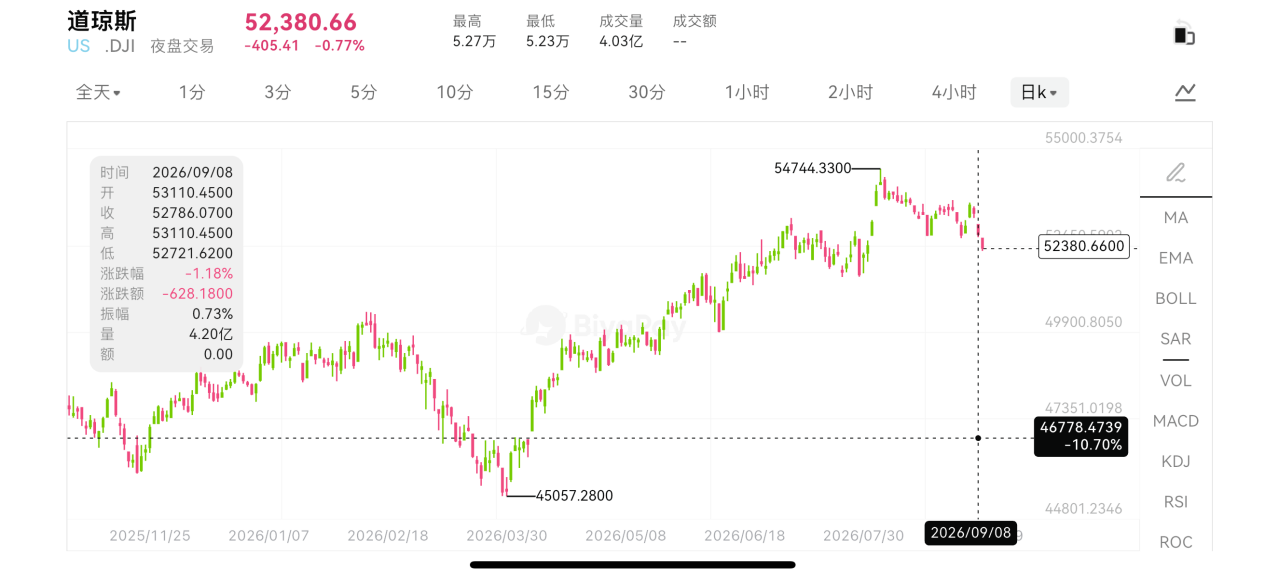
This kind of market can easily create a false impression. By only looking at the indices, one might feel that tech stocks are cooling off; however, observing individual stocks reveals that capital has not left AI and chips but is rapidly switching between different directions. Especially when oil prices, US Treasury yields, Federal Reserve expectations, and the AI supply chain stir the market simultaneously, focusing solely on one market could easily miss the real signals.
When observing this type of market, it is more habitual to observe several assets together. For example, in the BiyaPay App, one can focus on individual US stocks like Intel, AMD, Qualcomm, and Nvidia while simultaneously observing changes in Hong Kong stocks, BTC, ETH, gold, and oil. As a global one-stop asset allocation platform, BiyaPay covers scenarios involving digital assets, US stocks, Hong Kong stocks, and fiat currency exchange, making it more suitable for observing price changes across different markets. For such high-volatility market conditions, the key is not to chase daily fluctuations but to see whether capital is trading based on interest rates, inflation, AI orders, or risk preference.
This indicates that capital has not simply withdrawn from AI and chips but is rather reselecting its direction.
In the past period, trading in US tech stocks has been highly concentrated around keywords like Nvidia, AI servers, storage chips, and computing capital expenditure. However, as oil prices rise again, US Treasury yields increase, and the Federal Reserve's September meeting approaches, the market's tolerance for high-valuation assets will decline. At this point, capital is more willing to seek two types of companies: one type has clearly defined orders or customer validation, and the other has a clearer profit recovery logic.
Intel, Qualcomm, and AMD being pulled back into the spotlight is precisely based on this logic.
Market Pressure: Why Can Chip Stocks Still Rise?
This round of pressure on the US stock market primarily comes from macroeconomic factors.
Brent crude oil briefly approached and surpassed the $100 mark, while WTI also rose above $90. Rising oil prices will push inflation expectations upward again, and once inflation becomes more persistent, it becomes more difficult for the Federal Reserve to quickly transition to easing. Meanwhile, the 10-year US Treasury yield has risen to around 4.8%, and the 30-year yield is also at a high level. For the US stock market, the interaction between oil prices, inflation, and interest rates places pressure first on valuations.
Rationally, tech stocks should be more sensitive, as many high-growth companies' valuations are based on future cash flows. The higher the interest rates, the lower the appeal of future profits discounted. However, this time the decline in the Nasdaq was actually less than that of the Dow, and semiconductors have risen against the trend, indicating that the market is not broadly selling off tech but is undergoing structural switches.
The true trading factors for capital are identifying who can continue to clearly articulate growth in a high-interest-rate environment, and whose price increases, orders, customers, and product lines are more likely to translate into profits.
Intel's Rise: Not Just Emotional Recovery
Intel's recent surge was superficially triggered by price and profit expectations.
DigiTimes reported that Intel may again raise PC CPU prices by about 10% in October. This news drove Intel's stock price significantly up, making it one of the top performing stocks in the S&P 500 index for the day. It is important to note that Intel has not made an official comment on this, so it cannot yet be taken as an established company guidance. However, the market's willingness to buy indicates that capital is paying attention to whether Intel's pricing power has returned.
This point is crucial.
In recent years, Intel's biggest issue has not been a lack of revenue but rather the constant pressure on profit margins, manufacturing investments, and competitive threats weighing down its valuation. Now, if CPU prices rise, server demand improves, and cost pressures are gradually passed on, the market will reassess its profit recovery potential. Additionally, with AI data centers demanding server CPUs, interconnects, and infrastructure, Intel is no longer just a traditional PC cyclical stock but is being revalued within the AI infrastructure chain.
Of course, Intel's logic has not yet reached the stage of a complete reversal. What truly decides how far the valuation recovery can go is not a single day's 9% increase, but whether it can prove over the next few quarters that rising prices will not significantly dampen demand, whether the data center business can continue to improve, and whether advanced manufacturing and foundry businesses can reduce market doubts.
The Spotlight on Qualcomm: From Mobile Phones to AI Data Centers
Qualcomm's recent strength is more focused on industry increments.
On September 8, Qualcomm officially announced a multi-generation product collaboration with Amazon, focusing on custom chips and optical interconnect solutions for large-scale AI data centers, emphasizing AI inference and optical connectivity capabilities of up to 1.6T. The market is not only paying attention to the name of this customer, Amazon, but also whether Qualcomm can use this opportunity to open up a second growth curve beyond mobile chips.
In the past, Qualcomm's core labels were mobile, baseband, and mobile computing. However, as AI enters the inference stage, data centers not only need GPUs but also require more efficient inference chips, low-power computing, and high-speed interconnects. If Qualcomm can transfer the energy efficiency advantages accumulated on the mobile side to data centers, it will have the opportunity to step out of the traditional mobile cycle.
However, it is essential to clarify that the so-called maximum potential scale of $60 billion does not equal confirmed order revenue. Some reports mention that this is related to Amazon's equity warrants and future procurement conditions, and whether it can all convert into Qualcomm's revenue will depend on subsequent product delivery, customer procurement rhythm, and competitive landscape. The market has initially risen to reprice Qualcomm's entry into AI data centers rather than confirming ten years' worth of revenue outright.
Why is AMD Also Being Driven?
AMD's rise is more driven by the sentiment in the AI chip and server chain.
AMD has always been in a delicate position. It is not an absolute leader in AI like Nvidia, but it is also not entirely insignificant. When the market looks at AMD, the core considerations are twofold: whether its MI series AI accelerators can continue to secure large customer orders, and whether its server CPUs and data center business can maintain market share gains.
When Qualcomm secures a partnership with Amazon and Intel is reassessed for its pricing power, AMD will also be compared within the same context. Besides Nvidia, who else can grab a sufficiently large slice of the AI infrastructure expansion? This is where AMD's elasticity comes from.
However, AMD's challenges are also here. The market does not award it a certainty premium but a chasing premium. Chasing stocks typically rise quickly, but they can easily pull back due to order rhythm, gross margin, supply chain issues, and software ecosystem challenges. Therefore, AMD's rise cannot be measured solely by single-day increases but must consider whether subsequent AI revenue proportions, customer expansion, and product iterations continue to materialize.
This Is Not an AI Retreat But AI Pricing Becoming More Discerning
This wave of semiconductor divergence is noteworthy not for who rises or falls but for how AI trading is transitioning from a singular leading narrative to more nuanced industry chain pricing.
Initially, the market favored the most certainty-driven companies, leading to Nvidia, TSMC, storage chips, and AI servers being the main narrative. However, as valuations rise, capital will start seeking new frameworks for explanation. For example, Intel is trading on price and profit recovery, Qualcomm is trading on AI inference and new data center entries, AMD is trading on alternative elasticity outside of Nvidia, and ASML and semiconductor equipment are trading on the advanced process expansion cycle.
Even within AI, the positions have now changed.
This also explains why semiconductor stocks can rise against the trend when the market is falling. The market is not uninterested in interest rates; rather, it is seeking technology assets that can better demonstrate their value in a high-interest rate environment. As long as AI capital expenditures are not discredited, chip stocks will not simply exit the stage but will rotate between different segments.
What to Truly Watch Next?
In the short term, the contrary rise of semiconductors has sent a signal to the market that the main narrative of AI and chips has not disappeared; instead, capital is beginning to seek new pivot points away from crowded trades. The decline in Nvidia does not indicate an AI retreat; the rise in Intel, Qualcomm, and AMD does not mean the market has fully switched. More accurately, the market is redistributing pricing power within the AI supply chain.
Several key variables should be closely monitored moving forward.
First, the US August CPI. The US Bureau of Labor Statistics has scheduled to release the August CPI on September 11. Oil prices have clearly risen, and if the inflation data continues to be strong, the pressure ahead of the Federal Reserve's September meeting will intensify. Second, the FOMC meeting on September 15-16. The current market has a high pricing for a rate increase in September, and the interest rate path will directly influence tech stock valuations. Third, subsequent orders in the AI supply chain. Qualcomm and Amazon's collaboration, Intel's price increase expectations, and AMD's server demand all need to be further validated in subsequent results and guidance.
Thus, this wave of semiconductor increases seems more like a structural revaluation rather than a mere emotional rebound.
High oil prices and rising US Treasury yields generally suppress risk assets; however, the strengthening of semiconductors against the trend indicates that capital is still willing to pay for AI infrastructure but has become more discerning. The companies that can continue to stand out may not be those that tell the loudest stories but those that can connect customers, orders, prices, and profit margins.
The US stock market remains under pressure, yet AI chips have not dimmed. The real question is not whether chip stocks can rise, but rather who will demonstrate next that AI investments can ultimately turn into cash flow.
免责声明:本文章仅代表作者个人观点,不代表本平台的立场和观点。本文章仅供信息分享,不构成对任何人的任何投资建议。用户与作者之间的任何争议,与本平台无关。如网页中刊载的文章或图片涉及侵权,请提供相关的权利证明和身份证明发送邮件到support@aicoin.com,本平台相关工作人员将会进行核查。


