Many people who are new to trading have a common confusion: the currency has risen so much, can I still buy it now?
When the price rises, they are afraid of chasing the high, and when it falls, they fear the market will collapse. The result is often that they do not dare to watch when they should be observing, and by the time the market rises again, they start to regret not getting on board.
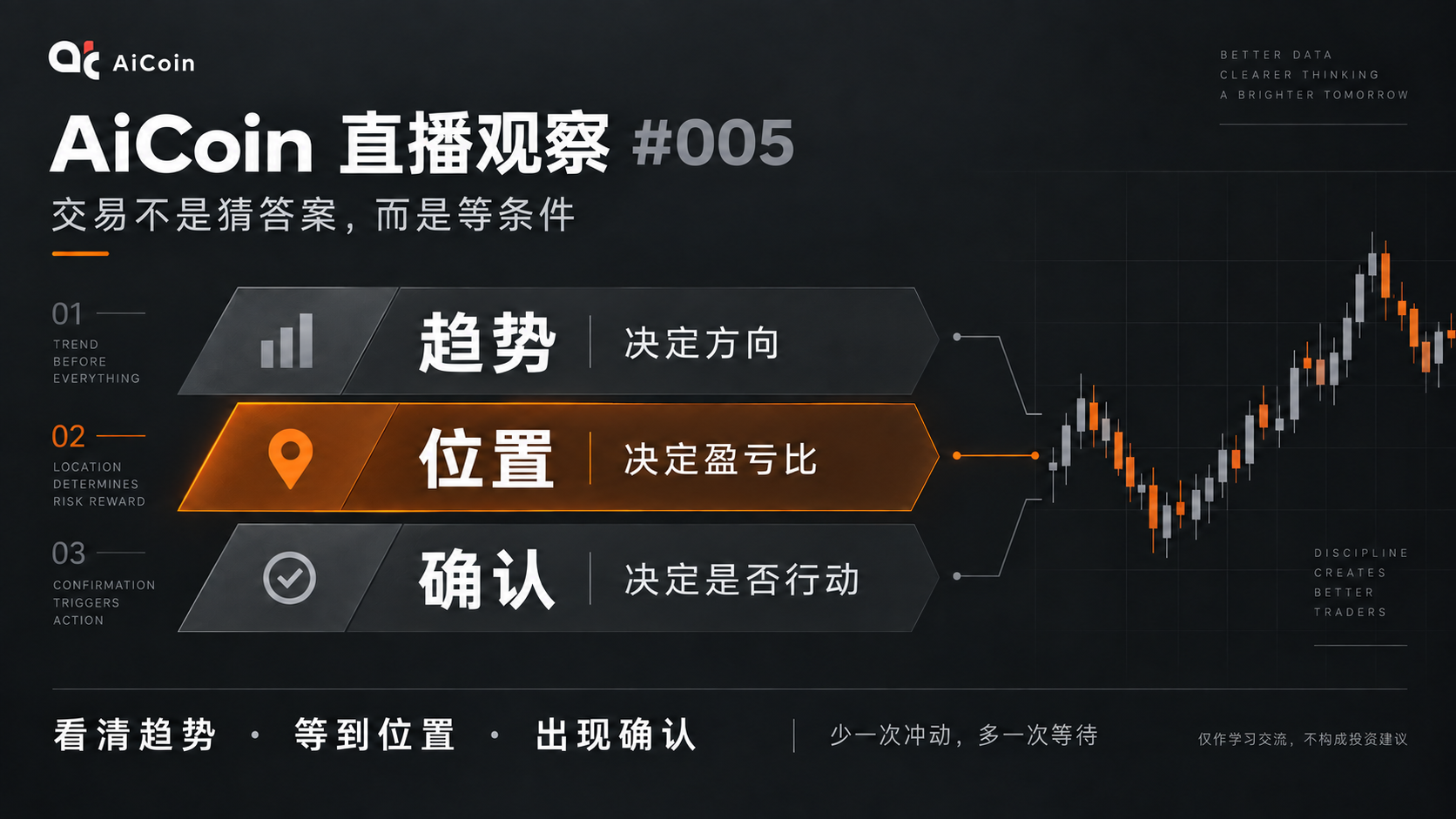
The biggest change this live session of the Domi Club brought me was: trading is not just a simple judgment of "up or down", but first judging the overall direction, then waiting for the price to return to a key position, and finally confirming with a shorter time frame.
1. The mistake I used to make easily: seeing the rise and wanting to chase immediately
In the past, when looking at the market, I easily formed a simple logic:
Rising → quickly buy; falling → quickly sell.
But what was emphasized repeatedly during the live session was that the real trading thought should shift:
In an upward trend, the focus is not on chasing the rise but on finding support levels.
The teacher suggested that, in judging a big upward trend, one should wait for the price to pull back to important support areas before looking for entry opportunities, rather than jumping in as soon as the price rises quickly.
This statement is actually very important for beginners.
Because the question "can I still buy it when it has risen" is hard to answer directly; but changing it to "where will it pull back to next before I consider buying?" makes the question much clearer.
2. A market case: Why is it not recommended to blindly chase around 82000 for BTC?
The live session focused on analyzing BTC.
At that time, the teacher believed that around 82000 is a quite apparent pressure area at the daily level. It is important to note that the teacher emphasized "range", rather than a magically precise number.
Because in real trading, it is difficult for anyone to accurately judge that "82000.00 is the highest point".
So what beginners should learn more is:
Price at pressure zone → do not chase;
Price pulls back → look for support later;
When near support → combine with a shorter time frame for judgment.
So where is the support?
The several observation areas for Bitcoin given during the live session were:
- Around 76600
- Around 75800
- Around 74500
Among them, the area around 74500 is considered to be a more important lower support area; while around 75800 corresponds to the pullback position after the previous rise. The teacher's approach does not require betting fully at once, but to consider in batches based on the depth of the price pullback and set defensive positions.
This made me understand a very simple truth:
Real good buying points are often not when "the market is hottest", but rather when everyone starts to fear, and the price returns to key supports.
Of course, this is just a technical analysis viewpoint from the live session and does not mean that these prices will definitely become actual bottoms.
3. The second important knowledge: support levels are not drawn randomly
In the past, when seeing others draw candlesticks, I often found it very mysterious: why do they draw here, and I draw there?
There was a very easy-to-understand explanation during the live session:
Support and resistance are not meant to make the chart look pretty, but to find the actual locations where the market has reacted.
For example:
- The price has stopped here multiple times;
- There was a significant spike down followed by a rebound;
- A certain position had long-term consolidation;
- The starting point of a big rise;
- After breaking from previous resistance, becoming support later.
These positions are worthy of attention because they have apparent market trading behaviors. That is to say, beginners should not think about learning dozens of indicators right off the bat.
First ask yourself three questions:
Where has the price stopped before?
Where has there been a significant rebound?
After the breakout, did the original resistance become new support?
This is an easier way to establish a trading framework than researching a bunch of complicated indicators right away.
4. The third knowledge: indicators are not for "predicting magical prices"
There was another statement during the live session that left a deep impression on me: moving averages, Bollinger bands, MACD, and other technical indicators ultimately serve to help us find support and resistance levels.
In other words, the indicators themselves are not the answer.
For example, seeing a MACD golden cross should not immediately turn to: "It golden crossed, so it will definitely rise."
A more reasonable understanding should be: "If there's a change in the indicator, then I’ll check if the price is also near important support."
If price position, trend, indicators, and candlestick signals can validate each other, then the trading logic will be more complete.
The process was summarized during the live session into a clearer framework:
Step 1: Judge the big trend;
Step 2: Find support and resistance;
Step 3: Wait for key positions;
Step 4: Use shorter time frames to find entry signals.
This is also the set of methods I think are most worth remembering for beginners from this live session.
5. A real change in cognition: from "guessing ups and downs", to "waiting for conditions to appear"
After listening to this live session, I feel the biggest change is not having learned a few prices but rather changing a trading habit.
Before, I might ask:
"Will BTC go up now?"
Now it should be more about asking:
"If it continues to rise, where will I not chase?"
"If it pulls back, where do I start observing?"
"After reaching support, what signals do I consider for action?"
This is actually a shift from "predicting the market" to "setting conditions".
6. From this live session, I ultimately remembered three sentences
The first sentence: In an upward trend, do not blindly chase the rise out of fear of missing out; learn to wait for a pullback to find support.
The second sentence: All technical indicators ultimately return to the core question of "support and resistance levels".
The third sentence: Trading is not about predicting the future, but about preparing different response plans under various circumstances.
What is truly worth taking away is not a certain "magical point", but a sequence to view the market:
First, look at the trend → then find positions → wait for pullbacks → confirm with shorter time frames → control your position → exit on mistakes.
[Domi Club] Live: Wednesday at 8 PM
The above content is organized from the [Domi Club] live session, where the teacher analyzed the multi-timeframe trends of BTC and ETH, key support and resistance, as well as short-term trading rhythm, and this article only distills parts suitable for trading novices to understand and review.
To continuously track the latest market trends and analyses, you can follow the Domi Club live session on the AiCoin official website at 8 PM on Wednesdays.
One-click reservation: https://www.aicoin.com/zh-Hans/live
Live room️: https://meeting.tencent.com/dm/LhiVwj7EwMoe
The above content is only a compilation of live viewpoints and market analysis, and does not constitute any investment advice. The cryptocurrency market is highly volatile; please make independent judgments and manage risk accordingly.
免责声明:本文章仅代表作者个人观点,不代表本平台的立场和观点。本文章仅供信息分享,不构成对任何人的任何投资建议。用户与作者之间的任何争议,与本平台无关。如网页中刊载的文章或图片涉及侵权,请提供相关的权利证明和身份证明发送邮件到support@aicoin.com,本平台相关工作人员将会进行核查。