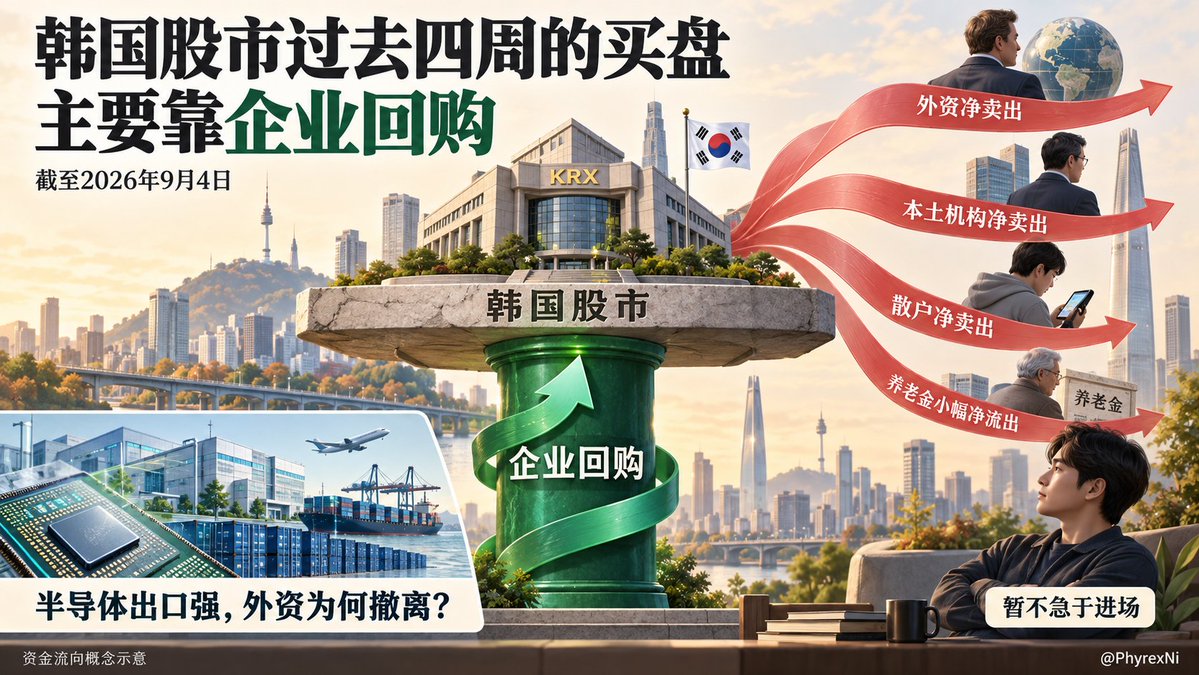
The buying in the South Korean stock market over the past four weeks has mostly relied on corporate buybacks.
As of the four weeks ending September 4, South Korean companies have repurchased approximately 11 billion dollars of stocks, while foreign investors have net sold about 3 billion dollars during the same period. Domestic institutions and retail investors have net sold around 4 billion dollars, and there has also been a slight net outflow from pensions. The amount of corporate buybacks is nearing the scale of net sales by several other types of investors combined.
The changes in foreign investment are the most significant. In mid-August, during this four-week statistical period, foreign investment net buying reached about 6 billion dollars, but by September 4, it had turned into a net sale of about 3 billion dollars, equivalent to an additional net sale of around 9 billion dollars afterward. The money that was previously bought has not only been withdrawn but is also continuing to reduce holdings.
This indicates that the recent net buying in the South Korean stock market is mainly provided by the listed companies themselves, while foreign investors, domestic institutions, and retail investors have overall reduced their positions during this time. Buybacks can indeed absorb selling pressure, but there are no signs of other types of funds also turning to buy.
Corporations willing to use their cash to buy back their own stocks certainly provides support to the market. However, it remains to be seen how large a scale the buybacks can maintain. If companies buy less, and foreign investors and other investors do not step in, the pressure to absorb selling in the market will increase.
Therefore, I believe that a healthy market is definitely not supported solely by corporate buybacks; corporate buybacks only provide confidence to users. The key is whether users are willing to buy, and for the South Korean stock market, it is not just retail investors but also foreign capital. I am actually a bit confused; clearly, South Korea's semiconductor exports are doing well, so why are users not willing to support?
If it were only domestic users, one could say it was due to over-leveraging leading to insufficient funds, but foreign capital is also withdrawing, especially those that have already made profits. This puzzles me a bit, but compared to understanding, I’m not in a rush to enter the market.
@Gate Crypto, U.S. stocks, Hong Kong stocks, Korean stocks, gold, CFD, one-stop trading for predicted markets
免责声明:本文章仅代表作者个人观点,不代表本平台的立场和观点。本文章仅供信息分享,不构成对任何人的任何投资建议。用户与作者之间的任何争议,与本平台无关。如网页中刊载的文章或图片涉及侵权,请提供相关的权利证明和身份证明发送邮件到support@aicoin.com,本平台相关工作人员将会进行核查。


