Original | Odaily Planet Daily (@OdailyChina)
Author | Asher (@Asher_0210)

On September 6, the attacker exploited a vulnerability in the Elements software to create approximately 4000 LBTC out of thin air, and exchanged about 3998.5 BTC, valued at approximately 320 million dollars, through SideSwap's normal withdrawal channel from Liquid's multisig wallet.
However, the attacker later left a message in a Bitcoin transaction: “We are whitehats, please contact us on-chain.” After Blockstream fixed the vulnerability, the attacker returned 3400 BTC but left approximately 598.5 BTC in an address they controlled, valued at around 47 million dollars.
Currently, Blockstream is communicating with the attacker in an attempt to recover the remaining 598.5 BTC, and the official has not confirmed it as a bounty for the vulnerability.
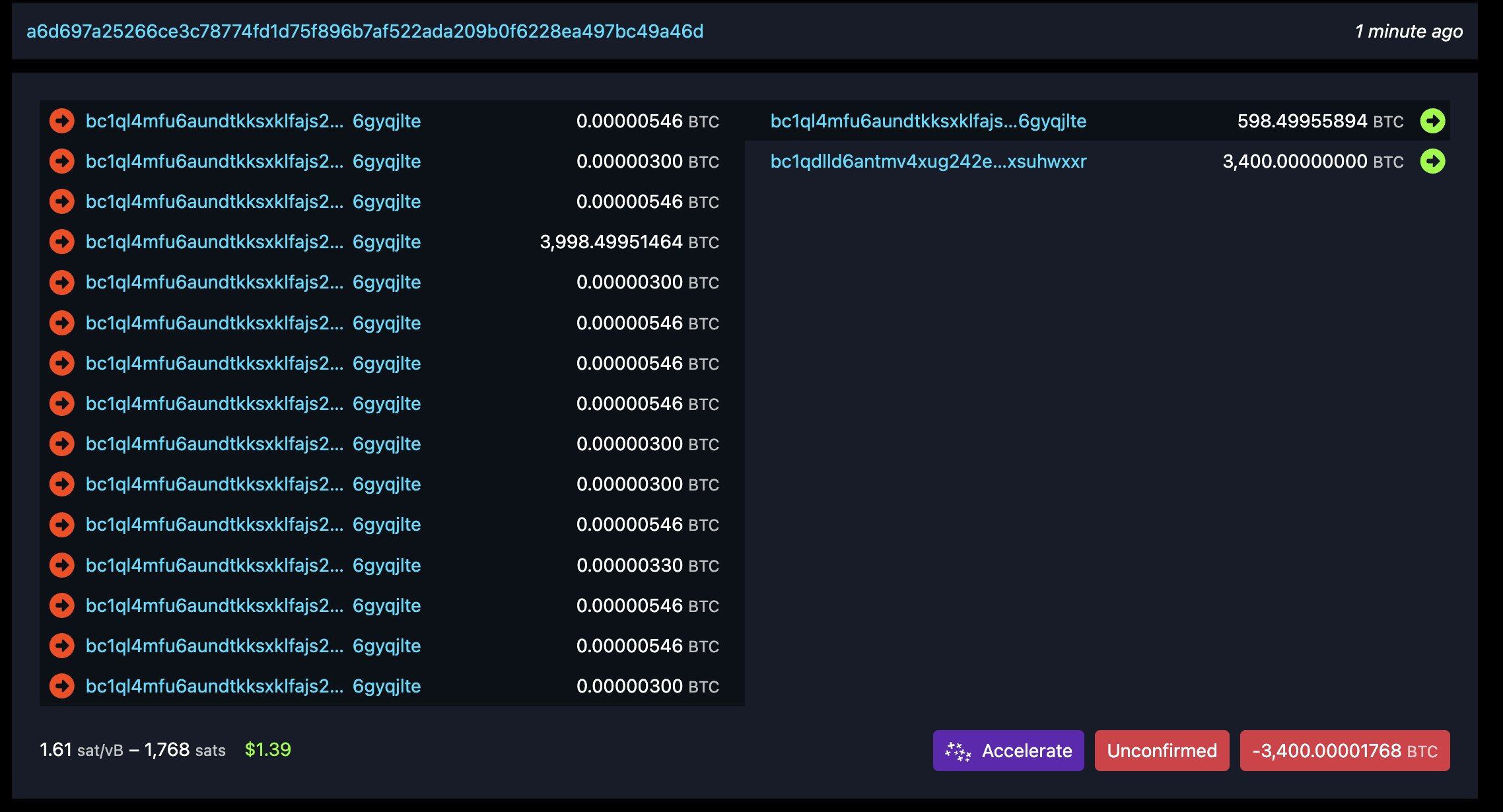
Returning 85% and keeping 15%, is this an expensive whitehat operation, or is the attacker demanding a huge reward under the condition of returning the funds?
Creating LBTC out of thin air, exchanging for nearly 4000 real BTC
Liquid Network is a Bitcoin sidechain launched by Blockstream in 2018. Unlike the Lightning Network, which mainly services daily payments, Liquid is more focused on Bitcoin settlement between exchanges and institutions, while also supporting the issuance of stablecoins, securities, and other digital assets. The institutions participating in Liquid's governance and operation have increased from the initial 23 to 87, and the scale of RWA assets issued on Liquid has surpassed 5 billion dollars.
On September 6, Liquid encountered the most serious security incident since its launch, with related withdrawals completed in two stages. The attacker first withdrew approximately 2.5 BTC for testing, and then transferred about 3996 BTC. The two transactions accounted for about 95% of the Bitcoin reserves in the multisig wallet before the incident. After the funds were transferred out, only about 197 BTC remained in the wallet. Liquid immediately closed the bridge nodes and paused network operations, while several exchanges also halted LBTC deposits and withdrawals.
This incident was not due to the leakage of the multisig wallet's private key, and the Peg-out Authorization Key used by SideSwap for withdrawal authorization was also not stolen. The real problem lies within the Elements software used at the underlying level of Liquid.
According to information disclosed by SideSwap, the attacker exploited a vulnerability in the Elements software to generate approximately 4000 LBTC without real BTC reserve support, and then sent them to SideSwap's Peg-out service. From the system's perspective, these LBTC generated through the vulnerability were indistinguishable from normal assets. Therefore, SideSwap destroyed the LBTC according to the normal process and submitted the withdrawal request, while Liquid's multisig wallet paid the corresponding real BTC to the attacker's address.
In simple terms, the attacker did not directly breach the wallet holding the BTC, but created a batch of "fake LBTC" that could deceive the system, and then exchanged it for real BTC through the normal withdrawal channel.
Liquid's multisig wallet employs an 11-of-15 mechanism, requiring the approval of at least 11 out of 15 multisig members for a withdrawal. However, this incident demonstrated that multisig can only confirm that the withdrawal has obtained enough authorization, and cannot determine whether the LBTC entering the withdrawal process was generated through the vulnerability. When problems arise in the asset verification process, even multiple subsequent signatures may potentially release an erroneous transaction.
A negotiation occurring on the Bitcoin chain
After transferring the funds, the attacker left a message in the OP_RETURN field of a Bitcoin transaction: “we are whitehats. contact us on chain.”
Blockstream sent 1000 satoshis to the attacker's address, requesting them to contact the security team. The two parties then began on-chain communication through OP_RETURN, PGP signatures, and encrypted messages. The attacker stated that they were willing to return "most of the funds" after the vulnerability was fixed, and requested Blockstream to ensure that all bridge nodes completed updates. Once the repairs were completed, Blockstream informed the attacker via a signed message: “The bridge nodes have been repaired and funds can be safely returned.”
On September 7, the attacker returned 3400 BTC to Liquid's multisig wallet, while transferring the remaining approximately 598.5 BTC to an address under their control. However, both parties' publicly available on-chain information neither established how much BTC the attacker could keep nor negotiated the 598.5 BTC as a bounty for the vulnerability.
Liquid's latest security incident report indicates that Blockstream is still in communication with the attacker in an attempt to recover the remaining 598.5 BTC. In this view, Blockstream's prior agreement for the attacker to return "most of the funds" does not imply that it acknowledges the retention of approximately 47 million dollars worth of BTC. At least in the current official statements, this portion of the funds remains an asset to be recovered rather than a confirmed bounty for whitehats.
47 million dollars, bounty or extortion?
Supporters of the attackers argue that if the vulnerability had been discovered by malicious hackers first, Liquid could have lost all of its Bitcoin reserves. The attacker requested Blockstream to complete the fix first and ultimately returned 85% of the funds. Even if nearly 600 BTC are no longer returned, compared to the total loss of funds, Liquid still avoided a worse outcome.
The anonymous owner of Bitcoin.org, Cøbra, believes that whitehats should receive compensation that matches the losses they mitigate; the founder of Slow Mist, Yu Xian, also suggested that in the future, major theft incidents could gradually form a consensus of return bounties starting at "15%". In their view, higher bounties could incentivize vulnerability discoverers to choose to return funds rather than keep them all.
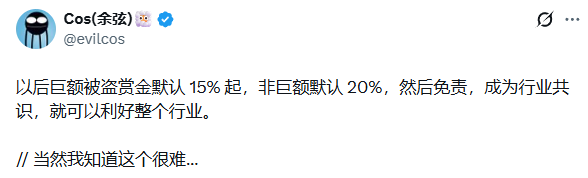
The root of the controversy lies in the "process of doing things"—traditional whitehat disclosures typically involve reporting the vulnerability first, followed by a project party making payments based on established rules or negotiated results; however, the Liquid attacker withdrew nearly all reserves first and then kept 15% on their own. Ledger's Chief Technology Officer, Charles Guillemet, thus questioned whether this practice is more akin to demanding payment under the condition of returning funds rather than normal whitehat behavior.
For Liquid, recovering 3400 BTC only temporarily alleviated the reserve crisis. The process for fixing the vulnerability has already entered the internal and external review stage, and the official plans to urgently release Elements v23.3.4, followed by adjustments to the network by Functionary operators, rejecting previously invalid Peg-outs and restoring network operations.
Whether the remaining funds can be recovered and when Liquid will recover fully remains to be seen in further developments. However, the latest official statements have clarified this controversy: attackers may call themselves whitehats, but they cannot unilaterally define the 47 million dollars in withheld funds as a bounty for the vulnerability.
免责声明:本文章仅代表作者个人观点,不代表本平台的立场和观点。本文章仅供信息分享,不构成对任何人的任何投资建议。用户与作者之间的任何争议,与本平台无关。如网页中刊载的文章或图片涉及侵权,请提供相关的权利证明和身份证明发送邮件到support@aicoin.com,本平台相关工作人员将会进行核查。


