Not only is it the "scapegoat" for internet outages, but it is also the "shovel" that is easily overlooked in the AI era.
On the evening of September 3rd, the three leading AIs, ChatGPT, Claude, and Grok, went offline almost simultaneously.
Quietly complaining: Now there are "new three families" even for outages, is Gemini no longer on the list?
Interestingly, after the incident, many people’s first reaction was to check the status pages of Cloudflare, AWS, and Azure, especially Cloudflare.
However, this time it seems that it really doesn’t have to bear the blame, as the Cloudflare status page did not show any major global incidents, and there is currently no evidence indicating that the outages of the three are from the same source.
Thus, the question becomes more interesting: Why is it that when the modern internet experiences widespread service anomalies, Cloudflare is always one of the first names to be suspected?
Especially since this time it clearly was not responsible, yet it was the first thought on everyone’s mind, which itself says a lot.
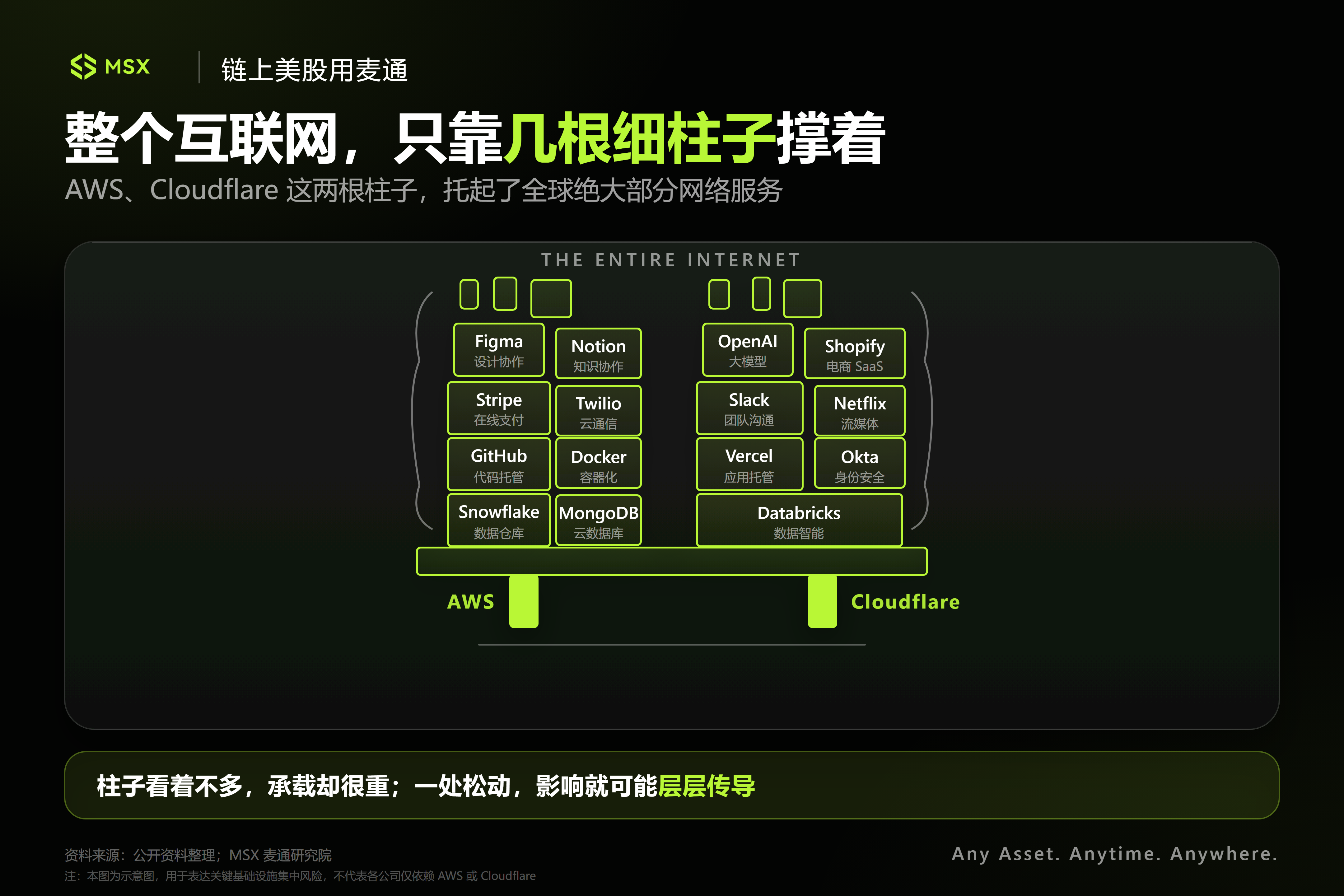
1. Why is Cloudflare the first thought when there's an outage?
Many people first came to know Cloudflare probably because of its CDN, website acceleration, or DDoS protection services.
However, if we still only understand it today as a CDN company, that would be a bit outdated.
When we open a website, it seems simply to be " user → website."
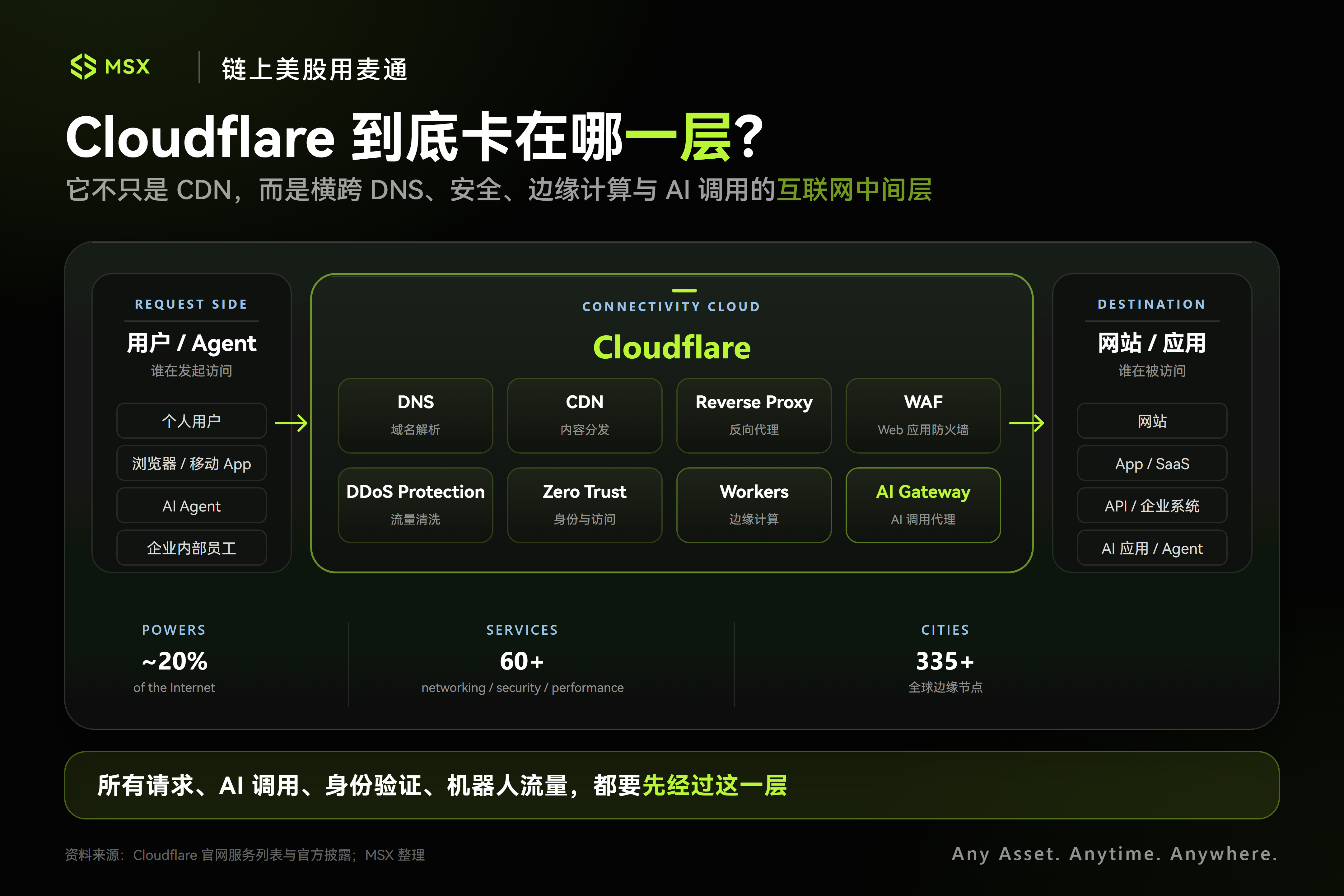
In reality, the chain in between is much more complex and closer to, "user → domain name → DNS → Cloudflare → CDN / WAF / DDoS / authentication / edge computing → website server."
This means that Cloudflare does not necessarily host the website you are ultimately visiting, but it may stand between you and the website:
- The website wants to load faster, it has to go through it;
- When under DDoS attack, if someone needs to stand in front, it relies on it;
- API requests, bot traffic, and enterprise employees accessing internal systems have to go through it;
- Developers have started running programs directly on edge nodes with Workers;
- In the AI era, model APIs, AI Gateways, Agents, MCPs, Cloudflare is also beginning to extend to this layer;
Cloudflare's current external positioning is that it is a unified platform serving apps, agents, and workforce, and I believe understanding Cloudflare as the "water, electricity, and gas" of the internet might be more accurate.
It is usually completely unobtrusive; the web pages load normally, APIs respond correctly, and malicious traffic is blocked in the background, but as soon as something goes wrong, all websites suddenly crash together.
For an infrastructure company, this is a very privileged position.
Followofficial X for US stock information
2. When Cloudflare goes down, does half the internet crash too?
Of course, the more important the position, the greater the cost of errors.
A look back at Cloudflare's history of outages is nearly a modern distributed network’s cautionary tale.
In 2019, a regex in a WAF security rule had issues, quickly maxing out the CPU handling HTTP traffic, ultimately affecting the core proxy, CDN, and WAF, leading to a widespread 502 Bad Gateway across the internet.
In 2022, a network configuration adjustment went wrong, affecting 19 data centers, specifically the busiest nodes, momentarily impacting about 50% of request volume.
By 2025, as Cloudflare’s product offerings continued to expand, incidents started to occur with "internal transmission."
In June, the underlying storage infrastructure that Workers KV depended on malfunctioned, causing services like WARP, Access, Gateway, Workers AI, and Turnstile to go down for over two hours.
Even more exaggerated was in November when a database permissions modification caused a configuration file used by Bot Management to suddenly expand to twice its original size, synchronizing to many machines, ultimately causing issues with core network traffic.
This led Cloudflare to initially suspect they were experiencing a massive DDoS attack, only to discover they had generated an excessively large file...

Ultimately, the true magnifier of small errors is Cloudflare's position; it has embedded itself into the essential pathways of too many websites, applications, and services.
Joinofficial community to discuss hot topics
3. NET: The "shovel" easily overlooked in the AI era
However, viewing Cloudflare merely as "an important internet infrastructure company" overlooks another layer.
In recent years, the trajectory of its business has become clearer: expanding from CDN, DNS, and DDoS protection towards Zero Trust, cybersecurity, and the Workers development platform, now also incorporating AI Gateway, Workers AI, and Agent infrastructure.
And AI may be making its already critical position even more valuable.
The reason isn’t complicated: the more agents there are, the more network requests, identities, and security needs arise.
This logic differs from traditional SaaS; previously, the internet mainly involved humans accessing machines, where one person could open a webpage, click a few links, and log off, resulting in a limited number of requests each day.
However, an Agent is completely different; to complete a task, it may continuously search dozens of pages, call several APIs, potentially resulting in dozens or hundreds of machine calls behind the scenes.
If in the future, more internet traffic truly shifts from Human-to-Machine to Machine-to-Machine, then Cloudflare will be the platform they run on and the network they must pass through, theoretically becoming increasingly busy.
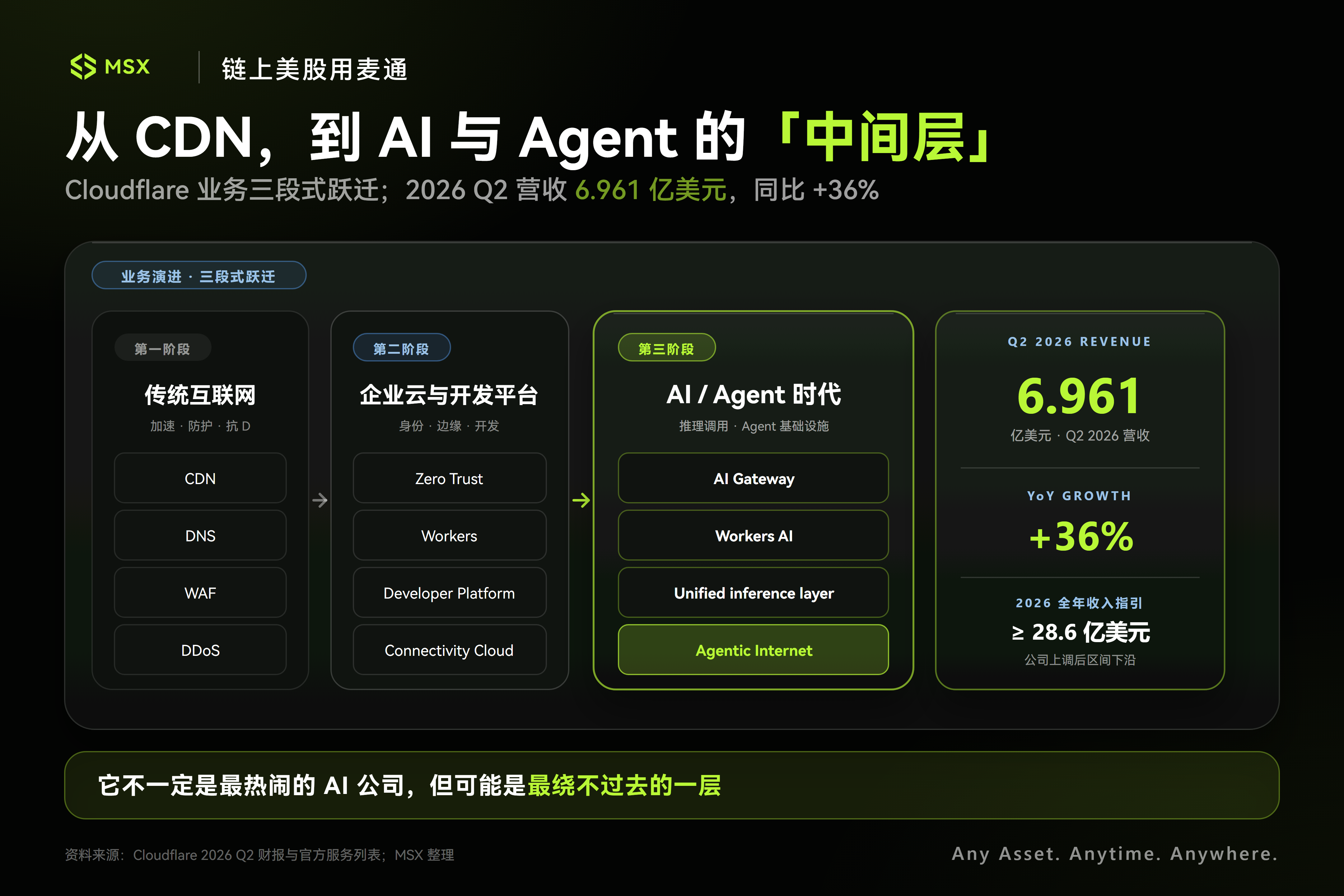
The latest financial report verifies this trend, with Q2 revenues reaching $696 million, a 36% year-over-year increase, and the growth rate has continued to rise from around 34% in last year's fourth quarter and this year's first quarter.
For a company with annual revenue already surpassing $2 billion, achieving this level of re-acceleration isn’t easy. This is why, after the financial report came out in early August, NET briefly surged above $330.
However, with a solid foundation, the market also already knows that it’s doing well, hence after the August peak, the stock price has fallen back significantly.
Next, we’ll see whether the machine traffic, security requirements, and development platform revenues driven by Agents can run fast enough to continue digesting the high expectations already set today.
In conclusion
Last night, ChatGPT, Claude, and Grok experienced a collective failure, although it was not caused by Cloudflare.
Yet this mix-up itself is very suitable for understanding Cloudflare.
What we usually see is only the uppermost layer; today it’s ChatGPT, tomorrow it’s Claude, and in a few years, perhaps it will shift to a new batch of Agents.
Applications will change, and so will the entrances.
But as long as they still need to connect to the internet, access data, verify identities, and call APIs, while needing someone to block attacks, the underlying infrastructure layer will not disappear out of thin air.
In fact, the more machines there are, the busier this layer may become.
What Cloudflare is betting on is probably this very issue.
免责声明:本文章仅代表作者个人观点,不代表本平台的立场和观点。本文章仅供信息分享,不构成对任何人的任何投资建议。用户与作者之间的任何争议,与本平台无关。如网页中刊载的文章或图片涉及侵权,请提供相关的权利证明和身份证明发送邮件到support@aicoin.com,本平台相关工作人员将会进行核查。


