Opening Hyperliquid's latest "prediction" page, you will find that it is no longer just a feature test.
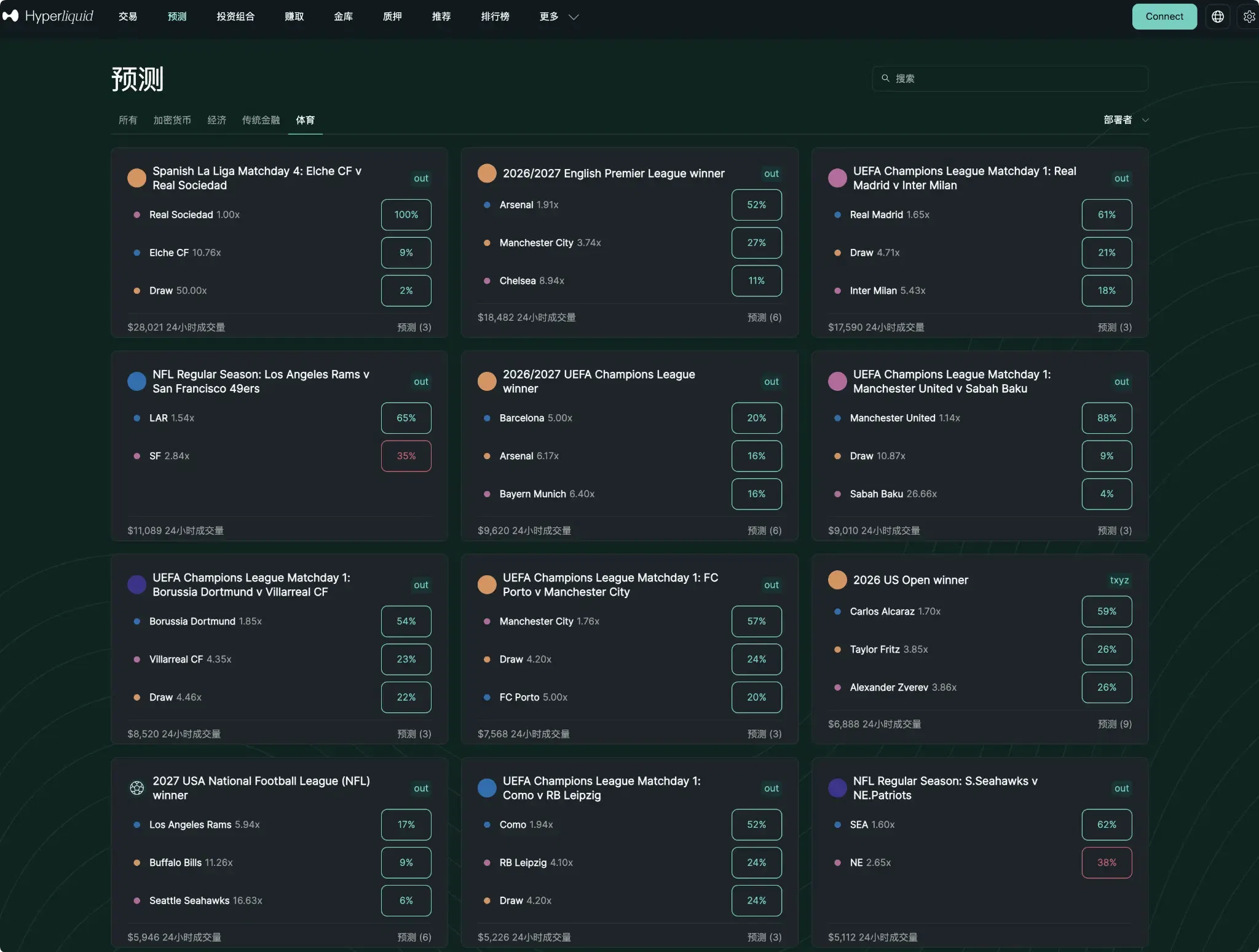
In the price prediction category, you can see "Will HYPE reach $90 before October 1?" and "Will BTC reach $85,000?" Switching to the sports category, you can also see the Premier League champion, Champions League single matches, NFL, and the US Open. Cryptocurrency and sports events have been put into the same blockchain order book.
Meanwhile, the market has provided another observation: The scale of USDC on Hyperliquid has approached $6.95 billion, significantly narrowing the gap with Solana; while the HIP-4 prediction market has just begun to expand, new use cases may continue to attract USDC deposits and convert them into protocol reserve income through AQAv2.
These two observations together are what makes HIP-4 the most noteworthy aspect.
Hyperliquid has not only added an "prediction market" entry but is also expanding the trading objects from "price" to "outcomes": perpetual contracts compete for asset pricing power, while HIP-4 starts to compete for event pricing power.
Perpetual contract trading "path", HIP-4 trading "endpoint"
Traditional perpetual contracts answer the question: What will price do next?
Traders must not only judge direction but also face entry points, leverage, funding rates, price paths, and liquidation risks. Even if the final direction is correct, if the fluctuations along the way are too large, positions might still get liquidated.
The outcome contracts of HIP-4 answer a different question: Will something happen before the specified time?
Hyperliquid defines the Outcome as a fully collateralized contract settled within a fixed range, which can be used for prediction markets and bounded option-like products. It has a clear expiration date and non-linear returns, but does not utilize perpetual contract-style leverage, nor does it have perpetual-style liquidations.
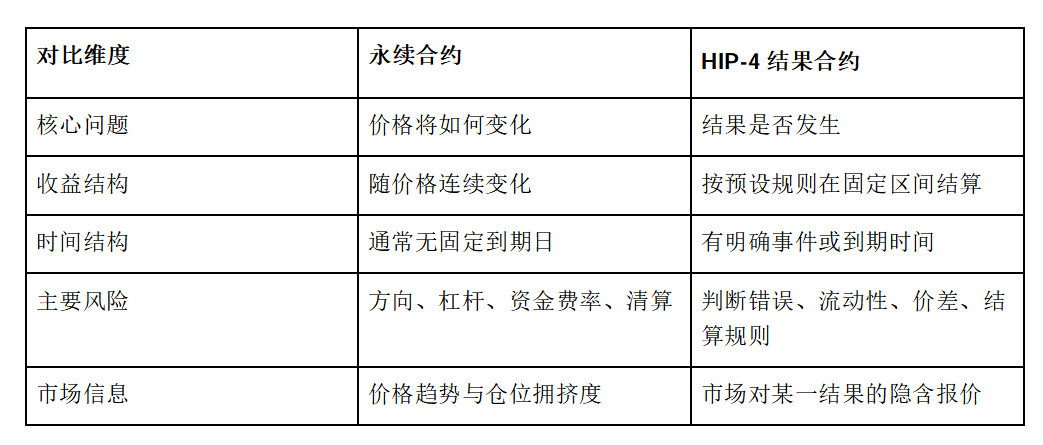
This means Hyperliquid is filling a previously missing piece: users can trade not only "how much BTC will rise or fall" but also directly trade "whether BTC can reach a certain price before a certain date."
A BTC "probability ladder," more informational than a single-point target price
Multiple BTC touch price markets appear near the same expiration:
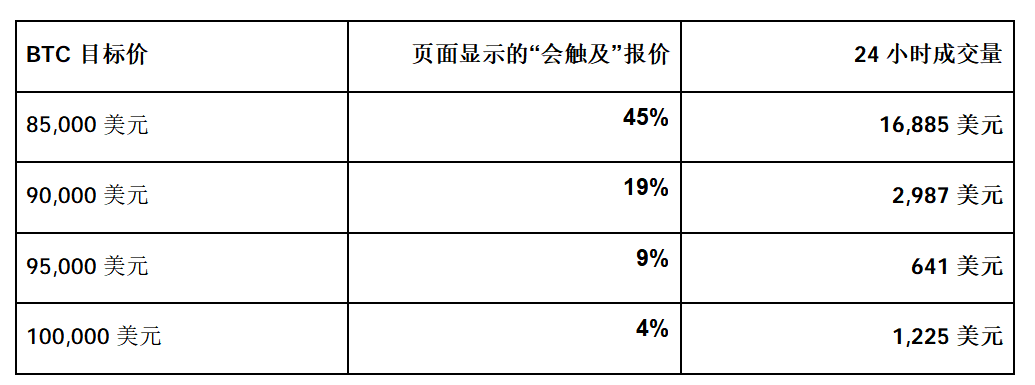
Looking solely at the candlestick chart, traders can usually only come to a vague conclusion of "bullish" or "bearish"; this group of markets breaks different target prices into a probability ladder.
Funds believe there is still a certain chance of BTC reaching $85,000, but as it moves towards $90,000, $95,000, and $100,000, market quotes drop rapidly. This expresses not just direction, but how funds price different tail scenarios.
This type of probability curve can serve as a supplementary signal to the price market. For example, if the perpetual price of BTC has no significant changes, while the quote for a certain high touch price market suddenly rises, traders should at least check: whether there have been new large positions, changes in funding rates, spikes in volatility, or news-driven events.
However, it must be emphasized that the page shows implied quotes formed by order book transactions, not official predictions, and certainly not statistical accuracy. Insufficient depth of trades, excessive bid-ask spreads, or individual large orders can all cause temporary distortions in the quotes.
The sports page indicates that HIP-4 is stepping out of the Crypto native market
The sports category of Hyperliquid has already covered events like La Liga, Premier League champions, Champions League, NFL, and tennis. From the screenshot, the total transaction volume of the 12 visible sports markets is $133,072; the total transaction volume of the 12 visible cryptocurrency markets is $104,921. The total transaction of the 24 visible markets in the two screenshots is $237,993.
This is just a sample of the page within the screenshot scope and cannot be extrapolated to the total transaction volume of the entire HIP-4 platform. However, the visible transaction volume of the sports sample has already surpassed that of the crypto sample, at least sending a signal:
The outcome market may help Hyperliquid reach those users who do not want to trade perpetual contracts but are willing to express opinions on tournaments, elections, macro data, or corporate events.
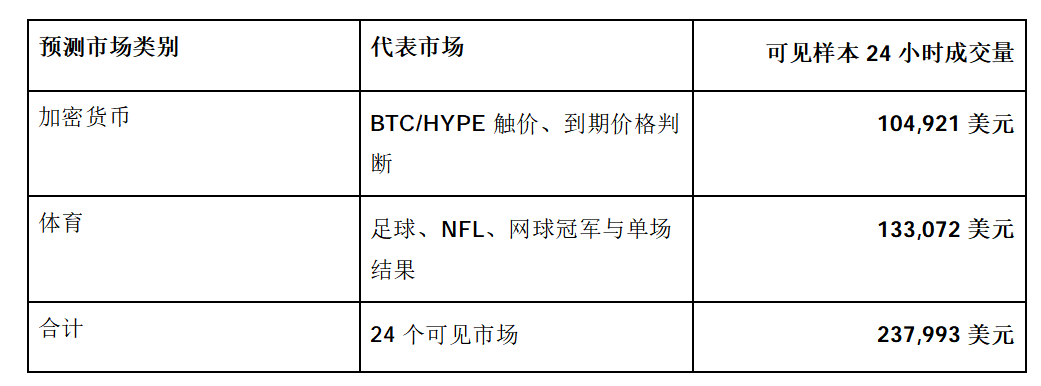
This is also where HIP-4 differs from simply "adding more coins." Adding a new token market still competes for the same pool of Crypto trading funds; adding a new category of events may bring in new users, new trading frequency, and new fund retention scenarios.
Of course, the sports page also reveals the real-world problems of early markets. The sum percentage of some multi-result markets exceeds 100%, which may stem from the page only displaying partial outcomes, bid-ask spreads, low liquidity, or quotes not being fully normalized. Users cannot mechanically treat each number as a real probability that can be directly added together.
HIP-4 is not an unrestrained "anyone can open markets"
Whether prediction markets can exist long-term is essential not just based on the number of markets but also includes problem definitions, settlement standards, and responsibility attribution for faulty markets.
Hyperliquid’s permissionless deployment uses a template mechanism: validators first approve the Outcome template, which fixes the display structure, outcome name, and keyword type; deployers then create specific markets within the semantic range allowed by the template. If a market violates the template’s semanticRestriction, it may be considered a format error and trigger penalties.
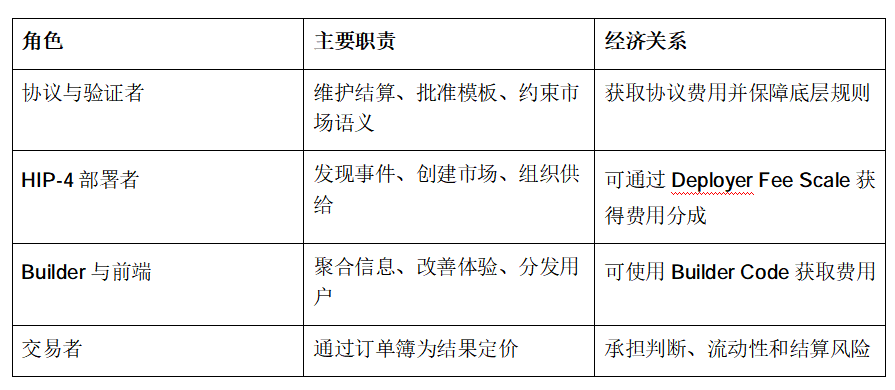
The official rules allow deployers to set a fee multiplier between 0 to 10, with the protocol sharing transaction fees based on this; current fee documentation also stipulates that outcome contracts are only charged when closing or settling, with no fee for opening, and no Maker rebate offered.
The focus of this design is to leave the "discovery of what is worthwhile to trade" to the deployers while keeping "how to define and settle" within standardized templates. Market supply no longer fully relies on the Hyperliquid team, but it is also not completely unrestricted free release.
Approaching $6.95 billion USDC, can HIP-4 continue to accelerate the flywheel?
According to publicly available market data, as of September 8, 2026, the circulating amount of USDC on Hyperliquid L1 is $6.9545 billion, while on Solana, it is $7.3276 billion. Hyperliquid has reached 94.91% of Solana, with only 5.09% difference.
Therefore, the market's statement of "approaching $7 billion, close to Solana’s size" can be supported by the data at this point.
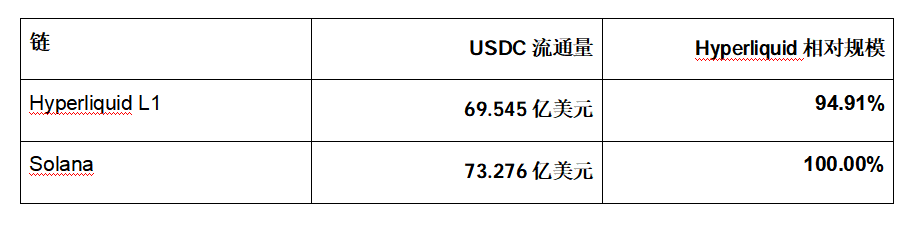
Why might HIP-4 affect this set of data? Because the outcome market also needs USDC to complete quoting, trading, and settlement. The richer the cryptocurrency, sports, macro, traditional finance, and event market, the more reasons users will have to keep USDC in their Hyperliquid accounts.
AQAv2 then links "stablecoin retention" more directly to protocol economics for the first time. The official documentation states that stablecoin issuers must share about 90% of cost-adjusted reserve income corresponding to their Hyperliquid supply with the protocol; income is accumulated over a 30-day period and automatically sent to the Assistance Fund eight days after the period ends.
This theoretically forms the flywheel:
More market supply → More user scenarios → More net new USDC → Higher retention after event settlement → Larger AQAv2 reserve income base → Stronger ecological feedback.
But this flywheel is not without conditions.
The biggest misconception: volume growth does not equal USDC inventory growth
HIP-4’s contribution to volume and USDC inventory should be viewed separately: if users merely move USDC originally used for perpetual contracts to the prediction market, the turnover rate will increase, but the on-chain USDC will not consequently grow.
This is the easiest point to overlook when judging HIP-4’s success or failure.
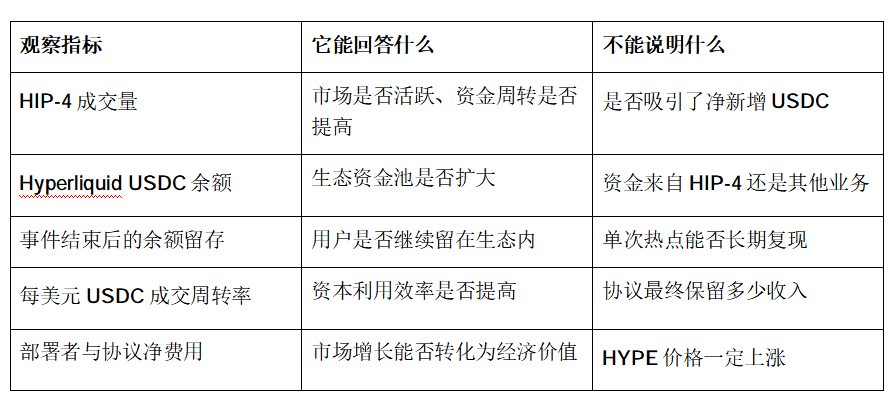
Thus, what HIP-4 truly needs to verify is not "how many new markets have launched" but rather three stricter questions:
Firstly, can it attract new users and new funds from outside Hyperliquid? Second, after event settlement, do users continue to leave USDC on the platform? Third, how much economic value can the platform ultimately retain among deployer shares, Builder fees, and protocol fees.
If these three metrics improve simultaneously, the prediction market will become a new engine for the USDC flywheel; if it is only existing funds cycling between different products, HIP-4 is more about increasing turnover rate rather than expanding the balance sheet.
When probabilities also start trading, data tools become even more important
The prediction market compresses complex views into a percentage, but the simpler the percentage, the easier it is to overlook its underlying conditions.
The quote for "BTC reaching $85,000 before October 1" is 45%. This number alone cannot tell you how deep the market is, whether the quote is driven by a few accounts, whether the perpetual funding rate is moving in sync, if the open interest is rapidly piling up, and whether big players are hedging on the other side.
HIP-4 provides the "market answer," while AiCoin helps users check the funding evidence behind this answer.
By entering Hyperliquid through the exclusive AiCoin portal and using the invite code AICOIN88, you can receive 4% fee rebate according to the activity rules:
Exclusive link: https://app.hyperliquid.xyz/join/AICOIN88
Final Judgment
The imagination of HIP-4 does not lie in whether Hyperliquid should become another Polymarket, but in how it packs originally fragmented markets into the same account:
Perpetual contract trading price paths, outcome contract trading event endpoints; HyperCore manages the order book and settlement, deployers continuously increase market supply, USDC undertakes unified quotes and capital retention, while AQAv2 attempts to convert stablecoin scale into protocol income.
This is a logic that is more complete than just "adding a prediction feature."
But whether it can become a second growth flywheel still needs to be verified by net deposits, retention after settlement, liquidity quality, and protocol net income, rather than just by looking at market quantity or short-term trading volume.
When Hyperliquid simultaneously starts pricing for both price and probability, it competes not only for the share of cryptocurrency trading assets but also for all clearly defined, publicly traded, and ultimately settled real-world events.
Exclusive Benefits for AiCoin Users
👉 Input the invite code AICOIN88 when binding your Hyperliquid account to enjoy a 4% fee rebate.
🔗 Exclusive registration link:
https://app.hyperliquid.xyz/join/AICOIN88
📖 Beginner's Tutorial:
- "AiCoin PC Terminal Hyperliquid Authorization Trading Tutorial":
https://www.aicoin.com/zh-Hans/article/514197
- "AiCoin Mobile Terminal Hyperliquid Authorization Trading Tutorial":
https://www.aicoin.com/zh-Hans/article/541383
- "Zero Basics Entry! Hyperliquid First Trade Ultra Detailed Illustrated Tutorial":
https://www.aicoin.com/zh-Hans/article/510225
📖 Community Communication:
- Telegram:
https://t.me/AiCoinWhaleData
- Discord:
https://discord.gg/D7UjAcFrah
- AiCoin Group Chat:
https://www.aicoin.com/link/chat?cid=N6OVMor5g
The content of this article only represents the author's personal views and does not represent the platform's position. The opinions, conclusions, and suggestions in the article are for investors' reference only and do not constitute any investment advice related to the platform. Engaging in US stock investment still requires bearing market risks, regulatory risks, and compliance risks with local laws and regulations (especially foreign exchange control and offshore investment declarations).
免责声明:本文章仅代表作者个人观点,不代表本平台的立场和观点。本文章仅供信息分享,不构成对任何人的任何投资建议。用户与作者之间的任何争议,与本平台无关。如网页中刊载的文章或图片涉及侵权,请提供相关的权利证明和身份证明发送邮件到[email protected],本平台相关工作人员将会进行核查。