

Article|Wang Yuchan, Wen Lihong
Editors|Zhang Yuxin, Yang Xuan

Hot Money
When Zhu Kexin learned about the annual salary of a colleague from 1998, a front-line algorithm researcher who switched to Tencent, she felt dizzy.
The increase was as high as three times — during a dinner, Zhu Kexin and her colleagues at the big company guessed how much the others were making, "boldly guessing an increase of 50%." But the answer was revealed to be an increase from one million to three million, far exceeding their expectations. Throughout the meal, everyone at the table re-evaluated their self-worth.
The old salary coordinates were rewritten rapidly, and the "dizziness" kept happening. Just a year after that job switch, Zhu Kexin said that now nobody would be surprised at a front-line researcher making three million a year.
The age group with high annual salaries is still decreasing.
At Tencent Mix, a post-2000 graduate has yet to leave the campus, yet as an intern, he is earning a daily salary of 5,000 yuan, which is much higher than the monthly income of most white-collar workers in this big city. His supervisor had informed him, "If you graduate and get regularized, you can get an annual salary of three million." This young man told 36Kr frankly that he wants to graduate immediately this year.
From Silicon Valley to China, as top AI talents are being fought over with annual salaries in the tens of millions and "the top position warms greetings" — ByteDance’s top AI position, Wu Yonghui, was secured after Zhang Yiming spent eight months negotiating; Tencent’s top AI position, Yao Shunyu, was personally negotiated by President Liu Chao Ping in Silicon Valley; and Meta not only can offer sky-high salaries but Zuckerberg personally delivers "homemade soup" to the OpenAI researchers he wants to recruit — at every level of the talent pyramid in AI, prices are being pushed higher.
Those at the pinnacle can earn over 10 million a year — Yao Shunyu entered Tencent, and DeepSeek's Guo Daye switched to Byte, both rumored to have annual salaries exceeding 10 million. But this group is very small; each company’s model team typically has only a few people.
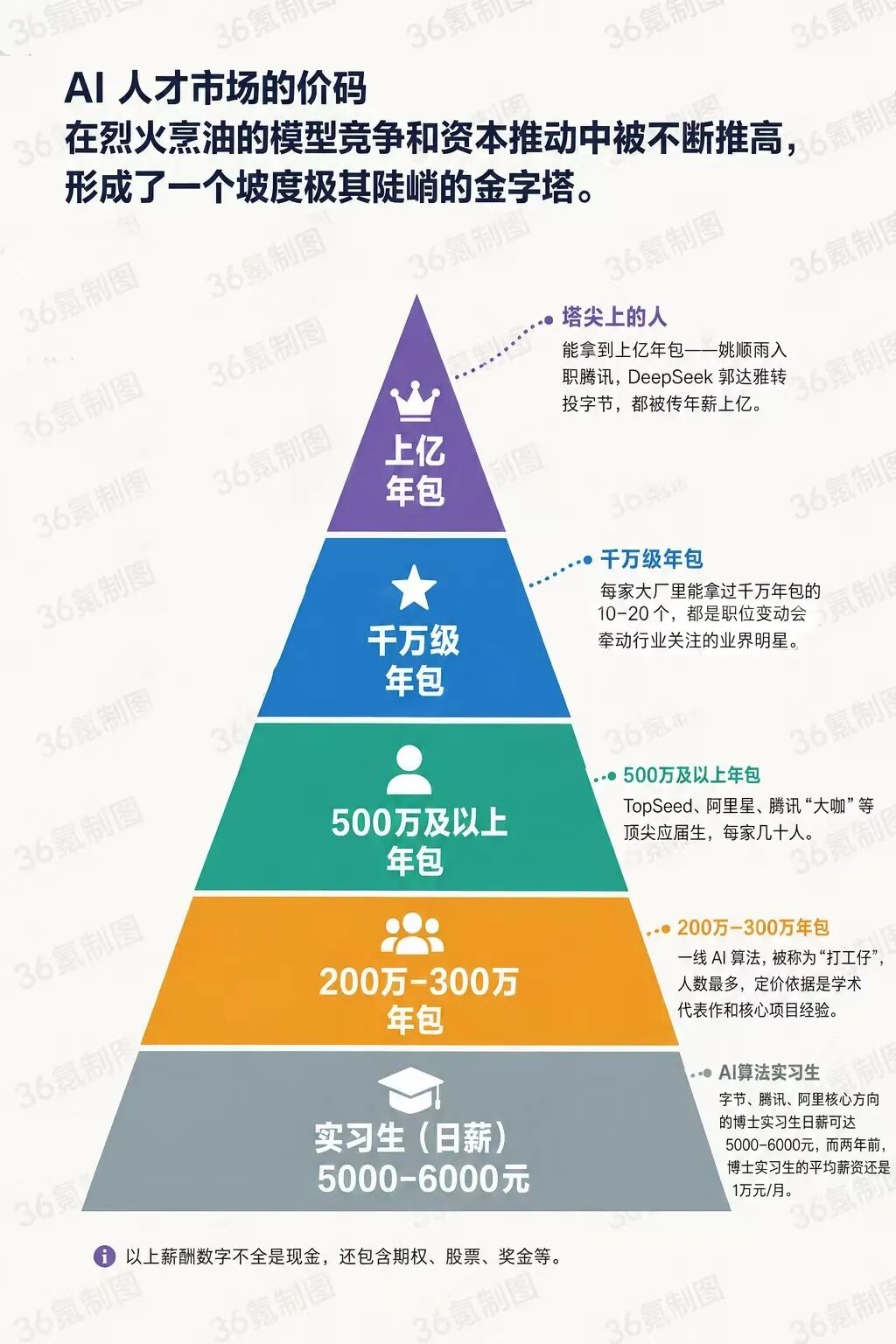
The next tier consists of individuals in large companies earning over 10 million a year. A headhunter told 36Kr that each large company has about 10-20 such individuals, each of whom is an industry star whose job changes attract attention.
The next layer down includes top-tier graduates from TopSeed, Alibaba, and Tencent, with annual packages of "5 million and above," with dozens in each company. A doctoral candidate who joined Byte this year explained the breakdown of a 6 million salary: "It's not all cash; it also includes Byte options, Doubao stocks, and bonuses." He also mentioned that some graduates can earn more than 6 million, "but those are extremely rare."
Further down are first-line AI algorithms with salaries ranging from 2 million to 3 million, colloquially known as "worker bees," and the most numerous, whose pricing is based on academic works and core project experience. "This year, an annual salary of over 2 million is an acceptable baseline for an ordinary algorithm researcher; last year, it was over 1 million," said an algorithm researcher from a major company. "I have a friend who previously received an annual package of over 2 million from Seed but ultimately rejected it because another AI company offered him over 3 million and a higher position."
At the very base of the pyramid are AI algorithm interns. Doctoral interns in core directions at Byte, Tencent, and Alibaba can earn daily salaries of 5,000-6,000 yuan, whereas two years ago, the average salary for doctoral interns was still 10,000 yuan/month, equivalent to just two days’ pay now.
As monthly salaries for interns have exceeded 100,000 yuan, the competition for AI talent, especially for large model researchers, has entered a stage of full-blown intensity from the top of the pyramid to the bottom.
This dynamic reflects the competitive evolution among China's model companies: Byte was originally the most generous buyer of AI talent in the market, but in the past year, Tencent has also ramped upits recruitment efforts, becoming a major financial backer of top talent. Meanwhile, DeepSeek and Yuezhian have secured substantial financing in the primary market, Zhipu and MiniMax have gone public, and large model startups have also raised additional funding.
Traditionally, “talent” has been an important variable in competition across various industries. However, the intensity of talent competition in the current AI industry is significantly higher than in the last hot money influx into the internet industry. The only comparable period might be the rise of the semiconductor industry during 1950-1970 with its fierce competition for core talent.
Both of these industries share a common characteristic: companies may appear to possess technology, but the real holders of technology are those dozen core technical personnel. Therefore, talent has become the crucial variable that can "choke" companies in competition.
Thus, ,the competition among AI companies has evolved into a competition among talents. The flow of talent intensely changes every company involved, and deeply impacts the overall landscape of the AI industry.

Buying Recipes
The core talent in large companies and large model companies is what they fight over — the "recipe" of technology held by key talents.
When training models, researchers use the term "recipe" to describe various aspects of model training: model size, data ratios, training routes, key tricks, etc.
The success of a model is achieved through extensive trial-and-error experience. Those who have gone through all this possess this knowledge. It is similar to the early semiconductor industry: process parameters, yield, materials, and manufacturing tricks are difficult to fully write into patents. Therefore, finding the right person can provide access to these "invisible know-how," quickly bridging the gap in model training time and reducing the distance from competitors.
Recipes are expensive for a reason. The reset cost of model training is extremely high: training a base model or fine-tuning a 100 billion parameter model can cost hundreds of thousands or even millions of dollars in computational power for a single full experiment. If the training direction or method is incorrect, the loss far exceeds the annual salary of several researchers.
More importantly, there are very few who possess core recipes.
Unlike most so-called entrepreneurial experience in the internet era, the "10,000-card training experience" valued in the model community is only available to a few top-tier companies and leading laboratories that have enough computing power and data support. Among these few companies, those who can obtain the qualification of "training commander" are also extremely rare.
"In all of China, only about 200 people can spearhead large-scale pre-training." Headhunter York said. A Byte HR also told 36Kr that when they began to focus on headhunting core researchers in 2024, they drew up a list that included only a few hundred people.
When the people who possess core recipes begin to move, the training insights that were originally held by a few companies will be "open-sourced," enabling cross-company migration and ultimately raising the ceiling of the entire industry. This is akin to: when a recipe for a dish is initially held by only a few chefs, those restaurants with these chefs may seem very strong temporarily; however, once a top chef changes jobs, the recipe will quickly spread, and no restaurant will maintain a leading position for long, but more delicious restaurants will raise the ceiling of the entire industry.

In the second half of 2024, Zhou Chang, who was originally responsible for multimodal pre-training at Alibaba, joined Byte, and although Byte paid a tens of millions annual salary for this, Zhou Chang's arrival quickly helped Byte achieve breakthroughs in multimodal capabilities, forming the basis for the now explosively popular Seedance model.
Another industry insider told 36Kr that Cheng Ye'an, a former Zhipu researcher and core contributor to GLM-4.5 and GLM-4.5V, joined Yuezhian this year and is listed among the authors of the K3 technical report. His main contribution lies in post-training on Agentic Coding, which is Zhipu's forte.
For a company, when core talent departs, it suffers not just the loss of workforce, but also the collective knowledge accumulated by the team — experimental paths, failure records, debugging experience — are completely handed over to competitors. This handover may not even need to wait until the employment begins. Some people start sharing how things are done within the team during interviews. The interview itself has become the most frequent channel for leaking technical details.
If those who hold the recipes choose to start their own businesses, they will certainly become favorites of investors.
Former SenseTime research director Liu Yu experienced a complete closed-loop from data processing, training infrastructure, and model development to product landing in 2024, when multimodal was just starting, managing over 4,000 GPUs to train models. At that time, talents with experience in training were already very scarce. Therefore, when he left to start his own business, investors flocked to him immediately. Due to the large number of investors he brought in, Liu Yu had to mostly shut the door to meetings, leading to the industry calling him "someone rarely seen in the investment circle."
The flow of talent itself is an important part of the competitive race among domestic large model companies. "The core of model competition mainly lies in computing power, data, and people," headhunter Sam told 36Kr. "Finding the right people ensures that computing power and data are not wasted. Otherwise, no matter how much money you spend, it will be futile."
This is why "people" have become an important contested asset in the competition within the AI industry.
Of course, in addition to finding that small group of recipe holders, large model companies also need to find many smart and reliable young people to do the "grunt work." Thus, a comprehensive war for talent has begun.

Strange Tactics
Two years ago, the high ground and loss source of AI talent were primarily Baidu and Alibaba, as they had led technically. However, recently, Byte, which is rich in AI talent, has also become a new "mountain" and target for poaching. An insider from a modeling major company revealed to 36Kr that they are benchmarking Byte's data system, poaching people position by position, "as long as they are poached, the salary can double."
Byte quickly reacted. By the end of 2025, ByteDance sent a company-wide email announcing a 35% increase in bonuses and a 1.5 times increase in salary adjustments, as well as the implementation of a new job grade system, raising the salary caps of each grade. The adjustments related to job grades were considered targeted measures for AI talents: high-paid researchers couldn't fit into the original job grading framework.
Retention measures have continued to be intensified this year: Byte's "Doubao stocks," which are only issued to AI-related employees, now have a clear price and redemption opportunity, and those holding Doubao stocks can opt to exchange more of their annual bonuses or total packages for Doubao stocks. This is like the options that were equally valuable at the founding of Byte. These measures might all be triggered by a common reason — nearly 70 technical backbones left Seed throughout the entire last year.
Tencent is not only generous with money but also with positions. High-profile researchers from Silicon Valley, such as Yao Shunyu and Tian Yonglong, can directly lead a team upon joining Tencent, or even become the head of the entire model team. With such examples, headhunters have also gained conversation material when poaching: "If you stay at OpenAI, you’ll just be one among hundreds of top researchers; if you come to a Chinese big company, you can hold the business's top position."
However, money and positions are not everything. Many entrepreneurial companies have their own "strange tactics" for recruitment.
Two AI startups in Shanghai often target the same person at the same time. This year, both companies were interested in a doctoral student who had originally prepared to accept one of their offers but was ultimately poached by the other company backed by the university. The reason was not money, but because the other side claimed they could offer him "a teaching position at a certain university in Shanghai."
Zhipu might be the pioneer in this "university route." The company’s founder and chief scientist, Tang Jie, and the core management team are almost all from Tsinghua University. In this strong "academic atmosphere," many Tsinghua students choose to join Zhipu as a stepping stone to apply for Tang Jie's master's or doctorate.
If unable to offer strong resources, HRs or headhunters may resort to "psychological tactics."
Li Qing works for a company ranked among the "six small tigers of large models." Recently, he receives several headhunting calls every week, often during working hours, where the other side employs "psychological tactics" — they are not in a hurry to discuss positions or salaries but instead focus on negative topics like the stock price of Li Qing's company, work intensity, and his health, indirectly undermining his confidence in his current company.
Li Qing recalls that one headhunter was keen to talk about his company's stock every time they spoke. "Your company's stock is falling; wouldn't you consider opportunities elsewhere? Once xx goes public, its potential will definitely be greater."
Large companies have a more systematic approach, which we call "saturation employment."
A Byte employee told 36Kr that Seed keeps two teams with similar capabilities in some core research areas beyond the resource allocation level. "Thus, even if one team is completely poached by competitors, the other can definitely fill the gap. Even if you leave a core position in Byte, it won't make a splash."
Headhunters can also sense this "saturation employment." One headhunter told 36Kr that among the companies he works with, Tencent tends to concentrate on talent searching during team formation, but Byte's poaching rhythm shows little fluctuation, "regardless of whether they lack personnel currently, Byte continues to look for talent."
免责声明:本文章仅代表作者个人观点,不代表本平台的立场和观点。本文章仅供信息分享,不构成对任何人的任何投资建议。用户与作者之间的任何争议,与本平台无关。如网页中刊载的文章或图片涉及侵权,请提供相关的权利证明和身份证明发送邮件到support@aicoin.com,本平台相关工作人员将会进行核查。