Recently, a discussion about the Robinhood ecosystem summarized the potential benefits into a single path: PONS → UNI → HOOD → ARB → ETH.
The value of this path lies not in whether it can be directly converted into a "buying list," but in posing a question worthy of serious study: When Robinhood incorporates stock tokens, stablecoins, wallets, DEXs, lending, and perpetual trading into an on-chain system, how will value be transmitted through financial infrastructure?
If Robinhood merely launched a crypto trading portal, it would still be an internet brokerage that has expanded its digital asset business. However, if Robinhood Chain can continuously support users, assets, and trading activities, Robinhood's role will change: it will no longer just be the front end for distributing financial products, but will start to participate in the issuance, circulation, collateralization, and settlement of financial assets.
The core judgment of this article is: The importance of Robinhood Chain lies not in it adding another Layer 2, but in a financial platform with a large-scale retail user base starting to use blockchain as the underlying technology for running financial products.
This is also the correct starting point for understanding the relationship between PONS, Uniswap, HOOD, ARB, and ETH.
1. Robinhood is transitioning from a "trading application" to a "financial system entry point"
Robinhood's early value primarily came from user entry. It transformed stock investment from the professional account experience of traditional brokerages into a consumer-grade product aimed at young users and small investors through mobile access, low barriers to opening accounts, and zero-commission trading.
However, the user entry is just the first layer of value. As Robinhood adds crypto assets, wallets, retirement accounts, cash management, options, futures, memberships, prediction markets, and asset management, the platform's competition is no longer just about a single stock trade, but rather the entire share of the user’s financial wallet.
Robinhood Chain is a further extension of this strategy. The official announcement in July 2026 confirmed that the Robinhood Chain public mainnet has launched, built on the Arbitrum platform, and positioned as a Layer 2 targeting financial services and tokenized real assets. The announcement also disclosed that initial partners for the on-chain ecosystem included Uniswap's dedicated AMM, Pleiades AMM, as well as infrastructure partners such as Alchemy, BitGo, and Chainlink.
The official description of Stock Tokens has also gone beyond mere price tracking: eligible users can trade 24/7 on Robinhood Chain and contribute relevant assets to lending pools or use them as collateral for trades; Robinhood Wallet has also integrated with trading venues such as Uniswap, Rialto, Lighter, Arcus, and 1inch.
This forms a new structure for the financial platform:
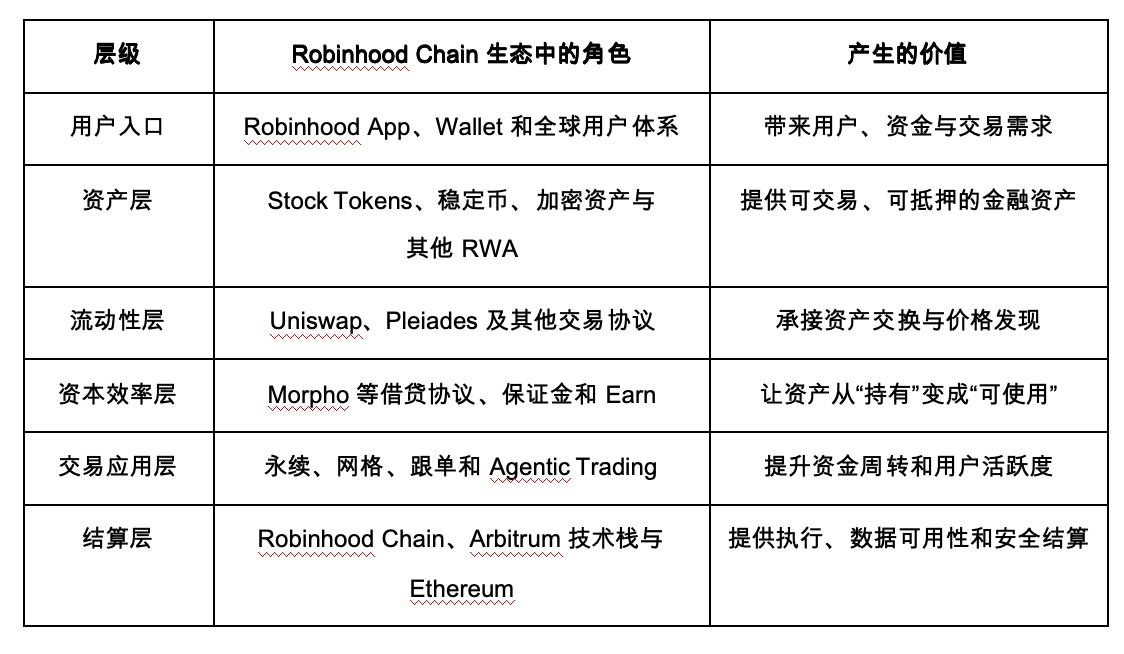
Traditional brokerages primarily handle accounts and trades; Robinhood is attempting to integrate assets, liquidity, and applications into the same programmable financial network.
2. Why is PONS a window into the application layer?
PONS is placed at the forefront because it represents the application layer closest to user trading behavior.
No matter how advanced the technology of a chain may be, it ultimately requires applications to create real transactions. Launchpads, trading markets, wallets, lending protocols, and payment products are all specific entry points that convert blockchain infrastructure into user behavior.
PONS is an unmanaged launchpad on the Robinhood Chain and mentions its fixed supply, Uniswap v4 graduation mechanism, fee distribution, and buyback-destruction logic. These specific mechanisms require further verification in conjunction with protocol contracts, on-chain transactions, and official disclosures, and therefore cannot be directly used as established facts. However, from an analytical framework perspective, the "application layer entry" represented by PONS is indeed significant: it may become the place where users first encounter Robinhood Chain, where projects first gain liquidity, and where new assets first enter the trading system.
The economic value of the application layer typically comes from three capabilities.
The first is traffic aggregation. If a large number of assets are issued, traded, and user behaviors are concentrated at the same entry point, applications may gain strong network effects. The second is fee capture. The more frequently transactions occur, the more likely the protocol or platform is to earn fees from transactions, issuance, and other service revenues. The third is liquidity orientation. If projects are directed to public liquidity venues like Uniswap after issuance, the launchpad is not only a tool for issuance but also becomes part of the asset lifecycle.
However, the value of PONS cannot be judged solely by transaction volume. What truly needs to be observed is whether transaction volume is driven by real users, whether assets can be traded continuously, whether fees are sustainable, whether the token economic model is transparent, and whether activities heavily rely on short-term incentives.
Therefore, PONS is more suitably defined as an application layer thermometer for the Robinhood Chain, rather than a complete representative of the entire ecosystem's value.
3. Why might Uniswap become the liquidity amplifier for Robinhood Chain?
If PONS represents the starting point of trading activity, then Uniswap represents the liquidity layer after assets enter the public market.
Robinhood has confirmed that Uniswap will deploy a dedicated AMM on the Robinhood Chain and serve as one of the main public liquidity protocols. This is not an ordinary ecosystem partnership. For RWA, the completion of asset issuance is just the first step; the true determinant of its financial value lies in whether it can enter a continuous price discovery, exchange, and combination process.
Stock tokens, stablecoins, ecosystem tokens, and other on-chain assets ultimately need an exchange medium. A mature AMM can provide pooled liquidity, automatic pricing, and permissionless trading interfaces, enabling assets to be recognized and utilized by wallets, aggregators, and other protocols.
Structurally, Uniswap may gain three types of incremental opportunities:
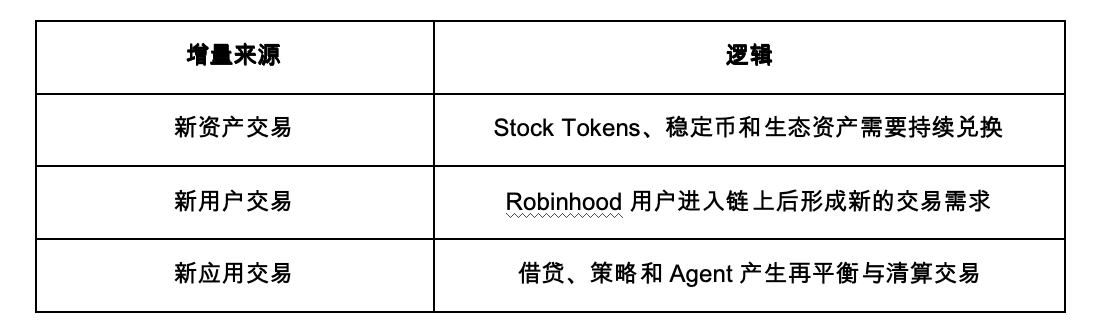
UNI is the "amplifier closest to the transaction," meaning that Uniswap does not need to bet on a single asset; as long as the overall transaction volume on Robinhood Chain expands, the public AMM may benefit from broader liquidity demand.
However, it is essential to distinguish between protocol usage and UNI token value capture. An increase in Uniswap transaction volume does not automatically equal a rise in the price of the UNI token. There are still intermediary processes involving protocol fees, fee switches, governance decisions, treasury allocations, and token economic mechanisms between the two. It can be said that Uniswap might be an important liquidity infrastructure for Robinhood Chain, but ecosystem trading volume cannot be directly equated to guaranteed earnings for UNI.
From the perspective of RWA, the real significance of Uniswap is that it allows tokenized assets to no longer be locked within the issuance platform, but to have the opportunity to become part of the public chain's financial market.
4. The core value of HOOD: user, account, and asset distribution rights
In this chain of transmission, HOOD represents Robinhood itself. What it acquires is not the fees from a single transaction, but the most challenging-to-replicate resources within the entire ecosystem: users, accounts, brand, funding entrances, and asset distribution capabilities.
Robinhood's official announcement shows that Robinhood Chain is natively connected to Robinhood Wallet and integrates stock tokens, lending, collateral, DEX, and perpetual products into the same ecosystem. This means Robinhood can concentrate financial behaviors that were previously scattered across different platforms into its product system: users enter the market through the App or Wallet, hold assets, use stablecoins, trade stock tokens, engage in lending, and even execute strategies through Agents.
This is a typical expansion of the "account economy."
The more asset categories users own on a platform, the higher the migration cost usually is; the more financial functions available in an account, the higher the lifetime value of each user. Robinhood does not need every user to become a professional on-chain trader; as long as it can hide complex on-chain functions behind familiar product experiences, it can convert the blockchain's technological capabilities into financial services that ordinary users can use.
Related analyses of Arbitrum have also emphasized this point: for blockchain to achieve scale, it should not require each user to manage keys, connect to RPCs, or read block explorers independently; blockchain can handle settlement and asset circulation in the background while users continue to use familiar mobile interfaces.
Therefore, the potential value of HOOD does not only stem from crypto trading volume but from whether it can convert RWA and DeFi into account functionalities usable by ordinary investors.
5. The position of ARB: the value of the tech stack and token value must be separated
The use of the Arbitrum tech stack by Robinhood Chain is the part of this transmission chain that is most easily over-interpreted.
From an infrastructure perspective, the value of Arbitrum is very clear. It provides Layer 2 technology, Ethereum compatibility, development tools, and a financial application ecosystem to Robinhood, allowing it not to start building an independent blockchain from scratch.
Robinhood's choice of Arbitrum instead of starting an entirely independent Layer 1 indicates that large financial platforms may prioritize the following factors:
First, rapid access to Ethereum's developer and application ecosystem. Second, the ability to lower user trading and asset transfer costs. Third, the ability to utilize ready-made bridges, oracles, wallets, and DeFi tools. Fourth, the ability to maintain connectivity with a broader Ethereum financial network.
However, the value of the tech stack does not mean that ARB tokens will necessarily gain direct benefits.
To determine whether ARB can capture the economic value of Robinhood Chain, it is necessary to continue verifying specific Orbit or chain licensing arrangements, sequencer revenues, data availability costs, ecosystem incentives, cross-chain bridge fees, and whether there is clear value return for token holders. The referenced content raises the hypothesis of "ARB sub-packaging" or tech stack profit-sharing, which is worth researching, but cannot be established as a fact in the absence of protocol documents or financial disclosures.
A more prudent conclusion is that the launch of Robinhood Chain enhances Arbitrum's demonstration effect and narrative as an enterprise-grade financial tech stack; whether this ecological impact can translate into ARB’s direct economic value needs individual analysis.
6. ETH: the underlying settlement layer, but not the most direct high-elasticity beneficiary
ETH is at the bottom of this transmission chain because Robinhood Chain, as a Layer 2 based on Arbitrum, needs to connect with Ethereum's security and settlement system.
From a long-term structure perspective, a Layer 2 operated by a large financial platform that carries RWA and on-chain transactions does indeed help reinforce Ethereum's narrative as a public settlement layer. It proves that traditional financial users do not necessarily need to use the Ethereum mainnet directly, but financial products can operate on Layer 2 and ultimately rely on Ethereum's security and data settlement system.
However, the way ETH benefits is more akin to an infrastructure-type benefit rather than from the application layer. The data submission and gas consumption of a single Layer 2 may not be sufficient to have a significant short-term impact on ETH prices; relative to Ethereum's overall scale, Robinhood Chain's marginal cost contribution may be limited.
Thus, the most reasonable judgment regarding ETH is that Robinhood Chain's value is primarily manifested in ecosystem adoption, positioning as a financial settlement layer, and long-term network effects, while short-term price elasticity may be weaker than that of PONS, HOOD, or infrastructure that directly undertakes transactions.
7. The truly important transmission chain: user entry — asset — liquidity — capital efficiency — settlement
Rather than understanding this relationship as a "speculative transmission chain" among five tokens, it is more insightful to view it as a value chain of financial infrastructure:
Robinhood provides users and accounts, RWA provides assets, applications like PONS generate trades, Uniswap provides public liquidity, lending protocols enhance capital efficiency, Arbitrum provides the execution environment, and Ethereum provides settlement and security.
This structure is more valuable for analysis than individual token narratives.
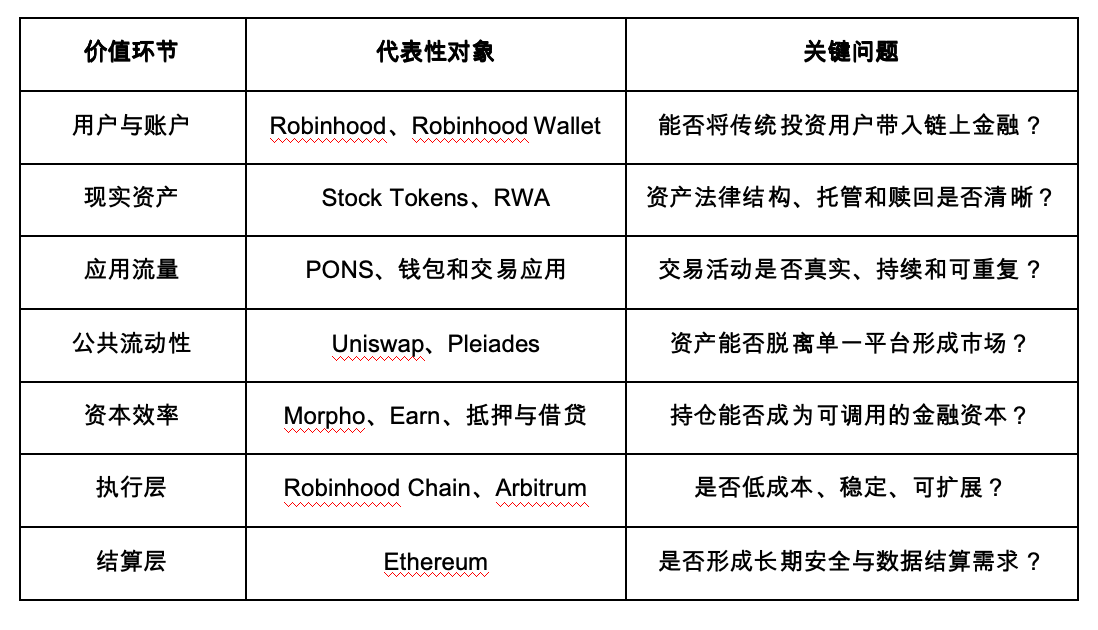
The true innovation of RWA occurs within this chain: assets are no longer merely bought and held but can be transferred, traded, collateralized, lent, combined, and automatically managed.
8. How should the Robinhood ecosystem be observed?
The most worthy indicators to track within the Robinhood ecosystem are not short-term fluctuations of a particular token, but several deeper metrics.
First is asset supply. It is necessary to observe exactly what stock tokens, ETFs, stablecoins, and other real assets are on Robinhood Chain, who the issuers are, the underlying assets, and whether the legal structures are consistent.
Second is on-chain liquidity. Different assets should be compared in terms of the number of holders, transfer volume, trading markets, cross-chain deployments, and price deviations. The issuance of an asset does not mean that an effective market has been formed.
Third is DeFi usage. It is important to observe whether stock tokens enter Uniswap, lending pools, collateral markets, or other financial protocols. Only when assets are used does the on-chain finance demonstrate its incremental value compared to traditional accounts.
Fourth is ecological transmission. Whether the growth in trading on Robinhood Chain truly generates demand for Uniswap liquidity, Morpho lending, stablecoin settlements, and Ethereum settlement requires verification through on-chain data and protocol disclosures, rather than relying solely on narrative deduction.
The value of AiPlot lies in transforming "project announcements" into data objects that can be continuously observed: issuance volume, holder count, transfer volume, cross-chain distribution, trading markets, DeFi TVL, and asset correlations collectively form a real picture of the RWA ecosystem.
9. Conclusion: Robinhood Chain could be a key example of RWA moving from products to a network
PONS → UNI → HOOD → ARB → ETH is not a price prediction formula that can be mechanically replicated, but it reveals the multi-layer structure of Robinhood Chain well.
PONS represents the application layer and trading activities; Uniswap represents public liquidity; HOOD represents users, accounts, and the distribution of financial products; ARB represents the enterprise-level on-chain tech stack; ETH represents the underlying secure and settlement network.
What truly deserves attention in this structure is that Robinhood is attempting to connect "comprehensive financial accounts familiar to users" with "open on-chain financial infrastructure."
If Stock Tokens can continue to expand, stablecoins can become settlement mediums, DEXs like Uniswap can provide liquidity, protocols like Morpho can facilitate lending, Robinhood Wallet can enhance user experience, Arbitrum can provide execution layers, and Ethereum can deliver settlement layers, then RWA will no longer just be a tokenized package of traditional assets but will become a new financial network that can be traded, collateralized, and combined.
Of course, the specific economic model of PONS, the value capture method of ARB, and the marginal benefits of ETH still need to be validated with on-chain data and official documents. What is most affirmable is not how much profit any particular token will gain, but that Robinhood is undertaking an important experiment in financial infrastructure: making blockchain no longer just a market that users proactively enter but a technical layer supporting the backend operations of financial products.
This may be the greatest significance of Robinhood Chain for the RWA industry.
免责声明:本文章仅代表作者个人观点,不代表本平台的立场和观点。本文章仅供信息分享,不构成对任何人的任何投资建议。用户与作者之间的任何争议,与本平台无关。如网页中刊载的文章或图片涉及侵权,请提供相关的权利证明和身份证明发送邮件到[email protected],本平台相关工作人员将会进行核查。