Probability no longer belongs solely to any one platform; the aggregation, derivatives, and intelligent execution infrastructure surrounding it are taking shape.
Written by: Farmer Frank
Prediction markets are undergoing an interesting change recently.
From Binance and Coinbase to Interactive Brokers (IBKR) and Robinhood, leading players are shifting their focus and no longer obsessed with replicating a Polymarket.
Everyone is trying to figure out how to gradually make Polymarket and Kalshi "take a back seat" and become underlying capabilities that other financial products can directly access.
This is very much like today's stock trading, where users buy TSLA by clicking on Futu, Tiger, or Robinhood, and most users do not care where the orders ultimately flow, which Market Maker they go to, or which clearing system is involved.
The future of prediction markets may be similar.
The front end might be a brokerage, wallet, news app, or even an AI agent, with aggregators and routers in the middle, while Polymarket and Kalshi, which truly provide the markets, liquidity, and settlement, are increasingly like hidden financial infrastructures.
Looking back at DeFi, from AMM to aggregators, derivatives, professional market making, and intelligent execution, this path has already been traversed.
Prediction markets may also be entering a similar second half.
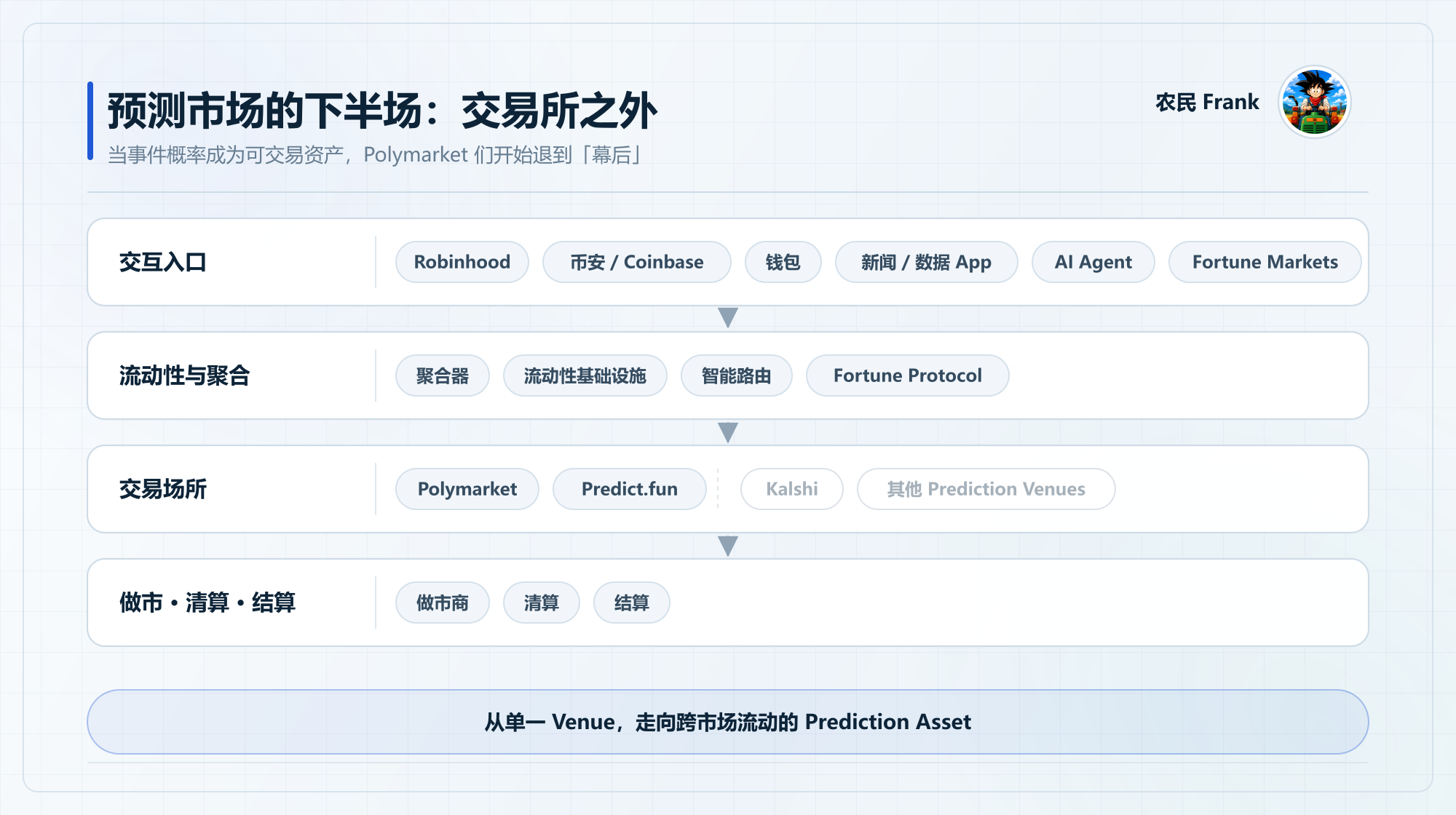
I. Prediction markets begin to "go behind the scenes" more
In recent years, prediction markets have proven that the "uncertainty" of the real world can indeed become a tradable asset with a price and liquidity.
From the U.S. presidential election to the World Cup and other sports events, crypto, macroeconomics, and entertainment culture, many issues that were originally only open for discussion have been compressed into buy-sell, profit-loss Event Contracts on platforms like Polymarket and Kalshi.
This is a crucial step, and once this layer of demand is gradually validated, the strategies of leading players begin to change significantly.
In April this year, Binance integrated Predict.fun, providing market capabilities through third-party prediction market infrastructure while offering its own front-end entry, allowing users to trade probabilistic events directly in the app; two months later, it further opened the Prediction Markets API to allow quantitative strategies, trading bots, and third-party products to directly access market data and trading capabilities.
Coinbase has taken a similar route, incorporating Prediction Markets into its "Everything Exchange," but initially, all market liquidity came from Kalshi and explicitly stated that it would support more Prediction Market venues in the future.
On the traditional finance side, IBKR has gone even further.
In May this year, IBKR directly integrated Kalshi, CME Group, and ForecastEx into a unified interface, allowing users to search for events, compare prices and liquidity from different exchanges within the same account without needing to open separate accounts.
Robinhood has also begun extending towards trading and clearing layers, collaborating with Susquehanna to operate Rothera, which took on the former MIAXdx/LedgerX CFTC-registered exchange and clearing infrastructure, routing some World Cup and professional baseball Event Contracts to this associated exchange since June.
The actions of these top players point to the same thing, namely that prediction markets are transforming from a "destination" that users need to actively visit to a financial capability that can be accessed by other products.
In the past, if we wanted to trade the upcoming U.S. midterm elections, we might have needed to open Polymarket and then find the corresponding market; in the future, it could be an event card appearing on the Binance homepage or a real-time probability next to a financial news item on Robinhood.
Users may not even realize they are trading in prediction markets, and whether orders ultimately come from Predict.fun, Kalshi, CME, or are split across multiple markets by routers is not as important.
This also implies that prediction markets are becoming increasingly invisible while Prediction Assets are becoming increasingly important.
Once we reach this step, the real interesting question for the industry changes—how should the liquidity scattered across Polymarket, Kalshi, Predict.fun, and even more markets be organized?
For example, around the U.S. midterm elections, where is the best price? Where is the deepest liquidity? Is there a probability bias between two markets?
This set of questions is quite similar to early DeFi. After Uniswap proved that tokens could be traded on-chain, the market did not stop at "recreating ten Uniswaps". Instead, what truly emerged were liquidity aggregators like 1inch, smart execution networks like CoW Swap, derivatives infrastructures like Hyperliquid, along with the market makers and quantitative trading systems that grew around them.
Prediction markets are gradually reaching a similar stage.
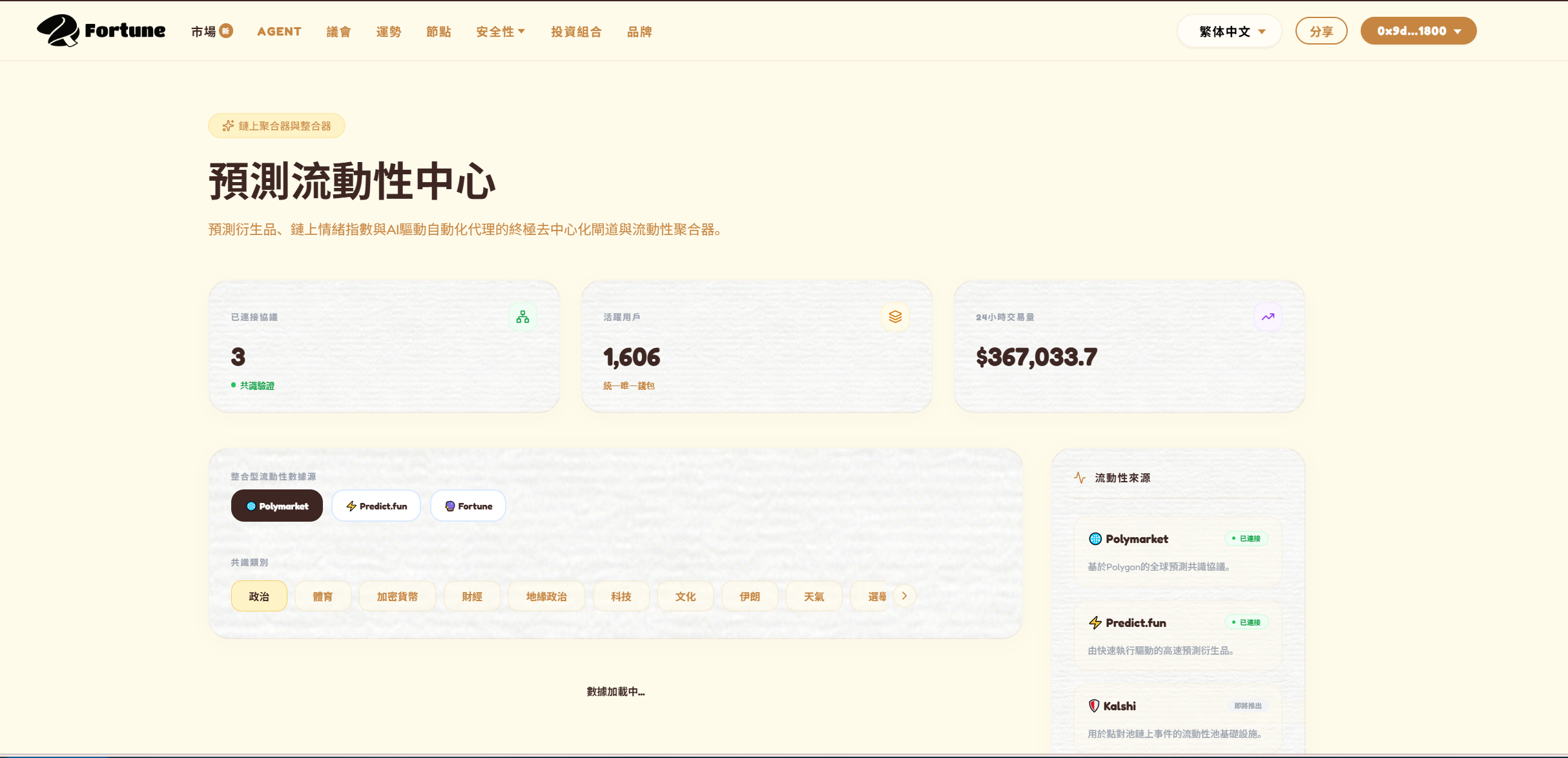
Fortune is a very typical early case; as of August this year, it has completed multiple rounds of financing including Seed and Pre-A, accumulating over $4 million for Fortune Agent upgrades, integrating more prediction markets, and expanding liquidity and related infrastructure.
What it aims to tap into is "The Liquidity Infrastructure for Prediction Markets," and recently it further integrated Polymarket's liquidity along with the already supported Predict.fun into a unified access point for Fortune Markets.
Users can now view event markets from different liquidity sources in one access point and compare their liquidity, trading volumes, and implied probabilities before establishing positions.
The new trading process adds features like Outcome Selection, Position Preview, and Portfolio, gradually linking market discovery, position establishment, and subsequent management.
In the past, if a user wanted to trade the same category of political, sports, or crypto events, they might have needed to enter several platforms to search and compare prices and depth themselves; now, Fortune Markets compresses this process into "discover events → compare different platforms → choose price and liquidity → establish positions → unified management".
Theoretically speaking, aggregating prediction markets is far more complex than a regular DEX aggregator.
1 ETH in Uniswap and Curve is still the same ETH, but two seemingly identical prediction markets may become completely different assets due to slight differences in deadlines, event definitions, adjudication conditions, or settlement rules.
From this perspective, Fortune's first step is not to create more markets but to transform the Prediction Assets originally scattered across different platforms into a more easily searchable, comparable, and tradable asset pool.
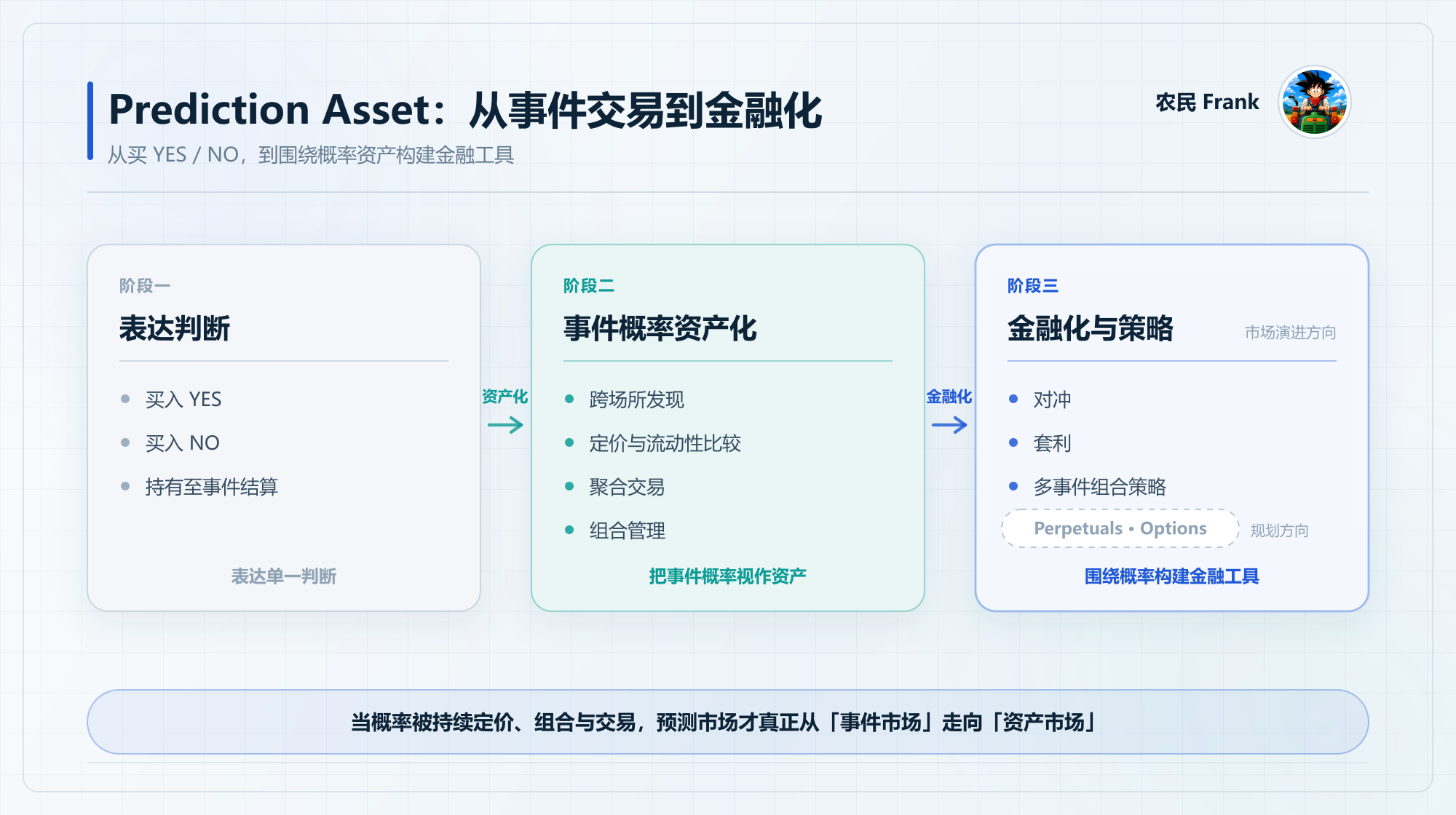
2. Moving from "buy YES / NO" to more complete financial products
Once assets are connected, the next set of questions naturally changes.
The most common trading method in today's prediction markets is still betting on a positive outcome by buying YES; if unsure, buy NO, and then wait for the event to settle.
This is very akin to the early days of Crypto, where only spot trading existed.
However, if Prediction Assets eventually develop into a sufficiently large asset class, trading demand theoretically will not remain solely in binary betting. When the underlying asset size is large enough, markets typically continue to grow leverage, options, combinations, hedges, and structured products.
This is also the reason why Fortune includes Prediction Derivatives in its overall product direction; it aims to further transform Event Contracts from a "wait for the final answer" binary contract into a Prediction Asset that can be combined, managed, and utilized with strategies.
This step is indeed critical.
Because the true maturity of an asset class is often not about how vibrant the spot market is, but whether it can form a sufficiently rich financial structure around it.
BTC gradually formed today's complete trading system after transitioning from spot to perpetuals, options, and structured products; the stock market is similarly equipped with futures, options, ETFs, and various combination tools.
Fortune is betting that Prediction Assets will also undergo a similar financialization process.
However, this also raises another question: If a user no longer faces just a few markets but rather hundreds or thousands of Prediction Assets, or even different combinations and strategies, can a person still manage all the research and execution on their own?
This is precisely where Fortune's AI Agent should come into play.
3. Allowing AI to directly enter the trading workflow
Realistically speaking, prediction markets might be one of the most comprehensible financial scenarios for AI agents.
Because it inherently possesses a very clear transmission chain: changes in the real world → new information emerges → event probabilities change → markets reprice → trading opportunities arise.
However, traditional trading requires manually completing the entire process, from reading news, scrolling through social media, analyzing market sentiment, to judging whether this news will alter the probability of a certain event, and finally finding the corresponding market, comparing prices, defining positions, and executing trades.
Fortune Agent aims to compress this chain.
The currently launched Trading Agent is designed as a Multi-Agent System, continuously seeking opportunities from three categories of signals: News, Sentiment, and Arbitrage, and further validating conditions, where users can set the trading amount, risk level, and whether to enable Automated Trading after connecting their wallets.
If we delve deeper into Fortune's subsequent descriptions of the Agent, including 24/7 Market Intelligence, Structured Decision-making, Risk Management, and Execution, the entire product logic ties together completely with Fortune Markets.
For example, if a macro event suddenly presents new policy signals.
The Agent first captures the information and judges that it may alter the true probability of a certain event; then, Fortune Markets can simultaneously provide related Prediction Assets, prices, and liquidity from different venues; if the market quotes do not yet fully reflect the new information, the Agent further seeks more suitable trading opportunities and execution paths.
At this point, what Fortune desires is no longer just an "AI predictor," but something closer to connecting the information layer, asset layer, liquidity layer, and execution layer.
Additionally, there is an Incentive Layer responsible for getting this network off the ground. Fortune has already established an incentive system centered around F Points, including Daily Check-ins and invitation mechanisms; when users invite other participants, they can earn 10% of their F earnings.
While these may seem like common Points, NFTs, and Referral practices in traditional Web3 projects, within the entire product framework, they actually address a very practical issue:
Where does the early liquidity, trading users, and ecological participants come from for a new Prediction Asset network?
More user participation leads to more trading and liquidity; deeper liquidity improves the trading experience, further attracting new users and strategies; as Agents and more financial products join, trading frequencies and strategy complexities may likewise increase.
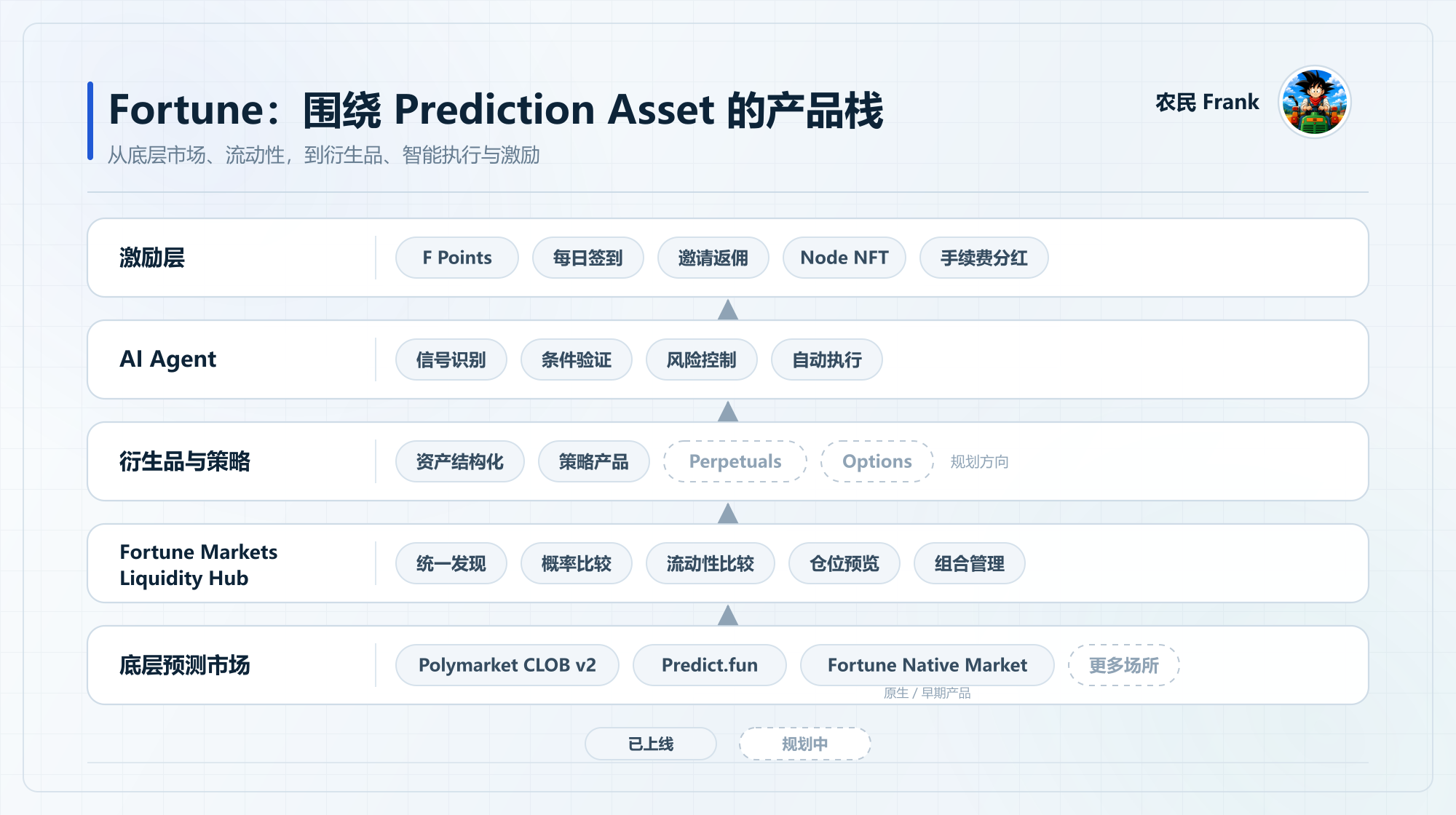
Therefore, viewing Fortune holistically, what it is now truly attempting to build is not an isolated function, but a relatively complete workflow:
Prediction Markets provide the underlying event assets;
Fortune Markets connects the assets and liquidity;
Prediction Derivatives expand the financial expressions of assets;
Fortune Agent manages information processing and trading execution;
Incentive Layer provides initial growth momentum for the entire network;
Thus, if Fortune must be positioned in any way, it is neither just a Prediction Market nor just "the Prediction Market version of 1inch."
More accurately, it aims to establish a trading and execution infrastructure centered around Prediction Assets.
II. When "Probability" Truly Becomes an Asset
Of course, whether Fortune can effectively execute this roadmap remains to be seen.
It is still an early project.
The liquidity access of Polymarket and the Agent can already see practical products, but the unified order routing, mature Prediction Derivatives, and sufficiently deep cross-market liquidity networks are still far from their ultimate form.
However, if we shift our perspective to the entire industry, Fortune's direction is not isolated. Apex has begun to integrate Kalshi's Event Contracts through APIs into brokerage infrastructures; Paradigm is also developing a Prediction Market Terminal aimed at professional traders and exploring internal market making and the Prediction Market Index.
Prediction markets increasingly resemble a true financial market, and a real financial market will undoubtedly not consist solely of exchanges.
There are at least three layers of changes worth observing.
1. From Bet to Portfolio, Highly Financialized
Many people's first exposure to a Prediction Market is still understanding it as "I bet whether something will happen."
However, for more mature traders, it can create a series of asset portfolios that express complete viewpoints.
For example, when a trader judges that U.S. inflation is re-accelerating and the Fed is becoming hawkish, they might not just trade "whether the next FOMC will raise interest rates," but could simultaneously establish positions around "whether the Fed maintains higher rates," "whether BTC will break a certain price by the end of the year," and "whether the U.S. will avoid a recession."
Each of these events viewed separately is an Event Contract, but when combined, they can express a complete Higher for Longer macro thesis.
If this stage truly emerges, Portfolio Management, Correlation, Hedging, and Risk Management will naturally follow, and at that time, if projects like Fortune can genuinely fill in the Derivatives and portfolio layers, the value will no longer just be in helping users "open a few fewer web pages".
2. From Single Market Trading to Cross-Market Aggregated Execution
This is easy to understand; as the market grows larger, the importance of a single platform may actually diminish.
Crypto ultimately did not form a pattern of "one exchange carrying all liquidity," and prediction markets likely will not either.
Different regulatory systems, user demographics, market makers, event categories, and regions will long create market segmentation, and market segmentation is itself an opportunity for infrastructure, as arbitrageurs need prices, market makers need order flow, institutions need depth, and ordinary users need the best transaction prices, while agents need enough venues to scan and execute.
Therefore, when prediction markets truly mature, the trading entry may become increasingly "invisible," such as seeing a news item on a brokerage app: "Fed's probability of adjusting interest rates next month: 72%."
Next to it, a button allows for purchase; as for where the underlying orders come from—whether from Polymarket, Kalshi, or split across three markets by a router—it is not important.
This is the change that APIization can truly bring.
3. From Human Trader to AI Trader
I have always believed that prediction markets could become one of the most natural financial applications for AI Agents.
Because it is fundamentally "information → probability → price → transaction", which is exactly the chain that AI excels at intervening.
If Crypto provided AI Agents with a financial system that does not require a bank account and can be directly controlled 24 hours a day, then Prediction Markets further gave them a market where "cognition" can be directly traded.
One of AI's core capabilities is processing information, and the core asset of Prediction Market is precisely the probability created after information is compressed.
The two are a natural fit.
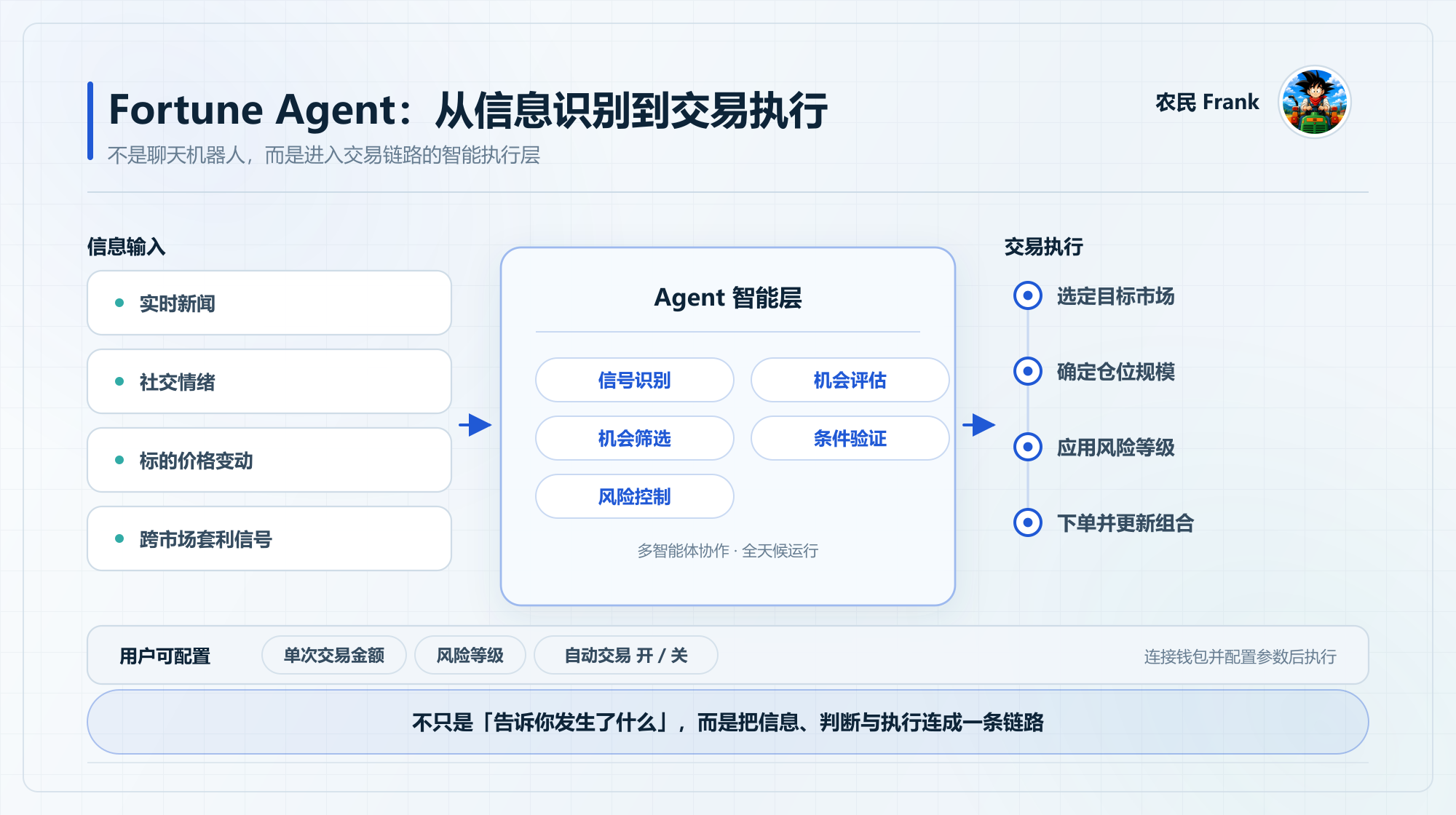
We can envision a future where an Agent simultaneously listens to news, social media, macro data, on-chain data, corporate announcements, sports events, policy documents, etc., and continuously recalculates its probability model.
Once market prices diverge significantly from the model, the Agent will place an order directly, at which point the speed of the Prediction Market will also change.
In the past, Alpha might have come from seeing a piece of news earlier than others; in the future, it may shift to: my Agent understands what this news means faster than your Agent; and even in the next phase, who can faster convert cognitive advantages into transactions across more venues.
Thus, informational advantage, model advantage, and execution advantage will gradually merge into one.
This might be the truly interesting aspect of AI × Prediction Market; of course, before all these imaginings become reality, several practical issues must be addressed.
First is liquidity; without sufficiently deep markets, even the most advanced routers and derivatives become meaningless;
Secondly is Resolution; prediction markets ultimately require a reliable, clear, and as little contentious as possible event settlement mechanism;
Further down is regulation; the classification of an Event Contract as a derivative, a bet, or a new financial instrument still varies significantly by region;
Finally, there's the Agent itself; AI can process vast amounts of information, but there remains a significant distance between "able to summarize news" and "capable of generating stable Alpha.";
These questions will not automatically disappear just because the market is growing.
Only when these infrastructures are progressively filled in, may Prediction Assets truly transition from a novel trading category into a mature asset class.
In Conclusion
Objectively speaking, from the 2024 U.S. presidential election to the 2026 World Cup, Polymarket and Kalshi have completed the most challenging first-round user education for prediction markets:
Many uncertainties in the real world can indeed be traded.
But this feels more like the first half; if we look back at almost all financial market histories, we can find that demonstrating that an asset can be traded has never been the endpoint of the story.
As more participants, more assets, and more platforms join, the maturity of the market is often determined by those less glamorous aspects outside the exchange, such as liquidity, market making, routing, derivatives, risk management, portfolio strategies, and more free and automated execution.
DeFi has already traversed this path; prediction markets are likely following a similar trajectory.
Thus, reconsidering new players like Fortune, what really deserves attention is how we can trade probabilities more efficiently once they truly become assets.
It requires deeper liquidity, richer financial tools, more efficient execution, and AI Agents that can understand the real world 24/7, continuously recalibrating probabilities.
This may indeed represent the genuine second half for Prediction Market as it transitions from being a "market" to becoming Prediction Assets.
免责声明:本文章仅代表作者个人观点,不代表本平台的立场和观点。本文章仅供信息分享,不构成对任何人的任何投资建议。用户与作者之间的任何争议,与本平台无关。如网页中刊载的文章或图片涉及侵权,请提供相关的权利证明和身份证明发送邮件到support@aicoin.com,本平台相关工作人员将会进行核查。