UNI Rises 39%, ARB Doubles in a Week: Is Robinhood Chain Reevaluating DeFi?
In the past week, funding in the cryptocurrency market has notably begun to concentrate on the DeFi sector.
The most attention-grabbing are Uniswap (UNI) and Arbitrum (ARB). As of September 7, UNI has increased by about 39% over the past week, while ARB has more than doubled. On the surface, this appears to be a sudden surge for these two established DeFi tokens, but when examining the timeline, it becomes clear that their rises point to the same entity—Robinhood Chain.
This Layer 2 that has been online for just over two months is rapidly becoming a new hotspot for on-chain trading activity, with UNI and ARB positioned at two critical junctures of this funding chain.
Robinhood Chain: The Sudden Contender for Traffic
Robinhood Chain officially launched its mainnet on July 1 of this year, built on Arbitrum technology, with tokenized assets, stock trading, and DeFi as core application scenarios.
When launching the mainnet, Robinhood officially stated that Uniswap would be one of the first core partners, providing the main public liquidity infrastructure for Robinhood Chain. At the same time, Robinhood also began to promote tokenized stock products to enter the on-chain trading system.
Just two months later, this new chain has already seen trading activity far exceeding market expectations.
According to the latest reports, Robinhood Chain's cumulative DEX trading volume has surpassed $40 billion, with daily on-chain fees once exceeding $4 million, making it one of the blockchain networks with the highest fee income recently.
More crucially, a substantial amount of the trading is not occurring on a completely new, unfamiliar protocol, but rather concentrated on Uniswap.
This directly alters the fundamental logic underlying UNI.
Uniswap Becomes the Biggest Beneficiary
Most DEX trading on Robinhood Chain is completed through Uniswap.
This means the higher the trading volume on Robinhood Chain, the more fee income Uniswap receives.
Notably, Uniswap's fee levels on Robinhood Chain are higher than on its other networks. According to relevant reports, Uniswap earns about 0.465% in fees for every $1 transaction on this chain, while the average across other networks is approximately 0.214%. The increased share of tokenized stock trading further augments the high-fee trading pool.
Thus, a very clear funding chain has emerged:
Increase in Robinhood users → Increase in on-chain trading → Increase in Uniswap trading volume → Increase in protocol fees → Increase in UNI destruction.
This time, the connection between UNI and protocol income has changed.
Daily sharing of real-time trading strategies, free provision of position diagnostics, liquidation solutions, and practical market insights, scan to follow our official account《Bitcoin Radar》!

The Real Change for UNI: Fees Begin to Impact Token Supply
In the past, an increase in Uniswap's trading volume did not necessarily mean that UNI holders could directly obtain corresponding economic value.
However, as Uniswap's fee mechanism and the "buy and burn" mechanism have started to take effect, a portion of the fees generated by the protocol can be used for repurchasing and destroying UNI.
This signifies that the increase in trading volume on Robinhood Chain is further translating to the supply side of UNI through the fee mechanism.
Recent data shows that Uniswap's daily UNI destruction value has surpassed $1 million for the first time. On September 4, approximately 184,000 UNI were destroyed in a single day, marking one of the largest daily destructions in history.
This is why the market has begun to reassess UNI.
Previously, the market was more accustomed to viewing UNI as a governance token, but now, with the strengthened connection between protocol income and token destruction, UNI is starting to exhibit a more pronounced "cash flow asset" narrative.
ARB's Logic is Completely Different
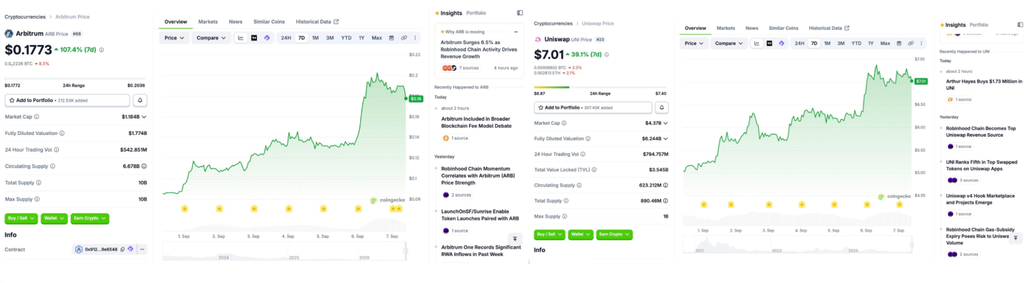
If UNI directly benefits from the trading flow of Robinhood Chain, ARB gains from infrastructure income.
Robinhood Chain uses the Arbitrum technology stack; therefore, a portion of the protocol revenue generated by Robinhood Chain will flow back to the Arbitrum ecosystem per relevant arrangements.
According to currently disclosed information, Robinhood Chain pays 10% of its net protocol revenue to the Arbitrum ecosystem, with 8% going to the Arbitrum DAO treasury and another 2% for developer-related arrangements.
It is important to note that this does not mean that ARB holders can directly receive this income.
Funds first enter the DAO treasury, thus the value transmission of ARB is more derived from the market's revaluation of Arbitrum's revenue capabilities rather than simply "fees directly distributed to ARB."
However, for ARB, which has long faced valuation and income issues, this is still a significant change.
Why Did the Market Suddenly Start Reevaluating ARB?
One of the biggest market issues for ARB previously was, “The network is busy, but how much value can the token actually capture?”
Robinhood Chain provides a very special answer.
If a large fintech company can continuously bring real users, stock tokenization trading, and on-chain financial activities into the Arbitrum technology system, then the infrastructure of Arbitrum will no longer just serve ordinary DeFi protocols but will begin to accommodate the genuine trading demands stemming from traditional financial asset tokenization.
This is also the core narrative behind ARB's recent increase.
Data shows that Robinhood Chain has continuously broken daily fee records since early September, with a single day's fee reaching about $3.75 million, and then further rising to around $4.5 million. Related reports have also indicated that the DEX trading volume on Robinhood Chain once reached approximately $1.7 billion.
What the market sees is no longer just "another Layer 2."
Instead, it is a traditional finance platform that is generating real traffic for on-chain infrastructure.
However, Robinhood Chain also Faces a Worrisome Issue
The aspect that the market is currently most likely to overlook is precisely the centralization of Robinhood Chain.
Uniswap currently receives a very high proportion of its fee income from Robinhood Chain. Some reports even estimate that Robinhood Chain has contributed a significant percentage of Uniswap's total protocol income.
This means UNI is gaining a new source of income growth but also bears a new dependence on a single ecosystem.
If in the future Robinhood changes its trading routing, adjusts its fee structure, or if the regulatory environment impacts its on-chain stock trading business, then the income Uniswap receives from Robinhood Chain may quickly decline.
Consequently, behind this increase, there are both fundamental improvements and new structural risks.
What Truly Deserves Attention is "Traditional Finance Going On-Chain"
The most noteworthy aspect of Robinhood Chain is not how much UNI has risen or how many times ARB has multiplied in the short term.
What truly matters is that it is validating a new model:
Traditional financial platforms are responsible for bringing users and assets, Layer 2 provides infrastructure, DEX ensures liquidity, and DeFi protocols earn fee income from real trading activities.
Upon launching its mainnet, Robinhood clearly specified that the tokenization of real-world assets would be a core direction, indicating that stock tokens could be traded on-chain 24/7 while connecting to decentralized trading protocols like Uniswap.
This implies that in the future, if more and more real-world assets such as stocks, funds, and bonds enter the chain, the beneficiaries may not just be the platforms issuing these assets.
Trading infrastructure, DEXs, lending protocols, and the underlying Layer 2 may all acquire new sources of income.
The Rise of UNI and ARB May Just be the First Phase
From the current market performance, UNI and ARB have become the most apparent beneficiaries in this narrative of Robinhood Chain.
UNI represents the value capture logic of "trading volume → fees → destruction."
ARB symbolizes the logic of "infrastructure → protocol income → ecosystem value."
Although the reasons for their increases differ, ultimately, they point toward the same trend:
Traditional finance is beginning to generate genuine on-chain trading demand.
Of course, Robinhood Chain is still very young, and whether trading volume can be sustained long-term, whether stock tokenization can continue to expand, whether regulations will permit more assets to enter on-chain, and whether Uniswap and Arbitrum can consistently capture this value still need to be validated.
Thus, the recent increases of UNI and ARB are more appropriately understood as the market's early pricing of a new narrative, rather than a final answer.
If Robinhood Chain can convert short-term hype into sustained real trading volume, then this new chain could potentially not only change Robinhood's own business model but also redefine the way value is distributed between traditional finance and DeFi.
This, ultimately, is the story behind UNI's 39% rise and ARB's doubling in a week that truly deserves attention.
Daily sharing of real-time trading strategies, free provision of position diagnostics, liquidation solutions, and practical market insights, scan to follow our official account《Bitcoin Radar》!

免责声明:本文章仅代表作者个人观点,不代表本平台的立场和观点。本文章仅供信息分享,不构成对任何人的任何投资建议。用户与作者之间的任何争议,与本平台无关。如网页中刊载的文章或图片涉及侵权,请提供相关的权利证明和身份证明发送邮件到[email protected],本平台相关工作人员将会进行核查。